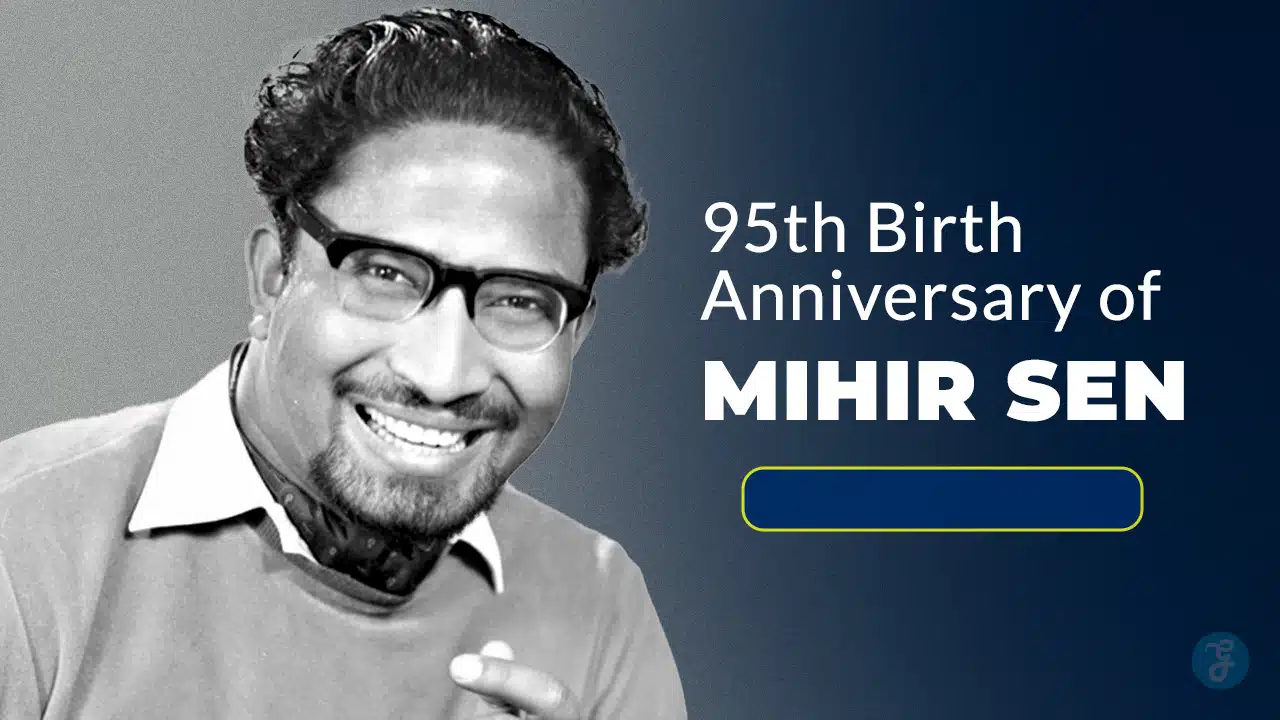
You know that feeling when you hear about someone doing something that seems impossible? That’s precisely what Mihir Sen did back in 1958. He became the first Asian to swim across the English Channel. Today is his 95th birth anniversary.
Think about that for a second. Cold water between England and France. It took fourteen hours and forty-five minutes of unwavering perseverance. And here’s the wonderful part: this swim wasn’t just about crossing water from Dover to Calais. It became a symbol of hope for millions of Indians and sports lovers everywhere.
In this post, I’m going to walk you through how Mihir Sen prepared for this incredible feat, the challenges that nearly stopped him, and how he changed Indian sports forever. Are you prepared to learn about one of the most inspiring comebacks in swimming history?
Key Takeaways
- Mihir Sen became the first Asian and Indian to swim the English Channel on September 27, 1958, completing it in 14 hours and 45 minutes.
- He failed seven times before his historic success, showing that persistence pays off when you refuse to quit.
- Sen trained at YMCA London while studying law, teaching himself the American crawl technique from books with support from Prime Minister Nehru.
- He braved water temperatures between 15 and 18°C (59 and 64°F), strong tides, jellyfish, and shipping traffic during his swim.
- In 1966, Sen became the only person to swim oceans across five continents in one calendar year, earning him a spot in the Guinness Book of Records.
- He received both the Padma Shri (1959) and Padma Bhushan (1967) for his achievements and inspired a generation of Indian swimmers.
The Historic Swim Across the English Channel
Mihir Sen was born on November 16, 1930, in Purulia, West Bengal. His family moved to Cuttack when he was eight years old so he could attend better schools. After graduating with a law degree from Utkal University in Bhubaneswar, Sen got his big break.
Then-Chief Minister Biju Patnaik financed his passage to England in 1951.
At 21, Sen arrived in London to study at Lincoln’s Inn, the prestigious society of barristers. He worked nights at India House and studied law during the day. The YMCA was nearby, and that’s where he rediscovered his childhood love of swimming. One day in 1953, Sen picked up a newspaper on his way to work. The front page carried a story about Florence Chadwick, an American woman conquering the English Channel.
That bus ride changed everything.
How did Mihir Sen prepare for the English Channel swim?
Sen had big dreams but limited resources. He earned just five pounds a week as a clerk at the Indian Embassy in London. That was barely enough to survive, let alone train for one of the world’s toughest swims.
So he did something bold.
He wrote directly to Prime Minister Jawaharlal Nehru, explaining his dream to become the first Indian to swim the English Channel. He didn’t expect the letter to reach Nehru. But it did. And Nehru responded with a small government stipend that allowed Sen to start training.
According to a 2024 article from ThePrint, Nehru’s response was “encouraging” and gave Sen just enough financial support to begin his quest.
Here’s how Sen prepared with almost no money and no coach:
- He spent hours at the YMCA pool in London, teaching himself the American crawl technique by reading books and watching other swimmers.
- He trained in the freezing English Channel waters to build stamina against temperatures between 15 and 18°C (59 and 64°F).
- He balanced his law studies at Lincoln’s Inn with daily swimming practice, pushing both his mind and body to their limits.
- He worked a full-time job at India House under Ambassador V. K. Krishna Menon, which gave him a support system while adapting to life in England.
- He followed a strict fitness routine, mixing long-distance swimming with running and full-body strength exercises.
- He consulted local swimming associations for advice on tides, weather patterns, and the best training spots along England’s coast.
- He planned his nutrition carefully, eating hearty, calorie-packed meals since long-distance swims drained energy fast.
Sen made his first attempt on August 15, 1955. He chose India’s Independence Day to make it special for his country. After nearly 12 hours of swimming, he had only 2.5 miles to go. The white cliffs of Dover loomed on the horizon.
Then a storm broke out.
The Channel turned into what Sen later called a “raging hell.” He was picked up by a boat, exhausted and defeated. Over the next three years, he failed four more times. By 1958, Sen had failed to cross the English Channel five times from the easier France-to-England direction.
Therefore, he set a higher standard.
He decided to attempt the harder route: England to France. On September 6 and 9, 1958, he tried twice more. Both failed. That made seven failures total. Most people would have given up. But Sen made one more decision: he would give it one last shot before summer ended.
What challenges did Mihir Sen face during the swim?
On the night of September 26, 1958, Sen entered the water at Dover for his eighth attempt. In front of him stretched 53 kilometers of deep, snake-infested waters.
Colder than he’d ever experienced.
Here are the brutal challenges he faced for 14 hours and 45 minutes:
- The water temperature stayed between 15 and 18°C (59 and 64°F), which, according to the Channel Swimming Association, puts swimmers at risk of hypothermia within hours.
- He coated his body in mustard oil, just like he would on a winter’s day back home in India, to protect against the cold.
- Strong tidal currents in the Channel threatened to sweep him off course with every stroke, as the Dover Strait has tides that change direction every 6 hours.
- He swam utterly alone for nearly 15 hours without rest, knowing even a short break might mean failure.
- As the first Asian attempting this from England to France, Sen faced pressure and skepticism from critics who doubted an Indian could succeed.
- He had no fancy gear, no coach, and no support crew beyond a friend following in a small boat.
- Mental exhaustion crept up alongside physical strain as the hours dragged on in the cold, dark water.
- He crossed busy shipping lanes where large ferries moved between England and France, adding real danger at every turn.
- Poisonous jellyfish lurked in the Channel waters, ready to sting.
- Saltwater stung his eyes and mouth with each breath, forcing him to stay alert just to survive another minute.
According to the Channel Swimming & Piloting Federation, the English Channel is considered “the ultimate long-distance challenge” due to its variable conditions, which can range from mirror-like calm to wind force 6 and wave heights above 2 meters.
On September 27, 1958, after 14 hours and 45 minutes, a shivering and exhausted Mihir Sen staggered onto a deserted section of the French coast near Calais. His friend joined him on the shore. Together, they held up a soggy Indian tricolor.
He had done it.
What made Mihir Sen’s swim a record-breaking achievement?
Sen became the first Asian and Indian to swim the English Channel. He finished in the fourth-fastest time ever recorded at that point. The Guinness Book of Records later named him one of the world’s greatest swimmers.
But here’s what’s truly remarkable.
According to a Reuters report picked up by Indian newspapers, the international media initially focused on a bizarre detail: Sen was “the first man with a beard to ever complete the swim in the England-to-France direction.” It took time for people to understand the real significance. When they did, Sen became a national hero overnight.
Prime Minister Jawaharlal Nehru personally congratulated Sen and awarded him the Padma Shri in 1959, one of India’s highest civilian honors.
His achievement made headlines from West Bengal to London. It sparked interest in long-distance swimming across India. Young swimmers at Utkal University, where Sen had studied law, suddenly dreamed bigger. Someone from Purulia had demonstrated to them that it was possible.
And Sen wasn’t done yet.
What is the legacy of Mihir Sen’s English Channel conquest?
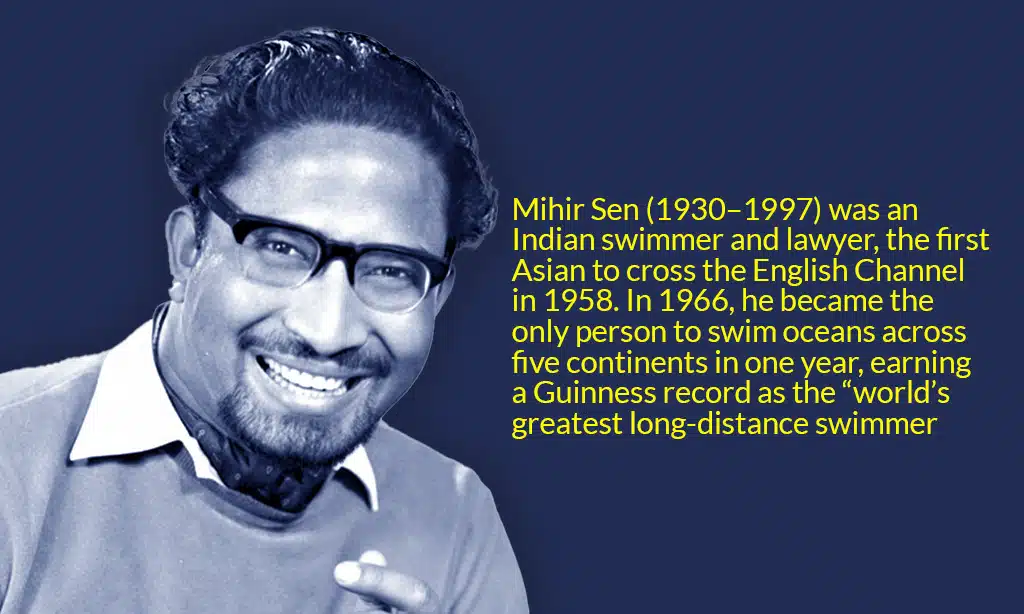
Sen’s 1958 swim changed Indian sports forever, but his biggest achievement came in 1966. That year, he accomplished something no one else had ever done: he swam through five channels across five continents in a single calendar year.
Think about that.
Here’s precisely what he did, with dates and times:
| Channel | Date | Time | Achievement |
|---|---|---|---|
| Palk Strait | April 5-6, 1966 | 25 hours, 36 minutes | First Indian to swim between Sri Lanka and India (Dhanushkodi) |
| Strait of Gibraltar | August 24, 1966 | 8 hours, 1 minute | The first Asian to cross from Europe to Africa. |
| Dardanelles | September 12, 1966 | 13 hours, 55 minutes | The world’s first man to swim the 40-mile length from Gallipoli to Asia Minor |
| Bosporus | September 21, 1966 | 4 hours | First Indian to swim through Istanbul’s strait |
| Panama Canal | October 29-31, 1966 | 34 hours, 15 minutes | First non-American and third person ever to swim the 50-mile length |
To fund the Palk Strait swim alone, Sen needed Rs 45,000 to pay the Indian Navy to record and navigate it. He raised half the money through sponsors, notably The Statesman, a Kolkata daily. Prime Minister Indira Gandhi personally contributed the rest and extended full support of the Indian Navy.
Two naval ships, INS Sukanya and INS Sharada, accompanied Sen during his Palk Strait crossing.
The Guinness Book of World Records crowned him “the world’s greatest long-distance swimmer.” In 1967, Prime Minister Indira Gandhi awarded him the Padma Bhushan, India’s third-highest civilian honor. He also won the Blitz Nehru Trophy that year for “daring achievements in the seven seas of the world.”
But Sen’s impact went beyond medals and records.
After returning to India in 1958, Sen faced racial discrimination at clubs with “whites only” policies. He led a high-profile media campaign that forced clubs throughout India to open their doors to all Indians. He practiced criminal law at the Calcutta High Court and later became a successful businessman. His silk export company became India’s second-largest silk exporter, recognized by the Government of India.
According to his daughter Supriya Sen, writing for The Telegraph in 2013, “His motive for swimming the seven seas was primarily political. He wanted to show the world what Indians are made of, to set for young Indians an example of courage.”
Sen inspired a whole generation of swimmers. He showed that Indians could compete with anyone in the world. From Dhanushkodi to Israel, young athletes suddenly saw that dreams had no borders. Swimming wasn’t just a sport anymore. It was a stage where Indians could shine.
How did Mihir Sen’s achievement impact Indian sports and gain global recognition?
When Sen returned to India after his 1958 Channel swim, newspapers flashed headlines across the country. People grew proud overnight. But the real impact was what happened next.
Sen showed Indian swimmers that world records were within reach.
His 1966 achievement of swimming five oceans in one calendar year put India on the global swimming map. Sponsorships poured in. Prime Minister Indira Gandhi helped raise Rs 45,000 so he could compete internationally. Young athletes all over India saw hope of making their mark. According to a 2019 article from The Better India, Sen’s achievements proved that “Indians were capable of greatness.”
The Guinness World Records recognition made him famous worldwide. He was inducted into the International Marathon Swimming Hall of Fame as an Honor Swimmer in 1966. His achievements paved the way for future Indian swimmers and dismantled long-standing racial barriers.
Sen’s later years were difficult.
In 1977, Communist Party leader Jyoti Basu asked him to campaign for the party in exchange for a high-profile government post. Sen refused because he didn’t believe in the ideology. After the Communist Party won, his business suffered from labor unrest and government pressure. His company was eventually forced to shut down. He was diagnosed with Alzheimer’s and Parkinson’s disease and passed away on June 11, 1997, at the age of 66.
Despite the tragic end, his legacy remains powerful.
Takeaways
Mihir Sen’s story is one of pure determination. He failed seven times before succeeding. He had no money, no coach, and no fancy equipment. Just a dream and the refusal to quit.
His swim across the English Channel in 14 hours and 45 minutes broke records and set dreams on fire for every Indian kid who thought oceans were impossible to cross. From a law student to a swimming legend, his journey spills over with inspiration for anyone brave enough to chase big waves.
He brought home medals, national pride, and new respect for long-distance swimming. His 1966 feat of swimming five oceans across five continents in one year earned him a permanent place in the Guinness Book of Records. He proved that an ordinary person can make history with heart, grit, and one legendary swim.
Now, future swimmers have giant footsteps to follow right there in the cool splash of Mihir Sen’s journey.
FAQs on Mihir Sen
1. Who was Mihir Sen and what made him famous?
Mihir Sen was an Indian lawyer and swimmer who made history on September 27, 1958, by becoming the first Asian to swim across the English Channel. He completed the difficult swim from Dover to Calais in 14 hours and 45 minutes. This achievement made him a national hero in India.
2. What other water crossings did Mihir Sen complete?
In the single year of 1966, Sen became the first man to swim the oceans of five continents. He conquered the Palk Strait between India and Sri Lanka, the Strait of Gibraltar, and the Dardanelles. He also swam the length of the Panama Canal in 34 hours.
3. What was Mihir Sen’s background before his swimming career?
Before his swimming career took off, Sen earned a degree in law from Utkal University in Bhubaneswar and was called to the Bar in London. He practiced as a barrister at the Calcutta High Court and also worked as a silk exporter.
4. Did Mihir Sen have any connection to politics?
Yes, Sen entered politics later in his life, running as an independent candidate. The leader of the Communist Party of India, Jyoti Basu, personally asked Sen to campaign on the party’s behalf.
5. When did Mihir Sen pass away?
Mihir Sen died on June 11, 1997, at the age of 66 after a long illness.
6. How did India recognize Mihir Sen’s achievements?
The Government of India awarded Mihir Sen the Padma Shri in 1959 and the Padma Bhushan in 1967, two of the country’s highest civilian honors. The Channel Swimming Association also officially recognized his record-breaking swim.