Clinics, hospitals, and pharmacies often struggle with drug delays and shortages. They worry about high costs, safety checks, and tough shipping rules. They need clear info on the best exporters.
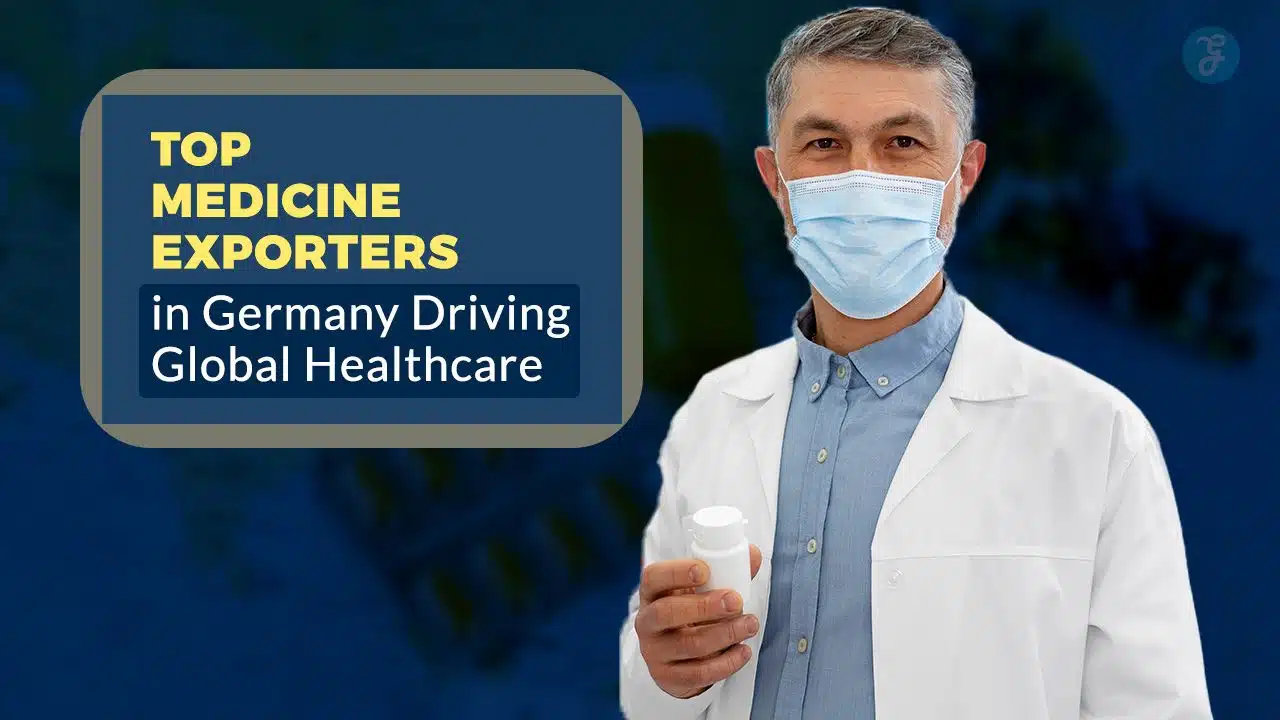
Germany leads global medicine exports, shipping more than any other nation. This post lists 15 top exporters and shows how they use research and development, clinical trials, and smart logistics.
You will get export stats, company strengths, and health impacts. Read on.
Key Takeaways
- Germany leads world drug exports. Its pharma output hit €37.4 billion in 2022 and firms ship life-saving medicines to over 100 countries.
- Bayer tops the list with €50.7 billion in revenue and 100 000 staff in 83 nations. Merck earned €22.2 billion and Boehringer Ingelheim €24.1 billion in 2023.
- German companies reinvest 11.1 % of revenue (€9.6 billion in 2022) into R&D. They filed 613 patents at the European Patent Office and ran 524 clinical trials.
- Biopharma exports reached €19.2 billion in 2023 and OTC exports grew 7.3 % to €12.9 billion. Oncology sales rose 17 % and immunology sales climbed 9 %.
- Firms use smart logistics—cold-chain units, RFID, GPS, and real-time software—to speed medicine delivery and boost global healthcare.
What makes Bayer a global leader in pharmaceuticals?
Bayer logs 50.7 billion euros in revenue. It employs a workforce of over 100,000 across 83 nations. The group drives Innovation in Pharmaceuticals and Life Sciences through genomics studies and clinical trials.
Its R&D hubs churn out new therapies each year. Bayer also ranks as a key German Exporter on the global market.
A long research history cements its Industry Leader status. It pumps big funds into Research and Development. Chromatography tools and lab automation boost drug discovery. These steps heighten Competitiveness and grow its product line.
Bayer’s Export reach supports Germany’s lead in Europe’s pharmaceutical market.
How is Merck Group innovating biopharma and life sciences?
Merck Group hits 22.2 billion euros in revenue. A global team of 60,000 staff powers its work. The firm spans pharmaceuticals, biotechnology, and specialty chemicals. Lab crews use fluid separation devices, gene cutting tools and cell sorting machines.
Scientists rely on gene reading scanners and mass analyzers. Merck builds giant bioreactors for large scale production. Top export lists name the group among Germany’s leading drug exporters.
Its innovation fuels new biopharmaceutical production.
The company pours billions into research and development. German research intensity finds a strong ally in Merck. Scientists create personalized medicine and specialty therapies. Pharma labs test targeted antibodies for cancer and autoimmune care.
Teams deploy cell sorters and PCR amplifiers to refine results. Next generation platforms speed drug discovery. Partners at hospitals and institutes share data on new treatments. Patients see faster access to advanced therapies.
What animal health solutions does Boehringer Ingelheim pioneer?
Boehringer Ingelheim drives veterinary medicine with vaccines and diagnostics. It ranks among the top for animal health solutions and generates EUR 24.1 billion in revenue with 53,000 employees.
Lab teams run PCR assays and ELISA tests to spot pathogens fast. Researchers focus on livestock management and clinical research to boost animal welfare.
New pharmaceuticals for pigs, cattle, and poultry aid biosecurity and animal nutrition. The animal health division forms a major segment in Germany’s pharmaceutical exports. It fuels global innovation in research and development.
Growth in clinical research extends Germany’s influence in world markets.
How does Fresenius SE & Co. KGaA excel in medical devices and therapies?
Fresenius Kabi booked 7.9 billion euros in revenue in 2023. Its sales rose to 23.86 billion dollars that year, up from 22.29 billion in 2022. The company employs 43,200 staff across 45 plants in over 20 nations.
It specializes in critical care instruments and medical technology for hospitals. The firm ranks among top makers of medical devices in Germany. Products span infusion sets, transfusion kits, and clinical nutrition solutions.
Global operations fuel export growth and boost healthcare worldwide.
How is BioNTech revolutionizing immunotherapy and vaccines?
BioNTech drives change in immunotherapy and vaccine science. It created the first approved mRNA vaccine against COVID-19 in late 2020.
The firm supplies biopharmaceuticals for personalized medicine, including cancer treatments. Germany’s infrastructure and skilled workforce support its research and development. Investors link its success to high R&D investment across the German biotech sector.
It runs global clinical trials to speed therapy tests.
What role does PHOENIX Pharma SE play in pharmaceutical distribution?
PHOENIX Pharma SE ships prescription drugs and OTC medications across Germany and Europe. The company uses a vast distribution network.
The firm has 39,000 staff. It uses supply chain software to move medicines from factories to pharmacies. The wholesaler earned EUR 30.7 billion last year. Modern warehouse software cut medicine logistics costs and sped medicine deliveries.
These moves support Germany’s exportation of health products.
How does Sartorius AG drive biotechnology and lab solutions?
Sartorius AG reported 4.2 billion euros in revenue last year. It employs 15,900 people in Germany and abroad. The firm leads in life sciences with bioprocessing tools. Its single-use bioreactors speed drug development tests.
Scientists use its microfluidic systems and cell culture stations. They rely on its chromatography systems and filter membranes. Exports reach labs in more than 100 countries.
The company drives pharmaceutical research with smart sampling devices and scales up manufacturing runs. Its modular fermenters boost biopharmaceutical yields. Germany’s biotech hubs grow around its research solutions.
Labs tap its pipettes and analytical instruments to refine protein analysis. Sartorius stands as a top innovator in lab supplies and process development.
What strengths does Stada Arzneimittel have in generic and consumer medicines?
Stada Arzneimittel ranks among Europe’s top generic drug makers. The group earned 3.8 billion euros in revenue last year. The company has 13,000 staff at its factories. It supplies prescription medicines at lower cost to health centers.
Stada’s consumer health unit fuels a big share of its sales. Its products span OTC and prescription market distribution in over 100 countries. The firm holds a lead in medicine export from Germany.
Low-price wellness and therapy items boost global access to care.
How does Grünenthal specialize in pain management and innovation?
Grünenthal sits in Aachen and drives EUR 1.7 billion in revenue with 4,500 staff. It focuses on pain relief and neurological disorders. The team runs clinical tests to prove how well drugs work.
Researchers use a mass analyzer and spectrometer in labs. A regulations team secures market access across dozens of countries.
The firm invests heavily in research and development to grow its therapeutic offerings. Its creative labs yield new pain management drugs. It ships millions of doses each year as a top German pharmaceuticals exporter.
This specialization supports Germany’s reputation for innovative therapies.
In what ways does B. Braun advance medical technology and pharmaceuticals?
B. Braun has 65,000 employees and earned 8.5 billion euros in revenue last year. It works in over 60 countries. The firm makes anesthetics and hospital solutions. It blends raw chemicals in clean rooms to craft pharmaceuticals.
It sells infusion pumps and safety catheters. Hospitals rely on its infection control gear and wound care. This lineup advances healthcare delivery. Each worker generates 144,200 dollars.
That sum shows strong productivity.
Family owners have steered B. Braun since 1839. They push new drug formulations and device designs every day. B. Braun ships surgical sets and dialysis machines worldwide, under strict quality control.
Their global presence boosts Germany’s medical technology stance. This exporter stands among the top five device sellers. Its innovations fuel labs, clinics, and surgical suites across continents.
Why is Berlin Chemie a trusted name in prescription medicines?
Berlin-Chemie reported 3.6 billion euros in revenue. It employs 5,000 people in labs and on production lines. A longstanding group in Germany, it leads in cardiovascular and respiratory prescription medications.
Export logistics networks move its medicines to markets worldwide, boosting Germany’s pharmaceutical sector. R&D teams run clinical trials and advance pharmacology research. Regulatory affairs experts protect safety and quality, so patients and doctors respect its record in prescription medicines.
What expertise does Gerresheimer offer in packaging for medical products?
Gerresheimer crafts vials, syringes, and cartridges that protect biopharma and vaccines. Its packaging solutions meet ISO standards, which help with regulatory compliance and product safety.
Teams inspect every batch with digital imaging, so drug distribution runs smoother than a well-oiled machine. The firm ties into pharmaceutical supply chains with glass and polymer parts, fueling Germany’s lead in medical technology.
Its production sites serve domestic markets and ship to export regions in over 100 countries. Experts use automated assembly and laser testing tools for tight seals. Customers get reliable packs that support safe use of medical devices and drugs.
How does Wacker Chemie AG support biotech with high-quality products?
German biotech firms rely on Wacker Chemie AG for advanced materials and high-purity compounds. The firm ships silicone-based polymers and cell culture additives to more than 80 biopharma sites across Germany.
Their materials drive innovation in drug development projects and scale-up trials in bioreactors. Wacker supports life sciences labs with polysilicon for microreactors and specialized emulsifiers.
Strong manufacturing processes in Germany keep the global pharmaceutical industry competitive. Wacker’s high-purity compounds match ISO 9001 and cGMP standards. The company joins cluster hubs in Munich and Berlin to share expertise and spur biotechnology growth.
This network boosts infrastructure and speeds up new vaccine and therapeutic launches.
What pharmaceutical logistics expertise does Sanacorp eG Pharmazeutische Großhandlung provide?
A vast supply chain handles prescription drugs and OTC drugs nationwide. Sanacorp eG Pharmazeutische Großhandlung runs a logistics network with transport management software and RFID tags.
It links GPS trackers, temperature controlled units, and real-time dashboards. Teams use warehouse management systems for inventory optimization. They follow EU rules for cold chain management and regulatory compliance.
Pharmacists and clinics rely on fast pharmaceutical distribution. Delivery trucks zip through cities and rural roads. Healthcare providers count on timely shipments. The group backs the export-driven pharmaceutical sector.
National distribution boosts medicine availability in every town.
How does AbbVie Deutschland GmbH & Co. KG focus on specialty medicines?
AbbVie Deutschland GmbH & Co. KG drives specialty pharmaceuticals in Germany. This local branch teams with the AbbVie global group on drug development. Researchers fund R&D labs that craft advanced therapies for complex diseases.
They target unmet medical needs in immunology and oncology.
Its work boosts Germany’s pharmaceutical innovation and export in specialty drug segments. The group secures market access for new biopharmaceuticals. Patients gain fresh healthcare solutions from its growing pipeline.
How do German companies contribute to global healthcare?
German pharma firms pump 11.1% of revenue back into R&D, totaling EUR 9.6 billion in 2022. The sector scored 613 new filings at the European Patent Office that year. Clinical trials reached 524, placing Germany second in the EU and fourth worldwide.
Biotechnology clusters link universities and industry in drug development. Firms apply bioprocessing methods and patent innovation fast. Labs run nucleic acid amplification and bioreactors to vet drug candidates.
Germany ranks as the EU’s second largest producer of approved biopharmaceuticals.
What are the challenges and opportunities in medicine exports?
Exporters face strict rules overseas. Some markets require deep regulatory affairs checks. Firms must prove safety with extra tests. All shipments need solid documentation. Cold chain logistics often slows down vaccines.
This issue can drive up costs. Many companies lack bioprocessing labs. Local pricing caps pressure their margins. Nonprescription health products need extra licenses. Stakeholders in oncology and immunology face more scrutiny.
Those segments grew 17% and 9% in 2023. Germany made EUR 37.4 billion in pharma output in 2022.
Global demand for vaccines and cancer drugs climbs. Biopharmaceutical exports hit EUR 19.2 billion in 2023. Sales in oncology and immunology rose by 17 and 9 percent. Market trends show more need for metabolic disorder medicines.
Over-the-Counter exports grew 7.3 percent to EUR 12.9 billion last year. Digital health platforms ease order tracking. Partnerships with local distributors reduce tariff hurdles. Lab analytics tools speed up quality checks.
Prescription revenue via pharmacies reached EUR 65.3 billion in 2023. Public-private ties unlock new continents. Small firms can win share with these moves.
Takeaways
German companies power global health with bold leadership. They ship life-saving medicines to over 100 nations, topping export statistics every year. This success rests on strict regulatory compliance, sharp innovation, and efficient logistics.
Healthcare supply chains hum like a well-oiled machine, fueled by biotech breakthroughs and robust R&D. Millions of patients gain steady access to vital treatments worldwide. Bright days lie ahead as trade relations expand and new therapies emerge.
FAQs on Medicine Exporters In Germany
1. What are the Top 15 Medicine Exporters In Germany Driving Global Healthcare?
They are 15 drug makers that pull their weight on the world stage, shipping vast stocks of meds, raising the bar in research, and lighting the way for new cures in global healthcare.
2. How do these companies drive global healthcare?
They send safe, tested treatments to Europe, the Americas, and Asia, back new trials, and break down barriers so patients everywhere can heal.
3. Which regions rely most on German medicine exports?
Hospitals in Europe, clinics in North America, care centers in Asia and beyond all tap into Germany’s labs for vaccines, therapies, and vital meds.
4. Can a smaller lab join the list of top exporters?
Sure, a small site can climb up if it boosts output, meets strict rules, and strikes smart trade deals with global partners.