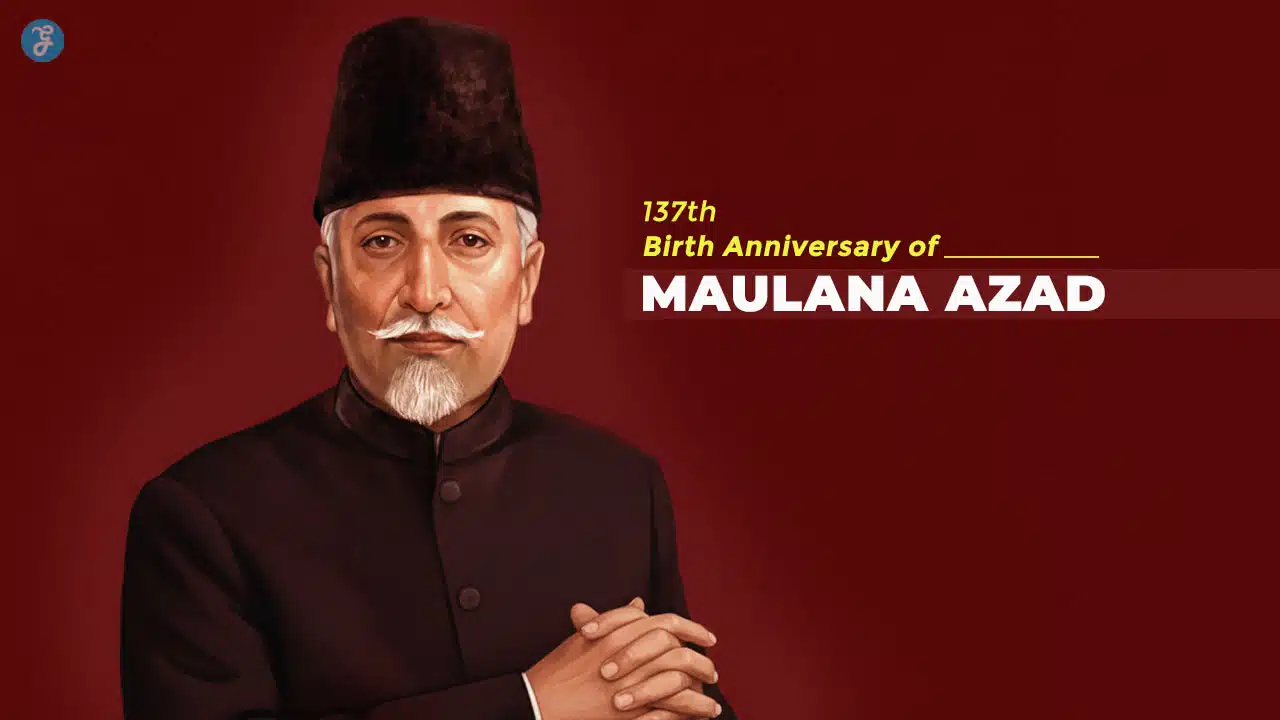
Have you ever wondered what it takes to shape an entire nation’s education system while also fighting for its freedom? That’s the story of Maulana Abul Kalam Azad.
Most articles about him skim the surface or list dry facts. But here’s what makes his story worth knowing: Born on November 11, 1888, in Mecca, Maulana Azad became one of India’s youngest and most powerful voices against British rule. At just 35 years old in 1923, he became the youngest president of the Indian National Congress.
Even more remarkable, he went on to build the foundation of India’s modern education system, establishing the first Indian Institute of Technology in Kharagpur in 1951 and the University Grants Commission in 1953.
You’ll discover how he used words as weapons through his newspaper Al-Hilal, which reached over 25,000 readers. You’ll see why he stood firmly against partition, even when it meant going against the tide. And you’ll understand how his vision still shapes millions of students’ lives today.
Let’s walk through his journey together.
Key Takeaways
- Azad was born on November 11, 1888, in Mecca and moved to Kolkata with his family in 1890, where he received a traditional Islamic education at home.
- He became the youngest president of the Indian National Congress at age 35 in 1923 and later served from 1940 to 1946 during the Quit India Movement.
- His Urdu newspaper, Al-Hilal, launched in 1912, achieved a peak circulation of over 25,000 copies, setting a record for Urdu journalism at that time.
- Azad opposed partition and warned it would cause violence. Between 1942 and 1946, he wrote his masterpiece, Ghubar-e-Khatir, while imprisoned at Ahmednagar Fort.
- As India’s first Minister of Education from 1947 to 1958, he established IIT Kharagpur in 1951 and UGC in 1953 and championed free education for all children up to age 14.
- He was posthumously awarded the Bharat Ratna in 1992, and his birthday, November 11, is celebrated as National Education Day across India since 2008.
Early Life and Education
Imagine growing up in a home where books lined every wall and scholars debated late into the night. That was Azad’s world.
What was Maulana Azad’s family background and childhood like?
Born as Abul Kalam Ghulam Muhiyuddin on November 11, 1888, in Mecca, Azad came from a family deeply rooted in Islamic scholarship. His father, Maulana Khairuddin, was a respected Bengali Muslim scholar of Afghan origin whose forefathers had migrated to India during the Mughal Emperor Babar’s reign from Herat, Afghanistan. His mother was the daughter of a wealthy Arabian Sheikh, connecting him to scholarly traditions on both sides.
When Azad was just two years old in 1890, his family returned to Calcutta (now Kolkata). This bustling city became the backdrop for his formative years, filled with religious discussions and cultural exchanges that welcomed visitors from near and far.
Life wasn’t easy, though. His mother passed away when he was only eleven years old. Two years later, at the young age of thirteen, he was married to Zuleikha Begum, following the customs of the time.
What influenced Maulana Azad’s early education?
Here’s where it gets interesting.
Azad never attended a formal school or madrasah. His father supervised his entire education at home, focusing on traditional Islamic subjects. By the time he was just 16 years old, Azad had completed his entire course of study in Arabic, Persian, and Urdu, along with philosophy, geometry, mathematics, and algebra.
But Azad wasn’t satisfied with just religious texts.
He secretly taught himself English, diving into world history, politics, and Western philosophy without his father’s knowledge. He devoured books on science and literature, forging what he called a “progressive worldview” that blended Eastern and Western thought.
His early writing bug showed up young, too. At just eleven years old in 1899, he started a monthly poetry magazine called Nairang-e-Alam. By 1904, he was contributing to journals and experimenting with his pen name “Azad,” which means “free.”
Between 1908 and 1910, Azad traveled through Egypt, Turkey, Syria, and France. In Egypt, he met followers of Mustafa Kemal Pasha who were publishing anti-colonial newspapers. In Turkey, he connected with leaders of the Young Turks Movement. These encounters lit a fire in him. When he returned to India, he met revolutionary leaders like Sri Aurobindo Ghosh and Shyam Sundar Chakraborty, who helped shape his radical political views.
Role in the Indian Independence Movement
Let me share how a young scholar became one of the most feared voices against the British.
Association with the Indian National Congress
After returning from his travels in 1912, Azad jumped into journalism and politics with both feet. He launched his Urdu weekly newspaper Al-Hilal on July 13, 1912, and it became an instant sensation. According to reports from that era, Al-Hilal’s circulation exceeded 25,000 copies within two years, a record-breaking number for Urdu journalism.
The British weren’t happy. They banned Al-Hilal in 1914 under the Press Act.
Azad didn’t give up. He started another weekly called Al-Balagh in 1915, but the British shut that down too by 1916. They then banished him to Ranchi, where he remained imprisoned until early 1920.
When Azad was released in 1920, he joined the Indian National Congress and became a key figure in the Khilafat Movement. This movement, which ran from 1920 to 1924, defended the Ottoman Caliph and brought Azad into close contact with Mahatma Gandhi. The two men formed a deep bond based on the philosophy of nonviolence.
Here’s a remarkable milestone: In 1923, at the special session of Congress in Delhi, Azad became the youngest person ever elected as president of the Indian National Congress. He was just 35 years old.
Despite disagreements within the party after the Non-Cooperation Movement ended in 1922, Azad stayed loyal to Gandhi’s vision. He participated in the Salt March of 1930 and was arrested multiple times between 1920 and 1945 for his activism.
His longest presidential term came from 1940 to 1946, elected at the Ramgarh session. Though most of this period was spent in prison after the Quit India Movement of 1942, he remained the symbolic leader of the Congress.
How did Maulana Azad promote Hindu-Muslim unity?
If there’s one thing that defined Azad’s political life, it was his unwavering belief in Hindu-Muslim unity.
He used every platform he had to spread this message.
Through Al-Hilal, Azad wrote powerful editorials urging Muslims to join the freedom struggle alongside Hindus. He reminded his readers that freedom was not just a patriotic duty for Hindus but a religious obligation for Muslims as well. According to historical accounts, Al-Hilal played a crucial role in forging Hindu-Muslim unity after the divisive Morley-Minto reforms.
At the 1940 Ramgarh session, Azad delivered a presidential address that became legendary. He spoke about India’s shared history spanning a thousand years and declared that Hindus and Muslims had become “an Indian nation, united and indivisible.” He argued that no false idea of separatism could break this oneness.
Azad consistently opposed the Muslim League’s two-nation theory promoted by Muhammad Ali Jinnah. He worked tirelessly within the Congress to ensure that representatives from all religious communities had a voice in shaping India’s future, participating actively in discussions during the Cabinet Mission talks in 1946.
Why did Maulana Azad oppose the partition of India?
Azad saw partition as a catastrophe waiting to happen.
He feared it would rip apart centuries of shared culture, friendships, and traditions. More urgently, he warned that dividing India would trigger massive violence and suffering for millions of people, especially Muslims who would remain in India after 1947.
In his autobiography India Wins Freedom, published in 1957, Azad documented his opposition in detail. He advocated for a confederation of autonomous provinces with their own constitutions but shared defense and economy. He believed this model would protect minority rights better than creating separate nations.
His fears proved tragically accurate. The partition led to widespread communal violence and one of the largest mass migrations in human history. As education minister after independence, Azad helped set up refugee camps and provided aid in violence-affected regions, trying to heal the wounds he had warned against.
Contributions to Post-Independence India
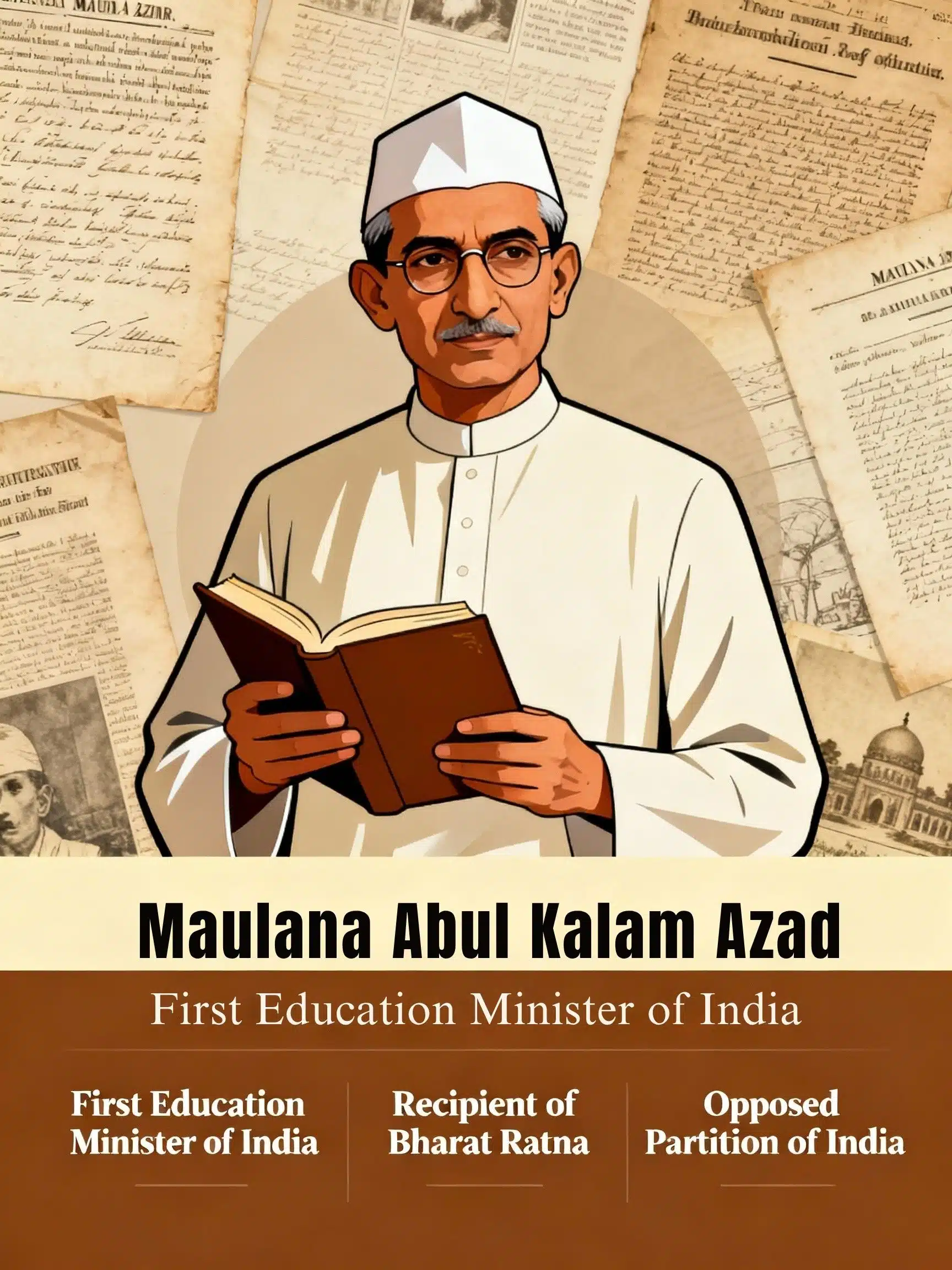
Now here’s where Azad’s story takes an inspiring turn. While partition broke his heart, he channeled his energy into building India’s educational foundation.
First Minister of Education
When India became independent on August 15, 1947, Prime Minister Jawaharlal Nehru appointed Azad as the country’s first Minister of Education. He would serve in this position for eleven years until his death on February 22, 1958.
Azad brought the same passion he had for freedom to the realm of education. At a conference on All India Education on January 16, 1948, he famously said, “It is a birthright of every individual to receive at least the basic education without which he cannot fully discharge his duties as a citizen.”
That wasn’t just talk. He backed it up with action.
Working alongside leaders like Nehru and Rajendra Prasad, Azad championed free and compulsory primary education for all children up to the age of 14. He also advocated strongly for women’s education, believing that “no country can make true progress unless its women are educated.”
How did Maulana Azad shape India’s educational policies?
Let me break down what Azad actually built. These aren’t just names on buildings; they’re institutions that transformed India.
Major Educational Bodies Established:
- Indian Institutes of Technology (IITs): Azad laid the foundation for the first IIT in Kharagpur in 1951, modeling it after MIT. He even chose the name “Indian Institute of Technology” himself before the inauguration. Today, IITs are globally recognized centers producing world-class engineers.
- University Grants Commission (UGC): Established in 1953, the UGC standardizes higher education quality and funding across India. This body still regulates universities and colleges throughout the country.
- All India Council for Technical Education (AICTE): Founded in 1945 under his guidance to regulate and expand skill-based training and vocational education.
- Indian Institute of Science (IISc), Bangalore: Azad strengthened this institution in 1948 as a hub for advanced scientific research.
Cultural Institutions:
- Sahitya Akademi (for literature)
- Lalit Kala Akademi (for visual arts)
- Sangeet Natak Akademi (for performing arts)
- Indian Council for Cultural Relations (ICCR) to promote cultural exchange with other nations
Azad also supported Jamia Millia Islamia, which he had helped establish in October 1920 at Aligarh. In 1934, he assisted in moving its campus to New Delhi, where it stands today as a respected central university.
Under his leadership, India’s literacy rate, which was a shocking 12% under British rule, began its slow climb upward. He established a board for adult literacy, recognizing that education wasn’t just for children but for anyone who wanted to learn.
Literary Works and Writings
Azad didn’t just lead; he wrote. His words inspired millions and still resonate today.
What are Ghubar-e-Khatir and other notable works by Maulana Azad?
Between 1942 and 1946, Azad was imprisoned at Ahmednagar Fort in Maharashtra after the British arrested Congress leaders following the Quit India resolution passed on August 8, 1942. During those long years of confinement, he wrote what many consider the finest example of epistolary literature in Urdu.
Ghubar-e-Khatir, which translates to “Sallies of Mind,” is a collection of 24 letters written to his close friend Maulana Habibur Rahman Khan Sherwani. These letters were never actually sent because prison rules forbade it. After his release in 1946, Azad gave them to his friend Ajmal Khan, who published them for the first time later that year.
The letters are deeply personal. They explore philosophy, religion, ethics, aesthetics, and even Azad’s love for brewing and drinking tea. He reflected on life, sin, morality, and the concept of God. The book is primarily in Urdu but contains over 500 couplets in Persian and Arabic, reflecting his multilingual mastery.
During this same imprisonment at Ahmednagar Fort, Jawaharlal Nehru wrote his famous book The Discovery of India, making the fort a symbol of intellectual resistance.
Other Important Works:
- Al-Hilal and Al-Balagh: His revolutionary Urdu newspapers that criticized British rule and advocated for Hindu-Muslim unity (1912-1916)
- India Wins Freedom: His autobiography published in 1957, offering his perspective on India’s freedom struggle and partition. A complete version with previously withheld portions was released in 1988, thirty years after his death.
- Tarjuman al-Quran: His incomplete but highly respected commentary on the Quran, written during his imprisonment between 1921 and 1923
- Tazkira: An autobiographical work produced during his early imprisonment
How did Maulana Azad’s writings impact Indian society?
Think of Al-Hilal as social media before the internet existed.
When Azad launched it in 1912, the newspaper reached readers across Bengal, the United Provinces, and Punjab. According to Azad’s own account, it even had devoted readers in Afghanistan. Its peak circulation of over 25,000 copies was unprecedented for Urdu journalism at that time, and back issues were constantly republished due to high demand.
The paper did more than inform. It transformed how Muslims saw their role in India’s freedom struggle. Jawaharlal Nehru later praised Azad in his 1944 book The Discovery of India, stating that Azad “spoke in a new language” to Indian Muslims through Al-Hilal, awakening political consciousness among youth.
Mahatma Gandhi also acknowledged the importance of Al-Hilal in a 1920 edition of his publication Young India, highlighting how the newspaper’s critique of British policies inspired resistance.
Azad’s writings challenged the two-nation theory promoted by Muhammad Ali Jinnah. His arguments for a united, secular India gave hope to millions who believed that Hindus and Muslims could coexist peacefully. Students and activists read his essays and letters to understand not just what freedom meant, but how to achieve it through unity rather than division.
Educational institutions like Jamia Millia Islamia were directly inspired by Azad’s vision of inclusive education. His call for cultural exchange between communities influenced how post-independence India approached its diversity.
Legacy and Recognition
Azad passed away on February 22, 1958, while still serving as Education Minister. He was 69 years old. But his story didn’t end there.
In 1992, the Government of India posthumously awarded him the Bharat Ratna, India’s highest civilian honor, recognizing his immense contributions to education and national unity.
Since September 2008, his birthday on November 11 is celebrated across India as National Education Day. Schools, colleges, and universities organize seminars, debates, essay competitions, and workshops to honor his vision that education is a fundamental right for every citizen.
The Ministry of Minority Affairs established the Maulana Azad Education Foundation in 1989 on his birth centenary to promote education among educationally backward sections of society. The ministry also provides the Maulana Abul Kalam Azad National Fellowship, offering financial assistance to students from minority communities pursuing higher studies like M.Phil. and PhD.
Numerous institutions across India bear his name: Maulana Azad Medical College in New Delhi, Maulana Azad National Institute of Technology in Bhopal, Maulana Azad National Urdu University in Hyderabad, and many more. His tomb lies within the boundary of Jama Masjid in Delhi, where he once delivered powerful speeches calling for unity.
Takeaways
Maulana Abul Kalam Azad stood tall during India’s darkest hours under British rule.
At 35, he became the youngest president of the Indian National Congress. His newspaper Al-Hilal reached over 25,000 readers and sparked a movement. His opposition to partition came from a place of deep conviction, warning of the violence and suffering that would follow.
But what truly sets him apart is what he built after independence.
The IITs, UGC, and countless educational institutions he established still shape millions of lives today. His vision that education is a birthright, not a privilege, continues to guide India’s policies. From 1947 to 1958, he worked tirelessly to ensure that every child, regardless of religion, gender, or background, could walk into a classroom filled with hope.
His life proves a simple truth: books, ideas, and courage matter more than borders ever could.
FAQs on Maulana Azad
1. Who was Maulana Abul Kalam Azad and why does he matter?
Maulana Abul Kalam Azad was a leading freedom fighter, a respected scholar, and independent India’s first minister of education. He was instrumental in shaping modern India’s educational framework, helping establish foundational institutions like the University Grants Commission (UGC) and the first Indian Institutes of Technology (IITs). His birthday, November 11th, is celebrated as National Education Day in India to honor his immense contributions.
2. What role did Maulana Azad play in the Khilafat Movement?
Maulana Azad was a prominent leader of the Khilafat Movement and served as president of the All-India Khilafat Committee. He passionately advocated for Hindu-Muslim unity against British rule through his influential Urdu newspaper, Al-Hilal, which was banned by the British in 1914 due to its nationalist stance. This movement was a significant step in uniting Indians for the larger goal of independence.
3. How did Azad oppose the partition of India?
Azad was a firm opponent of the partition of India and Jinnah’s two-nation theory, consistently arguing for a united country where Muslims and Hindus could coexist. He famously expressed his anguish and warned against the dangers of division in a historic speech at Delhi’s Jama Masjid in 1947. In his book, “India Wins Freedom,” he detailed his perspective and blamed some Congress leaders for eventually accepting the plan.
4. What was Azad’s connection to major independence movements?
In 1923, at the age of 35, Azad became the youngest person to be elected president of the Indian National Congress, a position he held again from 1940 to 1946. He was a key figure in Gandhi’s Non-Cooperation Movement, the Salt March, and the Quit India Movement, leading to multiple arrests by British authorities. He worked tirelessly alongside leaders like Jawaharlal Nehru and Rajendra Prasad to challenge British rule.
5. How did Maulana Azad contribute to India’s constitution and government?
As a member of the Constituent Assembly, Azad helped draft the Indian Constitution and was part of crucial negotiations with the British Cabinet Mission for India’s independence. In his decade-long tenure as the first education minister, he established major cultural and literary bodies, including the Sahitya Akademi and Sangeet Natak Akademi. He championed free and compulsory education for all children up to the age of 14.
6. What made Azad different from other Muslim leaders of his time?
Unlike many leaders in the Muslim League, Azad was a steadfast believer in a secular, united India and consistently rejected communal politics.