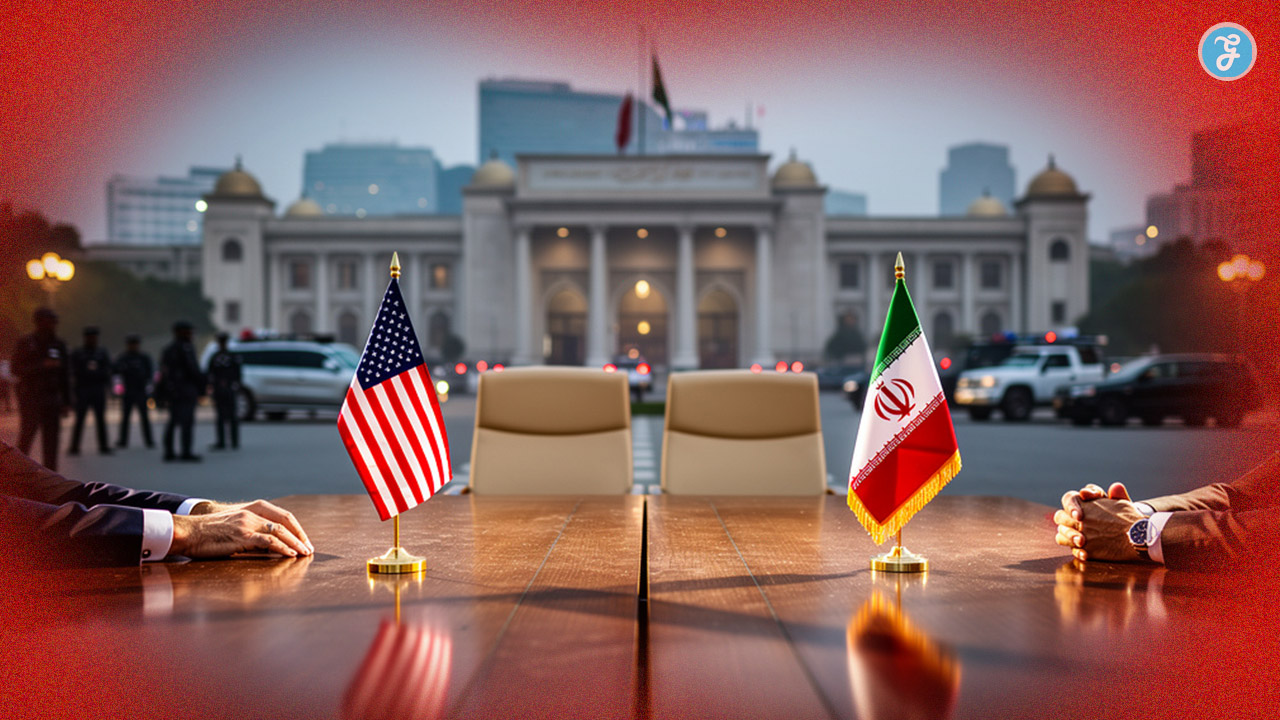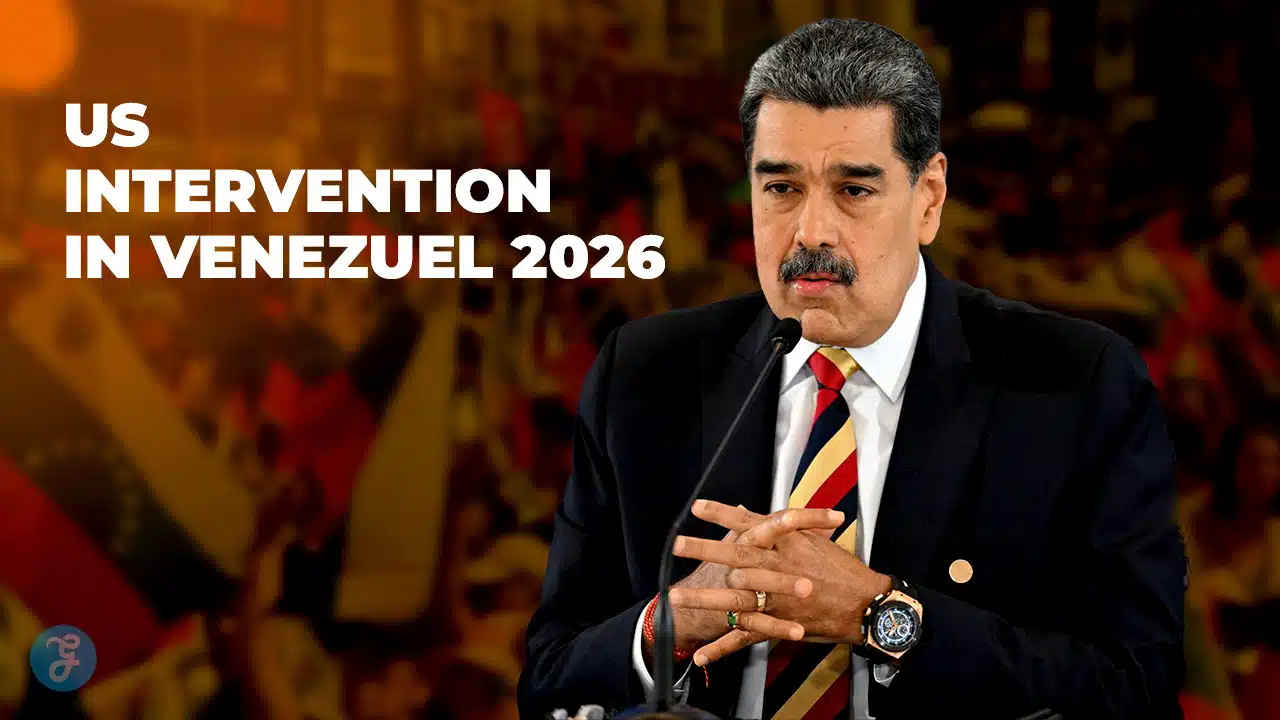
The geopolitical map of the Western Hemisphere was redrawn in less than four hours. The US military’s “Operation Absolute Resolve”—a precision extraction of Venezuelan President Nicolás Maduro and First Lady Cilia Flores to federal custody in New York—did not just dismantle a dictatorship; it signaled the violent rebirth of the Monroe Doctrine for the 21st century, marking what many analysts are calling the Maduro ouster and its far-reaching implications for hemispheric power dynamics.
The geopolitical map of the Western Hemisphere was redrawn in less than four hours. The US military’s “Operation Absolute Resolve”—a precision extraction of Venezuelan President Nicolás Maduro and First Lady Cilia Flores to federal custody in New York—did not just dismantle a dictatorship; it signaled the violent rebirth of the Monroe Doctrine for the 21st century, underscoring what many analysts are calling the Maduro ouster and its far-reaching implications for hemispheric power dynamics.
This event marks a decisive shift from the “strategic patience” of previous administrations to a doctrine of “hyper-aggressive extraction.” Washington is no longer waiting for democracies to bloom; it is forcibly clearing the weeds to secure energy assets. The critical question now is not if the regime will fall, but whether a decapitated state can be rapidly privatized to prevent a hemispheric refugee crisis and stabilize global oil markets.
Key Takeaways
- The Decapitation: On Jan 3, 2026, US forces executed a unilateral extraction of Nicolás Maduro, bypassing international extradition norms to charge him with narco-terrorism in Brooklyn.
- The “Donroe Doctrine”: A new foreign policy framework championed by Secretary of State Marco Rubio, prioritizing direct intervention over multilateral diplomacy to secure the Western Hemisphere against Chinese and Russian influence.
- The Privatization Pivot: Private military strategies, long advocated by Erik Prince and the “Ya Casi Venezuela” movement, are now central to the stabilization plan, aiming to secure oil fields with non-state actors.
- The “Survivalist” Compromise: Vice President Delcy Rodríguez has not been purged; instead, she has emerged as a pragmatic interlocutor, suggesting a deal was cut to preserve administrative continuity.
- The Economic Reality: The US is betting that Venezuelan oil can fund the reconstruction, but with infrastructure in ruins, the sector requires $8-9 billion annually just to recover pre-2015 levels.
From “Maximum Pressure” to “Absolute Resolve”: The Escalation Ladder
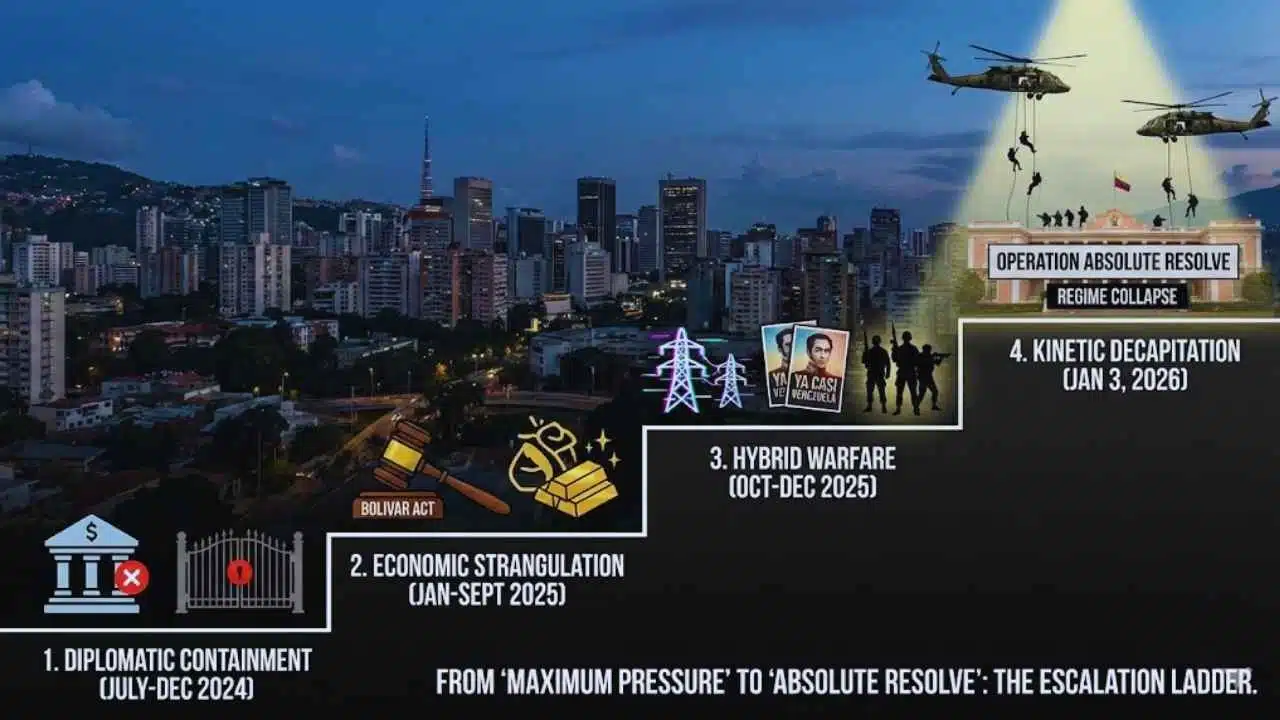
The raid on Miraflores Palace was not a sudden impulse but the inevitable kinetic conclusion to a diplomatic dead-end. The trajectory was set in July 2024, when the Maduro regime effectively nullified the election results favoring Edmundo González Urrutia. For 18 months, Washington exhausted every non-kinetic tool in its arsenal: seizing aircraft, sanctioning gold reserves, and recognizing the opposition government in exile.
By late 2025, the “stalemate” was deemed an unacceptable security risk. The passage of the BOLIVAR Act by the US Congress severed the last financial arteries of the regime, but it also pushed Caracas closer to Moscow and Tehran. Faced with the prospect of Venezuelan ports becoming permanent hosts to adversarial navies, the US administration climbed the final rung of the escalation ladder.
The Escalation Timeline (2024–2026)
| Phase | Timeframe | Key Actions | Outcome |
| 1. Diplomatic Containment | July 2024 – Dec 2024 | Non-recognition of election results; asset freezes on top officials. | Failure: Maduro entrenched power; opposition forced into exile. |
| 2. Economic Strangulation | Jan 2025 – Sept 2025 | Introduction of the BOLIVAR Act; secondary sanctions on partners. | Partial Success: State revenue collapsed, but illicit economies (gold, narcotics) surged. |
| 3. Hybrid Warfare | Oct 2025 – Dec 2025 | “Ya Casi Venezuela” campaign launches; cyber-attacks on state grid; psychological ops. | Destabilization: Paranoia within the regime; military defections increased. |
| 4. Kinetic Decapitation | Jan 3, 2026 | Operation Absolute Resolve: Direct military extraction of the head of state. | Regime Collapse: Command structure broken; immediate power vacuum. |
The “Donroe Doctrine” and the Logic of Decapitation
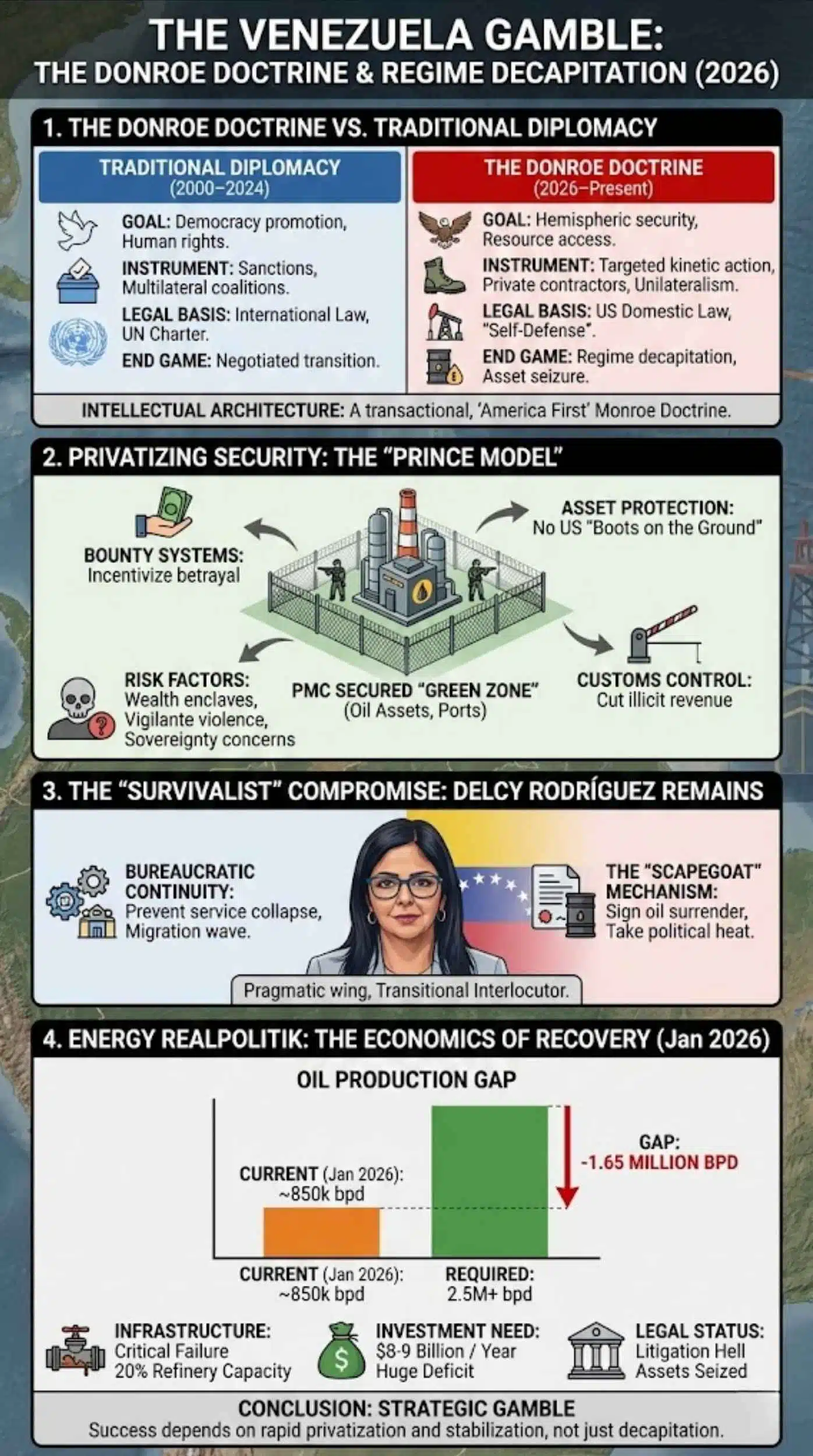
The intellectual architecture of this operation is what policy analysts are terming the “Donroe Doctrine”—a fusion of the 1823 Monroe Doctrine’s possessiveness over the hemisphere with a transactional, “America First” enforcement mechanism.
Under Secretary of State Marco Rubio and Defense Secretary Pete Hegseth, the US has redefined Venezuelan sovereignty. It is no longer viewed as an inviolable right but as a privilege conditional on not hosting “extra-hemispheric threats” (i.e., China, Russia, Iran). This doctrine posits that a “narco-terrorist state” forfeits its sovereign immunity. The capture of Maduro is designed to send a chilling signal to other adversaries in the region (principally Nicaragua and Cuba): Washington’s reach is limitless, and its patience has expired.
The “Donroe Doctrine” vs. Traditional Diplomacy
| Feature | Traditional Diplomacy (2000–2024) | The Donroe Doctrine (2026–Present) |
| Primary Goal | Democracy promotion and human rights. | Hemispheric security and resource access. |
| Key Instrument | Sanctions, multilateral coalitions (OAS, UN). | Targeted kinetic action, private contractors, unilateralism. |
| Legal Basis | International Law / UN Charter. | US Domestic Law (Anti-Terrorism), “Self-Defense.” |
| End Game | Negotiated transition and elections. | Regime decapitation and asset seizure. |
Privatizing the State: The Role of Private Military Contractors
Perhaps the most radical element of the post-Maduro landscape is the proposed “privatization of security.” The sheer scale of Venezuela’s territory and the corruption of its armed forces (FANB) make a traditional US military occupation politically toxic and logistically impossible.
Enter the “Prince Model.” Erik Prince, founder of Blackwater and a vocal proponent of the “Ya Casi Venezuela” movement, has advocated for a model where private military contractors (PMCs) secure high-value assets (oil fields, ports, refineries) while leaving municipal policing to local authorities. This creates “Green Zones” of stability essential for foreign investment, effectively creating a bifurcated state.
The “Prince Model” for Stabilization
| Component | Description | Strategic Advantage | Risk Factor |
| Asset Protection | PMCs deployed solely to secure PDVSA oil infrastructure. | protects revenue streams without US “boots on the ground.” | Creates “enclaves” of wealth amidst general poverty. |
| Bounty Systems | Cash rewards for the capture of mid-level regime enforcers. | Incentivizes betrayal within the old regime; low cost. | Encourages vigilante violence and settling of scores. |
| Customs Control | Private firms manage ports and borders to stop trafficking. | Cuts off drug revenue; ensures tariff collection. | Sovereignty concerns; potential for contractor corruption. |
The “Survivalist” Compromise: Why Delcy Rodríguez Remains
In any coup, survival depends on utility. While Maduro sits in a cell, his Vice President, Delcy Rodríguez, remains in Caracas, reportedly under heavy guard but operational. This anomaly suggests a pre-arranged “off-ramp.”
Intelligence circles suggest Rodríguez represents the “pragmatic wing” of the Chavismo movement—those willing to trade ideology for survival. By allowing her to remain as a transitional figurehead, the US achieves two goals:
- Bureaucratic Continuity: Prevents the total collapse of public services (water, power), which would trigger a migration wave.
- The “Scapegoat” Mechanism: Rodríguez can sign the surrender of the oil industry to US interests, taking the political heat while the opposition prepares for future elections.
Fate of the Regime Inner Circle
| Name | Role | Status (Post-Jan 3) | Future Outlook |
| Nicolás Maduro | President | Detained (New York) | Trial for Narco-Terrorism; likely life sentence. |
| Diosdado Cabello | Interior Minister | Fugitive / At Large | Likely organizing insurgency/guerrilla resistance. |
| Delcy Rodríguez | Vice President | Transitional Interlocutor | Managing administrative transfer; likely immunity deal. |
| Vladimir Padrino | Defense Minister | House Arrest | Neutralized; negotiating retirement for military brass. |
Energy Realpolitik: The Economics of Recovery
The administration’s narrative is that Venezuelan oil will pay for the country’s reconstruction. This is an optimistic gamble. The Venezuelan oil sector is not just paused; it is cannibalized.
Decades of mismanagement and sanctions have left PDVSA (the state oil company) in ruins. To bring production back to a level where it can actually fund a government (2.5 – 3 million bpd), massive capital injection is required. US oil majors like Chevron and ExxonMobil are interested, but they require legal certainty that a “transitional” government cannot easily provide.
Venezuelan Oil: The Gap Between Reality and Potential
| Metric | Current Status (Jan 2026) | Required for Stability | The Gap |
| Production | ~850,000 bpd | 2,500,000+ bpd | -1.65 Million bpd |
| Infrastructure | Corroded pipelines; 20% refinery capacity. | Modern export terminals; 80% refinery capacity. | Critical Failure |
| Investment Need | $0 (State is bankrupt) | $8-9 Billion / Year | Huge Deficit |
| Legal Status | Assets seized/sanctioned. | Clear property rights; debt restructuring. | Litigation Hell |
Strategic Outlook: Scenarios for 2026 and Beyond
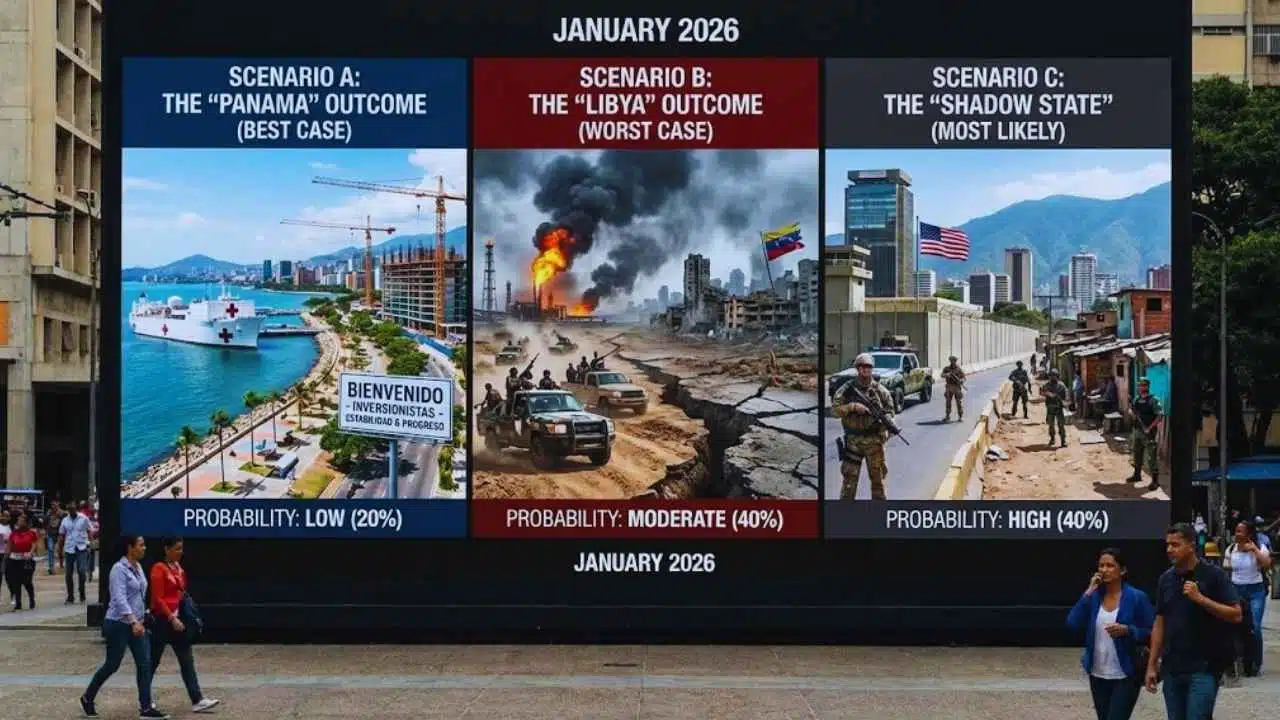
As the dust settles on Operation Absolute Resolve, three distinct scenarios are emerging for the remainder of 2026.
Scenario A: The “Panama” Outcome (Best Case)
Similar to the post-Noriega era in Panama, the removal of the dictator leads to a rapid collapse of the security apparatus. The private sector returns, the diaspora begins to send remittances, and a technocratic government stabilizes the currency.
- Probability: Low (20%). The ideological indoctrination of the Venezuelan military is far deeper than Noriega’s PDF.
Scenario B: The “Libya” Outcome (Worst Case)
The state fractures. Diosdado Cabello and the “Cartel of the Suns” retreat to the interior, forming a narco-insurgency. Oil fields become fortified castles guarded by mercenaries, while the cities descend into gang warfare.
- Probability: Moderate (40%). The proliferation of weapons and armed colectivos makes this a high risk.
Scenario C: The “Shadow State” (Most Likely)
A hybrid model emerges. The US controls the oil and the finances via a “Green Zone” in Caracas and Maracaibo. The rest of the country is managed by local warlords or remaining Chavista governors who have switched allegiance. It is stable, but it is not a democracy; it is a resource colony managed by an international coalition.
- Probability: High (40%). This aligns best with the “Donroe Doctrine” of prioritization of interests over values.
Final Thoughts
The ouster of Maduro is a tactical masterpiece but a strategic gamble. Washington has broken the stalemate, but in doing so, it has taken ownership of a broken nation. The success of this operation will not be measured by the jail sentence of one man, but by whether the US can convert a “failed state” into a “functional partner” without getting dragged into a twenty-year insurgency.