It might sound like a scene from a sci-fi movie, but scientists have used one of the world’s most powerful supercomputers to make a startling long-term prediction: life on Earth will eventually come to an end, not by war or asteroid, but due to the natural evolution of our Sun.
However, there’s no reason to panic—this predicted extinction event is billions of years away.
Scientists Use Supercomputer to Predict Earth’s Future
In a report published by LaGrada in April 2025 and confirmed by BGR on May 6, 2025, scientists from NASA and Toho University in Japan collaborated to simulate the distant future of our planet. They used a high-performance supercomputer to model the long-term evolution of Earth’s environment in response to changes in solar radiation.
Their calculations concluded that life on Earth will become impossible around the year 1,000,002,021—approximately 1 billion years from now. By then, conditions on the planet will have become too extreme for even the hardiest forms of life to survive.
The Sun’s Evolution Will Be the Cause
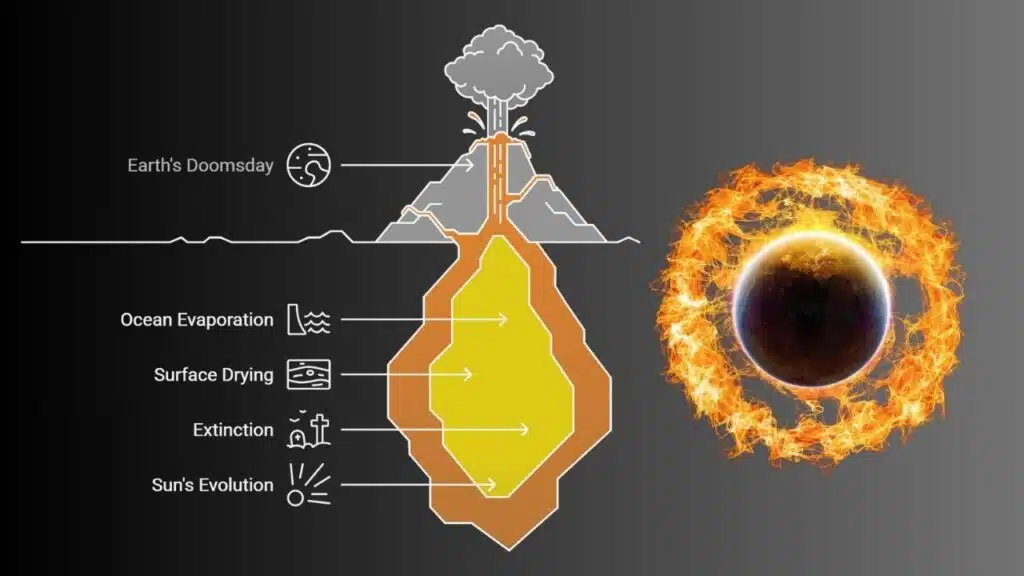
The primary culprit in this doomsday scenario isn’t a comet or a nuclear disaster—it’s our own Sun. While the Sun is currently a stable G-type main-sequence star, it is slowly becoming hotter and more luminous as it ages. This increase in solar output, known as solar luminosity, will eventually render Earth uninhabitable.
According to the BGR report, scientists explained that the Sun’s energy output will steadily rise, gradually raising Earth’s global temperature. This won’t happen overnight. It’s a slow and steady process, unfolding over hundreds of millions of years. However, the consequences will be profound:
- Increased temperatures will lead to the evaporation of oceans.
- The planet’s surface will dry out, causing widespread extinction of plant and animal species.
- Photosynthesis will eventually stop due to heat stress, which will reduce atmospheric oxygen.
This chain of events sets off a planet-wide decline in habitability, first making it difficult for complex organisms to survive, and eventually eliminating even microbial life.
Declining Oxygen: A Warning Sign from the Past
The theory that oxygen levels will play a major role in Earth’s eventual doom isn’t new. In 2021, researchers Kazumi Ozaki (Toho University) and Christopher T. Reinhard (Georgia Institute of Technology) published a landmark study in the journal Nature Geoscience. Using climate and biogeochemistry models, they found that:
“Earth’s atmosphere is currently rich in oxygen, but this won’t last forever. The biosignatures we rely on to identify life from space are temporary and will disappear.”
Their research indicated that Earth will begin to lose atmospheric oxygen in less than 1.08 billion years, well before the Sun reaches its red giant phase. This oxygen loss, they said, will likely collapse ecosystems and eliminate oxygen-dependent life, including humans, animals, and most plants.
This is a crucial detail because it shifts our understanding of the “end of life” timeline. It means the biosphere could collapse long before the planet becomes a scorched wasteland.
Why This Matters—Even If It’s Billions of Years Away
Although the extinction of all life on Earth is not expected for another billion years, the findings have important implications today.
- Understanding planetary habitability: These studies help us better understand the limits of life and what makes a planet habitable. This is essential for the ongoing search for Earth-like exoplanets.
- Impact on astrobiology: When astronomers look for life on other planets, they often search for oxygen as a biosignature. But this research shows oxygen is a temporary feature, not a permanent one, even on living planets. So we might be overlooking planets that had life in the past or will have life in the future.
- Perspective on Earth’s fragility: Although this timeline is unimaginably distant, it’s a reminder of the delicate balance that sustains life on our planet today. Our current climate system, atmosphere, and ecosystems are not eternal—they are dynamic and evolving.
So, What Happens After Life Ends?
By the time we reach the year 1,000,002,021, Earth will likely resemble modern-day Venus—a scorched, oxygen-poor planet incapable of supporting life. According to NASA’s solar evolution models, the Sun will continue heating the planet until it eventually enters its red giant phase, swelling to engulf Mercury, Venus, and possibly even Earth.
Any remaining traces of Earth’s surface features—oceans, mountains, cities—will be vaporized or melted. Our planet, once a vibrant blue orb teeming with life, will become just another lifeless rock.
What Can We Learn from This Prediction?
While the exact date—year 1,000,002,021—should be taken as an estimate rather than a fixed number, the models used by NASA and Toho University provide an extraordinary glimpse into the far future of Earth. These studies underscore the importance of:
- Investing in climate science and understanding the long-term changes to our biosphere.
- Enhancing space exploration to discover new habitable worlds.
- Developing sustainability policies that ensure Earth’s habitability for as long as possible.
The researchers are not sounding an alarm about tomorrow. They’re offering a long-range perspective on the lifespan of planetary environments—and reminding us that nothing lasts forever, not even Earth’s ability to support life.
Life on Earth is remarkably resilient, having survived asteroid impacts, ice ages, and supervolcanic eruptions. But even the toughest life forms will eventually face extinction—not because of human action, but because of stellar evolution.
Thanks to cutting-edge models and simulations, we now have a clearer picture of how and when that end might come. It’s not something we need to fear, but it is something worth understanding—for the sake of science, future generations, and our place in the universe.
The Information is Collected from Times of India and Yahoo.