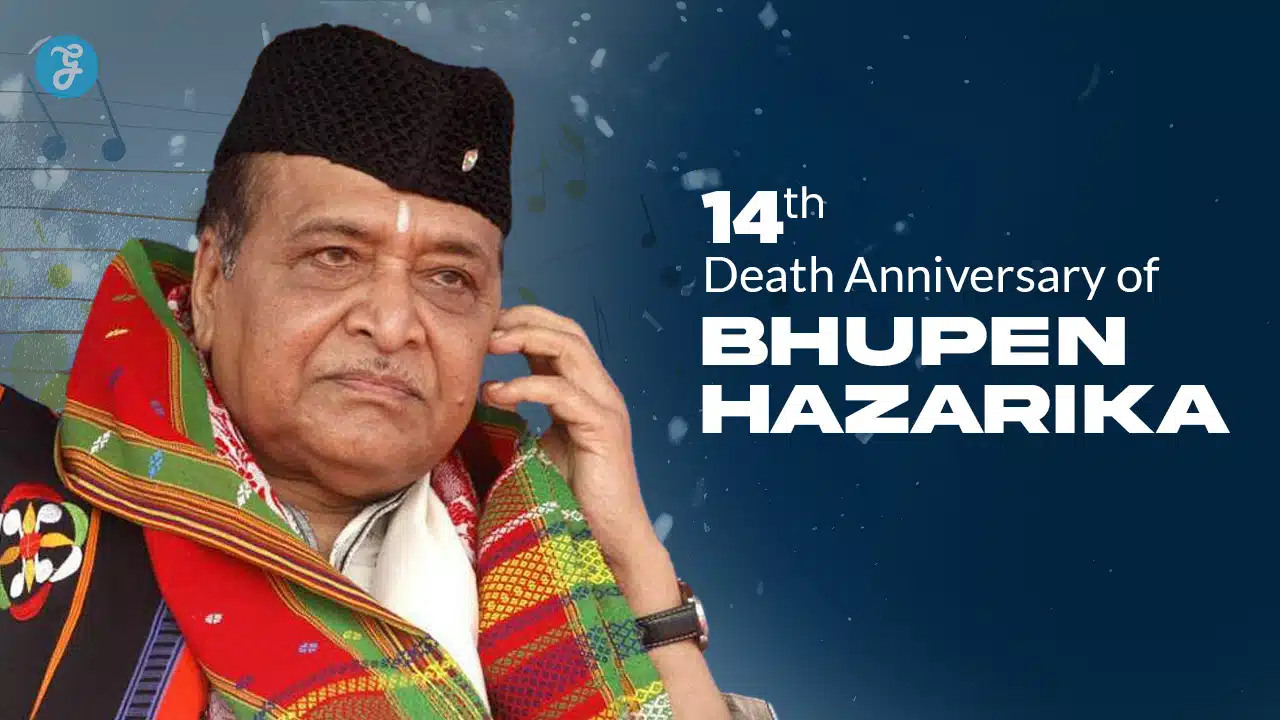
Have you ever heard a song that feels like home, even if you don’t quite understand the words? That’s the magic of Dr. Bhupen Hazarika, a legendary voice from northeast India whose music built bridges across the entire nation. Today is the 14th death anniversary of Bhupen Hazarika.
You might wonder how a single artist could capture the hearts of millions with folk music. It’s simple, really. He sang about life, hope, and standing together.
They didn’t call him the “Bard of Brahmaputra” for nothing. His songs flowed like the mighty river itself, carrying stories that everyone could feel. His work earned him some of India’s highest honors, including the Bharat Ratna, Padma Bhushan, and the Dada Saheb Phalke Award.
So, let’s explore the story of Dr. Bhupen Hazarika together. I’ll show you how he kept Assamese culture vibrant and why his melodies, filled with so much heart, still echo today.
Key Takeaways
- Bhupen Hazarika, known as the “Bard of Brahmaputra” and “Sudhakantha,” used his music to tell the stories of Assam’s people, earning top awards like the Bharat Ratna (posthumously in 2019), Padma Bhushan (2001), and the Dada Saheb Phalke Award (1992).
- He was a key figure in preserving Assamese folk music, collecting traditional songs and blending them with modern sounds in hits like “Manuhe Manuhor Babe,” which spread messages of unity and justice across India.
- He was an Indian singer, songwriter, writer, filmmaker and politician from Assam.
- In cinema, he was a powerhouse, composing for Assamese films like “Shakuntala” and leaving a huge mark on Hindi cinema with iconic songs like “Dil Hoom Hoom Kare” from the film *Rudaali*.
- His songs were a powerful tool for social justice, inspired by American singer and activist Paul Robeson. He gave a voice to the struggles of everyday people, from tea workers to villagers in Northeast India.
- His influence is still felt today, with India’s longest bridge, the Bhupen Hazarika Setu, named in his honor, and his songs playing a major role in the 1971 Bangladesh Liberation War, for which he received the Muktijoddha Award.
Titles and Recognition
Bhupen Hazarika was known by many names, and each one tells a part of his incredible story. These titles weren’t just nicknames; they were given to him by the people who loved his music and his message.
Why is Bhupen Hazarika called the “Bard of Brahmaputra”?
People call him the “Bard of Brahmaputra” because his songs are like stories flowing from the great river that runs through Assam. He sang about the lives, struggles, and dreams of the people who lived along its banks. His music painted a vivid picture of the region for the rest of the world to see.
Like a poet with a guitar, he used the folk music of Northeast India to speak about unity, brotherhood, and a deep love for his homeland. His powerful lyrics made him a true storyteller for his people, a modern-day bard singing by the riverside.
What does the title “Sudhakantha” signify?
Sudhakantha means “nectar-throated,” a beautiful way of describing his rich, soulful voice. People gave him this title, also translating to “Nightingale of Assam,” because his singing was just that captivating. His voice could soothe hearts and bring stories to life, making old folk tales feel new again.
This title shows the deep respect he earned within Assamese culture. But his intellect was just as powerful as his voice. He earned a Ph.D. in Mass Communications from Columbia University in 1952, with his thesis focusing on how to use audio-visual tools for education in India. This unique blend of artistic talent and academic insight made his work truly special.
Musical Contributions
Dr. Bhupen Hazarika didn’t just sing folk music; he breathed new life into it. He took the traditional sounds of Assam and shared them with the world, creating anthems of hope and humanity that still resonate today.
How did Bhupen Hazarika help preserve Assamese folk music?
He traveled through the villages of northeast India, collecting old folk songs that were fading away. But he didn’t just archive them. He gave them modern arrangements while keeping their original soul intact, using traditional instruments like the *dhol* (drum) and *pepa* (hornpipe).
This approach made the music accessible to younger generations, ensuring that the rich culture of Assam would not be forgotten. A prolific artist, he wrote and composed over 1,000 songs in his lifetime, creating a massive body of work that served as a bridge between the past and the future.
What are his notable songs about humanity and brotherhood?
“Manuhe Manuhor Babe” (“People are for People”) is perhaps his most famous anthem for unity. In it, he sings a simple but powerful message: that we should all care for one another. The song became a beacon of hope across India.
Another iconic song, “Bistirno Parore,” was famously inspired by Paul Robeson’s “Ol’ Man River.” Hazarika met the American singer and civil rights activist in New York, who told him his guitar wasn’t just a musical instrument, but a “social instrument” for change. This idea became central to Hazarika’s work.
“If a man does not think for another man with a little sympathy, who will? Tell me, my friend.” – A translated line from “Manuhe Manuhor Babe.”
Influence on Indian Cinema
Bhupen Hazarika’s influence wasn’t limited to the stage; he was also a giant in the world of Indian cinema. He used film to share the stories of Northeast India with a national audience, both as a composer and a filmmaker.
How did he contribute to Assamese and Hindi film industries?
He was a pioneer in Assamese cinema, directing and composing music for landmark films like “Shakuntala” (1961) and “Chameli Memsaab” (1975). His work helped put Assamese film on the map.
But his magic reached Bollywood, too. He introduced the sounds of Northeast India to Hindi cinema, creating unforgettable music. His most famous Hindi song, “Dil Hoom Hoom Kare,” was from the 1993 film *Rudaali*, directed by his long-time creative partner, Kalpana Lajmi. This song brought the soulful melodies of Assam to every corner of India.
What was his role as a filmmaker and composer?
Dr. Hazarika was a complete filmmaker who wore many hats. He wrote scripts, directed films, and composed powerful scores that brought his stories to life. He saw cinema as a tool for education and social change, not just entertainment.
Here’s a quick look at some of his key films that show his incredible range:
| Film Title | Industry | His Role |
|---|---|---|
| Shakuntala (1961) | Assamese | Director & Composer |
| Chameli Memsaab (1975) | Assamese | Music Director |
| Ek Pal (1986) | Hindi | Music Director & Actor |
| Rudaali (1993) | Hindi | Music Director |
| Daman (2001) | Hindi | Music Director |
Cultural and Social Impact
More than just an artist, Bhupen Hazarika was a cultural force. His music and films were a call for unity and justice, and his legacy is cemented not just in awards, but in the very landscape of India.
How did Bhupen Hazarika promote national identity and unity?
His songs, like “Ganga Behti Ho Kyun” (“O Ganga, Why Do You Flow?”), urged people to break down the walls between cultures and see themselves as one nation. He also took his ideals into the political arena, serving as an independent Member of the Legislative Assembly (MLA) in Assam from 1967 to 1972.
Perhaps the most powerful symbol of his unifying legacy is the **Bhupen Hazarika Setu**. Inaugurated in 2017, it’s India’s longest bridge over water, spanning 9.15 kilometers over the Lohit River. It connects Assam and Arunachal Pradesh, reducing travel time from six hours to just one and stands as a permanent tribute to the man who spent his life bringing people together.
Following the path of Paul Robeson, Hazarika used his songs to give a voice to the voiceless. He sang about the struggles of tea garden workers, farmers, and other marginalized communities, bringing their stories to a national audience.
His music was also a powerful force for freedom. During the 1971 Bangladesh Liberation War, his songs like “Joy Joy Nabajata Bangladesh” (“Victory to Newborn Bangladesh”) became anthems for the freedom fighters. His passionate support for their cause made him a beloved figure in Bangladesh.
Awards and Honors
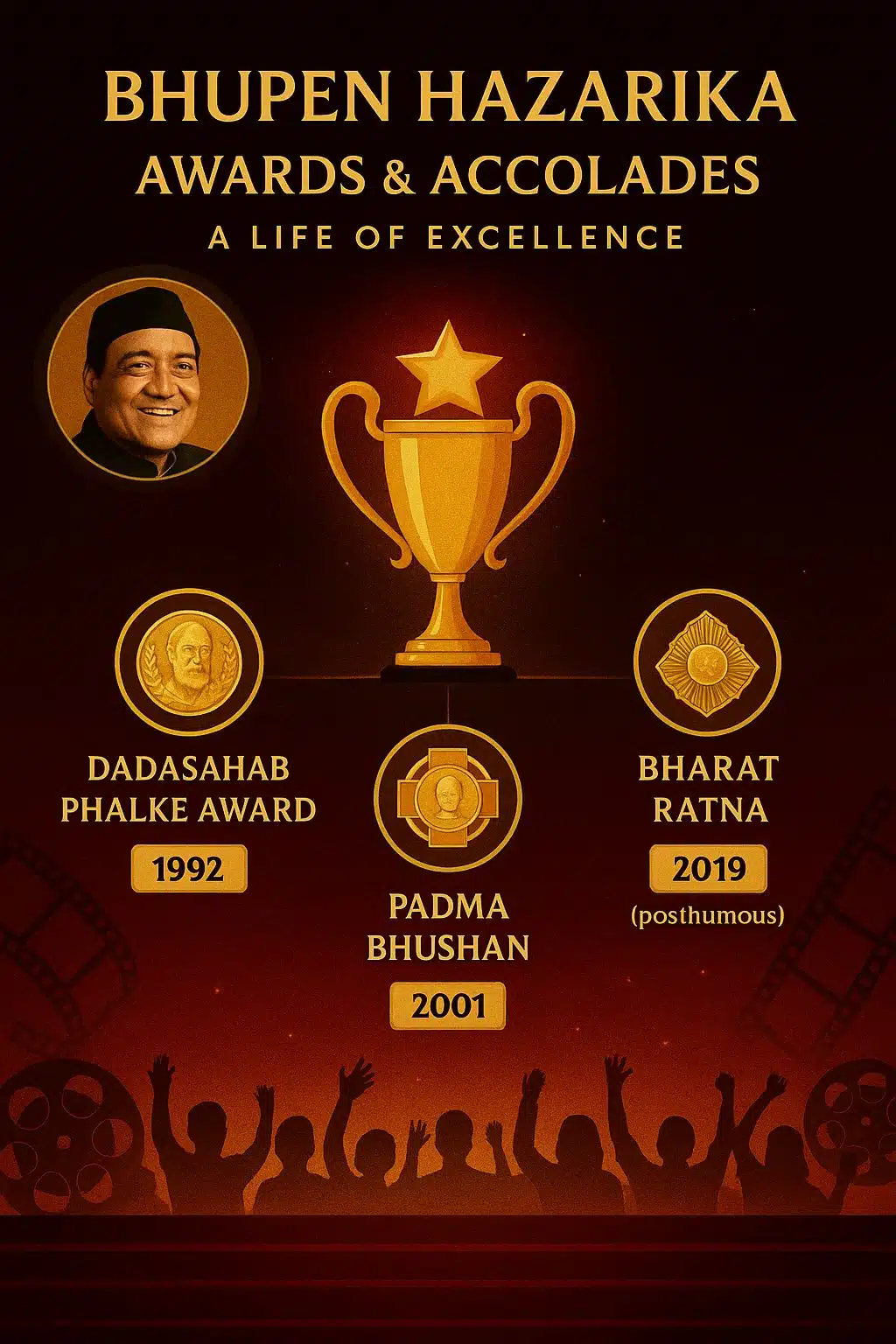
Throughout his incredible career, Dr. Bhupen Hazarika received some of the highest honors an artist can achieve. These awards are a testament to the immense impact he had on the culture of India and beyond.
What is the significance of the Bharat Ratna?
The Bharat Ratna is India’s highest civilian award, and it cemented his place as a national treasure. He was awarded this incredible honor posthumously in 2019, a recognition of his timeless contribution to the arts and his role in building a more unified India. This award placed him in the company of the nation’s most revered figures.
What other major awards did he receive?
His shelf was full of prestigious awards that recognized his talent across music, film, and culture.
- Dada Saheb Phalke Award (1992): This is India’s highest honor in cinema, celebrating his lifetime contribution to the film industry.
- Padma Bhushan (2001): Third highest civilian honors of the Republic of India, recognizing his exceptional service to the arts.
- Padma Vibhushan (2012): Second highest civilian award of the Republic of India.
- Bharat Ratna (2019): Highest civilian award of the Republic of India.
- Padma Shri (1977): Fourth highest civilian award of the Republic of India.
- Sangeet Natak Akademi Award (2008): He was honored by India’s top cultural body and later served as its chairman from 1998 to 2003.
- Asom Ratna (2009): Highest civilian award in the state of Assam, India.
- Friends of Liberation War Honor (2011): This honor from Bangladesh recognized his inspirational role during their 1971 Liberation War.
Takeaways
Bhupen Hazarika’s voice may have fallen silent, but his songs flow on, as powerful and relevant as the Brahmaputra river he so loved.
He was more than a singer, he was a storyteller, a unifier, and a voice for hope. From the highest civilian award, the Bharat Ratna, to the hearts of everyday people, his impact was immeasurable.
His legacy reminds us that a simple melody can carry a powerful message, bringing people together and inspiring a better tomorrow.
FAQs
1. Who was Bhupen Hazarika and why is he important in Indian music history?
Known as the “Bard of the Brahmaputra,” Bhupen Hazarika was a legendary singer and composer from northeast India who brought Assamese folk music to national attention. His songs, like the iconic “Manuhe Manuhor Babe,” powerfully told stories of humanity, justice, and social change, making him a cultural icon across India.
2. What awards did Bhupen Hazarika receive during his lifetime?
He was honored with the Dadasaheb Phalke Award in 1992, the Padma Bhushan in 2001, and was posthumously awarded the Bharat Ratna, India’s highest civilian honor, in 2019.
3. How did Bhupen Hazarika shape folk music in northeast India?
Bhupen Hazarika modernized traditional folk tunes by blending them with contemporary sounds and introducing them to a wider audience through his work in films like “Rudaali” and “Ek Pal.”
4. Why does Bhupen Hazarika’s legacy still matter today?
His legacy of unity and social consciousness endures through his timeless music and is honored in landmarks like the Bhupen Hazarika Setu, India’s longest bridge, inaugurated in 2017.