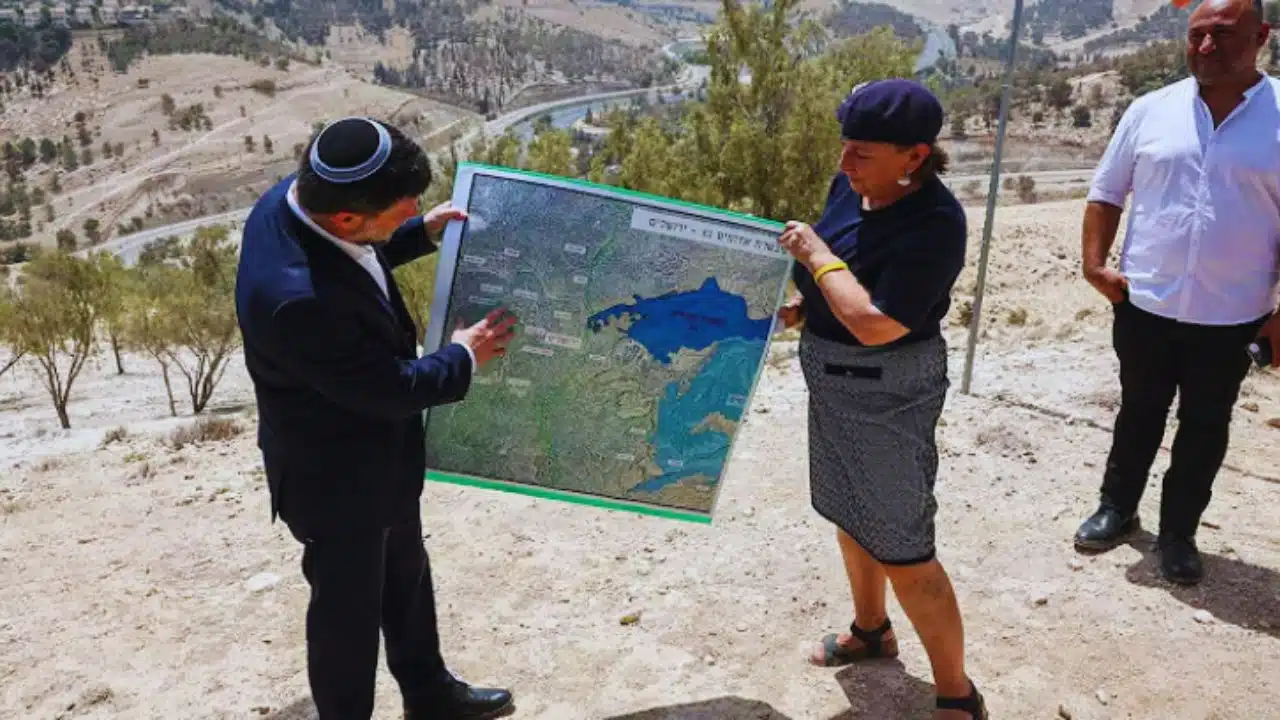
Israel has formally approved the construction of thousands of housing units in the E1 area, a strategic stretch of land east of Jerusalem that connects the settlement of Ma’ale Adumim to Jerusalem. This marks one of the most controversial settlement decisions in decades, effectively reviving a plan that has been on hold for over 20 years due to international opposition, particularly from the United States.
The E1 corridor is critical because it forms a narrow land bridge linking the northern and southern parts of the West Bank. For Palestinians, this corridor was always envisioned as the natural link between Ramallah in the north and Bethlehem in the south, cities that sit just 22 kilometers apart but require long detours through Israeli checkpoints. If built, the settlement would cut the West Bank in half, isolating East Jerusalem from the rest of the Palestinian territory and making a future contiguous Palestinian state nearly impossible.
For years, successive Israeli governments avoided finalizing this plan under U.S. and European pressure. The decision now comes amid shifting geopolitical realities and Israel’s increasingly hardline stance under a coalition dominated by right-wing and far-right ministers.
Global Condemnation: A Breach of International Law
The announcement immediately drew widespread condemnation.
- United Nations: The UN reminded Israel that settlements in occupied territories are illegal under international law, violating the Fourth Geneva Convention and multiple UN Security Council resolutions.
- International Court of Justice (ICJ): Just last year, the ICJ issued a historic ruling declaring Israel’s occupation of the West Bank, East Jerusalem, and Gaza unlawful and called for an immediate halt to settlement activities.
- United Kingdom: Foreign Secretary David Lammy denounced the E1 approval as a “flagrant breach of international law.”
- Germany: Government spokesperson Josef Hinterseher reiterated Berlin’s opposition, saying the project “undermines the viability of a two-state solution and violates relevant UN resolutions.”
Several European countries—including the UK and the Netherlands—have already imposed sanctions on senior Israeli officials such as Finance Minister Bezalel Smotrich and National Security Minister Itamar Ben-Gvir, both accused of inciting settler violence and promoting policies of ethnic cleansing in Gaza and the West Bank.
Israeli Government’s Position
Finance Minister Bezalel Smotrich, himself a former settler leader, welcomed the decision as a direct rebuttal to Western governments that recently announced moves to recognize Palestinian statehood. Smotrich said:
“The Palestinian state is being erased not with slogans but with actions. Every settlement, every neighborhood, every housing unit is another nail in the coffin of this dangerous idea.”
His comments reflect a wider push within Israel’s current government to bury the two-state solution entirely. Prime Minister Benjamin Netanyahu, while less vocal at the time of the announcement, has long opposed Palestinian statehood and has instead promoted policies expanding Israel’s “sovereignty” over the West Bank.
Consequences for Palestinians
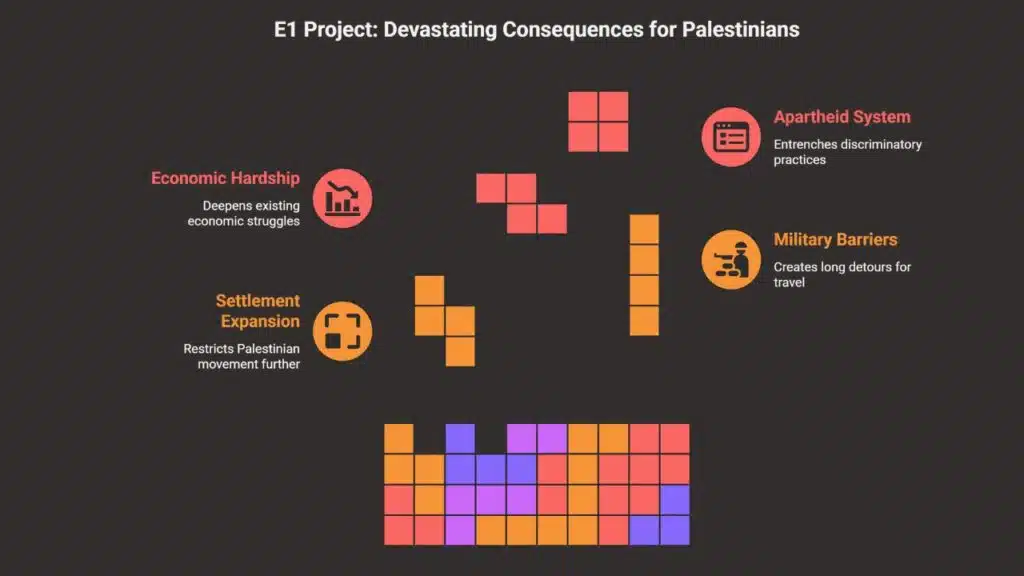
The approval of the E1 project is seen by Palestinian leaders as a devastating blow. For decades, Palestinians hoped that the land between Ramallah and Bethlehem would serve as the geographic heart of a future state. Instead, settlement expansion has forced them into fragmented enclaves, cut off by walls, fences, and checkpoints.
Today, Palestinians traveling between these cities often spend hours passing through detours and Israeli military barriers. Settlement expansion in E1, combined with other large-scale projects, would further restrict Palestinian movement, deepen economic hardship, and entrench what human rights groups describe as a system of apartheid.
Intensifying Crisis in the West Bank
The E1 announcement comes amid escalating violence in the West Bank. Over the past year, there has been a sharp increase in:
- Settler attacks on Palestinian villages and farmland.
- Israeli military raids on Palestinian towns and refugee camps.
- Forced evictions and demolitions, leaving families homeless.
- Movement restrictions, with checkpoints and roadblocks disrupting daily life.
Human rights organizations warn that the combination of settlement growth and settler violence is creating a dire humanitarian reality in the West Bank, even as global attention is largely consumed by the war in Gaza.
IDF Launches Gaza City Offensive
While international focus shifted to E1, the Israeli military simultaneously escalated operations in Gaza. On August 20, 2025, the Israel Defense Forces (IDF) announced the start of their offensive on Gaza City, the largest urban center of the enclave.
IDF spokesperson Brigadier General Effie Defrin confirmed that Israeli troops are now positioned on the outskirts of Gaza City, marking the first stage of a planned urban takeover. The operation is part of Israel’s broader war strategy to defeat Hamas after nearly two years of fighting.
Largest Reservist Call-Up in Months
To sustain the campaign, Israel has ordered the mobilization of 60,000 reservists, making this the largest military call-up in months. In a country of fewer than 10 million people, such mobilizations carry not only military but also economic and political consequences—removing tens of thousands from workplaces, families, and schools.
The move follows mass protests across Israel, where hundreds of thousands have taken to the streets demanding a ceasefire. Many Israelis are increasingly concerned about the war’s human toll, the economic burden, and the government’s lack of a long-term strategy.
Humanitarian Catastrophe in Gaza
The assault on Gaza City threatens to worsen an already dire humanitarian crisis:
- Displacement: Nearly 2 million Gazans—the overwhelming majority of the enclave’s population—have been displaced, with many crammed into overcrowded shelters or makeshift camps.
- Destruction: Large parts of Gaza, including housing blocks, schools, and hospitals, lie in ruins.
- Famine Risk: UN agencies warn that famine is looming, with reports of children already dying from malnutrition. Food and clean water remain critically scarce.
- Medical Collapse: Gaza’s healthcare system is on the brink of collapse, with hospitals overwhelmed, supplies running out, and doctors operating under impossible conditions.
Human rights groups have accused Israel of deliberately using starvation as a weapon of war, claims Israel denies.
Ceasefire Talks and International Reactions
Ceasefire negotiations continue but remain fragile. Reports suggest that Hamas recently accepted a 60-day ceasefire framework involving prisoner exchanges, but Israel has not formally responded.
Meanwhile, U.S. Ambassador to Israel Mike Huckabee blamed recent European decisions to recognize Palestinian statehood for undermining ceasefire talks, calling them “counterproductive.” This reflects Washington’s increasingly uneasy balancing act—criticizing settlement expansion while continuing to provide Israel with diplomatic and military support.
A Turning Point
The simultaneous approval of the E1 settlement project and the launch of the Gaza City offensive highlight Israel’s determination to reshape realities on the ground. Together, these moves:
- Undermine the two-state solution by fragmenting the West Bank.
- Escalate the humanitarian catastrophe in Gaza.
- Deepen Israel’s diplomatic isolation, as even close Western allies condemn its actions.
For Palestinians, these developments represent both an immediate humanitarian emergency and a longer-term political crisis, as hopes for statehood slip further away. For the international community, it underscores the urgent challenge of balancing condemnation with action, as the conflict threatens to spiral into an even greater regional crisis.
The Information is collected from BBC and MSN.