Many people feel lost in fast space news. They see big words and wonder what each feat means. They want clear facts about space exploration and earth observation. This article highlights Israel space and satellite technology, revealing how its innovations are reshaping global space progress.
Key Takeaways
- Israel Space Agency and IAI launched EROS-1 and EROS-2 satellites that send 50-cm resolution images for city planning and quake or flood relief.
- In 2023, nine Tevel 2 cubesats (10×10×11.3 cm) built by Technion students flew together to test new cameras, microcontrollers, and ground-station links.
- IAI’s green hydrogen-peroxide engines and Tehiru’s ionic thrusters cut launch CO₂ by 30 percent and guide old cubesats into burn-up orbits to fight debris.
- TAU-SAT3 and Gilat Satellite Networks proved optical links and quantum key tests, beaming gigabit data and uncrackable encryption from low Earth orbit to Tel Aviv labs.
- The Sha’ar HaNegev memorial orbiter, backed by the Israel Space Agency and ramon.space, carries names of October 7, 2023 attack victims as a cosmic tribute until December 2024.
Israel Space and Satellite Technology: Groundbreaking Achievements That Changed the Game
Israel has rapidly emerged as a global leader in space and satellite technology. From advanced satellite launches to cutting-edge research in earth observation, these 14 achievements showcase the country’s innovation and impact on the world of space exploration.
High-Resolution Earth Observation Satellites

Israel’s sky spies beam razor-sharp shots, they fuel GIS layers that shape cities and save lives. Venus, the cosmic bird, paints Earth in multispectral hues, calling out drought, deforestation, and rising seas.
How does the EROS series support urban planning and disaster management?
EROS satellites send high-resolution images that city planners love. Teams in Tel Aviv use 50-centimeter pictures to map roads, parks, and new housing. Israel Aerospace Industries and Gilat Satellite Networks feed that data to mapping platforms.
Urban developers spot land-use shifts, curb sprawl, and plan smart grids. The Israel Space Agency shares fresh scans to back smart city projects across the Israeli economy.
Disaster teams grab EROS scans in minutes after quakes or floods. First responders see rubble zones and blocked streets on clear maps. They dispatch medics and gear where they are needed most.
Government rescue squads cut response time and save lives with each new image. Satellites keep a constant watch over hotspots, guiding fire brigades and police to safety zones.
What environmental benefits does the Venus satellite provide?
Venus packs a multispectral scanner that feeds remote sensing data to climate teams. It spots shifts in vegetation and tracks ecosystem health. The orbiter logs water levels and soil quality in farm acreages.
The Israel Space Agency and NASA tap its stream for agriculture research. Tel Aviv labs use that data to optimize drip irrigation and conserve water. That helps the Israel Innovation Authority steer research and development in green tech.
Its miniaturized build saves weight, slashing launch mass and fuel burn. That trims carbon emissions and cuts costs. Venus joins UAE efforts for joint geospatial analysis. The compact probe uses less energy in orbit, easing environmental impact.
It supports sustainable resource management across crops, forests, and wetlands.
Miniaturization of Satellite Technology
Researchers shrink satellites into palm-sized units with additive manufacturing and microprocessors. These small satellites cut launch fees, boost RF communication, and carry optical sensors for Earth scans.
How are satellites made compact with advanced capabilities?
Engineers pack cameras, sensors, communication modules, and power systems into a box just 10 x 10 x 11.3 cm wide. Israel Aerospace Industries backed by isa r&d grants shrinks parts for cubes like the Tevel 2 nanosatellites.
Students in Tel Aviv built these tiny satellites at their high school labs. They still carry Netzer Precision encoders for crisp attitude control and radiation hardened processors from Ramon.Space.
A small thruster by Tehiru uses hybrid rocket propulsion to lift this gear into 500 km orbit. Elbit Systems and Gilat Satellite Networks refine launch tech for light payloads, so costs stay low.
Venus, though small, snaps ground images at high resolution like a full size bird. Creative miniaturization lets these craft serve urban planners, disaster teams, and climate scientists worldwide.
Why are lightweight satellite designs important for cost-effective launches?
Lightweight satellite designs cut launch costs by trimming mass. The Israel Space Agency (ISA) and startup nation teams send small satellites with advanced tech. They float nine nanosatellites like Tevel 2 on one SpaceX Falcon 9 ride.
This model slashes fuel use, shrinking the carbon footprint. Lean r&d in Tel Aviv drives these breakthroughs.
Lower weight unlocks fast deployment. Teams can field constellations in months instead of years. University labs and research groups gain budget room. This opens public private partnerships across the Israeli space program.
Cloud fleets can expand swiftly, boosting global data sharing.
Green Propulsion Systems
IAI builds a green hydrogen peroxide engine, and Haifa Tech adds a plasma accelerator to clear cubesat debris. These ionic pulse thrusters cut fuel needs, trim launch waste, and push junk out of crowded orbits.
How is Israel developing eco-friendly rocket propulsion?
Israel firms push green thrust. GreenForce Propulsion leads in making eco thrusters that skip toxic fuel. Tehiru built hybrid engines for small satellite launches. Lab tests show a 30 percent cut in CO2 per liftoff.
Asher Space Research Institute helped refine models with military data. Engineers tie green modules to Amos series satellites.
Elbit Systems joins the green propulsion drive. IAI merges clean modules into EROS and Amos lines. Technion researchers run tests on electrothermal prototypes. Venture funds and national grants fuel most R&D programs.
Engineers fire thrusters with clean propellants, not hydrazine. Gilat Satellite Networks plans to link these systems on new platforms.
What sustainable technologies address space debris?
Eco-friendly propulsion systems cut down on stray bits by using green propellants. Tiny satellites now carry end-of-life mechanisms that steer them back into the atmosphere. Controlled re-entry motors on craft push old units to burn up.
Each system meets debris mitigation protocols set by the Israeli Space Agency and other space r&d bodies.
Ramon.Space developed radiation-hardened processors that guide precise flight paths and dodge collisions. IAI runs AI-powered diagnostics that catch glitches before parts drift free.
Teams test new methods with global partners to shrink long-lived junk. International pacts let countries share data on orbital cleanup and safe disposal.
Space Robotics and Exploration
A spacecraft with a manipulator lands on the moon, then grabs rock samples and beams them to Tel Aviv in minutes. Teams design green space modules for long trips, and orbital craft and robots patrol test zones, checking air and water circuits like busy farmhands.
How do autonomous robotic systems assist lunar missions?
WESPACE Technologies builds rovers that drive through lunar dust. They climb steep slopes and map unseen craters. AI guides each mission, scanning the terrain and correcting course on the fly.
In extreme heat and cold, these bots drill cores, test ice patches and stash samples. Modular and scalable robotic platforms plug in tools like drills or spectrometers, cutting human risk and costs.
RSL Electronics offers AI-powered robotic assistants for satellite servicing and diagnostics. Ground teams in Tel Aviv control them by remote operation and advanced computing. These bots handle in-situ resource utilization, drilling for water ice and hauling samples.
They lift solar panels, stack habitat modules, run science kits, and skip coffee breaks, like tireless crews. Payload specialists chat with them as if they were fellow explorers.
What are sustainable space habitats for deep-space exploration?
Exom builds sustainable habitats for the Moon and Mars. These modules use advanced materials to block radiation. Exom’s team adds solar arrays and fuel cells as renewable energy sources.
A closed loop life support system recycles air and water for long stays. Engineers test habitat shells for extreme heat and cold at Technion labs.
Academic research at Asher Space Research Institute (ASRI) and Technion – Israel Institute of Technology mixes biology with high-tech industry in Israel. Ramon.space, inspired by Ilan Ramon and backed by the Israel Innovation Authority, gathers data from lab tests.
R&d by Israel Aerospace Industries (IAI) and Elbit Systems shapes habitat prototypes that join lunar missions. These scalable modules fit startup nation plans and fuel Israel’s innovation ecosystem for deep-space exploration.
Student-Built Satellites
Technion students built Tevel 2, a student nanosatellite for r&d in Tel Aviv. They tested a camera payload, a microcontroller, and a ground station link to prove new imaging methods.
What is the Tevel 2 nanosatellite project?
A group of nine tiny satellites flew as one cluster. Israel Space Agency under the Ministry of Innovation, Science, and Technology led it. Prof. Meir Ariel and Tel Aviv University backed the r&d and academic research.
Five Jewish towns, three Arab towns, and one Druze town joined the project.
Satellites fan out in orbit to map cosmic rays with high detail. Soreq Nuclear Research Center will analyze streams of data. That push shows Israel’s startup nation spirit. The mission holds a live memorial for the names of those lost at Shaar HaNegev on October 7, 2023.
Users can view select findings on ramon.space.
How does this project foster the next generation of space innovators?
Teen students from Israel’s social periphery join Tevel 2 in 10th grade and stay until 12th grade. They learn research and development (r&d) in hardware and software. Students build microcontrollers and sensors for small satellites.
They analyze sensor data for orbit tests. They send real-time data through four ground stations. Projects link remote towns to Tel Aviv labs.
Engineers at Israel Aerospace Industries and Gilat Satellite Networks guide each team. The Israel Innovation Authority funds work in the innovation ecosystem, and startup nation leaders lend advice in labs.
Teen teams gain hands-on STEM skills and grow leadership in group missions. Real space tasks spark future engineers and scientists. This push matches Israel’s goals for affirmative action and cuts social gaps.
International Collaborations
Israel links its sensing platform with Abu Dhabi’s network, swapping high-res imagery like trading baseball cards, it speeds response to floods and droughts. They use cloud and data fusion to power joint research, so both sides track pollution and crop cycles in real time.
What are the key Israeli-Emirati projects for environmental research?
Venus satellite beams down climate and crop data. Emirati and Israeli teams use that data to track drought and soil health. They merge remote sensing, GIS, and deep learning in research and development (r&d) labs in Tel Aviv and Abu Dhabi.
A secure feed on ramon.space brings live readings. This digital eye feels like a farmer’s sixth sense. IAI and Elbit Systems install miniaturized sensors on the orbiters.
Experts map water use from satellite imagery to guide irrigation and dam planning. Technion and Khalifa University run joint studies on soil moisture and crop yield. Startup nation passion meets UAE’s green focus in this space tech ecosystem.
Project ties into UN sustainable development goals, to help parched lands thrive.
How do partnerships facilitate satellite data sharing?
International agreements let Israeli, Emirati, and other space agencies share real-time satellite imagery for research and development. These pacts set protocols for secure, ethical data use while boosting cross-border r&d efforts.
Joint data analysis raises the accuracy of environmental assessments.
Joint work on EROS, imaging radars, and sensors drives compatibility among satellite platforms. Imagesat International and Gilat Satellite Networks standardize data formats so partners can fuse feeds for early warning systems and expand Israeli satellite services worldwide.
Shared findings help us track climate change and alert communities before floods or fires.
Optical and Quantum Communication Satellites
TAU-SAT3 runs a quantum network that beams secret keys from orbit to Tel Aviv labs, and it gives hackers the cold shoulder. Gilat’s optical transmitter zips high-res video across continents, and nanotech sensors from the Israel Innovation Authority board the rocket.
How does TAU-SAT3 advance communication technologies?
A nanosatellite mission led by Tel Aviv University uses light-based instruments to test high-capacity data links. It runs optical payloads that beam gigabit signals to ground stations.
The platform proves miniaturized modules can fit inside a 10 cm cube. Validation of low-cost, scalable data transmission methods happens in orbit. Engineers share findings on ramon.space to support research and development (r&d) in the space tech ecosystem.
Academic research joins elbit systems and gilat satellite networks in crafting next-gen communication algorithms. Israel innovation authority and israel aerospace industries (iai) fund trials that guide future high-throughput satellites.
This effort fuels science and technology in israel and bolsters the start-up nation vibe. Data from this project informs ventures aiming for commercial satellite services while boosting israel’s economy.
What are the latest innovations in secure quantum communication?
Teams in Tel Aviv test ground-to-satellite quantum encryption links. Elbit Systems, Israel Aerospace Industries and Technion – Israel Institute of Technology embed quantum key distribution modules on new satellites.
These modules generate uncrackable keys in real time. They protect data streams on ramon.space payloads and Gilat Satellite Networks channels. Funding from the Israel Innovation Authority drives research and development.
Academic labs join the European Organization for Nuclear Research in live trials.
Start-up companies in the startup nation build ground station nodes for QKD trials. Engineers harden links against Pegasus Spyware and protect the Iron Dome from cyber threats. Secure quantum links support national infrastructure and space exploration goals, even Beresheet Lander missions.
Teams deploy quantum repeaters and encryption modules to guard messages. R&D at ramon.space and labs at Technion shape this new era of satellite communication.
Space Memorial Satellites
Israel launched the Sha’ar HaNegev memorial orbiter, to beam tribute messages via a secure uplink, lighting the night sky with personal echoes. This voyage by IAI, backed by Gilat, sends names, songs, and poems into empty space, like a cosmic time capsule.
What is the Sha’ar HaNegev satellite commemoration mission?
Sha’ar HaNegev uses a Tevel 2 nanosatellite in a nine-unit constellation. It carries names of victims from the October 7, 2023 attack. This mission honors Mayor Ophir Libstein and other council members.
The satellite stands as a symbol of resilience and remembrance.
The Israel Space Agency funds and supports this project. High school students from the region helped build the satellite. It beams names until December 2024. Viewers can check the list on the agency website or at ramon.space.
How are memorial signals transmitted from space?
The satellite hosts a dedicated communication payload built by IAI and Elbit Systems in Tel Aviv. It flies at 500 km in low Earth orbit and streams the names of victims to ground stations.
Students at the Technion and other universities operate the uplink and downlink. The Israel Space Agency verifies each transmission to maintain data integrity.
The mission runs three years, with frequent updates to add new names or mark memorial days. It uses satellite navigation and robust communication protocols to avoid data loss. Ramon.space mirrors the live feed, so anyone can view the memorial signals.
This system shows the power of Israel’s innovation ecosystem and startup nation spirit in the space tech ecosystem.
Dual-Use Satellite Applications
Dual-use satellites jump from crop scans to threat tracking in a flash, yes, with no downtime. The aerospace giant builds them, and Gilat, the signal network, beams live feeds to farm hands and field squads.
What civilian and military uses do advanced satellites have?
Civilian planners use broadband connectivity to link remote towns.
Gilat Satellite Networks supplies internet to farms and clinics.
Sensors monitor crop health near Tel Aviv farms.
Satellites track floods and guide emergency teams in real time.
Researchers in the startup nation’s innovation ecosystem share maps for city planning.
Military units rely on reconnaissance data to protect borders.
Elbit Systems outfits troops with encrypted data links.
IAI designs early warning systems to spot missiles fast.
Satellites provide navigation for drones and ground forces.
Data from space informs national security and public policy decisions.
How do satellites enhance national security?
Satellites feed real-time intelligence to defense planners. They send high-res images of border areas. IAI and Elbit Systems build secure comm links. Units get encrypted data via Gilat Satellite Networks.
GPS guides Merkava tanks and UAV patrols. Early warning sensors detect missile launches fast. Resilient sat networks resist jamming by foes.
Academic research at Technion and Tel Aviv drives r&d. The Israel Innovation Authority builds a thriving startup nation. It grows our space tech ecosystem fast. Startups on ramon.space test new encryption modules.
Israel Aerospace Industries deploys systems for secure ops. Satellite data helps IDF plan precise raids.
Advanced Climate Monitoring Systems
IAI’s EROS satellites carry multi-band cameras that map greenhouse gas levels over farms, forests, and cities. Gilat Satellite Networks streams real-time radar scans to climate labs, feeding AI models that forecast storms and droughts.
How is satellite data used for climate change research?
High-resolution, frequent satellite imagery tracks long-term trends in global temperatures, vegetation cover, and ice melt. Sensors measure soil moisture, sea surface temperature, and greenhouse gas levels.
Climate Eyes satellites stream real-time maps of water supply in rivers and reservoirs. Tel Aviv researchers in the Israeli high-tech industry use this data to show rising heat waves.
Studies inform policy makers on climate adaptation and mitigation. Teams publish findings in academic journals and public reports. Partnerships with NASA, ESA and other agencies expand the impact of Israeli climate satellites.
The Israel Innovation Authority drives research and development (r&d), and ramon.space labs help track atmospheric changes.
How do satellites track natural resources and ecosystem changes?
Satellites scan land and sea with spectral scanning and radar detectors. Momentick uses this data to map greenhouse gas emissions and spot trends. They track shifts in forests, croplands, and water bodies, feeding insights to agricultural research in israel labs.
Ramon.space and gilat satellite networks deliver data streams to Tel Aviv labs at Technion – Israel Institute of Technology. The Israel Innovation Authority funds r&d in this space tech ecosystem.
Machine learning modules in spatial analysis systems flag illegal logging and overfishing in real time. Those alerts trigger action from NGOs, government agencies, and elbit systems ground stations.
Ofek 1 and later satellites from israel aerospace industries send early warnings on droughts and floods. Startup nation researchers, backed by vc funds, shape resource management and biodiversity studies.
Academic research teams in the israeli high-tech industries network link maps to conservation plans.
AI Integration in Space Technology
AI stands guard aboard orbital labs, scanning sensor feeds with trained neural networks like a watchful owl. Next, we unpack how spacecraft use predictive maintenance with machine learning models to stay mission-ready and cut costs.
How is artificial intelligence used in satellite operations?
AI runs checks on satellite systems every minute. Engineers in r&d labs at Elbit Systems and Israel Aerospace Industries feed telemetry into deep learning models at the Technion – Israel Institute of Technology.
Predictive maintenance algorithms cut unplanned downtime, and they let ramon.space teams launch more satellites with less fuss. Autonomous modules manage power, pointing, and data links on the fly.
AI-driven analytics process vast Earth observation data, supporting urban planning, disaster alerts, and climate research. Machine learning flags anomalies in telemetry before they become hazards.
Dynamic re-routing of communication links keeps signals strong, even during solar storms. Gilat Satellite Networks and other start-ups in the startup nation build these smart tools under the Israel Innovation Authority.
Predictive maintenance spots issues early and prevents costly failures. It uses AI and predictive analytics to scan telemetry from satellites built by Israel Aerospace Industries and Elbit Systems.
Early fault detection minimizes mission risk and cuts costs. Gilat Satellite Networks data feeds guide repair schedules and extend satellite operational lifespan with AI-based maintenance.
Autonomous navigation cuts ground control tasks. On-board sensors and smart software steer craft around debris and handle orbital maneuvers. This tool, born from Tel Aviv r&d labs, optimizes collision avoidance.
Teams can launch complex satellite formations with less human oversight.
Innovation in Satellite Components
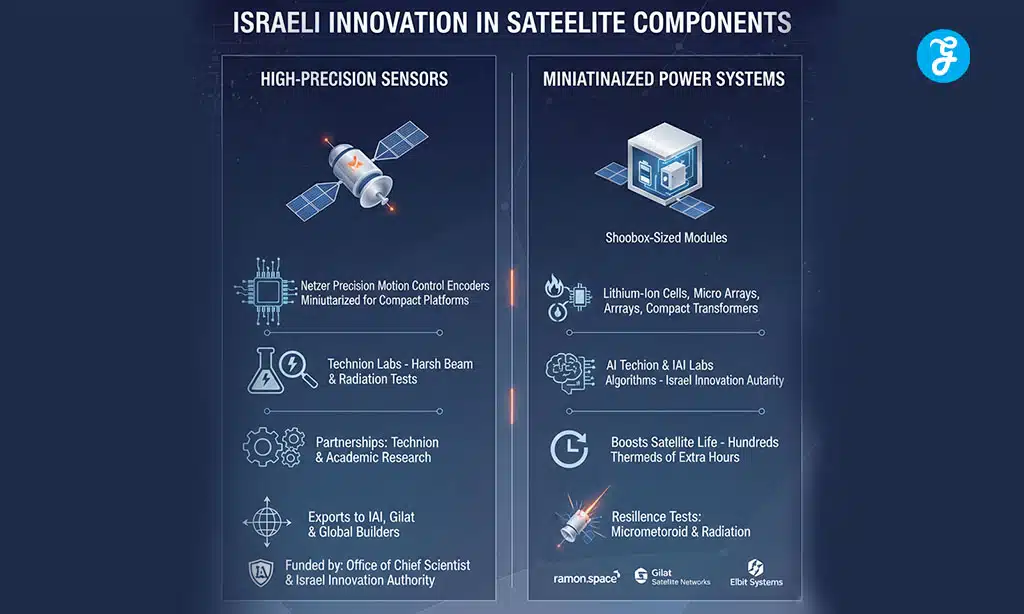
Elbit Systems teams push high-precision sensors to spot orbital shifts, then stress those chips at Technion labs with harsh beam tests. IAI shrinks power systems to cubesat size, cutting launch mass and cost, so new startups can chase deep-space dreams.
How are high-precision sensors developed for satellites?
Netzer Precision in Tel Aviv designs motion control encoders that power satellite positioning. Engineers miniaturize sensors to fit into compact platforms for low Earth orbit. The Office of the Chief Scientist and the Israel Innovation Authority fund these projects.
Partnerships span Technion – Israel Institute of Technology and other academic research labs.
Staff test parts with advanced calibration techniques to boost orbit reliability. They toughen components for radiation and wide temperature swings. Israeli firms export sensor sets to Israel Aerospace Industries (IAI), Gilat Satellite Networks and global builders.
This research and development drive cements Israel’s innovation ecosystem in space exploration.
What are miniaturized power systems for long-duration missions?
Israeli startups in Tel Aviv design mini power systems that pack lithium-ion cells, micro solar arrays, and compact transformers into shoebox-sized modules. These units rely on power management algorithms from the Israel Innovation Authority to optimize energy flow, cutting waste by up to 20 percent.
Labs at Technion and IAI test thermal control units against extreme cold and heat, keeping gear alive for months. Adopted by ramon.space and Gilat Satellite Networks, they drive r&d in Israel’s space tech ecosystem.
Engineers trade heavy fuel for energy cells and sun panels, boosting satellite life by hundreds of extra hours. Low-maintenance, autonomous designs let ground teams skip routine checks, cutting costs and launch risk.
Elbit Systems and startup nation partners build resilience tests that mimic micrometeoroid hits and radiation blasts. Commercial firms and academic research missions both fly this tech, feeding growth in Israel’s economy.
Israel’s Future in Space Exploration
The Israel Innovation Authority funds solar sails and lunar landers at the Ramon Space Center.
Elbit and IAI test AI on orbital labs and plan reusable eco rockets.
What are Israel’s plans for lunar and deep-space missions?
Israel plans new moon missions after the Beresheet 2019 mission.
Engineers will pack dual-use sat hardware into mini spacecraft.
Research teams at Technion and Tel Aviv University drive r&d on solar-powered lunar habitats.
Autonomous rovers will hop across dusty craters, test advanced propulsion and map hidden caverns.
ramon.space and the Israel Innovation Authority host AI-guided steering trials, and they nurture the startup nation spirit.
NASA and ESA lunar and Mars programs invite Israel to join crewed and robotic ventures.
Elbit Systems and Israel Aerospace Industries back solar-powered modules and AI navigation.
How will Israel scale space innovations for global impact?
Tel Aviv’s startup nation can gear up with extra research and development funds. The Israel Innovation Authority will boost government spending by thirty percent in 2025 to fund ramon.space labs and Israel Aerospace Industries test halls.
More cash grows new production bays, adds clean rooms and buys test rigs. It fuels CubeSat trials in Technion – Israel Institute of Technology labs and backs prototypes at Elbit Systems and Gilat Satellite Networks.
Israeli venture capital and academic research teams vet each module in quick, agile cycles.
Partnerships with NASA and Indian Space Research Organisation widen market access. Joint projects share ground stations and simulation tools for real world demos. Teams use its strength in dual use kits and small ion thrusters to sell abroad, boosting exports for moon missions.
Policy shifts ease visas for engineers and channel academic research into training hubs. This pipeline feeds fresh talent for large orbital launches and deep space missions.
Takeaways
Israel flew earth watchers like EROS to map cities and aid relief. It also lofted a climate orbiter that tracks forests and farms. Teams built student cubes in local labs, and startups like orbital data hubs pushed AI in orbit.
Green engines now curb debris, and small sats cut launch fees. This growth springs from a strong R&D base, a startup nation spirit, and global ties.
FAQs
1. What is Ofeq 1?
Ofeq 1 was the first Israeli satellite, designed and manufactured in Israel by Israel Aerospace Industries (IAI), and sent into orbit by the Israel Defense Forces.
2. How did Ramon.Space shake things up?
Ramon.Space is a private mission backed by VCs in Tel Aviv, it proved that startup nation spirit can fuel real space flights.
3. Who leads research and development in Israel’s space tech?
The Technion – Israel Institute of Technology, the Israel Innovation Authority, and strong academic research power r&d in the innovation ecosystem.
4. Which big firms drive satellite tech and space exploration?
Elbit Systems, Gilat Satellite Networks, NSO group technologies, and IAI build key gear, and push forward advanced robotics for space exploration.
5. How did India link to Israel’s moon missions?
Israel joined the Indian Space Research Organisation (ISRO) on lunar trips, they share ideas on source of energy and plans for human exploration of Mars.
6. How do startups like El-Op and Tauvex help Israel’s economy?
El-Op and Tauvex make new satellite gear and advanced robotics, they spin off from academic labs and boost Israel’s economy.