The 2025 Israel Iran conflict and WMD fears have reignited global anxiety over the unthinkable: the potential use of weapons of mass destruction in modern warfare. What began as a rapid escalation—marked by Israel’s Operation Rising Lion, which struck strategic targets deep within Iranian territory—has evolved into a broader crisis that threatens to destabilize not just the Middle East, but international norms governing warfare.
Unlike previous proxy battles and cyber skirmishes between the two longtime adversaries, this year’s confrontation has taken a sharp and dangerous turn. For the first time, Israel directly targeted Iran’s nuclear infrastructure, including sites like Fordow, a heavily fortified uranium enrichment facility built deep within a mountain. Iran, in turn, launched retaliatory drone and missile strikes across Israeli territory, further fueling fears that the conflict could spiral out of control.
What makes this conflict particularly alarming is not just its scale or intensity, but the growing specter of nuclear or WMD involvement. With international diplomacy in limbo and military strategies edging toward red lines, the world is now asking: are we standing on the brink of a wider war involving weapons that were once considered unusable?
This article explores how the Israel Iran conflict and WMD fears are shaping global responses, altering military doctrines, and challenging long-held assumptions about deterrence in a nuclear age.
A Brief History of Israel-Iran Nuclear Tensions
The Israel Iran conflict and WMD fears are rooted in decades of strategic mistrust, covert operations, and competing ambitions—especially in the realm of nuclear capability. To understand the gravity of today’s escalation, we must trace the arc of nuclear posturing and proliferation efforts that have defined relations between these two nations.
Israel’s Nuclear Ambiguity
Since the late 1960s, Israel has maintained a policy of nuclear ambiguity. Though never officially confirming its nuclear arsenal, Israel is widely believed to possess between 80 and 400 nuclear warheads. It has refused to sign the Non-Proliferation Treaty (NPT), arguing that it faces existential threats from hostile neighbors.
The so-called “Samson Option,” Israel’s unspoken strategy of last-resort nuclear retaliation, is a critical piece of its defense posture. This doctrine aims to deter large-scale attacks by implying catastrophic consequences if Israel’s survival is ever seriously threatened.
Despite its unofficial status, Israel’s nuclear capability has been quietly accepted by its Western allies, who see it as a stabilizing counterweight to Iran and other regional actors.
Iran’s Nuclear Aspirations and Accusations
Iran, on the other hand, has long maintained that its nuclear program is for peaceful purposes—mainly energy production and medical research. Yet, since the early 2000s, Western powers and Israel have suspected Tehran of pursuing nuclear weapons under the guise of civilian development.
The 2015 Joint Comprehensive Plan of Action (JCPOA) temporarily limited Iran’s uranium enrichment capabilities in exchange for sanctions relief. However, the U.S. withdrawal from the deal in 2018 under President Trump and the imposition of “maximum pressure” sanctions deeply damaged the agreement.
Since then, Iran has resumed uranium enrichment at levels close to weapons-grade, stockpiling fissile material far beyond JCPOA limits. Despite IAEA oversight, transparency has dwindled, and inspections have been blocked at key sites like Natanz and Fordow.
The Israel Iran conflict and WMD fears intensified when intelligence reports surfaced suggesting Iran was actively weaponizing nuclear materials—possibly using clandestine facilities in deeper, reinforced underground bunkers designed to withstand conventional strikes.
Israel, viewing these developments as an existential threat, has repeatedly warned that it will act unilaterally if the international community fails to stop Iran’s nuclear ambitions. That threat now appears to have materialized.
Operation Rising Lion and the Targeting of Nuclear Sites
The June 2025 Israeli offensive, dubbed Operation Rising Lion, marked a sharp departure from covert sabotage tactics and instead ushered in a direct military confrontation. The unprecedented strikes on Iranian soil targeted more than 100 strategic sites—many of which were believed to be part of Iran’s nuclear infrastructure. This aggressive escalation reinforced global concerns over the Israel Iran conflict and WMD fears, especially regarding the security and stability of nuclear materials in active conflict zones.
The Fordow Facility and Why It Matters
One of the most significant targets of the Israeli strikes was the Fordow Fuel Enrichment Plant, located deep beneath a mountain near the city of Qom. Fordow is heavily fortified and designed to be impervious to conventional airstrikes, making it a central pillar of Iran’s nuclear deterrent. The facility’s location—inside a hardened structure nearly 90 meters underground—has long frustrated Western and Israeli planners.
Intelligence analysts believe Fordow has resumed enrichment of uranium at levels that are alarmingly close to weapons-grade. Israel’s decision to strike areas around Fordow was not only symbolic but also strategic—it signaled a willingness to challenge Iran’s core nuclear capabilities directly.
By attempting to neutralize Fordow’s above-ground infrastructure and supply routes, Israel aimed to delay any potential breakout to nuclear weaponization. However, such strikes also risked radioactive contamination and drew condemnation from international watchdogs concerned about collateral damage to sensitive nuclear sites.
Tactical Objectives or Strategic Provocation?
Was Operation Rising Lion purely defensive, or was it meant to provoke a broader confrontation?
While Israeli officials claimed the strikes were preemptive and aimed at delaying Iran’s nuclear progress, critics argue that it was a high-risk gamble that could accelerate escalation toward WMD use. Iran’s initial restraint—avoiding immediate counterattacks on Israeli nuclear facilities—was short-lived. Within days, Tehran launched waves of missile and drone assaults on cities like Beersheba, Tel Aviv, and Haifa.
The Israel Iran conflict and WMD fears escalated further when reports emerged that Iranian ballistic missiles may have been fitted with conventional payloads near potential nuclear development zones. The possibility of radioactive fallout—accidental or intentional—heightened concerns that both nations were inching dangerously close to violating long-held global norms on non-use of weapons of mass destruction.
Operation Rising Lion may have achieved short-term military goals, but it also laid bare the fragility of deterrence strategies when nuclear sites become targets in active warfare.
The Escalation Ladder: What Triggers WMD Use?
As the Israel Iran conflict and WMD fears deepen, the world watches nervously for signs that the war could breach the ultimate red line—the use of weapons of mass destruction. While both nations have historically stopped short of deploying WMDs, the intensity and scale of the current confrontation are testing those limits.
Military theorists often refer to this danger zone as the “escalation ladder”—a series of steps that, if unchecked, can lead to catastrophic outcomes.
Israel’s “Samson Option” Doctrine
At the heart of Israel’s nuclear deterrence strategy lies what is unofficially known as the “Samson Option.” This doctrine is a last-resort policy suggesting that if Israel’s very existence is under imminent threat, it would retaliate using its full nuclear arsenal—ensuring mutual destruction.
Named after the biblical figure Samson, who brought down a temple on his enemies and himself, the doctrine is designed to dissuade adversaries from pursuing existential threats against Israel.
Although Israel has never acknowledged the Samson Option publicly, leaked government memos and military analyses have often alluded to its existence. In the current crisis, several former Israeli intelligence officials have warned that if Iran were to strike Dimona (Israel’s nuclear research center) or deploy chemical/biological agents, the government might be compelled to “consider extraordinary responses.”
This possibility—however remote—adds a terrifying layer to the Israel Iran conflict and WMD fears, especially with strategic analysts openly debating whether Israel is preparing for a pre-emptive or retaliatory nuclear scenario.
Iran’s Possible Chemical or Radiological Capabilities
While Iran has repeatedly denied pursuing nuclear weapons, Western intelligence has raised alarms about its stockpiles of chemical agents and its ability to deploy radiological “dirty bombs.”
Iran is a signatory to the Chemical Weapons Convention, but past conflicts—such as the Iran-Iraq War—exposed its willingness to retaliate with chemical agents when provoked. More recently, some analysts suggest Iran may have quietly resumed research into radiological dispersal devices, which could spread radioactive material without a nuclear explosion.
Such WMDs, while not as devastating as nuclear weapons, could cause widespread panic, long-term environmental damage, and global outrage. If used—even once—they could trigger a cascade of military and diplomatic consequences, especially from Israel, the U.S., or NATO-aligned powers.
In this volatile environment, the risk of WMD use becomes less about capability and more about calculation. The deeper the conflict digs into national pride and existential stakes, the more likely it is that either side might break a decades-long taboo.
The Role of the U.S. and Global Powers in De-escalation
With the Israel Iran conflict and WMD fears pushing the Middle East toward an unprecedented tipping point, global powers find themselves in a high-stakes diplomatic and strategic bind. The United States, long considered a key ally of Israel and a counterbalance to Iranian ambitions, now faces one of its most complex foreign policy challenges in recent memory.
Washington’s Reluctance on Fordow
In the early days of the conflict, Israel reportedly sought U.S. collaboration in launching bunker-busting airstrikes on Iran’s Fordow facility. Though sympathetic to Israel’s security concerns, U.S. leaders hesitated—fearing that a joint strike would not only legitimize unilateral WMD-focused warfare but also drag the entire region (and possibly NATO) into open conflict.
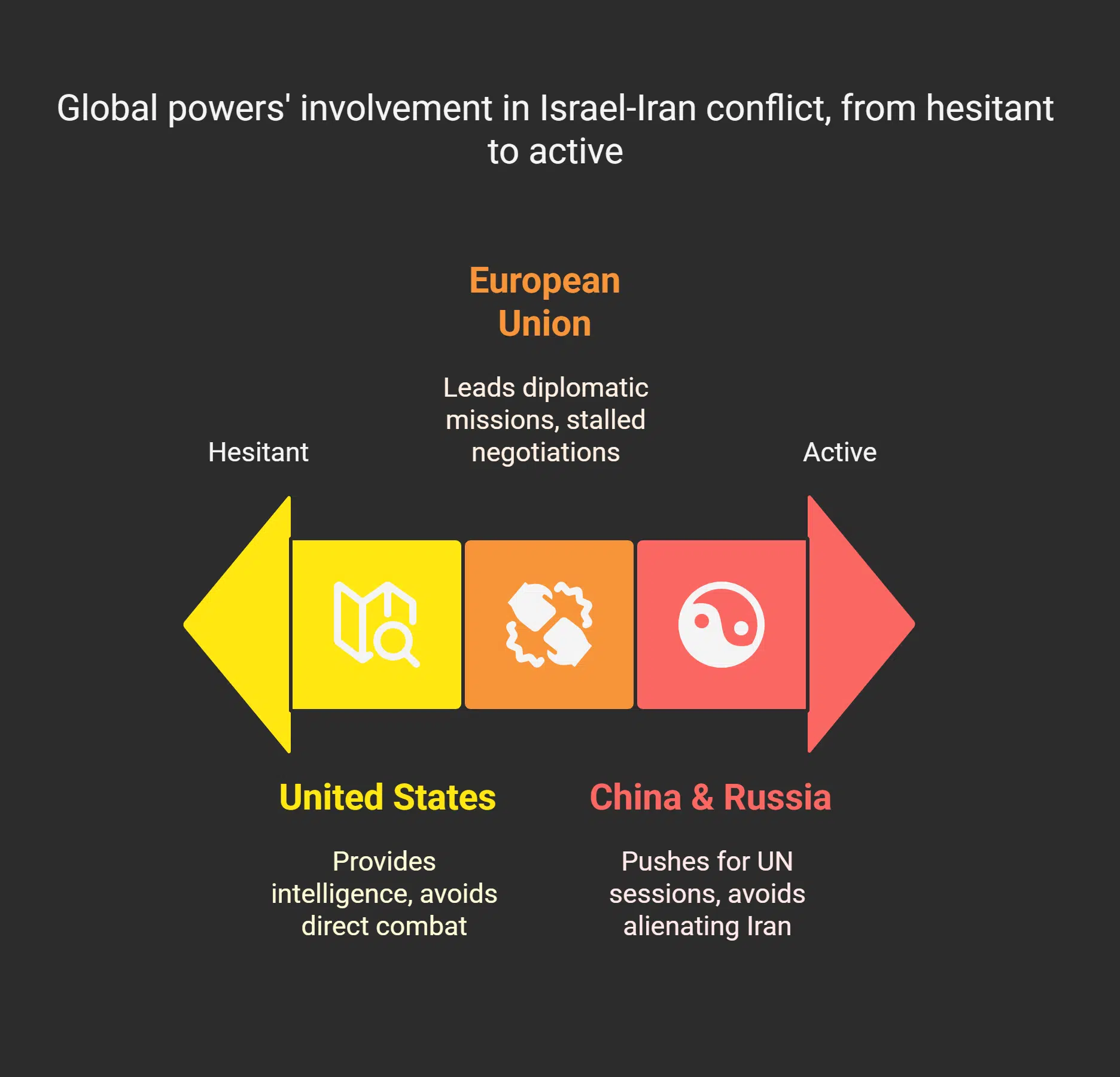
The American public remains divided. Some lawmakers call for full military backing of Israel, while others urge President Trump to double down on diplomacy to avoid igniting World War III. As of late June 2025, the U.S. has provided intelligence and limited logistical support but stopped short of active combat involvement.
This calibrated stance, however, may not hold. If Iran escalates further or if Israeli assets are severely damaged, pressure could mount for Washington to cross the line from indirect support to direct engagement—raising the stakes in the Israel Iran conflict and WMD fears even higher.
China, Russia, and EU Diplomacy
China and Russia, both major influencers in Iranian defense and nuclear technology, have expressed alarm over Israel’s attacks on nuclear facilities. Yet their responses have been careful not to alienate Tehran, a key regional partner. Instead, they’ve pushed for emergency UN Security Council sessions and called for a return to nuclear diplomacy.
The European Union, once the architect of the now-dismantled JCPOA, has led urgent diplomatic missions in Geneva and Vienna. However, efforts to bring both sides to the table have been repeatedly stalled. Iran demands an end to Israeli airstrikes as a precondition for talks, while Israel insists that any negotiations must begin with Iran halting all uranium enrichment and missile development.
Meanwhile, smaller nations like Turkey, Qatar, and Switzerland have offered to mediate. But without strong commitments from Washington, Moscow, and Beijing, these efforts risk being seen as symbolic rather than substantive.
Public and Strategic Fallout: Psychological and Economic Impact
As the Israel Iran conflict and WMD fears ripple outward, the damage is not confined to military installations or political institutions. Entire populations—on both sides of the border and across the globe—are now living under the psychological and economic weight of potential nuclear confrontation.
Fear as a Weapon
In both Iran and Israel, the fear of WMD deployment has spread faster than missiles. Following the strikes on Fordow and retaliatory salvos on Israeli cities, rumors of nuclear escalation have gone viral on social media, fueling chaos and panic. In Tehran, over 400,000 residents fled to rural areas in a matter of days. Gas stations ran dry. Banks were overwhelmed. Schools and universities shut down indefinitely.
Similarly, in Israel, emergency drills have resumed in Tel Aviv and Beersheba, where missile strikes injured civilians and damaged critical infrastructure—including Soroka Hospital, which required urgent evacuation of patients.
Psychological warfare has now become an unofficial battlefield in this conflict. The mere specter of nuclear or radiological fallout is enough to generate mass trauma, and leaders on both sides are increasingly using this fear as leverage—consciously or not.
The Israel Iran conflict and WMD fears have effectively weaponized public uncertainty, deepening divisions, increasing hostility, and undermining social trust. The longer the world remains on edge, the more corrosive this fear becomes—not just to the Middle East, but to the global psyche.
Oil, Supply Chains, and the Cost of Nuclear Brinkmanship
Global markets have not been spared either. The initial airstrikes on Iran sent oil prices soaring by 12% in under 48 hours. The Strait of Hormuz—a vital artery for 20% of the world’s oil supply—was briefly considered unsafe for shipping, forcing rerouting of tankers and delaying deliveries to Europe and Asia.
Stock markets responded in kind: the Nikkei plunged 800 points overnight; the Dow Jones lost over 600 points amid fears of long-term economic instability.
Beyond energy, the threat of WMD contamination—especially if any nuclear sites were compromised—has sparked anxieties over supply chain safety. Major logistics firms have temporarily paused air and ground shipments through affected regions, leading to delays in semiconductor components, pharmaceuticals, and agricultural imports.
All this underscores a sobering truth: the Israel Iran conflict and WMD fears are not just about bombs or diplomacy—they are deeply entwined with global economic health and the fragility of interconnected systems.
Expert Opinions – Could a Nuclear Exchange Really Happen?
The Israel Iran conflict and WMD fears have triggered a flurry of expert analysis across defense circles, policy think tanks, and nuclear watchdogs. As the world edges closer to an unthinkable scenario, seasoned analysts are weighing in on how close we actually are to a nuclear exchange—and what it would take to push either side over the edge.
Former IAEA Officials Sound the Alarm
Retired officials from the International Atomic Energy Agency (IAEA) have warned that the targeting of Iran’s nuclear facilities—even if done with precision—poses a grave risk of environmental contamination and retaliation. One former IAEA inspector, speaking to Foreign Policy, stated:
“Once a nuclear facility like Fordow is breached, even peripherally, the threshold for escalation shifts drastically. It signals that diplomacy has failed.”
IAEA monitors have since reported disrupted access to multiple enrichment and monitoring sites in Iran, raising fears that transparency has collapsed just when oversight is needed most.
Military Strategists Map Out ‘Doomsday Scenarios’
In Tel Aviv and Tehran, defense circles are drawing up escalation scenarios in which conventional warfare quickly gives way to tactical or strategic WMD deployment. One chilling possibility: if Iran were to unleash chemical or radiological weapons on urban Israeli centers, Israel might activate its second-strike protocols, possibly including nuclear retaliation.
Western analysts note that while Israel has superior missile defense systems like Iron Dome and David’s Sling, no system is foolproof—especially if overwhelmed. This makes the logic of deterrence less stable and more susceptible to miscalculation.
Diplomatic Experts Urge Restraint
Experts in international relations emphasize that what makes this conflict uniquely dangerous is its mix of public pressure, political ego, and religious ideology—all operating within nuclear-capable states.
“Rational actor theory breaks down in environments where national survival is framed in absolute moral terms,” says Dr. Miriam Cohen, senior fellow at the Brookings Institution. “And that’s exactly what’s happening now.”
Many fear that the Israel Iran conflict and WMD fears are entering a phase where traditional deterrence models no longer apply, especially if communication breaks down and leaders act preemptively out of paranoia.
While experts vary in their assessments, most agree on one thing: the current trajectory is unsustainable. The longer the conflict drags on, the narrower the window becomes for meaningful de-escalation. And in a world where nuclear capabilities exist without modern arms control frameworks, every day that passes without a ceasefire increases the risk of a historic—and tragic—milestone.
What the World Must Do Now
As the Israel Iran conflict and WMD fears threaten to spiral into a global security crisis, the international community faces a sobering question: What immediate steps must be taken to prevent the first use of weapons of mass destruction since World War II?
Reignite Arms Control and Non-Proliferation Talks
The collapse of the Joint Comprehensive Plan of Action (JCPOA) left a vacuum in nuclear diplomacy. With both Israel and Iran acting unilaterally, urgent calls are growing for a new, enforceable framework that includes not just Iran’s nuclear ambitions but Israel’s undeclared arsenal as well.
Organizations like the IAEA, UN Security Council, and regional blocs such as the Gulf Cooperation Council (GCC) must be empowered to convene emergency talks—not just to reimpose limits on uranium enrichment, but also to strengthen global WMD monitoring and verification protocols.
A modern arms control agreement must consider newer threats too, such as radiological “dirty bombs” and AI-controlled delivery systems, which are currently unregulated in global treaties.
Prioritize Ceasefire and De-escalation Mechanisms
Without an immediate ceasefire, all diplomatic and economic strategies risk becoming moot. Global powers must prioritize backchannel negotiations between Israeli and Iranian leadership, facilitated by neutral mediators such as Switzerland or the United Nations.
Confidence-building measures—such as mutual airstrike suspensions, reactivation of IAEA inspection teams, or civilian protection corridors—can help break the current deadlock. Regional players like Turkey, Oman, and Qatar may also serve as credible intermediaries to bring both parties to the table.
Failure to do so will only heighten the Israel Iran conflict and WMD fears, making any future diplomatic process vastly more difficult.
Strengthen Global Norms Against WMD Use
The taboo against nuclear and chemical weapons use has held for nearly eight decades, but that restraint is under unprecedented stress. It is imperative for world leaders to reaffirm the red lines that define international humanitarian law and the Geneva Conventions.
This includes:
-
Declaring military strikes on nuclear facilities a global security violation.
-
Issuing joint resolutions against first-use policies.
-
Applying economic sanctions not just for nuclear proliferation, but for violations of WMD-related norms.
The world must make clear that crossing the WMD threshold will trigger unified, coordinated global action—economic, diplomatic, and, if necessary, military.
Takeaways
The Israel Iran conflict and WMD fears have pushed the world to a moment of reckoning. What began as a high-stakes confrontation between two regional adversaries has evolved into a crisis that challenges global stability, nuclear non-proliferation norms, and the very idea of rational deterrence.
This is not merely a clash of armies or ideologies—it is a test of whether the world can prevent the catastrophic use of weapons that have long been considered unthinkable. The current escalation, marked by strikes on nuclear facilities, retaliatory missile attacks, and mass civilian fear, underscores just how fragile peace truly is in a nuclear-capable age.
The path forward is narrow but not closed. De-escalation, arms control, and transparent diplomacy must be prioritized before irreversible damage is done. Global leaders cannot afford to view this conflict as a localized affair—it is a bellwether for the future of warfare in an increasingly volatile and interconnected world.
If the international community fails to act decisively now, the Israel Iran conflict and WMD fears could become more than just headlines—they could become history’s next tragedy.