If you have been hearing the same headline everywhere, you are not alone. People keep asking, is SEO dead in 2026, because search pages look different, AI answers show up more often, and clicks do not behave like they used to. The truth is not dramatic, but it is important.
SEO is not dead. What is dying is low-effort SEO that depends on shortcuts, generic content, and outdated playbooks. In 2026, SEO is less about tricking an algorithm and more about earning visibility across a bigger discovery ecosystem.
That ecosystem includes classic search listings, AI summaries, local packs, video results, shopping panels, and social search. If you want leads, you need to understand what changed, what stayed the same, and how to build content that gets surfaced and converts.
Is SEO Dead In 2026 The Short Answer
No, SEO is not dead in 2026. Search still drives demand, research, and buying decisions, especially for high-intent services and products. The real shift is that ranking alone does not guarantee clicks, and clicks alone do not guarantee growth.
If you want SEO to work now, your content must do three things:
- Answer the query clearly and quickly
- Prove it is worth trusting
- Give the reader a reason to continue, click, and take action
In other words, SEO success in 2026 is a mix of visibility, usefulness, and conversion.
Why People Think SEO Is Dead
Businesses are not imagining the change. The search experience is different, and it can feel like the old rules stopped working overnight.
Here are the biggest reasons people think SEO is dead:
- AI summaries often appear above the traditional results
- Search results are crowded with extra features and modules
- Some queries end without a click
- Rankings fluctuate more than they used to
- Content volume exploded, so the average posts disappear
- More people search on social platforms and marketplaces
- Older tactics like keyword stuffing and thin pages fail hard
The conclusion many people jump to is wrong. The real conclusion is that SEO is more competitive and more connected to content quality than ever.
What Actually Changed In Search From 2023 To 2026
Search engines are still trying to match intent. What changed is how they display answers and how users decide what to do next.
AI-Driven Answer Layers Changed The Top Of The Page
In many queries, the first thing a user sees is not ten blue links. It is an answer layer that tries to resolve the question immediately. This affects clicks, but it also creates a new opportunity.
If your content is well structured, clear, and specific, it is more likely to be selected as a source for summaries, snippets, and question blocks. If your content is messy or generic, it gets skipped.
Search Results Pages Became More Crowded
Even when you rank well, you might be pushed down by:
- AI answer panels
- Featured snippets
- People also ask sections
- Video carousels
- Local packs
- Shopping results and product panels
- Forum and community results
This means you can be doing “SEO” and still feel like nothing is working, because your visibility is split across multiple sections.
User Behavior Shifted Toward Skimming And Filtering
In 2026, many users skim quickly, compare sources, and decide fast. They click when they need detail, reassurance, or a step-by-step plan.
This changes how your content should be written:
- Give direct answers early
- Use scannable headings
- Use short paragraphs
- Add lists and tables when they reduce confusion
- Provide deeper value beyond the first screen
Discovery Is Now Multi-Platform
A lot of search still happens on Google and similar engines. But discovery also happens on:
- YouTube and short-form video platforms
- Social platforms where people search for recommendations
- Marketplaces where buyers compare options
- Community and forum-style results
This does not kill SEO. It expands the game. Strong SEO content can be repurposed into formats that win in other discovery channels, too.
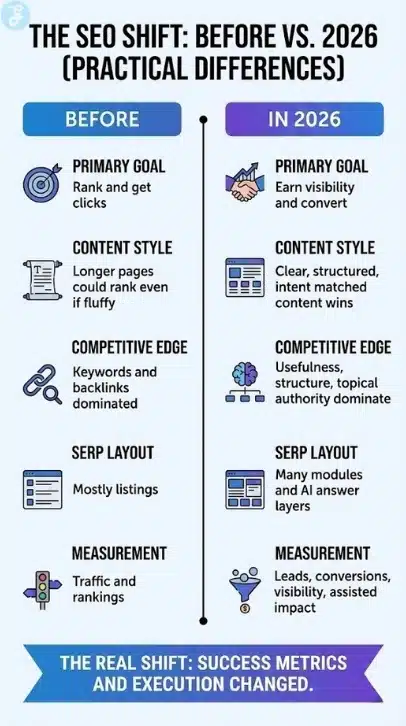
Then Versus Now: The Practical Differences
| SEO Focus | Before | In 2026 |
| Primary goal | Rank and get clicks | Earn visibility and convert |
| Content style | Longer pages could rank even if fluffy | Clear, structured, intent-matched content wins |
| Competitive edge | Keywords and backlinks dominated | Usefulness, structure, topical authority dominate |
| SERP layout | Mostly listings | Many modules and AI answer layers |
| Measurement | Traffic and rankings | Leads, conversions, visibility, assisted impact |
This is the real shift. The foundations are still there, but the success metrics and execution changed.
What Still Works If You Want Rankings And Leads
Some SEO fundamentals still work because they reflect what users want. They were never magic. They were always about clarity and relevance.
Intent Match Still Runs Everything
Search intent is the fastest way to diagnose why a page is not ranking. If your page targets the wrong intent, the best writing in the world will not save it.
Common intent types:
- Informational, learning, and understanding
- Commercial, comparing options
- Transactional, ready to buy or contact
- Navigational, trying to find a specific brand or page
If your page is informational but the query is commercial, your content will struggle. If your page is commercial but the query is informational, it will feel pushy and underdeliver.
On Page Structure Still Matters
Structure helps readers and helps systems understand your content.
Strong structure includes:
- A title that matches the real query
- An intro that confirms the reader is in the right place
- H2s that cover the subtopics people care about
- H3s that break down steps, choices, and definitions
- A wrap-up that summarizes the action plan
A simple structure often outperforms a complicated one. Most businesses lose because their content is hard to scan and too vague.
Technical Hygiene Still Matters For SMEs
You do not need perfect technical SEO, but you do need a baseline:
- Mobile-friendly pages
- Fast enough load times for real users
- Clean navigation and crawlable pages
- No broken pages, messy redirects, or duplicate chaos
- Clear contact and business information
Many SMEs blame AI and ignore the basics. Fixing basics often lifts rankings more than publishing ten new posts.
Updating And Refreshing Content Matters More
In 2026, freshness and relevance matter because the world changes faster. Outdated posts lose trust and visibility.
A strong refresh includes:
- Update examples, processes, and tools
- Improve structure and clarity
- Add missing subtopics and FAQs
- Remove weak sections that add no value
- Rewrite intros that feel generic
This is one of the most underrated SEO levers for small businesses.
What Works Better Now In 2026
This is where the new playbook shows up. These strategies do not replace SEO. They make SEO work in the current environment.
Topical Authority Beats Random Posting
Posting randomly is a slow strategy now. Topic clusters build authority faster.
A cluster system looks like this:
- One pillar page that covers the big topic
- Multiple cluster pages that go deep on subtopics
- Internal linking that connects the pillar and clusters
If you want a simple rule, publish fewer posts but connect them into a system. This is how SMEs can compete without huge budgets.
Around this point, most business owners ask again, is SEO dead in 2026, because they still feel overwhelmed. The real answer is that SEO is more about smart structure than sheer volume.
Entity Clarity Helps You Get Understood
In 2026, search engines are better at understanding entities. Your job is to be clear about who you are, what you offer, and who it helps.
Improve entity clarity by:
- Naming your offer consistently across pages
- Using plain language definitions for key terms
- Mentioning your audience clearly
- Including real scenarios and examples
- Avoiding vague claims that could apply to anyone
If your content reads as if it could be about any business, it will rank like any business, which means it will not rank.
Snippet Friendly Writing Helps You Get Surfaced
If you want to be selected for snippets and AI summaries, your writing must be easy to lift and summarize.
Use a simple section pattern:
- One sentence direct answer
- 2 to 4 sentence explanation
- Bullets for steps or options
- A short example or practical note
This makes your content useful for humans and easy for systems to interpret.
Conversion Focus Matters More Than Traffic
Traffic that never turns into leads is vanity. In 2026, you should build content that attracts the right people, qualifies them, and moves them toward action.
Conversion elements that work well:
- Clear service positioning inside informational pages
- Comparison tables that help make decisions
- Simple checklists that reduce overwhelm
- Strong next step calls to action that match the reader’s intent
If clicks decrease but conversions rise, you are winning.
How SMEs Should Adapt Their SEO Strategy In 2026
This section is the practical plan. It is designed for small businesses that do not have a dedicated SEO team.
Start With A Simple Content Audit
Audit your top pages first, not your whole site. Most SMEs get most leads from a small set of pages.
Audit checklist:
- Does the page match a clear intent
- Does it answer quickly in the intro
- Are the headings clear and complete
- Is there fluff that could be cut
- Are the examples and steps specific
- Are there missing FAQs that people ask
- Does the page have a clear next action
Fixing 10 pages often does more than writing 20 new ones.
Build Clusters Around Your Money Topics
Money topics are the topics directly connected to your offers and revenue. This is where SMEs should focus.
Examples of money topic clusters:
- Service page, plus how-to guides plus pricing explanations
- Product category page plus comparisons plus troubleshooting guides
- Local service pages plus neighborhood-specific guides
Pick one cluster first. Build it fully. Then expand.
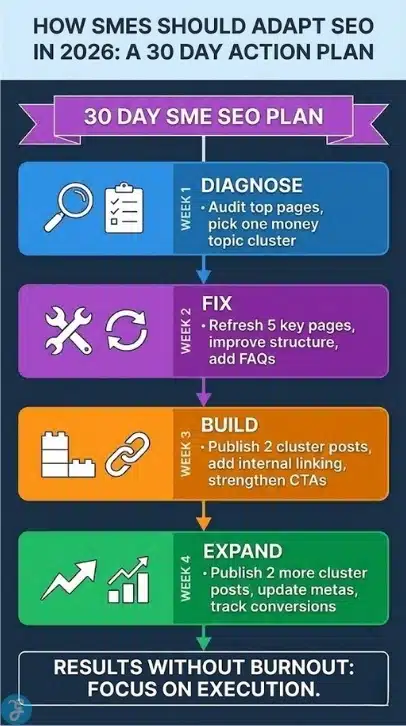
Use A 30 Day Action Plan
This plan is realistic for a small team.
| Week | Goal | Actions |
| Week 1 | Diagnose | Audit top pages, pick one money topic cluster |
| Week 2 | Fix | Refresh 5 key pages, improve structure, add FAQs |
| Week 3 | Build | Publish 2 cluster posts, add internal linking, strengthen CTAs |
| Week 4 | Expand | Publish 2 more cluster posts, update metas, track conversions |
This is the kind of execution that produces results without burnout.
Write With Clarity Instead Of Over-Optimization
Over-optimization is what makes content feel robotic. Clarity is what makes content perform.
Clarity rules:
- Short sentences when possible
- Short paragraphs
- Defined terms
- Specific steps
- Real examples
- Logical flow from problem to solution
If your content reads naturally, it is more likely to be trusted and shared.
How To Write For AI Answers Without Losing Clicks
The goal is not to fight AI answers. The goal is to be selected and still give users a reason to go deeper.
Use Two Layer Content
Layer one is the direct answer. Layer two is the depth that makes the click worth it.
Layer one should include:
- A direct answer sentence
- A short list of key points
- A quick definition, if needed
Layer two should include:
- Step-by-step detail
- Scenarios and examples
- Comparisons and decision support
- Common mistakes and fixes
This structure supports visibility and conversion.
Add Mini Definitions And Context
Many queries fail because the reader does not understand the terms. Add mini definitions where they help.
Example approach:
- Define a term in one sentence
- Explain why it matters in 2 to 3 sentences
- Show a simple example
This helps both the user and the system.
Avoid Weak Claims And Over Promises
AI content often overpromises. That hurts trust.
Replace absolute claims with realistic guidance:
- Say what works for most cases
- Explain tradeoffs
- Give clear conditions
- Encourage readers to validate based on their context
Trust is a ranking advantage and a conversion advantage.
How To Measure SEO Success When Clicks Drop
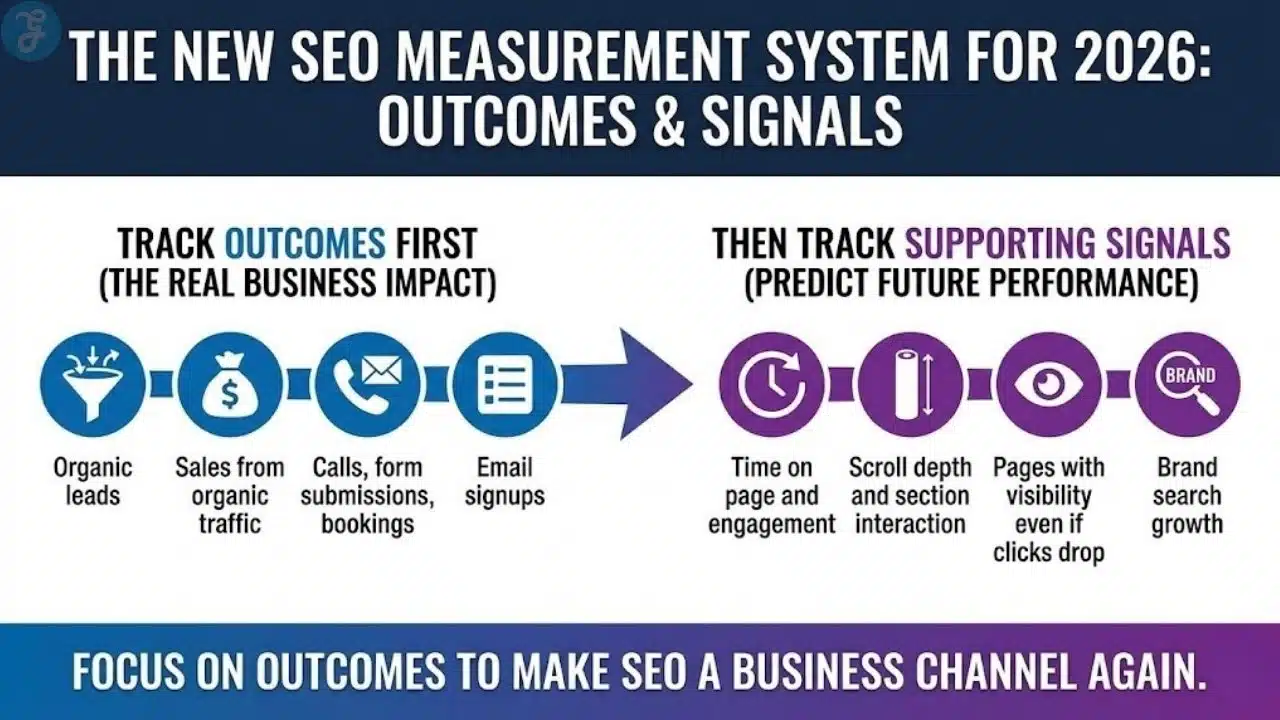
If you only measure traffic, you will feel like SEO is failing. In 2026, you need a measurement system that matches how visibility works.
Track outcomes first:
- Leads from organic traffic
- Sales from organic traffic
- Calls, form submissions, bookings
- Email signups from SEO pages
Then track supporting signals:
- Time on page and engagement
- Scroll depth and section interaction
- Pages that appear in queries, even with fewer clicks
- Brand searches that increase after publishing
A Simple KPI Table For SMEs
| KPI | What It Tells You | Why It Matters |
| Organic leads | Real business impact | Better than traffic alone |
| Conversion rate | Page effectiveness | Helps prioritize fixes |
| Top pages by leads | Where to invest | Focus on what works |
| Engagement signals | Content usefulness | Predicts future performance |
| Brand search growth | Awareness increase | Shows long-term lift |
When you focus on this, SEO becomes a business channel again, not a vanity metric.
Common SEO Mistakes That Make 2026 Feel Impossible
Most businesses struggle because they repeat the bad habits.
Avoid these mistakes:
- Publishing generic AI content at scale
- Writing without a clear intent per page
- Ignoring internal linking and cluster structure
- Chasing keywords unrelated to your offers
- Refusing to update old posts
- Measuring only rankings and traffic
- Trying to do everything instead of dominating one niche
If you fix these, the question is SEO dead in 2026 stops being scary. It becomes a strategy problem you can solve.
Wrap Up And Next Steps
So, is SEO dead in 2026? No. But shortcut SEO is dead, thin content is dead, and generic content that adds no value is dead.
The opportunity is still huge for SMEs that build clear, structured, intent-matched content and connect it into clusters. Start by refreshing your top pages, then build one cluster around a money topic, and measure results in leads, not only clicks.
If you execute this plan, you will not only survive AI-driven search. You will compete better than brands that still rely on old tactics.
Frequently Asked Questions
Here are the most frequently asked questions people have about Is SEO Dead In 2026.
Is SEO still worth it in 2026
Yes, because people still search when they are learning, comparing, and buying. The strategy is changing, but SEO still produces leads when your pages match intent, answer clearly, and provide real value beyond what is shown in summaries.
How do I optimize for AI search results
Use clear headings, answer first formatting, and short sections that can be summarized. Add depth after the direct answer with steps, examples, and comparisons. Build topical clusters so your site signals authority instead of isolated posts.
Does blogging still work for SEO
Blogging still works when it is purposeful and connected to a cluster. Random posts tend to fail. Blogs win when they target real questions, solve problems completely, and guide readers toward the next step.
Can small businesses still rank without backlinks in 2026
Yes, especially in local and niche topics, but it depends on the competition. Many SMEs can rank by targeting specific intent-driven keywords, building topical clusters, and publishing clearer, more helpful pages than bigger sites. Backlinks still help, but strong structure, strong relevance, and consistent updates can win a lot of queries without heavy link building.
How often should I update old blog posts for SEO in 2026
A practical rule is to review your top-performing pages every 3 to 6 months and refresh lower performers at least once a year. Update sooner if the topic changes quickly, competitors improve their content, or your rankings drop. Focus on improving clarity, adding missing subtopics and FAQs, refreshing examples, and tightening the structure so the page matches current search intent.
What is GEO and how is it different from SEO
GEO is often used to describe content that is selected and summarized by AI systems. SEO is the broader practice of earning visibility in search results. In practice, clear structure, entity clarity, and helpful content support both.
How do I measure SEO if clicks drop?
Track leads, conversions, and assisted conversions first. Then track engagement signals and brand search growth. In 2026, success is about outcomes, not only traffic.