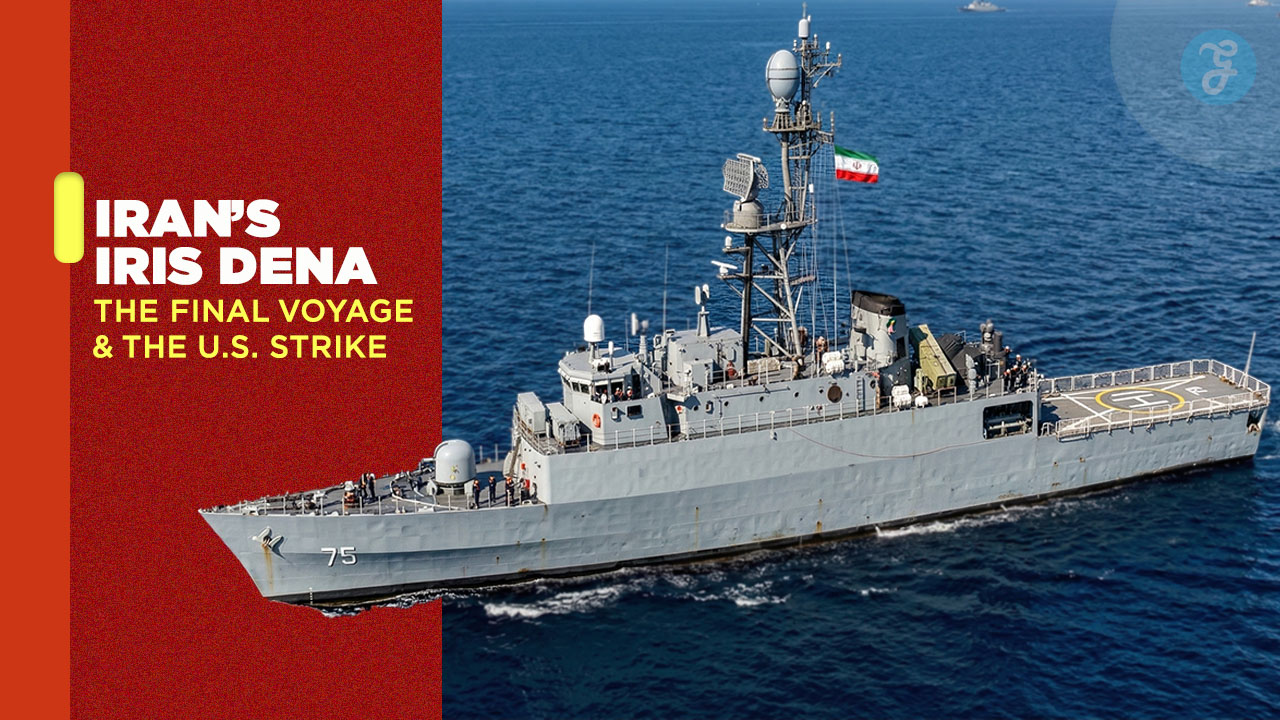
Washington calls the U.S. Sinking of Iran’s IRIS Dena a naval engagement. The phrase is neat, official and deeply misleading. What happened in the Indian Ocean was not a clash between opposing fleets but the sudden destruction of a single warship by a submarine lurking unseen beneath the waves. In the quiet anonymity of the deep, a torpedo ended the voyage of a vessel whose sailors likely had little warning that they had entered the lethal geometry of a widening shadow war.
On March 4, 2026, the pride of Tehran’s southern fleet met a sudden, violent end in the waters roughly forty miles off the coast of Galle, Sri Lanka. There were no warning shots and no exchange of fire. There was only a sudden eruption from beneath the sea that left 87 sailors dead and a modern frigate resting on the floor of the Indian Ocean. When the Pentagon later released periscope footage of the strike, the message was unmistakable. The grainy images show the Dena’s hull breaking apart with brutal efficiency.
The 81-Year Silence: Breaking the Streak
This was the first time a U.S. Navy submarine has sunk an enemy warship in combat since August 1945. For eighty one years the Navy’s “Silent Service” remained largely in the shadows, serving as a deterrent rather than an executioner. That long era of restraint has now ended. By pulling the trigger in the open waters of the Indian Ocean, Washington signaled a shift from quiet pressure to overt lethality. The sinking of the Dena was not only a military strike but also a message. It demonstrated, with stark clarity, the vulnerability of Iran’s surface fleet to an enemy it cannot see.
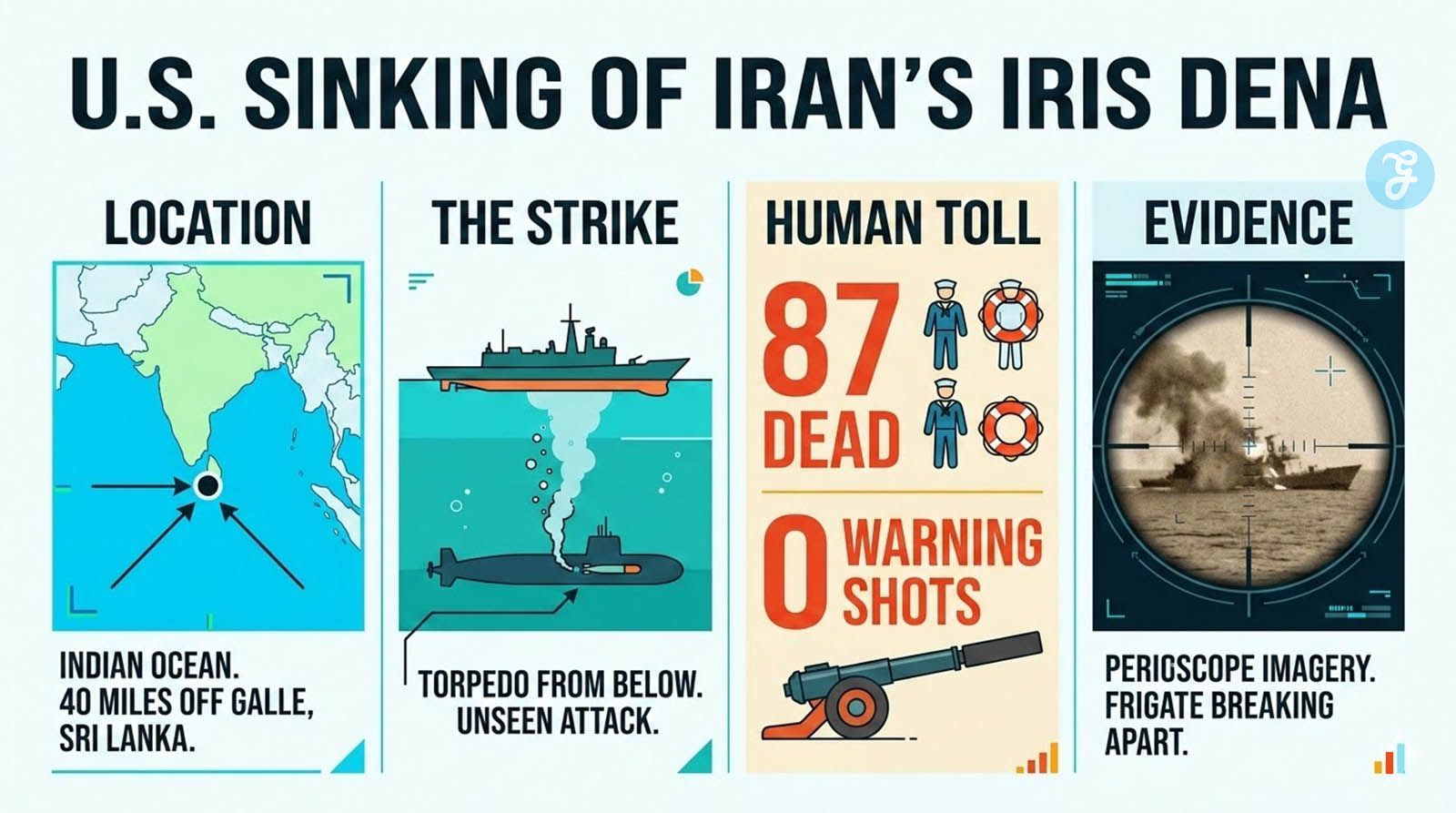
For more than eight decades the informal rules governing the U.S. submarine fleet were simple. Watch, listen and wait. Submarines were the ultimate strategic pieces on the maritime chessboard, powerful, invisible and rarely used in open combat. Even during the most dangerous moments of the Cold War, the torpedo often stayed in the tube.
The destruction of the IRIS Dena marks a sharp departure from that history. It signals to Tehran and to other naval powers that the threshold for submarine warfare has shifted. By breaking an eighty one year streak of restraint, Washington is indicating that maritime deterrence may now involve visible demonstrations of force rather than silent surveillance.
The Physics of the “Snap”: Engineering a Message
There is a reason the Pentagon released a video of Dena’s final moments. The weapon believed to have sunk the ship, a Mark 48 ADCAP torpedo, is designed not simply to strike a vessel but to break it. The torpedo detonates beneath the hull. It creates a massive gas bubble. This lifts the ship out of the water.
When the bubble collapses, the vessel’s centre is left unsupported. Gravity does the rest. The keel, the structural spine of the ship, fractures under the strain and can split the vessel in two. For naval professionals, the sight of a frigate breaking apart is a stark reminder that surface defenses offer little protection against an attack from below.
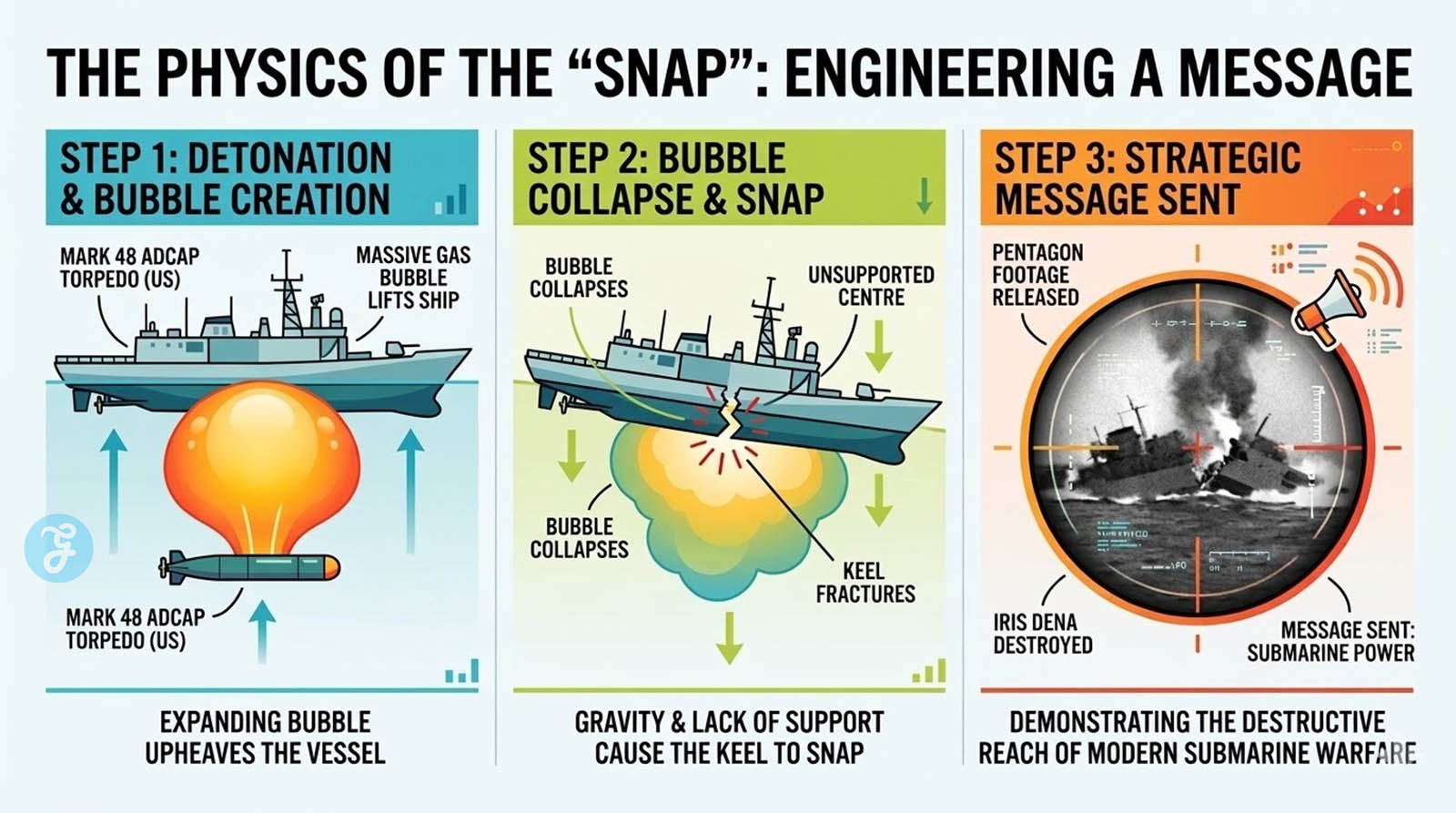 By broadcasting this moment, the United States was doing more than documenting a battlefield success. It was sending a signal about the destructive reach of modern submarine warfare.
The Illusion of Restraint
Some argue that this was a dangerous overreach. They say Washington should have stuck to the old playbook of sanctions and strongly worded statements. The logic is simple. If you sink a ship in international waters, you invite a cycle of violence that nobody can control. They fear that by killing 87 sailors, the U.S. has handed Tehran a moral victory and a reasonto set the Persian Gulf on fire. These critics believe the ocean should remain a space for posturing, not a slaughterhouse.
It is a fair point, but it ignores the cold reality of 2026. For over two years, the world watched as “proportional response” failed to stop the chaos. Since the Red Sea crisis began, drone attacks on merchant ships have become a daily routine. Piracy is back. Global trade was already bleeding out from a thousand small cuts. The old way of doing things didn’t bring peace. It brought a slow, expensive rot that made every shipping lane a gamble.
Waiting for Iran to blink was no longer a strategy. It was a surrender. Data from the first quarter of this year shows that despite every diplomatic effort, Tehran’s interference in the Indian Ocean actually increased by forty per cent. The “Subsurface Ultimatum” changed that math in ten seconds. You cannot negotiate with a force that views your restraint as a weakness. By snapping the Dena, the U.S. proved that the cost of challenging the high seas is now total. Critics worry about escalation, but they forget that a war you refuse to win is the most dangerous escalation of all.
The Torpedo Doctrine
| Entity | Declared Status | Actual Strategic Reality |
| Washington | Winner: Demonstrated lethal undersea dominance and ended maritime chaos. | Loser: Shattered the “Global Commons” and now bears the total burden of policing a “glass floor” ocean. |
| Tehran | Loser: Suffered a total loss of a modern frigate and 87 elite crew members. | Winner: Gains a powerful narrative of “unprovoked” martyrdom to unify domestic support and regional proxies. |
| Global Trade | Winner: Deterrence supposedly clears the lanes of harassment. | Loser: Faces tripled insurance premiums and $92+ oil, as the “Green Zone” becomes a war zone. |
| Regional Powers (India) | Neutral: Acted as a stabilising force through rapid search and rescue efforts. | Loser: Its perceived maritime “backyard” was breached; must now manage a diplomatic catch 22 between its guest (Iran) and its partner (U.S.). |
| China | Observer: Not a party to the kinetic naval engagement. | Loser: Realises its energy “throat” (80% of oil imports) is now under the absolute subsurface ultimatum of the U.S. Navy. |
Geopolitics of the Indian Ocean: No Safe Harbour
The location of the strike adds another layer of strategic significance. This did not occur in the narrow and heavily militarised waters of the Persian Gulf. It happened near Sri Lanka, along one of the world’s most primary corridors for energy shipments and commercial shipping.
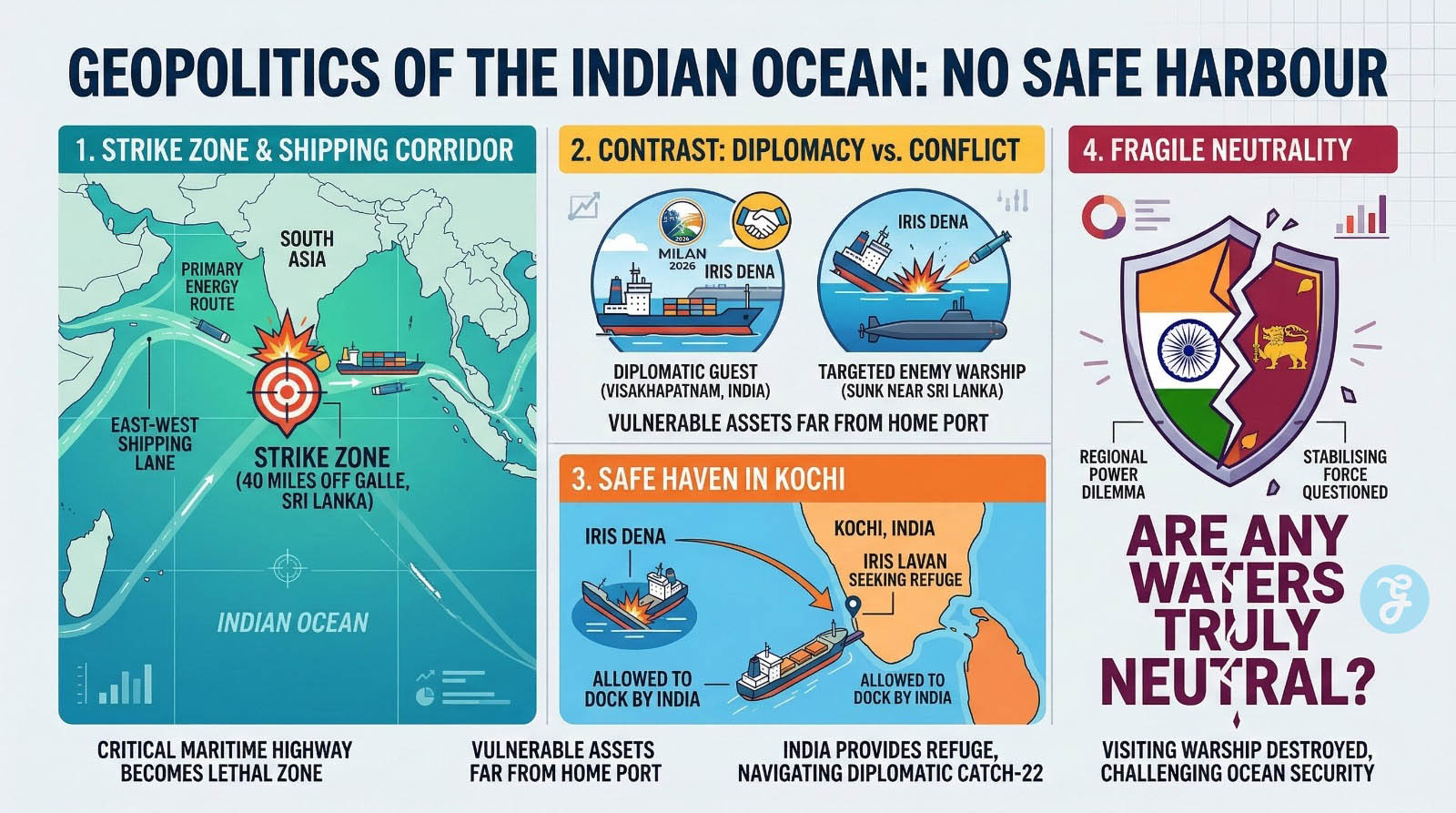 The IRIS Dena had reportedly been returning from the MILAN 2026 naval exercises hosted by India, an event meant to showcase maritime cooperation rather than confrontation. Striking the vessel so far from Iranian waters suggests that Iranian naval assets could be vulnerable far beyond the Gulf.
For regional powers such as India, which seeks to present itself as a stabilising force in the Indian Ocean, the incident also raises uncomfortable questions. If a visiting warship can be tracked and destroyed thousands of miles from its home port, the idea of truly neutral waters begins to look increasingly fragile.
The Economic Domino Effect: Shaking the Global Conveyor Belt
Think of the global economy as a massive, high-speed conveyor belt. This belt runs on trust and predictable costs. The U.S. Sinking of Iran’s IRIS Dena has just thrown a heavy iron bar into the gears. When the U.S. Navy pulled the trigger off the coast of Sri Lanka, it didn’t just sink a ship. It destroyed the safety of the world’s most crowded maritime highway.
Now, the money men in London are panicking. For decades, the Indian Ocean was a “green zone” for commerce. It was cheap to insure a tanker. That stability evaporated in an afternoon. Within forty-eight hours of the strike, maritime war-risk premiums tripled. This is the maritime equivalent of a sudden, catastrophic reassessment of risk in a previously stable market. That is what every oil tanker and cargo ship now faces. These extra millions in costs are passed directly to you. These costs appear in the price of petrol at the pump and the cost of bread on the shelf. As of March 7, 2026, Brent crude has leapt to over $92 per barrel. Analysts warn the price could reach $150 if this Subsurface Ultimatum continues.
In Beijing, the mood is even darker. China is the world’s largest energy importer. Nearly eighty per cent of its oil flows through these exact waters. By snapping an Iranian frigate in two, Washington has proven it can effectively sever China’s maritime energy supply lines. The old rules of global trade are gone. We are entering a new age where the ocean is no longer a shared resource. It is a high-stakes theatre where one invisible strike can bankrupt a market or starve a superpower.
A New Charter for the High Seas
We cannot go back to the world as it was before March 4. The U.S. Sinking of Iran’s IRIS Dena has shattered the old illusions of maritime safety. If we want to prevent the Indian Ocean from becoming a permanent killing field, we need a radical shift in how we police the waves. The first step is honesty. We must stop pretending that international law exists if there is no one to enforce it. The current system is a toothless ghost. It relies on the good intentions of regimes that have spent years proving they have none.
The solution starts with a new Global Maritime Compact. This cannot be another talk shop in Geneva. It must be a hard alliance of the world’s major shipping nations. We need a unified “Red Line” policy that is public and absolute. If any nation interferes with a merchant vessel or attacks a neutral port, their own naval assets must be considered forfeit. No more backroom deals. No more “proportional” wrist slapping. The rules must be as clear as the physics of a torpedo strike. If you touch the trade routes, you lose your fleet.
Launching the Neutral Shield Initiative
We must demilitarise the strategic chokepoints. This requires a permanent, multinational naval presence in the Indian Ocean that is independent of any single superpower. India, Australia, and the U.K. should lead a “Neutral Shield” initiative. This force would have one job: protect the conveyor belt of global trade. The sinking of the Dena was a shock to the system. Let it also be the spark for a smarter, tougher kind of peace.
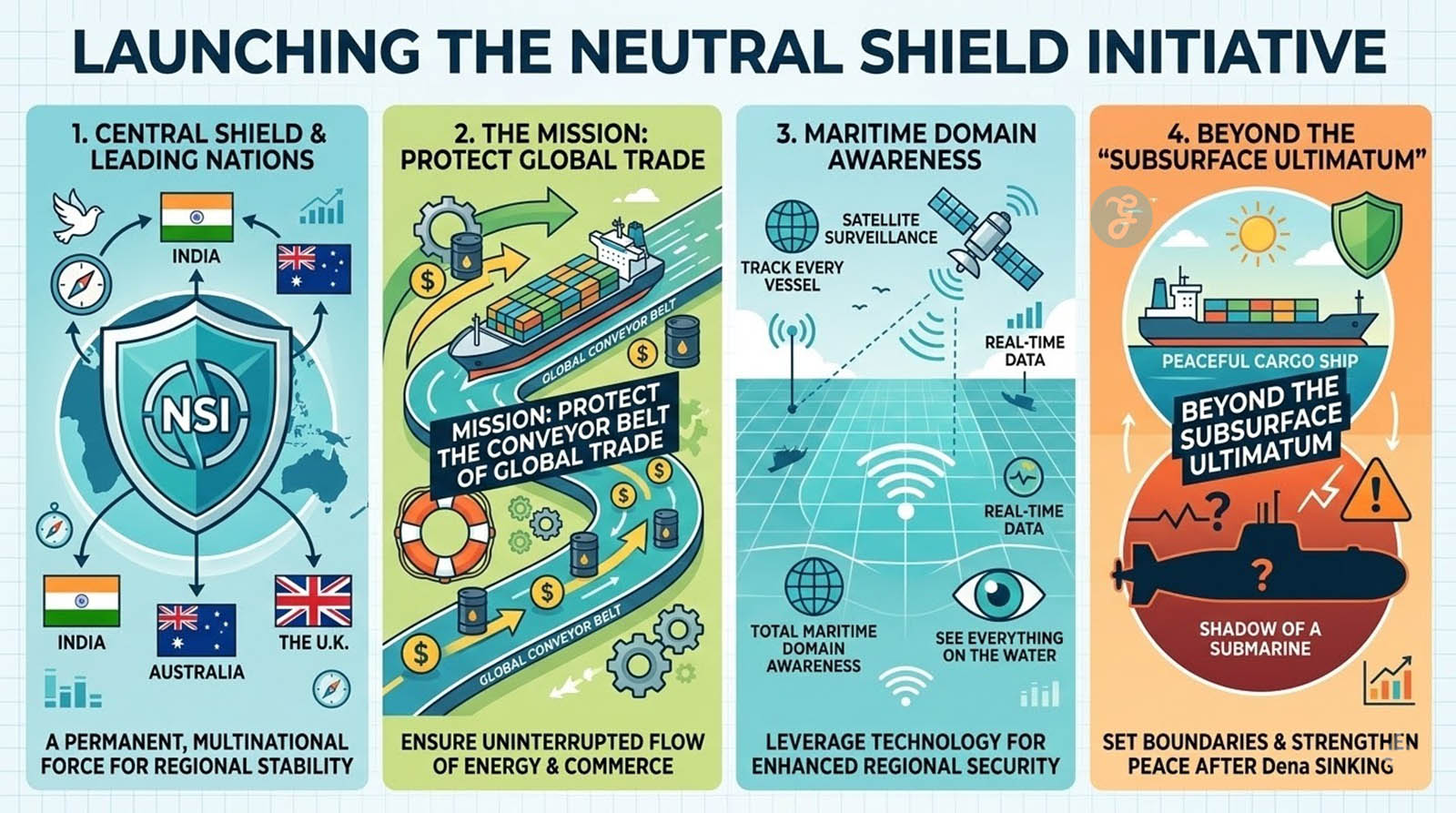 We have the technology to see everything that moves on the water. Now we need the courage to set the boundaries before the next ship snaps in two. This isn’t just about naval tactics anymore. It is about the survival of the global commons. If we fail to build this protective layer, the “Subsurface Ultimatum” will be the only law left on the ocean.
The Era of the Glass Floor
The sinking of the IRIS Dena marks the moment the U.S. Navy stopped playing the game of regional containment and started the work of structural dismantling. By choosing a torpedo over a missile, the Pentagon removed the possibility of a “near miss” or a repairable hit. They opted for a total kill that leaves no wreckage for a salvage crew. This shift reveals a new institutional appetite for finality. For decades, the presence of an American carrier was enough to freeze a crisis. Now, that presence has been replaced by an invisible predator that operates without the need for a public buildup. Over the next five years, expect the “Silent Service” to become the primary tool for enforcing maritime order. The era of surface posturing is being replaced by a doctrine where any adversary hull in contested waters is essentially walking on a glass floor.
This engagement also signals a quiet but profound realignment of global intelligence sharing. The precision of the strike, forty miles off the coast of a neutral nation, suggests a level of real-time tracking that bypasses traditional regional monitors. It proves that the U.S. has achieved a “transparent ocean” capability that renders stealth for surface ships obsolete. For nations like China and Russia, the message is clear: your secondary fleets and proxy assets are no longer shielded by the vastness of the sea. We are moving toward a world where the ocean is subdivided into zones of absolute surveillance. In this environment, the “Blue Water” ceases to be a commons and becomes a controlled corridor where the cost of entry is total submission to the prevailing naval power. The Dena was just the first high-profile casualty of this new, unforgiving geography.
Beyond the Silence
The U.S. sinking of Iran’s IRIS Dena is more than a tactical milestone. It is a definitive rupture in maritime history. The long-standing, unspoken agreement of restraint that governed the world’s oceans for decades died on the morning of March 4, 2026. By choosing to sink a modern frigate in open water, Washington has moved beyond the era of managed escalation toward a “War Department” doctrine. This marks the end of the shadow war.
The image of the Dena’s shattered keel serves as a final warning. It tells a story of an invisible, absolute power that can reach out and strike anywhere on the globe. The Indian Ocean is no longer just a transit point for energy or a stage for diplomatic exercises. It is now a high-stakes theatre where “international waters” no longer guarantee immunity. The Pentagon has proven that it can hunt, track, and annihilate its adversaries with a terrifying, quiet efficiency.
This is the Subsurface Ultimatum. It warns every nation challenging American naval supremacy that the old rules no longer apply. In this new era of conflict, the vastness of the deep blue is no longer a shield. It is a graveyard. The sinking of the IRIS Dena has redefined the map of global power. It has sent a clear message to Tehran and the world: there is no safe harbour left in the silence of the deep.
Disclaimer: Editorialge maintains a steadfast commitment to responsible reporting on the evolving conflicts in West Asia involving Israel, Iran, U.S., Gulf nations and non-state actors like Hezbollah, Hamas, Houthis, Islamic State, and others. In an environment where digital disinformation is widespread, we cannot independently verify every social media post or claim involving national and non-state actors. Our priority remains factual accuracy and the exercise of extreme caution when documenting all regional media.