
In the rapidly evolving world of blockchain and decentralized technologies, one of the most exciting developments is the rise of Web3 bridges.
These bridges are the connective tissue that enables different blockchain networks to communicate with each other, breaking down the silos that have traditionally existed in blockchain ecosystems.
As blockchain technology matures and use cases diversify, the ability to connect blockchains seamlessly has become paramount. This article explores how Web3 bridges are revolutionizing the landscape, providing a seamless experience for users, developers, and businesses alike.
Introduction to Web3 Bridges and Blockchain Interoperability
Web3 bridges are decentralized systems that allow data, assets, and transactions to flow between different blockchain networks. Simply put, these bridges enable one blockchain to communicate with another, unlocking a world of interoperability and multi-chain ecosystems.
Blockchain technology, at its core, is designed to be decentralized and independent, but for a truly connected and functional digital economy, multiple blockchains need to communicate effectively.
Think of Web3 bridges like bridges that span across rivers, connecting otherwise isolated islands [blockchains]. By enabling inter-chain communication, Web3 bridges allow users to take advantage of the strengths of various blockchain ecosystems. Whether it’s moving assets from Ethereum to Solana or leveraging Polkadot’s unique features alongside those of other networks, Web3 bridges make all of this possible.
The Importance of Blockchain Interoperability in the Web3 Ecosystem
One of the most significant challenges facing the blockchain world today is interoperability—the ability for different blockchains to communicate and work together seamlessly.
Blockchain networks, despite their decentralized and secure nature, often operate in isolation, meaning users and developers are limited by the boundaries of each individual blockchain’s ecosystem.
Web3 bridges aim to solve this problem by providing the necessary infrastructure for cross-chain communication. This interoperability is essential to the development of a multi-chain world, where users can freely move assets and data between different blockchain ecosystems without encountering the barriers that typically exist in isolated systems.
A blockchain’s lack of interoperability can restrict the overall efficiency of decentralized applications [dApps] and projects. With Web3 bridges, blockchain ecosystems can now work together harmoniously, much like different departments of a corporation communicating with each other to meet larger organizational goals.
Key Challenges in Blockchain Interoperability
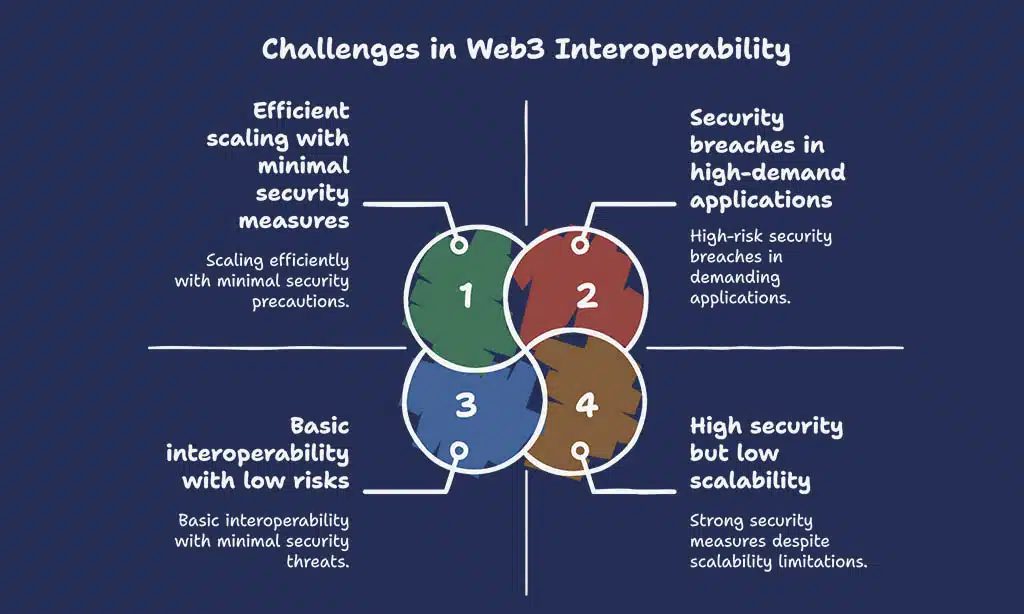
While Web3 bridges offer the potential to solve many of the issues surrounding blockchain interoperability, there are still significant challenges to overcome:
1. Security Risks:
Cross-chain transactions introduce a range of security concerns. Malicious actors may exploit vulnerabilities in bridge protocols, leading to incidents such as double-spending or hack attempts. Since Web3 bridges often rely on smart contracts, securing these contracts is paramount.
2. Scalability:
As blockchain networks grow and the volume of transactions increases, Web3 bridges need to scale efficiently to handle high transaction throughput without compromising performance. Many current bridges have faced challenges in scaling with high-demand applications.
3. Standardization:
For bridges to operate smoothly across different blockchain networks, they must adhere to a set of common standards and protocols. However, many blockchains have different consensus mechanisms and data formats, creating potential barriers to smooth interoperability.
These challenges are significant, but as Web3 technology continues to evolve, solutions will emerge to address them and improve the interoperability landscape.
How Web3 Bridges Facilitate Seamless Blockchain Integration
At the heart of Web3 bridges is cross-chain communication. Without the ability for blockchains to communicate with one another, users would be limited to interacting only within the confines of one specific blockchain ecosystem.
Web3 bridges break down this barrier by enabling the transfer of assets, data, and even smart contract execution between different chains.
Example Use Case: Ethereum and Solana
Let’s say you have assets on Ethereum and wish to use Solana for a particular decentralized application [dApp] that offers faster transaction speeds.
With Web3 bridges, you can transfer assets from Ethereum to Solana seamlessly. These cross-chain transactions remove friction from the process, making it easier for users to leverage the advantages of multiple blockchains simultaneously.
| Blockchain | Use Case | Benefits |
| Ethereum | Smart Contracts & dApps | Robust and secure for smart contracts |
| Solana | Fast Transactions & DeFi | Low fees, high throughput, and speed |
Types of Web3 Bridges [Trusted vs. Trustless]
Web3 bridges can be broadly classified into two categories: trusted and trustless. Understanding the differences between these types is key to appreciating the underlying mechanics of blockchain interoperability.
Trusted Bridges:
These bridges rely on centralized entities or intermediaries to facilitate the transfer of assets and data between blockchains. The trust model is similar to that of traditional financial systems, where users rely on a central authority to manage transactions. While these bridges are faster and easier to implement, they introduce a single point of failure, making them less secure in a decentralized context.
Example of Trusted Bridge: Wormhole Bridge [Solana-Ethereum]
Wormhole is a trusted bridge that allows assets to move between Solana and Ethereum. It relies on validators that are trusted to verify transactions, which results in faster confirmation times but raises concerns about decentralization.
Trustless Bridges:
In contrast, trustless Web3 bridges rely on decentralized protocols to transfer assets and data. They utilize smart contracts, cryptographic algorithms, and consensus mechanisms to ensure that transactions are secure, transparent, and irreversible without relying on a third-party intermediary.
Example of Trustless Bridge: Polkadot’s Cross-Chain Message Passing [XCMP]
Polkadot uses a trustless bridge model based on the XCMP protocol, enabling seamless communication and data transfer between parachains without a trusted central entity. This approach aligns with Polkadot’s vision of enabling complete decentralization.
Real-Time Data Transfer Across Blockchain Networks
Another important feature of Web3 bridges is their ability to facilitate real-time data transfer between blockchains. In many cases, blockchains operate in silos, meaning that one blockchain cannot access the data on another blockchain without significant delays or technical workarounds.
Web3 bridges address this issue by allowing for the instant transfer of data between chains, enabling developers to build applications that can leverage real-time information across multiple networks.
Example: Cross-Chain Oracles in DeFi
Imagine a scenario in DeFi where a smart contract on Ethereum needs real-time price data from an oracle deployed on Binance Smart Chain [BSC]. With Web3 bridges, the contract can instantly retrieve and use the data, ensuring that the application operates in real-time.
| Blockchain | Real-Time Data Transfer Use Case | Benefits |
| Ethereum | Price Oracles for DeFi | Real-time data and decentralized trust |
| BSC | Token Transfer in DeFi | Low transaction fees and fast confirmations |
Key Benefits of Web3 Bridges for Users and Developers
One of the most significant benefits of Web3 bridges is their potential to enhance scalability. As more blockchain networks are created and used for various purposes [e.g., smart contracts, DeFi, NFTs], the need to scale solutions that work across multiple chains becomes crucial.
Benefits:
- Faster transaction throughput by offloading transaction volume to chains with lower congestion.
- Lower fees by leveraging networks with cheaper transaction costs.
- Increased efficiency for dApps by using the most suitable blockchain for each task.
Example: Layer 2 Scaling Solutions Some Web3 bridges integrate with Layer 2 solutions [such as Polygon or Arbitrum] to further enhance scalability, providing low-cost and high-speed transactions while still interacting with Layer 1 chains like Ethereum.
Reducing Friction for Users in Decentralized Finance [DeFi]
In the world of DeFi, users often need to transfer assets between different blockchains to take advantage of the best available opportunities. Without Web3 bridges, this would be an incredibly cumbersome process, requiring users to manually move assets through centralized exchanges or other intermediaries.
By enabling seamless transfers between chains, Web3 bridges remove friction for users, allowing them to access a broader range of DeFi protocols without being restricted by a particular blockchain’s limitations. This has the potential to increase liquidity across the entire DeFi ecosystem and make decentralized finance more accessible to everyone.
| DeFi Platform | Supported Blockchains | Key Feature |
| Aave | Ethereum, Polygon, Avalanche | Cross-chain lending and borrowing |
| Uniswap | Ethereum, Optimism, Arbitrum | Cross-chain token swapping |
Optimized Developer Experience and Increased Innovation
For developers, Web3 bridges provide a platform to create cross-chain applications that can leverage the unique features of various blockchain ecosystems. This opens up new possibilities for innovation, allowing developers to build applications that combine the strengths of different blockchains.
For instance, developers could build a DeFi application that uses Ethereum’s smart contract capabilities, Polkadot’s interoperability features, and Solana’s fast transaction speeds—all in one platform. This level of flexibility encourages the creation of new and innovative solutions that would be difficult to achieve on a single blockchain.
| Blockchain Feature | Use Case | Benefit |
| Solana | High-speed transactions and NFTs | Low fees, high throughput |
| Polkadot | Cross-chain interoperability | Enhanced communication between chains |
| Ethereum | Smart contracts and DeFi protocols | Robust ecosystem for decentralized apps |
Security Considerations in Web3 Bridges
While Web3 bridges offer immense benefits, they also come with security considerations. The bridging process often involves the transfer of assets and data across different networks, which can expose both users and developers to certain risks. The most common security concerns related to Web3 bridges include:
- Smart Contract Vulnerabilities: As Web3 bridges rely on smart contracts to facilitate transactions, any vulnerabilities in the code could be exploited by malicious actors. It is crucial for developers to undergo rigorous auditing and testing of bridge contracts before deployment.
- Double-Spending Risks: In some cases, attackers may try to double-spend assets during the bridging process. This can be prevented by using secure consensus mechanisms and careful monitoring of cross-chain transactions.
- Centralized Points of Failure: Trusted bridges are often susceptible to risks associated with centralized intermediaries. If the central entity managing the bridge is compromised, users may lose access to their assets.
| Security Concern | Explanation | Solution |
| Smart Contract Bugs | Vulnerabilities in bridge contracts | Rigorous contract audits |
| Double-Spending | Risk of malicious re-use of funds | Consensus mechanisms, verification |
| Centralization | Central authority as a vulnerability | Use decentralized protocols |
Popular Web3 Bridge Projects Revolutionizing Blockchain Connectivity
Several Web3 bridge projects have emerged, aiming to solve the challenges of blockchain interoperability. Some of the leading platforms include:
- Thorchain: A decentralized liquidity network that allows users to swap assets between different blockchains without using centralized exchanges. Thorchain facilitates trustless cross-chain asset transfers, making it one of the most popular Web3 bridge platforms.
- Ren Protocol: Ren is a decentralized protocol that facilitates the transfer of assets across blockchains. It uses a unique approach to secure cross-chain transactions and is widely used for bridging assets like Bitcoin to Ethereum-based platforms.
- Cosmos: Cosmos is a blockchain ecosystem designed for interoperability, with its IBC [Inter-Blockchain Communication] protocol enabling cross-chain communication. It serves as a platform for connecting multiple blockchains in a decentralized manner.
Case Study 1: How X Bridge Connects Ethereum and Solana
One of the most notable examples of a Web3 bridge in action is X Bridge, which connects Ethereum and Solana. Ethereum is known for its robust smart contract capabilities, while Solana is recognized for its high-speed, low-cost transactions. By leveraging Web3 bridges, users can transfer assets between these two chains and take advantage of both platforms’ strengths.
| Bridge Platform | Blockchains Connected | Key Features |
| X Bridge | Ethereum and Solana | Cross-chain transfers, low fees on Solana |
| Thorchain | Bitcoin, Ethereum, BNB Chain | Decentralized cross-chain swaps |
Case Study 2: Cross-Chain DeFi with Web3 Bridges
Cross-chain DeFi is another area where Web3 bridges have made a significant impact. For instance, the Aave protocol, a popular DeFi lending platform, has integrated multiple Web3 bridges to enable users to deposit assets from different blockchain networks, including Ethereum, Polygon, and Avalanche.
This cross-chain functionality allows users to participate in DeFi without being limited to a single blockchain’s ecosystem, creating a more inclusive and diverse financial environment.
Takeaways
In conclusion, Web3 bridges are playing a pivotal role in connecting blockchains and creating a seamless experience for users, developers, and businesses.
By enabling interoperability between different blockchain ecosystems, Web3 bridges open the door to a more connected and efficient decentralized world.
As blockchain technology continues to evolve, these bridges will be essential in fostering innovation, scalability, and security across the entire ecosystem. The future of blockchain is multi-chain, and Web3 bridges are leading the way toward this exciting new frontier.