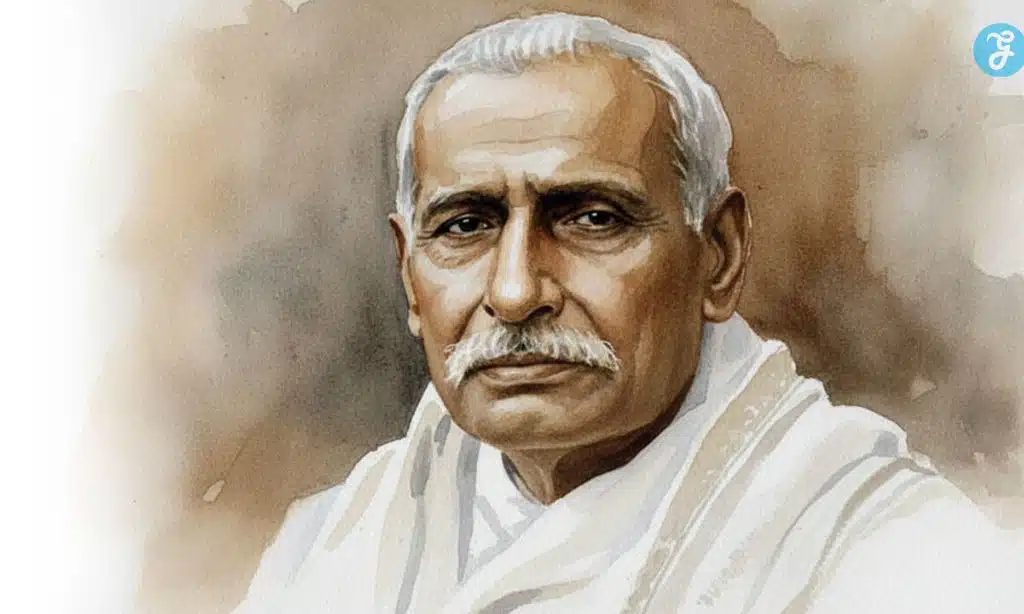
Today, December 6, 2025, marks the 172nd birth anniversary of one of Bengal’s greatest scholars, Hara Prasad Shastri. Known for his groundbreaking discovery of the Charyapada, Shastri didn’t just study history—he unearthed it.
Through his tireless expeditions to Nepal’s royal archives, he recovered manuscripts that proved the Bengali language had roots stretching back over a thousand years. Without his relentless pursuit of knowledge, much of our early literary heritage would have remained lost in the dust of oblivion.
On this centennial anniversary, we celebrate Mahamahopadhyay Hara Prasad Shastri, not just as a Sanskrit scholar, but as a tireless archaeological detective for the Bengali language. He bridged the divide between ancient Buddhist mysticism and the Bengali spoken today, showing us that our language isn’t a recent construct but an ancient, ever-flowing river that has shaped our identity for centuries.
Hara Prasad Shastri at a Glance
Before diving into the monumental impact of his discoveries, let’s quickly review the key milestones of his life and career:
- Full Name: Hara Prasad Bhattacharya (Known as Shastri)
- Born: December 6, 1853, Naihati, Bengal Presidency (now in West Bengal, India)
- Died: November 17, 1931
- Key Roles:
- Principal of Sanskrit College, Kolkata
- President of the Asiatic Society of Bengal
- Head of the Department of Sanskrit, University of Dhaka
- Signature Achievement: Discovery of the Charyapada manuscripts in Nepal (1907)
- Major Honors:
- Mahamahopadhyay (1898)
- Companion of the Order of the Indian Empire (CIE)
These facts provide a glimpse into the life of this scholar, but the true weight of his legacy lies in the lost manuscripts he brought back to life.
Early Life: A Heritage of Scholarship
Born in Naihati, Bengal, Hara Prasad Shastri was raised in an academic family where scholarship was highly valued. The title “Shastri” was not merely inherited but earned through rigorous study. A brilliant student, he caught the attention of Ishwar Chandra Vidyasagar, and his education at Sanskrit College in Calcutta set him on a path to becoming one of Bengal’s greatest scholars.
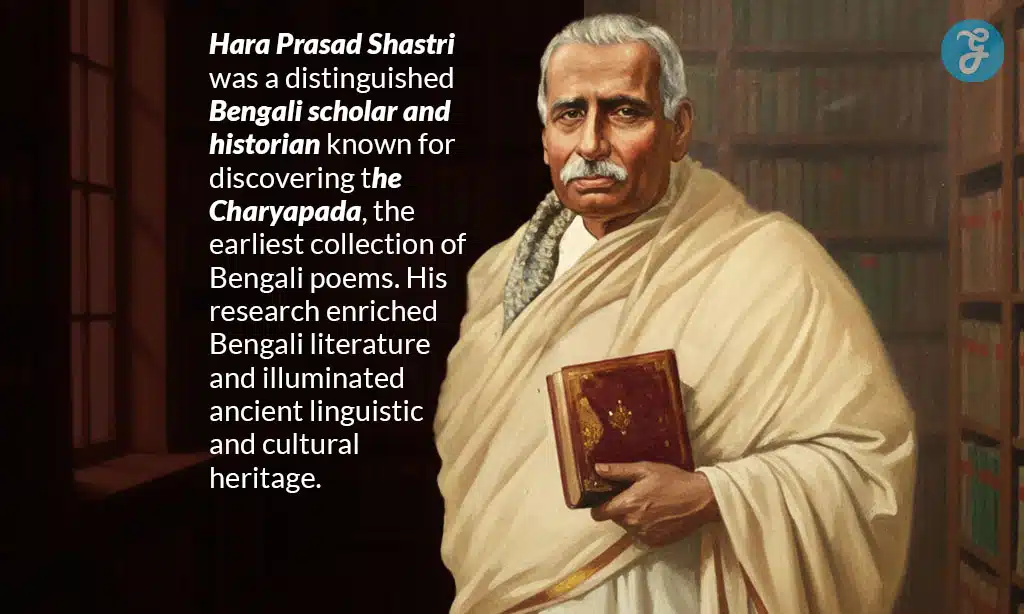
While many of his contemporaries focused on analyzing existing texts, Shastri had a rare drive to uncover what was missing. His curiosity led him to search for ancient texts that had been lost or hidden, and it was this unyielding determination that would eventually lead to one of the most significant discoveries in Bengali literature.
The Great Discovery: The Treasure of Nepal
If there is one event that defines Hara Prasad Shastri’s legacy, it is his historic expeditions to the Royal Court Library of Nepal.
The Search for Roots
Historians had long speculated that Buddhist monks, fleeing the Turkic invasions of the 12th and 13th centuries, had carried ancient Bengali texts to Nepal and Tibet for safekeeping. Shastri was determined to find these lost manuscripts.
1907: The Year History Changed
In 1907, during his third visit to Nepal, Shastri discovered a bundle of manuscripts that stood apart from the rest. One of these, titled Charyacharyavinishchaya, turned out to be a key find. Upon deciphering the script, Shastri realized that he had uncovered a monumental piece of Bengali history.
Written in a language known as Sandhya Bhasha (Twilight Language), a proto-Bengali dialect used by Buddhist Sahajiya mystics between the 8th and 12th centuries, the Charyapada was far older than anything previously known about Bengali literature. It was an anthology of Buddhist songs and poems, and it represented the earliest extant example of Bengali literature.
Giving Bengal Its History
Shastri published these manuscripts in 1916, under the title “Hajar Bachhorer Purano Bangala Bhashay Bauddha Gan O Doha” (Buddhist Songs and Verses in Bengali Language of a Thousand Years Ago). His work proved that Bengali had a distinct and independent evolution from Sanskrit, thus pushing the history of the Bengali language back by several centuries.
The Collector of Civilizations
Hara Prasad Shastri was not only a discoverer of ancient texts but also an insatiable collector of history.
The Asiatic Society Years
As a prominent figure in the Asiatic Society of Bengal, Shastri was instrumental in collecting and preserving thousands of manuscripts from across India and beyond. His dedication took him to remote villages, temples, and private collections, where he convinced people to hand over deteriorating manuscripts for preservation.
Beyond Language
Shastri was not content to simply preserve manuscripts—he also sought to understand the social history behind them. His historical novels, such as Bener Meye (The Merchant’s Daughter), offered a vivid glimpse into Bengal’s 10th and 11th-century social fabric, reconstructing the lives of common people using the same manuscripts he had painstakingly collected.
A Bridge Between Eras
Hara Prasad Shastri was a man uniquely positioned between the ancient and the modern. As a classically trained Sanskrit scholar, he was deeply rooted in traditional knowledge. Yet, he championed the vernacular Bengali language, believing that it was not just a tool of the common people but also a rich, ancient language deserving of preservation and study.
He was instrumental in founding the Department of Sanskrit and Bengali at the University of Dhaka, ensuring that the study of Bengali remained rigorous and institutionalized in East Bengal (now Bangladesh) as well.
Final Words: The Guardian of Bengali Identity
On his 172nd birth anniversary, Hara Prasad Shastri stands as a guardian of Bengali identity. Without him, we might never have known the names of the first Bengali poets, such as Luipa, Kanhapa, or Bhusuku. We would not have known that our language, even a thousand years ago, carried songs of philosophy, love, and rebellion.
Through his discoveries, Shastri proved that the Bengali language is not just a tool for communication but a vibrant, ancient tradition capable of carrying the hopes and struggles of generations. He is the man who went into archives, dusted off the forgotten corners of history, and brought Bengal’s lost voice back to life.
His legacy reminds us that a nation’s future is built on the preservation of its past, and through his tireless efforts, Shastri ensured that the roots of Bengali literature are forever anchored in the soil of our shared cultural heritage.
Frequently Asked Questions (FAQs) on Hara Prasad Shastri
What is Hara Prasad Shastri most famous for?
Hara Prasad Shastri is most famous for his discovery of the Charyapada, a collection of Buddhist songs written in a proto-Bengali dialect. His work proved that Bengali literature is over a thousand years old.
When was Hara Prasad Shastri born?
He was born on December 6, 1853, in Naihati, Bengal Presidency (now in West Bengal, India). Today marks his 172nd birth anniversary.
What is the Charyapada?
The Charyapada is a collection of mystical poems and songs written by Buddhist Siddhacharyas between the 8th and 12th centuries. It is considered the earliest extant specimen of Bengali literature.
What titles did he receive?
Shastri was honored with the title Mahamahopadhyay in 1898 and was made a Companion of the Order of the Indian Empire (CIE) by the British government for his contributions to scholarship.
Did he write fiction?
Yes, Hara Prasad Shastri wrote historical novels such as Bener Meye, which offers an in-depth social history of Bengal during the Buddhist era.