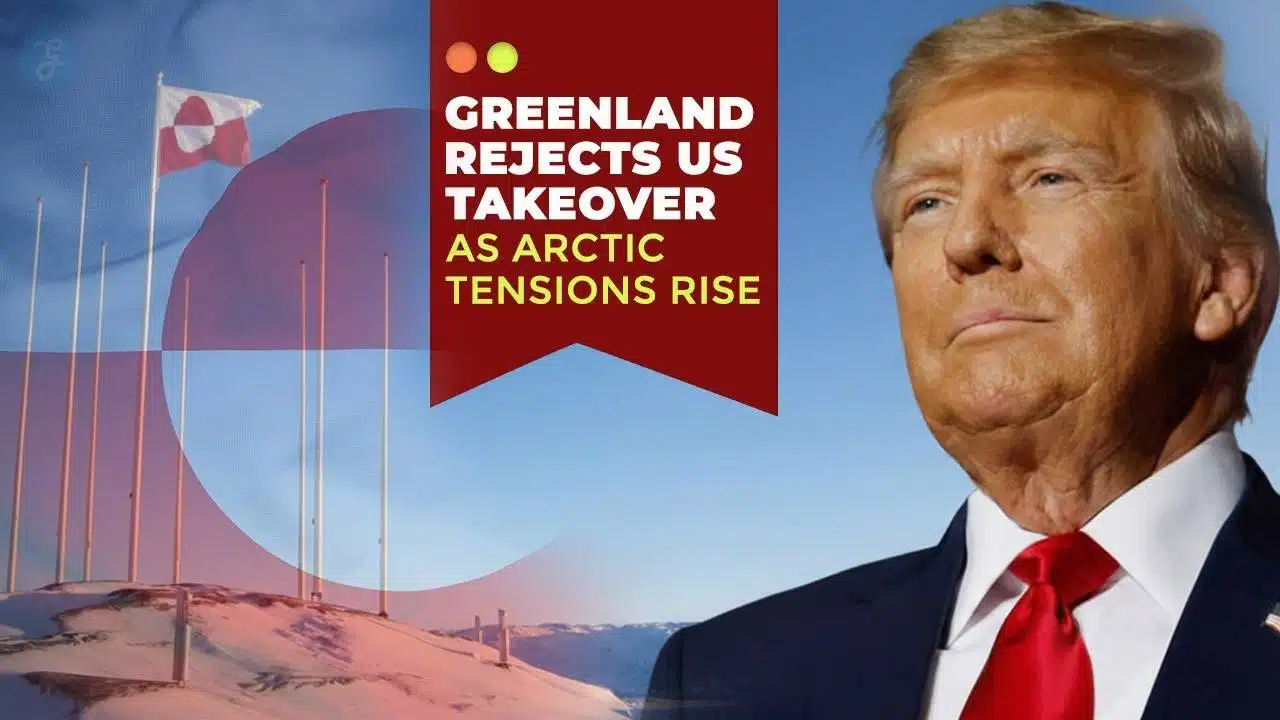
The Greenland Geopolitical Crisis 2026 has officially moved from diplomatic theater to tangible military friction. As of this morning, January 16, the runways at Kangerlussuaq International Airport are no longer just servicing tourists and scientific expeditions.
In a move without precedent in the history of the North Atlantic Treaty Organization (NATO), transport aircraft from France, Germany, and the United Kingdom have begun landing “logistical support teams” in Greenland. While officially termed the Arctic Resilience Exercise 2026, the symbolism is stark and unmistakable. European powers are deploying boots on the ground to defend a NATO member’s territory, not from Russia or China, but from the aggressive acquisition demands of their most powerful ally, the United States.
This deployment marks the most significant test of the Western Alliance since 1949, challenging the very definition of sovereignty within NATO.
Key Takeaways for Readers:
- The Trigger: The US “Venezuela Operation” proved force is an option, scaring Europe into action.
- The Prize: Kvanefjeld’s rare earth minerals are the key to breaking China’s tech dominance.
- The Threat: Hybrid warfare (economic sanctions on Danish pharma) is the likely next step before any shooting starts.
- The Pivot: This marks the first time NATO troops have deployed to protect a member from the US.
The Diplomatic Rupture: “Not For Sale”
The immediate trigger for this military escalation was the fiery joint press conference held yesterday, January 15, in Nuuk. Standing shoulder-to-shoulder, Greenland’s Prime Minister Jens-Frederik Nielsen and Danish Prime Minister Mette Frederiksen issued a categorical rejection of the US “defense takeover” proposal. Nielsen’s words were blunt and designed to end the conversation: “Greenland is not a commodity, and our sovereignty is not a negotiation point in Washington’s budget.”
Yet, the crisis is deepening rather than resolving. The White House, through its newly appointed Special Envoy to Greenland, Jeff Landry, has publicly dismissed this rejection as a “predictable opening bid” in a negotiation that “will happen, one way or the other.” With US Vice President J.D. Vance scheduled to visit the Pituffik Space Base (formerly Thule) later this month, the standoff has shifted from a political disagreement to an open confrontation.
The Catalyst: Why 2026 is Different
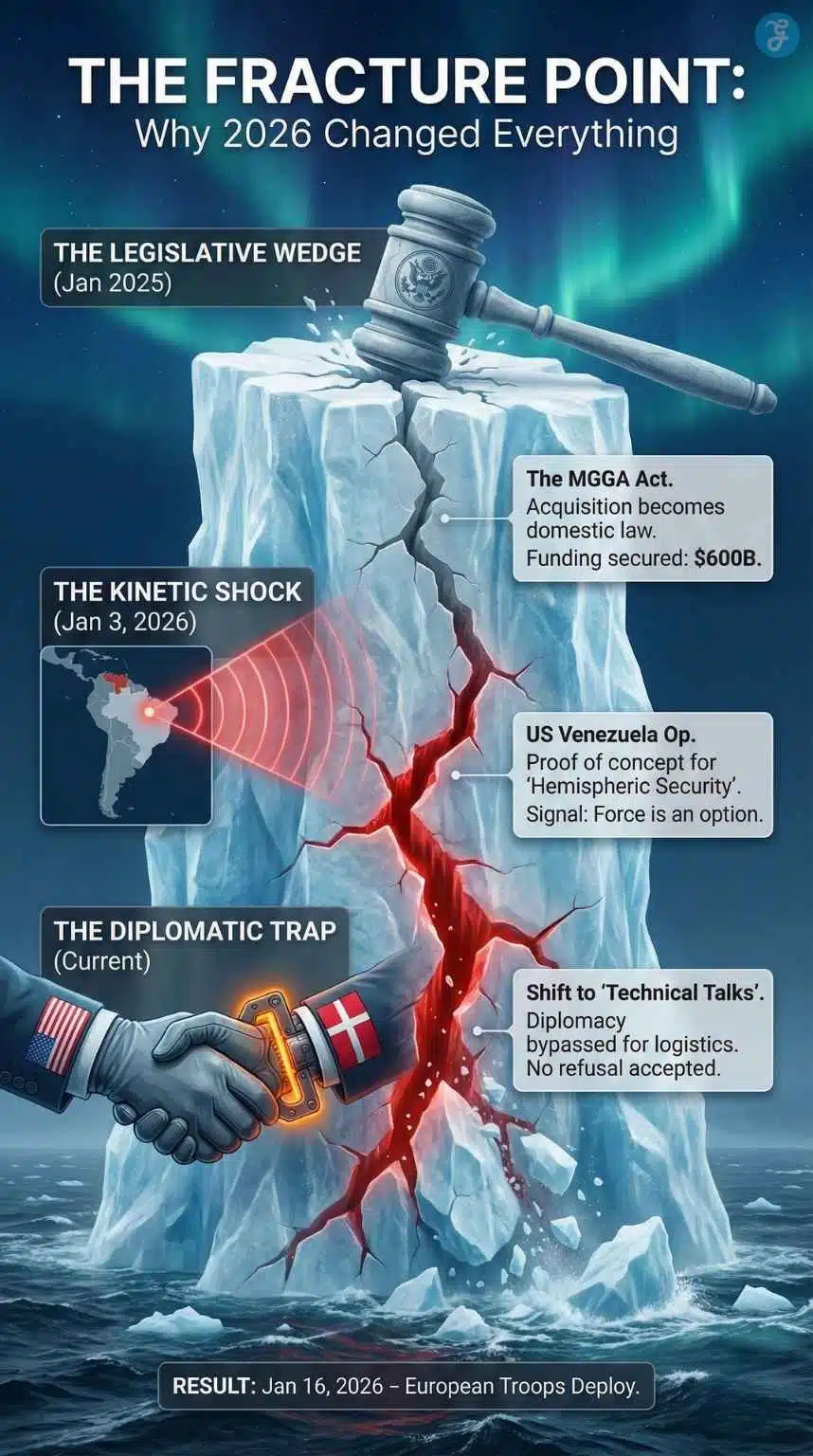
To understand why a long-standing American desire has mutated into an existential crisis, one must look at the rapidly shifting context of the last 12 months. Three specific factors have turned a “real estate absurdity” into a lethal geopolitical maneuver.
1. The “Venezuela Precedent” [January 3, 2026]
The shadow hanging over Nuuk is not located in the Arctic, but in the Caribbean. On January 3, 2026, US special operations forces conducted a lightning raid in Caracas, effectively decapitating the Venezuelan leadership under the justification of “hemispheric security” and “resource stabilization.”
This operation, conducted unilaterally and without prior UN consultation, sent a chilling signal to Copenhagen. It demonstrated that the current US administration is willing to operationalize a “maximalist” interpretation of the Monroe Doctrine. When President Trump stated last week that the US would secure Greenland “one way or the other,” Danish intelligence agencies no longer viewed this as rhetorical bluster. The Venezuela operation proved that “force” is on the table, normalizing the idea that the US will physically seize assets it deems critical to national survival.
2. The “Make Greenland Great Again Act” [Jan 2025]
Legislation passed early last year fundamentally altered the US President’s operational mandate. The Make Greenland Great Again Act (MGGA) did two things:
- Domestic Mandate: It legally classified Greenland’s rare earth deposits as “Tier 1 National Security Assets,” equivalent to domestic US stockpiles.
- Funding Mechanism: It authorized the Treasury to bypass standard congressional approval for “territorial acquisition” up to $600 billion, effectively giving the President a loaded checkbook and a legal obligation to use it.
3. The “Technical Talks” Trap
For months, the US State Department has refused to engage in “diplomatic” talks with Denmark regarding Greenland. Instead, they have insisted on “technical talks on acquisition mechanics.” By controlling the nomenclature, Washington has attempted to bypass the question of consent. In their view, the acquisition is a decided policy outcome; the only remaining variable is the execution price. This refusal to acknowledge the “No” is what forced the European escalation we are seeing today.
The Strategic Imperative: The “Why” Behind the Aggression
Why is the United States risking the collapse of NATO for an island of 56,000 people? The answer lies in the convergence of two wars: the kinetic war for Arctic control and the economic war for the periodic table.
1. The Resource War: Breaking the Chinese Chokehold
The primary driver is not ice, but what lies beneath it. The US transition to a high-tech, AI-driven defense economy is currently held hostage by China, which controls over 70% of global rare earth mining and 90% of processing.
- The Kvanefjeld (Kuannersuit) Factor: Located near Narsaq in southern Greenland, this deposit is the “crown jewel” of the crisis. It contains an estimated 1.01 billion tonnes of ore, rich in Neodymium and Dysprosium, elements essential for the permanent magnets used in F-35 fighter jets, nuclear submarines, and wind turbines.
- The China Connection: For years, the project was tied up with Shenghe Resources, a Chinese firm with a major stake in the mining license. The US views this as intolerable. The “defense takeover” is fundamentally a seizure of these assets to prevent Beijing from maintaining its leverage over Western rearmament. The US logic is simple: If we don’t own the ground, China owns the supply chain.
2. The “Unsinkable Aircraft Carrier”
Geographically, Greenland is the gatekeeper of the Atlantic.
- The GIUK Gap: The sea lines between Greenland, Iceland, and the UK (the GIUK Gap) are the only exit points for Russian nuclear submarines stationed in the Kola Peninsula to enter the Atlantic Ocean. US control of Greenland’s coast allows for total sonar and naval lockdown of the Russian Northern Fleet.
- Hypersonic Defense: As Russia and China develop hypersonic glide vehicles, seconds matter.
- Pituffik Space Base (Thule): Located 750 miles north of the Arctic Circle, Pituffik hosts the AN/FPS-132 Upgraded Early Warning Radar. It is the only US asset capable of detecting a polar missile strike in time to trigger interception systems. The US argues that relying on a “lease” for its most critical nuclear shield is a strategic vulnerability it can no longer afford.
3. Monroe Doctrine 2.0
Ideologically, the current administration has revived and expanded the 1823 Monroe Doctrine. The new interpretation argues that the Arctic is an extension of the North American continent. Therefore, Danish (European) sovereignty over Greenland is framed as a “historical anomaly” and a violation of the Western Hemisphere’s security integrity. This worldview delegitimizes Denmark’s claim, treating it not as an ally but as a colonial interloper in the American sphere of influence.
The View from Nuuk & Copenhagen: Sovereignty vs. Survival
The crisis has placed the Kingdom of Denmark in an impossible vice.
Greenland’s Dilemma: The Irony of Independence
For decades, Greenlandic politics has been driven by a desire for independence from Denmark. The Self-Government Act of 2009 was a roadmap to that future, granting Nuuk control over police, courts, and, crucially, mineral resources.
- Section 21: The Act explicitly states that the decision regarding Greenland’s independence belongs solely to the people of Greenland.
- The Twist: Paradoxically, Greenland now clings to Danish sovereignty as a shield. Prime Minister Nielsen realizes that “independence” from Denmark in 2026 would likely mean immediate absorption by the US. As one Nuuk official privately noted, “Better a neglected child of Copenhagen than a military colony of Washington.”
Denmark’s Nightmare: The NATO Paradox
Prime Minister Frederiksen is fighting to preserve the unity of the Realm (Rigsfællesskabet) while avoiding a war with her protector.
- The Legal Wall: Denmark cannot sell Greenland. Under the 1953 Constitution, Greenland is an equal part of the Kingdom, not a possession. Selling it would require a constitutional amendment and a referendum, which would fail.
- The Betrayal: Danish officials feel a deep sense of betrayal. Denmark has been a loyal ally, sending troops to Afghanistan and Iraq, and allowing unfettered US access to Pituffik. That the US is now using coercion against them has shattered the psychological trust that underpins Article 5.
Ground Zero: The Indigenous and Environmental Cost
Beyond the maps in situation rooms, the crisis poses an existential threat to the Inuit way of life and the fragile Arctic ecosystem.
The “Thule Trauma” Returns:
- For many older Greenlanders, the US “defense takeover” reopens old wounds. The forced relocation of the Inughuit people in 1953 to make way for the Thule Air Base remains a scar on the national psyche. The prospect of massive US military expansion, potentially seizing hunting grounds and coastal waters for naval ports, is viewed not as development but as displacement.
- Quote to Include: Aqqaluk Lynge, former chair of the Inuit Circumpolar Council, warned: “We are the guardians of the ice, not the landlords of a military base. Our culture cannot survive becoming a garrison state.”
The Nuclear Shadow:
- The Camp Century Legacy: Greenlanders are acutely aware of “Camp Century,” a secret US nuclear base built under the ice in the 1960s, which was abandoned with toxic waste left behind. The fear is that a new, intensified US presence brings a renewed risk of nuclear accidents or waste dumping in pristine glacial waters.
- Climate Paradox: Industrializing Greenland for rare earth mining to “save the planet” (via green tech) involves destroying one of the planet’s most critical climate regulators. Environmental groups argue that turning Southern Greenland into a massive open-pit mine to satisfy US defense needs is an ecological catastrophe in the making.
The NATO Paradox: An Alliance Eating Itself
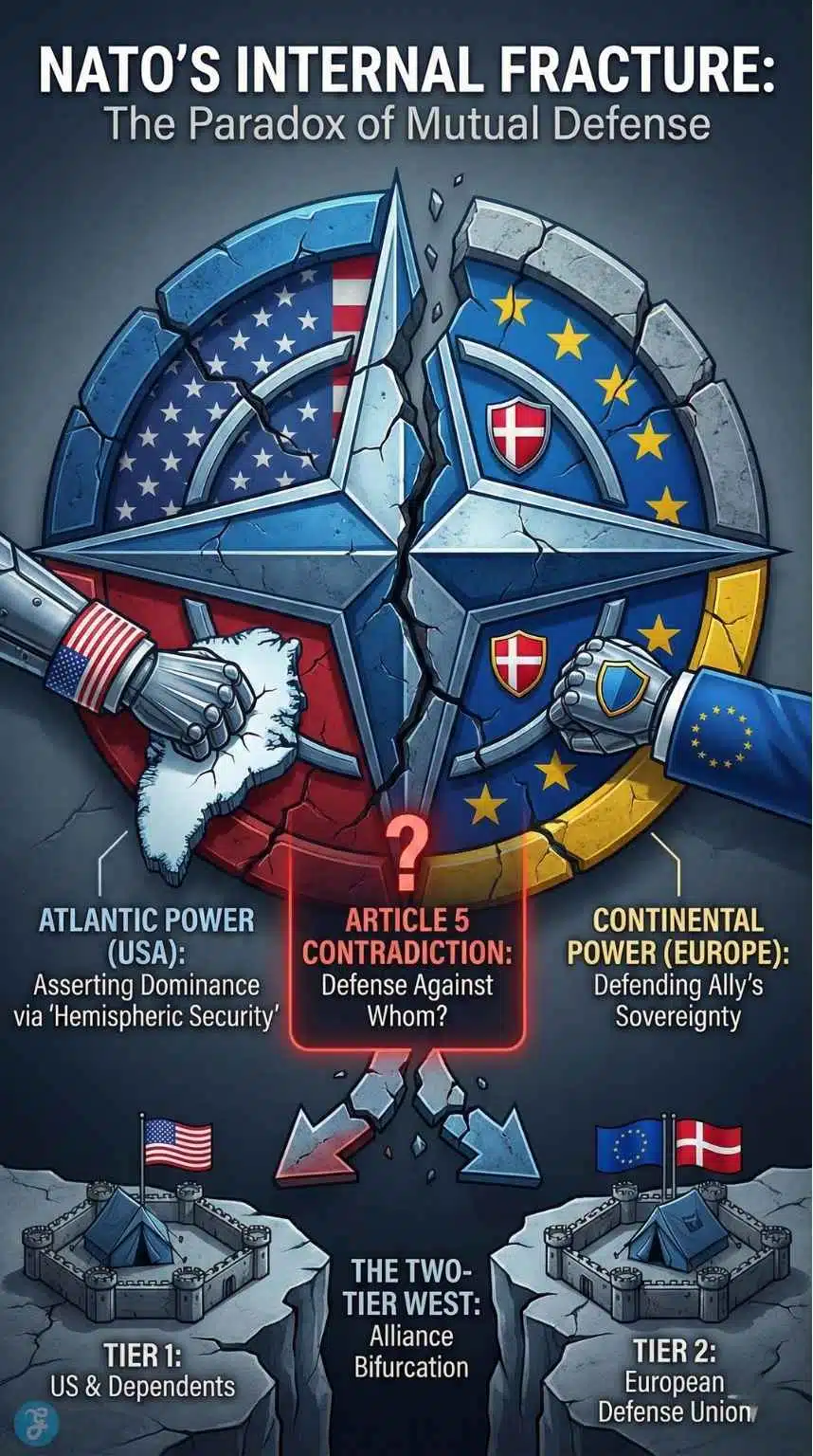
The arrival of French and British logistical teams in Greenland today (January 16) is the most dangerous development yet. It exposes the central contradiction now tearing NATO apart.
Article 5 Upside Down
NATO’s Article 5 states that an attack on one is an attack on all. But the alliance was designed to look outward (at the USSR/Russia), not inward.
- The Scenario: If US forces were to forcibly secure the Kvanefjeld mine or blockade Nuuk harbor, would Denmark invoke Article 5?
- The Response: The European deployment suggests the answer is “Yes.” France, in particular, is aggressively pushing for a “European Defense of European Territory.”
- French Consulate Signal: In a coordinated diplomatic strike, France announced today it will open a full consulate in Nuuk on February 6, explicitly to “counter annexation talk.” This is a direct challenge to Washington, signaling that the EU views Greenland as its northern border.
This is the beginning of a “Two-Tier West.” We are seeing the formation of a Continental Power (EU/UK) actively balancing against the Atlantic Power (US), all while ostensibly remaining allies under the NATO banner.
The Bear and the Dragon: Russia and China’s Calculus
While Washington and Copenhagen lock horns, the true beneficiaries of the crisis are watching from Moscow and Beijing. Analysts argue that the fracturing of the Atlantic Alliance is a strategic windfall for the East.
Russia: The Chaos Dividend
- Strategic Relief: For the Kremlin, the US-Denmark dispute is a miracle. A NATO distracted by internal infighting is a NATO less focused on the Kola Peninsula.
- The Narrative Flip: Russian state media has seized on the “takeover” narrative to frame the US as the true aggressor in the Arctic. President Putin is expected to leverage this at the UN, portraying Russia as the “stable partner” in the High North compared to an “imperialist” America. Intelligence suggests Russia may use this distraction to quietly expand its own claim over the Lomonosov Ridge seabed.
China: The “White Knight” Strategy
- Resource Ambitions: Beijing calls itself a “Near-Arctic State.” Having lost ground on the Kvanefjeld mine project due to Western pressure, China is now playing the diplomatic long game.
- Courting Nuuk: Instead of threats, Beijing is offering “sovereignty-respecting partnerships.” By contrasting US coercion with Chinese “investment without political baggage,” Beijing hopes to woo Greenlandic leadership. If the US pushes too hard, they risk driving Nuuk directly into the economic arms of the very rival it is trying to exclude.
Mechanisms of Takeover: The “Gray Zone” Offensive
While the arrival of European logistical teams suggests a conventional military standoff, defense analysts warn that the primary US strategy is likely to be hybrid warfare. The objective is to make Danish governance of Greenland so politically and economically costly that Copenhagen is forced to fold, not by missile strikes, but by exhaustion.
This “Gray Zone” offensive operates on three distinct fronts:
1. Economic Strangulation [ The “Novo-Maersk” Lever]
The US does not need to bomb Copenhagen to hurt Denmark; it simply needs to adjust its regulatory framework. Denmark’s economy relies heavily on two giants: Novo Nordisk (pharmaceuticals) and Maersk (shipping).
- The Pharma Threat: Sources inside the FDA have leaked memos suggesting a “security review” of foreign-manufactured biotechnologies. If the US were to threaten tariffs or regulatory hurdles on Danish insulin and weight-loss drugs, which constitute a massive chunk of Denmark’s GDP growth, the economic shock would be instant.
- The Shipping Squeeze: The US Navy could arguably reclassify Arctic shipping lanes as “domestic security zones,” forcing Maersk vessels to undergo costly, time-consuming inspections that competitors are spared.
- Strategic Goal: To force the Danish business elite to pressure Prime Minister Frederiksen into a deal. The message is clear: Keep Greenland, or keep your American market share. You cannot have both.
2. “Technical Annexation” [Facts on the Ground]
The White House has already begun a process of “ignoring the landlord.” Instead of waiting for permission, US Army Corps of Engineers teams have reportedly begun “surveying” expansion sites outside the designated Pituffik perimeter.
- The Infrastructure Bypass: By offering direct funding to local Greenlandic municipalities for airports, hospitals, and schools—bypassing the central government in Nuuk—the US is effectively buying loyalty brick by brick.
- The Shadow Government: This strategy aims to create a de facto reality where the US is the provider of public goods, rendering Danish sovereignty a hollow formality. If the lights, the roads, and the jobs are American, the flag flying above the town hall becomes irrelevant.
3. Political Destabilization [The “Fifth Column”]
Intelligence reports suggest a surge in funding for fringe Greenlandic political movements that advocate for “Immediate Independence.”
- The Trojan Horse: The US strategy is to encourage Greenland to declare total independence from Denmark now. Once that legal cord is cut, the newly independent (and financially insolvent) Greenland would immediately be forced to sign a “Protection and Economic Compact” with the US to survive.
- Psychological Operations: Social media campaigns targeting Greenlandic youth are currently pushing narratives that portray Denmark as a colonial relic holding back Greenland’s “oil-rich future”—a future that only US investment can unlock.
Future Outlook: Three Scenarios for the Ice Curtain
As the standoff enters its fourth week, the window for a diplomatic off-ramp is closing. Based on current trajectory models, intelligence communities in Brussels and Washington are gaming out three specific end-games.
Scenario A: The “Hong Kong of the Arctic” [The Sovereign Lease]
- Probability: 45% (Most Likely)
- The Mechanics: To avoid a NATO-shattering war, mediators (likely the UK or Norway) broker a face-saving compromise. Denmark retains “titular sovereignty” (the flag stays), but signs a 99-year “Strategic Administration Lease” with the United States.
- The Outcome: The US gains total military and resource rights (the “purchase” in all but name), paying an annual rent that matches the Danish block grant ($600M+). Greenland gets massive infrastructure investment. Denmark avoids the humiliation of a sale but loses actual control.
- Geopolitical Impact: This effectively turns Greenland into an American protectorate, similar to the Panama Canal Zone in the 20th century.
Scenario B: The Rupture [Sanctions & Isolation]
- Probability: 30%
- The Mechanics: Prime Minister Frederiksen refuses to buckle. The US retaliates with targeted sanctions on Danish industries and a freeze on intelligence sharing. The European troop presence in Greenland digs in, creating a “frozen conflict” zone.
- The Outcome: NATO effectively bifurcates. The US withdraws its ambassador from Copenhagen. The “West” splits into an Anglo-American bloc and a Continental European bloc.
- Geopolitical Impact: China capitalizes on the chaos, strengthening ties with a desperate Europe. The Arctic becomes the most militarized zone on earth.
Scenario C: The “Soft Coup” [Greenlandic Unilateralism]
- Probability: 25%
- The Mechanics: The US successfully flips the Greenlandic parliament (Inatsisartut). A vote of “No Confidence” removes Prime Minister Nielsen. A pro-US coalition takes power and unilaterally invites US “protective forces” to expand beyond Pituffik, defying the Danish defense authority.
- The Outcome: Denmark is placed in an impossible position: arrest the Greenlandic government (colonialism) or watch them walk away. Denmark likely withdraws, washing its hands of the territory.
- Geopolitical Impact: The end of the Danish Kingdom. Greenland becomes an unincorporated US territory, akin to Puerto Rico but with nuclear missiles.
Final Thought: The End of the Post-WWII Order
The Greenland Geopolitical Crisis of 2026 is not merely a dispute over ice and ore; it is the tombstone of the Atlanticist ideal. For 80 years, the security architecture of the West was built on the premise that the United States was the guarantor of European sovereignty. In the freezing winds of Nuuk, that premise has been inverted: the United States is now the challenger to that sovereignty.
Whether the crisis ends with a lease, a purchase, or a blockade, the damage is permanent. The “Ice Curtain” has descended, not between East and West, but right down the middle of the Atlantic.
For investors, the signal is to watch the Rare Earth markets and Defense Contractors (particularly Raytheon and Lockheed Martin), who are poised to fortify the Arctic. For the world, the lesson is stark: In the resource wars of the mid-21st century, even the closest of allies are not safe from the hunger of superpowers.