The promise of the “Future of Electric Aviation” has hovered on the horizon for decades, often feeling more like science fiction than a boarding pass you can hold in your hand. But as we settle into 2026, the script has flipped. The industry has moved from glossy concept art to tangible, certified reality, albeit in a way most travelers didn’t expect.
The revolution isn’t arriving in the form of a silent Boeing 747 crossing the Atlantic; it is arriving in the form of a four-passenger “air taxi” buzzing over the traffic of Dubai. This year marks a definitive split in the aviation timeline. On one side, we have the immediate launch of electric vertical take-off and landing (eVTOL) aircraft for urban mobility.
On the other hand, the sobering physics of long-haul flight means that carbon-neutral vacations to the other side of the world remain a distant goal. This comprehensive guide dissects the future of electric aviation in 2026, separating the imminent breakthroughs from the long-term moonshots.
Key Takeaways
- Air Taxis are Here: The “Future of Electric Aviation” begins late 2026 in Dubai with Joby Aviation. This is no longer a concept; it is an operational reality.
- Regional Hybrid is Next: Don’t expect electric flights to Paris or New York yet. The 2030s will be the decade of the hybrid-electric regional turboprop, led by Heart Aerospace.
- Long-Haul is Stalled: Batteries are simply too heavy for big jets. The path to decarbonizing your vacation flight relies on Sustainable Aviation Fuel (SAF) scaling up, not on electrification.
- Invest in Infrastructure: The biggest bottleneck is no longer the plane, but the power grid and the vertiports required to support them.
The Immediate Frontier: The Rise of eVTOLs in 2026
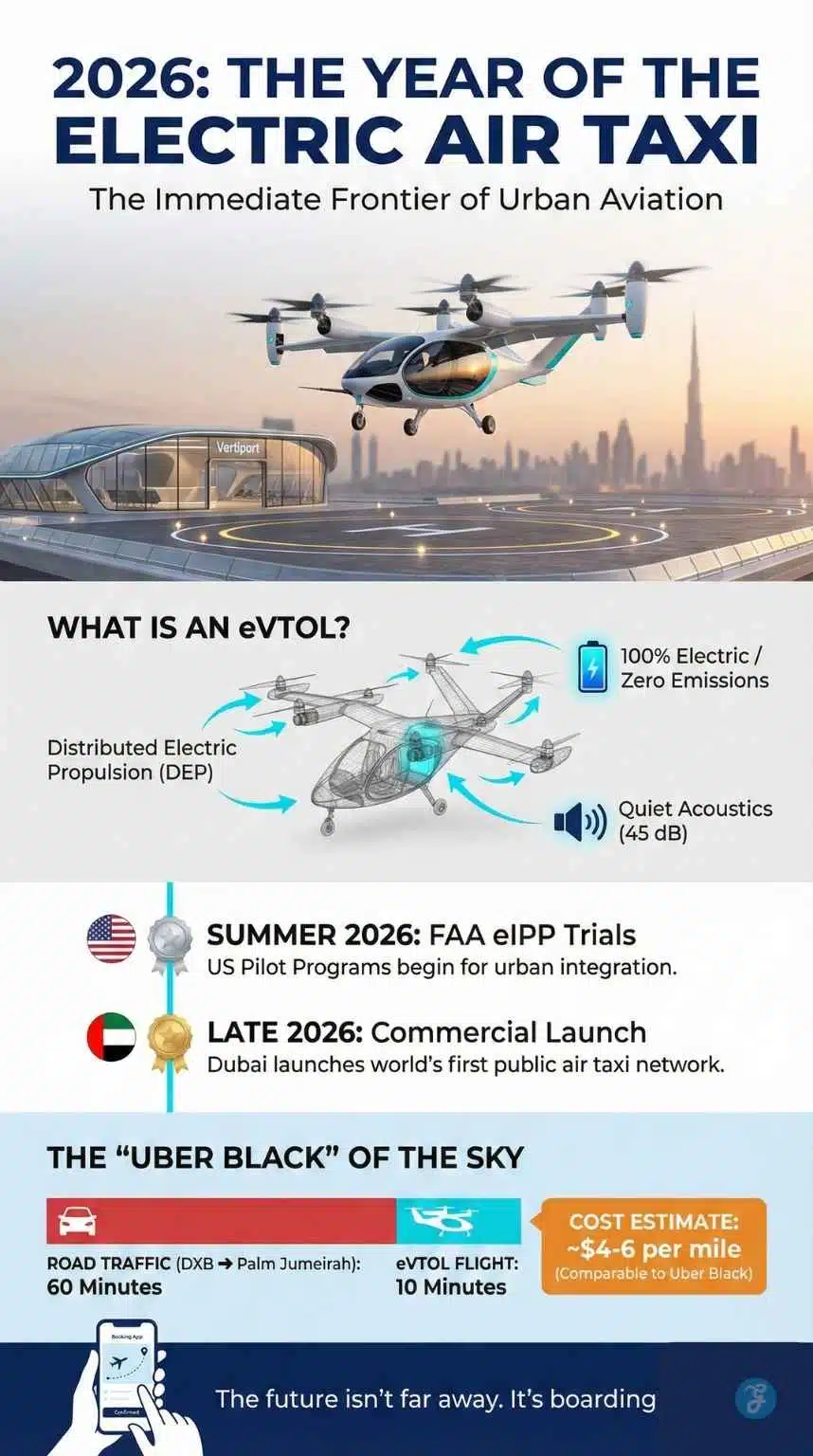
While the world was waiting for electric jets, a new category of aircraft quietly raced to the finish line. 2026 is officially the year of the eVTOL (Electric Vertical Take-off and Landing). These vehicles represent the first commercial application of fully electric propulsion in aviation, designed not for cross-country travel, but for cutting through urban congestion.
What is an eVTOL?
An eVTOL is a hybrid between a helicopter and a drone. Unlike a helicopter, which relies on a single massive rotor and a combustion engine, an eVTOL typically uses Distributed Electric Propulsion (DEP). This involves multiple smaller electric motors and propellers spread across the wings or tail.
- Quieter: The distributed motors spin at lower speeds than a helicopter blade, blending into the background noise of a city (approx. 45–55 decibels at 100 meters).
- Safer: Redundancy is key. If one motor fails, the others compensate, a safety margin single-engine helicopters cannot match.
- Cheaper: With fewer moving parts and no fuel costs, operating costs are projected to rival rideshare apps like Uber Black.
The 2026 Commercial Launch: Dubai Leading the Pack
As of January 2026, the race to the first commercial ticket has a clear frontrunner. Joby Aviation, in partnership with Dubai’s Roads and Transport Authority (RTA), has confirmed the launch of commercial air taxi operations by the end of 2026.
Key Launch Details:
- Location: Four initial “vertiports” have been identified: Dubai International Airport (DXB), Downtown Dubai (near Burj Khalifa), Dubai Marina, and Palm Jumeirah.
- The Experience: A passenger will be able to land at DXB and fly to the Palm Jumeirah in approximately 10 minutes—a journey that typically takes 45–60 minutes by car.
- Regulatory Clearance: The UAE’s General Civil Aviation Authority (GCAA) has accelerated certification, granting Joby exclusive operating rights for the first six years.
The US Market and FAA Progress
In the United States, the timeline is following close behind. The Federal Aviation Administration (FAA) cleared a major hurdle with the release of the Special Federal Aviation Regulation (SFAR) for powered-lift aircraft in late 2024. Now, in 2026, the focus is on the eVTOL Integration Pilot Program (eIPP).
| Company | Aircraft Model | 2026 Status | Target Launch |
| Joby Aviation | S4 (5-seat) | Commercial Launch (Dubai) | Late 2026 |
| Archer Aviation | Midnight | Final FAA Certification; UAE Operations | Q3/Q4 2026 |
| Beta Technologies | Alia-250 | Cargo/Medical Logistics | 2026 (Cargo first) |
| Lilium | Lilium Jet | Financial Restructuring / Regional Tests | Delayed to 2027+ |
Archer Aviation is aggressively targeting the 2026 window as well. Their “Midnight” aircraft, designed for rapid back-to-back flights with a 10-minute charge time, is slated for early operational flights in the UAE and potential route testing in the US, supported by partnerships with United Airlines.
The Eastern Giant: China’s Silent Dominance
While the Western world watches the FAA, a different story has already unfolded in the East. To talk about 2026 without mentioning China is to miss half the picture. While US companies are entering pilot programs, Chinese manufacturers have largely moved past the “testing” phase into commercial reality.
EHang: The First to the Finish Line
Guangzhou-based EHang is arguably the current world leader in regulatory success. Their flagship aircraft, the EH216-S, secured the world’s first Type Certificate in late 2023, followed by a Production Certificate in 2024. By January 2026, EHang will not just be testing; they will be conducting paid commercial flight operations in designated zones like Guangzhou, Hefei, and Shenzhen.
- The Difference: Unlike Joby’s piloted aircraft, EHang’s vehicles are autonomous (pilotless). This removes the weight and cost of a pilot, allowing for a smaller, more agile two-passenger vehicle.
- Global Expansion: In late 2025, EHang completed pilotless passenger flights in Doha, Qatar, marking the first autonomous eVTOL flights in the Middle East. This puts them in direct competition with the US-backed initiatives in Dubai.
AutoFlight and XPeng AeroHT
It is not just EHang. AutoFlight, another major Chinese player, delivered its first batch of “Prosperity” eVTOLs to Falcon Aviation Services in the UAE in early 2026. This delivery of 50 aircraft (a mix of cargo and passenger models) signifies a massive shift: the hardware is no longer just in labs; it is in hangars waiting for passengers. Meanwhile, XPeng AeroHT is targeting the private consumer market with “flying cars” that can drive on roads and detach a flying module, a concept that seems radical but is actively booking pre-orders in 2026.
The Verdict: While the US leads in high-performance aircraft specs, China leads in regulatory speed and deployment. For the traveler asking “Where can I fly right now?”, the answer in 2026 is likely China.
Regional Aviation: The “Hybrid” Bridge [2028–2035]
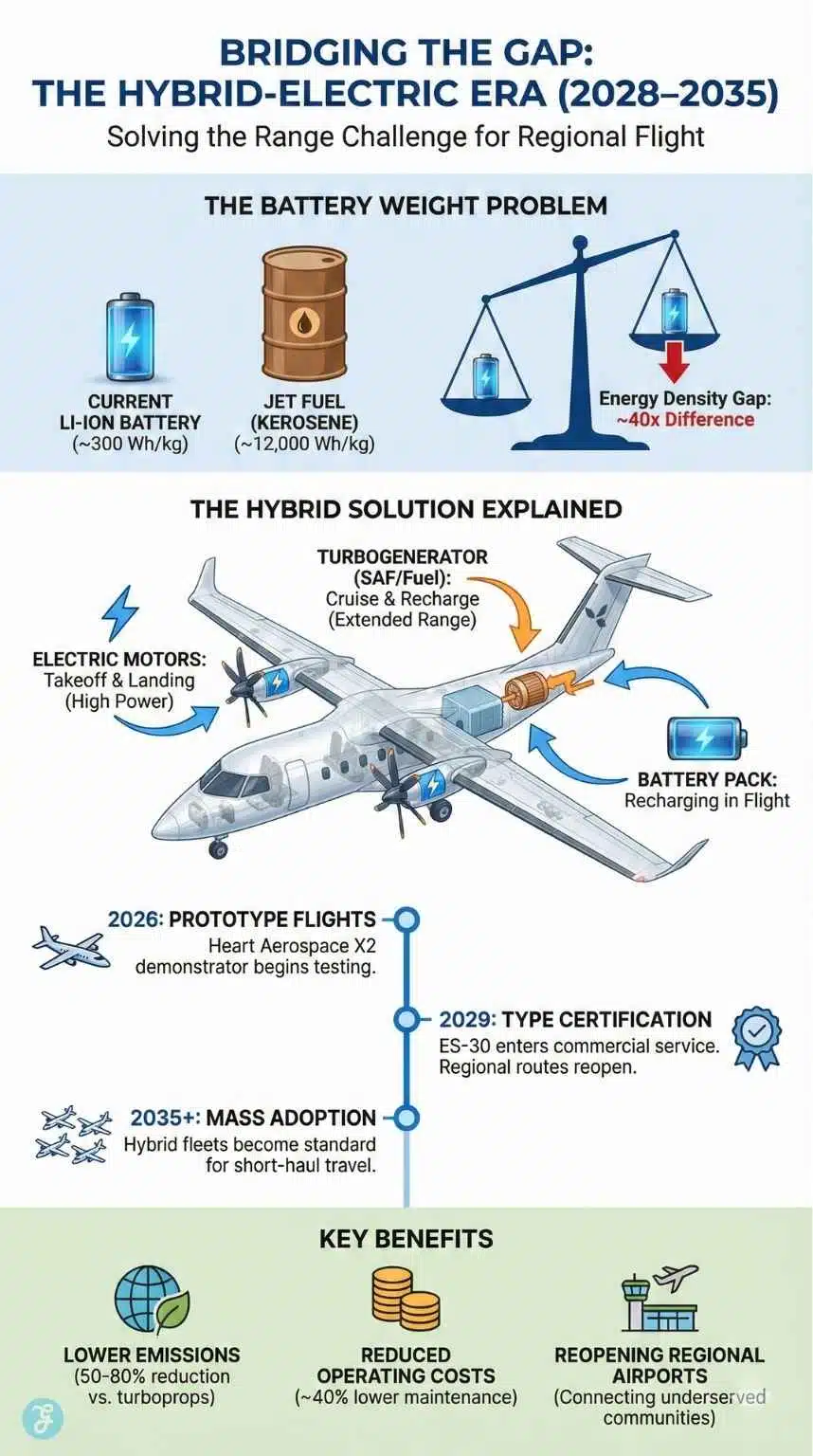
If eVTOLs are the “Ubers” of the sky, what about the buses? This is where the Regional Air Mobility (RAM) sector comes into play. For flights between 100 and 500 miles (e.g., London to Paris, or Los Angeles to San Francisco), pure electric power struggles with “range anxiety” due to battery weight. The industry’s answer for the next decade is hybrid-electric propulsion.
The Battery Density Gap
To understand why we can’t fly purely electric from New York to London yet, we have to look at Gravimetric Energy Density, the amount of energy a battery holds per kilogram of weight.
- Jet Fuel (Kerosene): ~12,000 Wh/kg
- Current Li-Ion Batteries: ~260–300 Wh/kg
- Solid-State Batteries (2026 Lab status): ~450–500 Wh/kg
Even with the promising solid-state breakthroughs seen in 2025, batteries are still roughly 24 times heavier than jet fuel for the same energy output. This makes pure electric flight impossible for large aircraft today.
The Hybrid Solution
Hybrid-electric aircraft function similarly to a Toyota Prius. They use powerful electric motors for the energy-intensive takeoff and landing phases, and a smaller turbogenerator (running on SAF or jet fuel) to cruise and recharge the batteries mid-flight. This slashes emissions by 50-80% without sacrificing the range needed for regional travel.
Key Player: Heart Aerospace
The Swedish company (now expanding in the US) Heart Aerospace is the standard-bearer for this segment. Their aircraft, the ES-30, is a 30-passenger regional plane designed to reopen small regional airports that have been abandoned by major airlines.
- 2026 Milestone: Following the rollout of their “X1” demonstrator, 2026 is the year for the X2 prototype to begin rigorous hybrid-propulsion flight testing.
- The Vision: The ES-30 targets a 2029 type certification. It promises a fully electric range of 200km and a hybrid range of up to 800km.
- Market Impact: This aircraft isn’t just about being green; it’s about economics. Electric motors have barely any moving parts compared to a turboprop engine, reducing maintenance costs by nearly 40%. This allows airlines to profitably fly routes that were previously too expensive to operate.
The Ticket Price Reality: Luxury or Mass Transit?
The technology works, but will it bankrupt you to use it? One of the biggest myths of electric aviation is that it will immediately be “as cheap as a bus.” In 2026, that is simply not true. However, it is also not reserved for billionaires.
The “Uber Black” Benchmark Joby Aviation, Archer, and other major operators have consistently modeled their initial pricing around Uber Black rates.
- 2026-2027 Estimate: approx. $4.00 – $6.00 per passenger mile.
- Example: A 20-mile trip from JFK Airport to downtown Manhattan would cost roughly $100–$120.
- Comparison: A standard Uber X might cost $60–$80 for the same trip (taking 70 minutes), while a traditional helicopter charter costs $250+ (taking 10 minutes).
- The Value Proposition: You are paying a ~40% premium over a luxury car ride to save an hour of your life.
The Path to “Uber X” Pricing [2030s]
The industry goal is to drive costs down to $2.50 per mile by the early 2030s. How?
- Scale: Manufacturing 5,000 aircraft a year drops the unit cost significantly compared to building 50.
- Autonomy: In 2026, you are paying for the pilot’s salary. Once regulations allow for autonomous flight (likely post-2030 in the US/EU), the cost per seat drops by roughly 30%.
- Maintenance: Electric motors have one moving part. A gas turbine has hundreds. Over time, the maintenance savings (approx. 40% less than helicopters) will be passed down to the ticket price.
Summary: In 2026, electric aviation is a “premium utility”, accessible to business travelers and urgent commuters, but not yet a replacement for your daily subway ride.
The Physics Barrier: Why Big Jets Are Still Dirty
It is crucial to manage expectations for the aircraft most people fly: the Boeing 737s and Airbus A320s of the world. For these workhorses, there is no path to full electrification in the foreseeable future (pre-2050).
The Weight Spiral
If engineers tried to electrify a Boeing 737 using today’s best batteries to achieve its standard range, the battery pack alone would weigh nearly 350 tons. The maximum takeoff weight of a current 737 is roughly 80 tons. The plane would literally be too heavy to lift itself off the ground, let alone carry passengers.
Even with “magic” batteries that are 5x better than what we have today, the physics of hauling that dead weight (batteries don’t get lighter as they empty, unlike fuel tanks) makes long-haul electric flight a non-starter.
The “Zero-Emission” Illusion?
Because of this, when major airlines talk about “Net Zero 2050,” they are not talking about electric planes. They are banking entirely on Sustainable Aviation Fuel (SAF) and, eventually, hydrogen.
The Long-Haul Solution: Hydrogen & SAF
If batteries can’t do the heavy lifting, molecules must. The future of electric aviation for big jets is actually not electric at all, it’s chemical.
Sustainable Aviation Fuel (SAF)
SAF is a biofuel made from waste oils, agricultural residues, or even captured carbon. It is a “drop-in” fuel, meaning it can be poured into existing jet engines without modification.
- 2026 Status: US production capacity is hitting a record high of approximately 4.5 to 5 billion gallons per year. While this is a massive increase from 2020, it is still a drop in the bucket compared to the global demand of ~100 billion gallons.
- The Problem: SAF is currently 2–3 times more expensive than standard jet fuel. Without massive government subsidies or carbon taxes, airlines are hesitant to buy it in bulk.
Hydrogen Propulsion: The True Zero
Airbus is betting the farm on hydrogen with its ZEROe project. Hydrogen has a specific energy 3x higher than jet fuel, making it incredibly light. However, it takes up 4x the volume and must be stored at -253°C (cryogenic liquid).
- Hydrogen-Electric (Fuel Cell): Hydrogen is fed into a fuel cell to create electricity, which turns a propeller. This is viable for regional aircraft (50–80 seats).
- Direct Combustion: Hydrogen is burned directly in a modified jet engine. This is the only viable path for larger, longer-range aircraft.
- Timeline: Airbus aims to have a hydrogen commercial aircraft in service by 2035, but prototype testing in 2026 is critical to proving the safety of cryogenic storage tanks in the sky.
Infrastructure & Regulatory Challenges
The aircraft are being built, but is the ground ready? The infrastructure gap is perhaps the most under-reported risk to the 2026 electric aviation launch.
The Grid Gridlock
Charging a fleet of 50 eVTOLs at a vertiport requires the power equivalent of a small shopping mall or a neighborhood.
- Megawatt Charging System (MCS): The industry is standardizing around MCS, a connector capable of delivering over 1MW of power. This allows an air taxi to charge in the 7–10 minutes it takes for passengers to swap out.
- Grid Upgrades: Airports like Dubai (DXB) and LAX are undergoing massive substation upgrades to handle this new load.
Certification Hell
The FAA and EASA (European Union Aviation Safety Agency) are rewriting the rulebook in real-time. Certifying an aircraft that relies on software to stay stable (Fly-By-Wire) is infinitely more complex than certifying a mechanical Cessna.
- The “Urban” Risk: Unlike planes that crash in open fields, eVTOLs operate over densely populated cities. The safety standard is 10^-9, meaning less than one catastrophic failure per billion flight hours, a standard usually reserved for commercial airliners, now being applied to air taxis.
The Green Dilemma: Batteries & Noise
While “Zero Carbon” is the headline, electric aviation brings two other massive environmental changes: one visible (or rather, audible), and one hidden in the supply chain.
The Sound of Silence: Acoustics as a Feature
If you have ever lived near a heliport, you know the bone-rattling “wop-wop” sound of a helicopter blade slapping the air. This is caused by “blade vortex interaction.”
- The Electric Difference: eVTOLs use multiple small propellers spinning at different speeds. This distributes the sound frequency, turning that low-frequency thumping into a higher-pitch “hum” that dissipates quickly in the atmosphere.
- The Data: In flyover tests, aircraft like the Joby S4 register around 45 decibels at 500 meters altitude.
- Context: A quiet conversation is 60 dB. A vacuum cleaner is 70 dB.
- Result: In a busy city with ambient traffic noise (approx. 50–55 dB), an electric air taxi flying overhead is effectively inaudible to pedestrians. This “acoustic invisibility” is the key to getting permission to land in city centers.
The Hidden Cost: The Lithium Loop
However, the “clean” image has a dirty secret: Batteries. The lithium-ion packs powering these aircraft have a limited lifespan. Because aviation requires peak performance, a battery might be considered “expired” for flight when it still holds 80% capacity (unlike your phone, which you use until it dies).
- The Second-Life Opportunity: These “retired” flight batteries are perfect for ground energy storage—storing solar power for the vertiports themselves.
- The Recycling Gap: As of 2026, the global capacity to recycle aviation-grade lithium batteries lags behind production. Stanford University research (2025) highlights that while recycling emits 58-81% less greenhouse gas than mining new lithium, the infrastructure to collect and process these massive aviation packs is still in its infancy.
- The Risk: Without a closed-loop recycling mandate, the industry risks trading CO2 emissions for a toxic waste problem. Sustainable aviation isn’t just about what comes out of the tailpipe (or lack thereof); it’s about where the battery goes when the flight is over.
Final Thought: A Sky Divided
As we move through 2026, we must accept a “sky divided.” The lower airspace, our cities and suburbs, will become increasingly electric, quiet, and vertical. The upper airspace, the realm of the stratosphere cruisers, will remain liquid-fueled for decades to come. The Future of Electric Aviation isn’t a single revolution; it’s a layered evolution. We won’t all be flying electric tomorrow, but for the first time in history, some of us actually will.
Are you ready to book your first air taxi? Keep your eyes on Dubai this winter.