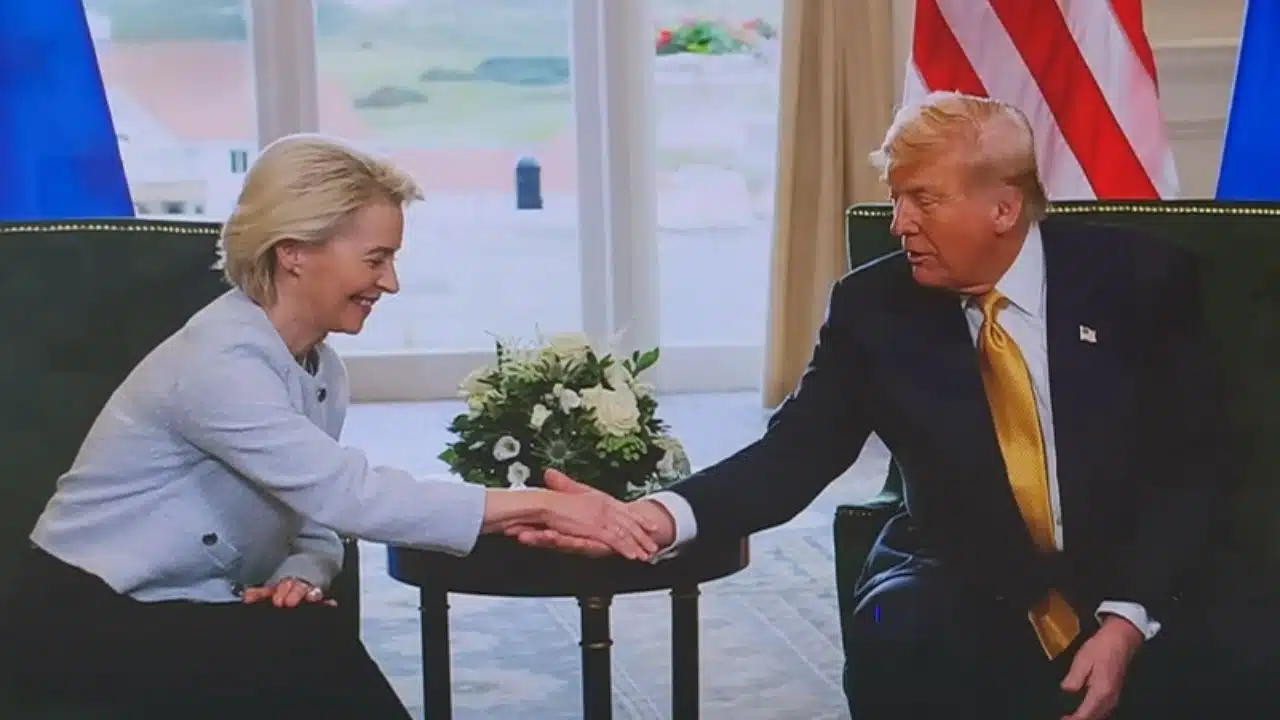
The recent trade deal struck between European Commission President Ursula von der Leyen and U.S. President Donald Trump has triggered a deeply divided reaction across Europe. While the agreement is being hailed by some as a necessary step to avoid economic escalation, key EU powerhouses like France and Germany have voiced serious concerns about its economic impact and the broader implications for the European Union’s sovereignty and trade independence.
The agreement—reached after private negotiations between von der Leyen and Trump at his Turnberry golf course in Scotland—will impose a 15% tariff on most EU exports to the United States. This is a reduction from the initial threat of 30% tariffs that had sparked fears of a full-scale trade war.
In return, the EU has agreed to increase imports of American energy products and reduce import taxes on certain U.S. goods. The final implementation of the deal will require formal approval from all 27 EU member states, each of which has different economic priorities and varying levels of dependence on U.S. trade.
Germany and France Criticize the Deal’s Terms and Impact
Germany and France, the two largest economies in the European Union, have emerged as the most vocal critics of the trade agreement. German Chancellor Friedrich Merz delivered a stark warning about the deal’s potential consequences, stating it would “substantially damage” Germany’s financial and industrial landscape. He emphasized that despite the EU negotiating team’s best efforts, it was virtually impossible to secure more favorable terms with a U.S. administration as aggressive as Trump’s on trade.
Meanwhile, French Prime Minister Francois Bayrou offered an even harsher condemnation, suggesting that the deal represents a loss of dignity and autonomy for Europe. Taking to X (formerly Twitter), Bayrou said, “It is a dark day when an alliance of free peoples, brought together to affirm their common values and to defend their common interests, resigns itself to submission.”
These statements reflect a broader unease among EU policymakers who feel the bloc was strong-armed into an agreement that may offer short-term relief but carries long-term strategic risks.
Uneven Enthusiasm Across Europe
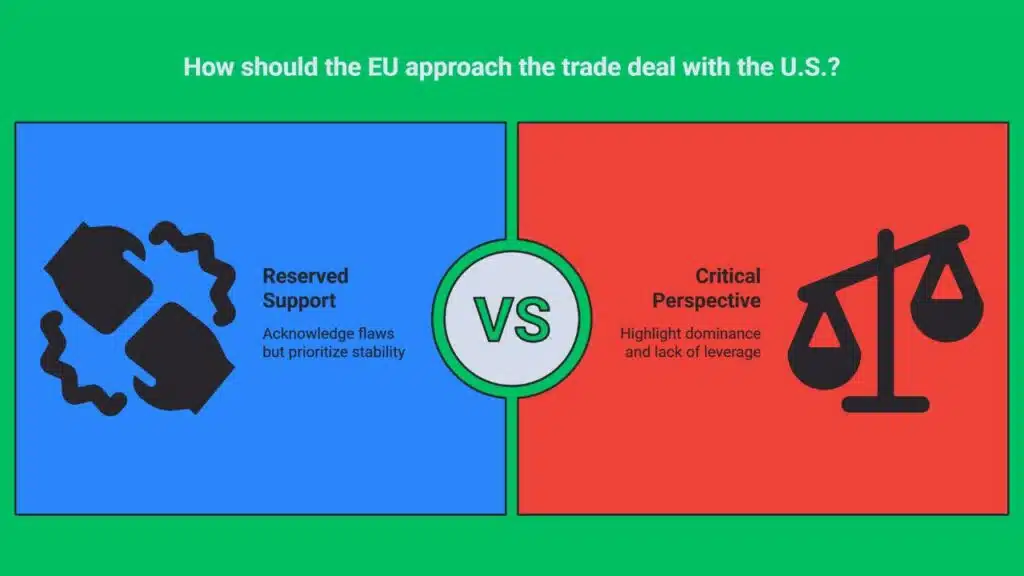
While no EU country has yet threatened to block the deal outright, there is a marked lack of enthusiasm from many national leaders. Spanish Prime Minister Pedro Sanchez declared that his government would approve the deal but “without any enthusiasm”. His reserved stance reflects a sentiment shared by many: that although the deal is deeply flawed, rejecting it could have unleashed even worse economic consequences.
Hungarian Prime Minister Viktor Orban, known for his close political alignment with Trump, used more colorful language to describe the dynamics of the negotiation, saying the U.S. president had “eaten von der Leyen for breakfast.” Orban’s comment underlines the perception that Trump dominated the talks and left little room for genuine EU leverage.
In contrast, leaders from smaller EU economies such as Finland and Ireland showed a more pragmatic tone. Finland’s Prime Minister welcomed the deal as bringing “much-needed predictability” to EU-U.S. relations in a time of geopolitical uncertainty. Irish Trade Minister Simon Harris also expressed cautious support, noting that the deal would offer stability that is crucial for safeguarding jobs, promoting investment, and supporting economic recovery across the bloc.
Brussels Defends the Agreement Amid Criticism
At a press conference in Brussels, EU Trade Commissioner Maros Sefcovic defended the deal against the growing backlash. He described it as the “best deal we could get under very difficult circumstances”, pointing to the relentless pressure from the Trump administration and the global economic turbulence caused by ongoing geopolitical tensions, especially the war in Ukraine.
Sefcovic emphasized that beyond trade, the deal serves important geopolitical purposes, including keeping the EU and the U.S. aligned in their foreign policy approach toward Russia and China. He acknowledged the sacrifices made in the negotiation but argued that they were necessary for the broader strategic interests of the EU.
He also reiterated that the agreement is not final until technical discussions are completed and ratification is secured from all EU member states. These next steps will be crucial in determining how the deal is shaped and how individual countries negotiate their national interests within the broader framework.
Tensions Around EU Sovereignty and Strategic Autonomy
The trade deal has sparked renewed debate within the EU about the bloc’s ability to act as a unified global economic force. In the weeks leading up to the final round of negotiations, some European leaders were exploring tougher “anti-coercion” mechanisms that would have restricted U.S. companies’ access to European markets in response to Trump’s tariff threats.
However, those plans were sidelined when the Trump administration signaled it would go ahead with punishing 30% tariffs on key European goods unless an agreement was reached quickly. As a result, the EU opted for a compromise that reduced the severity of the economic blow, albeit at the cost of strategic concessions and weakened leverage.
Critics say that the EU’s decision to bow to U.S. pressure sets a troubling precedent and undermines the EU’s long-term goals of achieving technological sovereignty, especially in key areas like digital regulation, green energy policy, and pharmaceutical pricing frameworks.
U.S. Business Reaction: Relief, But With Reservations
The initial reaction among American business groups has been similarly mixed. The National Foreign Trade Council (NFTC), a major U.S. trade advocacy group based in Washington D.C., welcomed the avoidance of an outright trade war, describing it as a “positive step” in the short term.
However, the Council expressed concern about the long-term impact on trust and partnership between the U.S. and the EU. It noted that industries like aerospace, pharmaceuticals, and manufacturing had flourished under the previous tariff-free regime, and warned that the new 15% tariff structure could dampen transatlantic innovation and cooperation.
Furthermore, the NFTC criticized the deal for failing to resolve existing disputes, such as what it termed the EU’s “discriminatory digital agenda” and “unfair pharmaceutical reimbursement policies.” These unresolved issues could continue to sour relations between both sides, the group warned.
Final Deal Still Under Development
Although the broad outlines of the agreement have been announced, the final version of the deal has yet to be written. Over the coming weeks, technical negotiations will be held between trade officials on both sides of the Atlantic to finalize the specifics, including which products are covered by the new tariffs and how energy purchasing agreements will be structured.
These discussions are expected to be complex, with multiple interest groups—ranging from national governments to industry associations and consumer advocates—weighing in.
Fragile Win or Strategic Surrender?
The EU-U.S. trade deal has delivered a temporary sigh of relief in Brussels and Washington by avoiding a high-stakes economic confrontation, but it has also exposed deep fractures within the European Union’s approach to global trade diplomacy.
For many in Europe, particularly in Berlin and Paris, the deal feels like a strategic retreat—an unavoidable compromise in the face of an unpredictable U.S. president. For others, it’s a necessary evil to preserve economic stability and political unity in a volatile global environment.
Whether this agreement marks a new chapter of transatlantic cooperation—or a slow unraveling of mutual trust—will depend on how both sides handle the next phase of negotiations and whether the spirit of partnership can overcome the tone of submission that now defines much of the public conversation.
The Information is Collected fr0m BBC and Yahoo.