Many traders feel stuck when they start forex trading, crypto, or stock trading. They face a maze of charts, fees, and fast swings. They want clear rules, stable moves, and low stress.
Stocks win on rules and steady gains, while crypto, backed by distributed ledger tech, shows wild swings. The foreign exchange market trades currency pairs 24/7 and lets you use high leverage.
This post will compare trading hours, fees, liquidity, and risk tolerance. It will show backtesting strategies and demo tools like a market tester. Keep reading.
Key Takeaways
- Forex accounts clear in 30 minutes with a $50 deposit. Crypto apps need 10 minutes and $10. Stocks take 1–2 days to verify with $0 cash, $2,000 margin, or $25,000 for 4:1 intraday.
- Crypto trades 24/7. Forex trades 24 hours a day, five days a week. Stocks trade from 9:30 AM to 4:00 PM EST. Forex fills near-instantly, stocks fill in milliseconds on large caps, and crypto fills in seconds on top tokens or minutes on thin coins.
- Crypto prices can swing up to 30% in one day. Forex pairs show lower volatility but react fast to central bank news. Stocks stay steadier, though earnings can trigger big moves. Traders get 50:1–100:1 leverage in forex, up to 100:1 in crypto, and 2:1 retail or 4:1 intraday in stocks.
- Stocks cost about $4.95 per trade on many brokers or zero on some apps. Crypto on Coinbase can carry fees up to 0.75%. Forex traders pay under 1 pip via spreads. Morpher charges zero fees and lets users stake MPH tokens at 11% APY.
- Stocks suit new traders with clear rules, paper trading, and firm research. Forex demands study of currency pairs, interest rates, and economic reports. Crypto needs caution with scams and tech shifts. Platforms like MT4, Coinbase, Robinhood, eToro, Fidelity, and Morpher all offer demo tools.
Market Accessibility
Good forex brokers let you open an account, drop in a few dollars, then trade currency pairs on a trading platform almost instantly. Crypto wallets and blockchain apps stream orders in seconds, while brokerage accounts for stock traders demand forms, IDs, and heftier deposits.
Ease of entry for Forex, Crypto, and Stocks
Here is a quick view of how you can join each market fast.
| Market | Barrier | Account Setup | Min Funds | Regulation | Platform Example |
|---|---|---|---|---|---|
| Forex |
|
|
$50 start | FCA, ASIC, NFA rules | MT4 demo or live |
| Crypto |
|
|
$10 often | Few rules; high risk | Binance, Morpher (zero fees, welcome bonus) |
| Stocks |
|
|
|
SEC, FINRA strict rules | Robinhood, Charles Schwab |
Trading Hours Comparison
TradingView shows forex markets run nonstop from Sunday evening to Friday, crypto exchanges like Binance never sleep, and the NYSE and NASDAQ clock out at 4 p.m. EST on weekdays—read on to pick your best trading window.
Availability of 24/7 trading vs restricted market hours
The cryptocurrency market trades around the clock. Retail traders can buy digital assets at any hour on a crypto exchange or blockchain network. The forex market runs 24 hours a day, five days a week on platforms like MetaTrader.
Day traders watch currency pairs and exchange rates for fast moves.
Stock market sites at the New York Stock Exchange and Nasdaq run from 9 30 AM to 4 PM Eastern time. After hours trading feels riskier, with wider spreads and low volume. Institutional investors may see big moves while retail traders cannot act.
Time zones leave some traders out of action and limit chances to spot events.
Volatility and Risk Levels
Crypto volatility can feel like a frog dancing on hot coals, and forex price fluctuations can drop faster than a raindrop in a storm. Keep reading to see how traders use margin accounts and analysis tools on platforms to tame wild swings.
Evaluating price fluctuations in each market
Digital assets swing as much as thirty percent a day, driven by few rules and frequent scams. That shocks many speculators, some might spill coffee on their screens. Forex traders see lower peaks in volatility, yet central bank rate moves often shift currency pair prices with little warning.
Volatility varies by the pairs traded, so day trading or swing trading calls for keen attention to price fluctuations.
Stocks stay calmer most days, though share prices can spike around earnings or big economic events. Traders use technical analysis, bid and ask data, and market sentiment to gauge risk in each market.
Tools like moving averages or Bollinger Bands help spot trending phases or breakouts across currency trading and public stocks.
Liquidity and Trade Execution
Major forex pairs stack deep limit orders on MT4, so the broker API fills your trades in a flash, you barely miss a beat. On a spot crypto market, big tokens flow easy, but small coins sit in shallow books and pay the slippage toll.
How quickly trades are executed in Forex, Crypto, and Stocks
Check out how fast trades fill in each market.
| Market | Execution Speed | Key Factors |
|---|---|---|
| Forex |
|
|
| Stocks (Regular) |
|
|
| Stocks (Extended) |
|
|
| Crypto |
|
|
Cost of Trading
Big spreads, hefty commissions, or sneaky slippage on a trading platform or crypto exchange can nibble away at your cash, so read on to find out how to trim those fees.
Comparing fees, spreads, and commissions
Major equity shares cost about 4 dollars and 95 cents per trade on many stock exchanges, but some zero fee brokerages cut that charge. Meanwhile, digital assets like Bitcoin and Ethereum carry fees up to 0.75 percent per transaction on Coinbase, especially for smaller tokens.
The currencies market uses spreads as its main cost, often under 1 pip on major pairs. Traders skip commission fees there, but they must watch for changing spread levels.
Morpher Platform eliminates all fees, so traders focus on price moves. Retail traders earn more on each win without commission drag. Lower costs boost risk management and margin trading on many trading platforms.
Algorithmic trading bots execute more often with no cost barriers.
Leverage and Margin Availability
Leverage can feel like a rocket on a euro-dollar swap, but it can burn you if you ignore your margin. Compare margin caps in charting software like MT4 and on an exchange like Binance to find your comfort zone.
Opportunities and risks with leverage in each market
Forex traders can use up to 30:1 leverage thanks to rules by central banks, but market moves from economic reports and interest rates can trigger rapid losses. Crypto markets let users borrow 100x on digital assets, but blockchain tech volatility can wipe out accounts when price drops surprise even seasoned swing traders.
Stock markets cap leverage at 2:1 for retail traders, though margin accounts lift this limit to 4:1 in some cases. Morpher Platform offers X10 on all markets, so traders must watch risk tolerance and use strict risk management to avoid overleveraged losses.
Regulation and Security
Regulators and central banks impose strict rules and run regular audits to guard your trades in stocks, forex and digital assets. But digital ledgers still beckon hackers like moths to a flame, so spy on platform security before you invest.
How regulated and secure each market is
Publicly listed firms file financial reports with a federal regulator. This step gives retail traders and institutional investors clear data on profit and debt. Equity markets gain high transparency and cut financial risks.
Forex trades run over the counter through banks, under rules from a market watchdog and central banks. That setup feels more opaque than stock exchanges, so traders must use solid risk management.
Cryptocurrency trading runs on a decentralized network with no uniform oversight. This structure raises fraud risks for digital assets, like fake coin launches. Morpher uses blockchain technology to lock trades on a public ledger, boosting security and transparency.
Traders with low risk tolerance can use these tools to guard against scams.
Tools and Platforms for Beginners
Retail traders can explore currency pairs with a free practice account on a beginner-friendly charting suite powered by blockchain technology—read on for more.
User-friendly platforms for trading Forex, Crypto, and Stocks
Trading multiple markets can overwhelm new investors.
Morpher cuts that friction with an all-in-one interface, zero commissions, instant settlement, and 24/7 access.
- Morpher: This platform combines forex trading, cryptocurrency trading, and equities in one view, with fractional stake options and an audit trail on blockchain technology.
- MetaTrader 4: Widely used by retail traders for currency pairs, it features chart indicators, expert advisors, and demo mode that helps test risk tolerance before real stakes.
- Coinbase: This exchange makes blockchain transfers simple, offers a secure wallet for digital assets, provides an otc desk for large trades, and covers major cryptocurrencies so novices can study inflationary pressures in crypto markets.
- Robinhood: Users trade publicly quoted equities, trend-following ETFs, and stock options without fees, tapping NASDAQ and NYSE liquidity while learning about macro-economic factors.
- eToro: Social trading on this site lets investors copy swing trading strategies from hedge funds, covers forex and digital assets, and even lets users stake coins to earn yield.
- Fidelity: Known for low-cost stock and bond trades, detailed fund screeners for mutual funds and ETFs, and research on interest rates, geopolitical events, and economic reports.
Learning Curve and Complexity
Most new traders spend weeks on risk management and trading strategies in each market. A solid charting platform and a practice tool can cut that time, like dropping training wheels and speeding off.
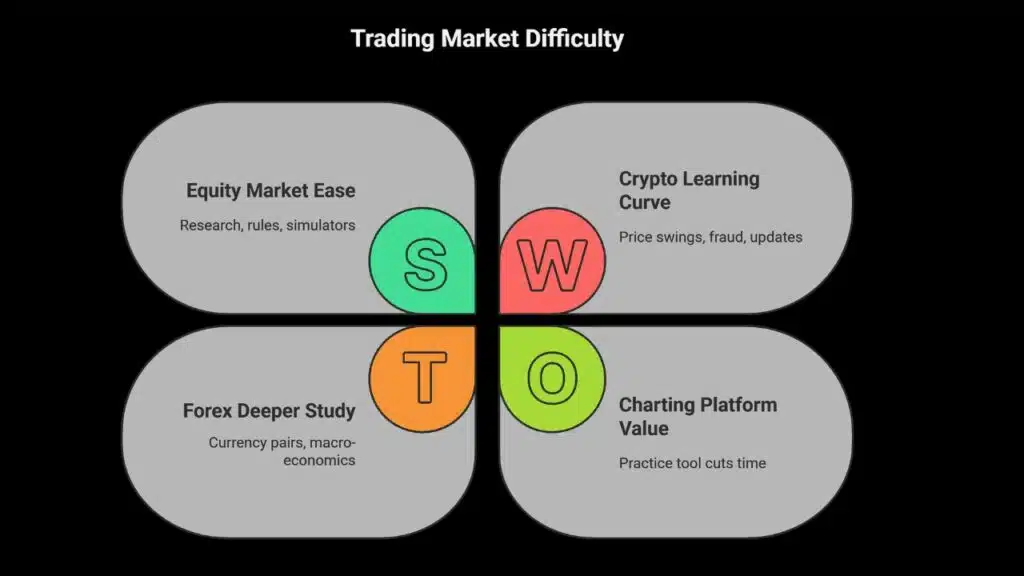
Equity market greets new retail traders with a wealth of research and firm rules. Regulated exchanges, like NASDAQ quotes, guide buying and selling. Paper simulators and backtesting tools let learners test trading strategies without real risk.
Stocks suit low-risk-tolerance investors and swing trading fans.
Foreign exchange demands deeper study of currency pairs and macro-economic events, like interest rate shifts and central bank reports. It tests risk management skills more than equity investing.
Cryptocurrency trading jumps even higher, with wild price swings, fraud risks, and fresh blockchain technology updates popping up daily. Lack of clear rules and thin research sources slows learners.
Potential for Profitability
Traders track risk-reward ratio and watch ROI climb. They use a charting platform to spot shifts fast.
Assessing ROI in Forex, Crypto, and Stocks
Stocks shine on long term gains. Publicly traded companies pay dividends that drive compounding returns. The currency market offers tight spreads on base currency and quoted currency pairs, fueling fast moves for forex trading fans.
A swing in pips can net real profit, yet central banks and geopolitical events can flip trends in moments. Digital coins tempt speculators with sharp spikes on blockchain technology, but risk management lapses can lead to heavy losses.
Morpher lets users stake MPH tokens at 11% APY for passive income beyond mere price bets. Intraday traders grab small wins in OTC markets while swing trading equity sections or digital assets can suit varied trading styles.
Institutional investors watch economic reports and interest rates to time entries. Retail traders can match their investment objectives and risk tolerance to macro economic factors.
ROI hinges more on strategy and disciplined risk management than on choosing one financial market.
Market Drivers and Influences
Central banks, Fed rate moves, big data reports, ledger tech shifts and liquidity crunches drive price swings in FX, crypto and stocks—keep reading to learn more.
Key factors affecting each market’s performance
Interest rate changes drive forex trading moves all over the world. Inflation announcements can spark big swings in quote currency values, so traders watch central banks, forex brokerages, and economic reports closely.
Geopolitical events add drama, sending speculators on a roller coaster ride. Retail traders and institutional investors apply risk management to tame volatility.
Swing trading and trend following in the stock market often hinge on earnings reports and economic indicators. Equity traders scan company news and sector developments before they place orders.
Digital assets move on sentiment shifts and regulatory news, making cryptocurrency trading a high-risk game. Blockchain technology upgrades can fuel fresh momentum or trigger sharp drops.
Suitability for Different Trading Styles
Swing traders lean on stock exchange orders, using a cloud charting tool, to ride mid-term trends in equities. Day traders often leap into the FX market with margin and currency pairs, or into digital assets on a peer-to-peer ledger, so pick your style and read on to match it with the right platform.
Day trading, swing trading, and long-term investing
Day trading feels like a sprint on the stock market highway. Long-term investing moves at a marathon pace on a less crowded path.
- Day trading tests retail traders’ nerves in forex trading, crypto trading, and stock market moves; they buy and sell currency pairs, Bitcoin, or shares in seconds, use technical analysis on MetaTrader 4, juggle tight spreads, adapt risk tolerance, and speculate on tiny gains.
- Swing trading fits those who hold positions for days or weeks in forex market or cryptocurrency market; traders mix chart signals with fundamental analysis, track central banks, economic reports, and geopolitical events, set stop orders, and ride midterm trends.
- Long-term investing suits people who seek compounding and dividend income in bonds or publicly traded companies; some hold only Bitcoin and Ethereum as digital assets built on blockchain technology, watch interest rates, macro-economic factors, and ride cycles in the secondary market.
Emotional Challenges in Trading
Fear can cloud your trading moves. Big swings can test your risk tolerance on a charting tool.
Stress and psychological factors in each market
Crypto swings can hit 30% in a single session. Retail traders face an emotional rollercoaster with each flicker of price. Lack of rules in cryptocurrency trading invites more doubt and fear of fraud.
Distributed ledger can feel like unknown ground. This strain will test anyone’s risk tolerance. Strong moves in exchange rates can do the same in forex trading. Central banks shape these shifts by changing interest rates.
Geopolitical events can strike like a storm, forcing rapid decisions under pressure.
Stocks on a stock exchange move with steadier rhythms. Publicly traded company shares often pay a small dividend, easing anxiety. A swing trading plan in equities can strengthen risk management.
Market liquidity in a financial market gives quick exits. Investors can use simpler trading strategies. This calm can help build mental resilience for future market swings.
Takeaways
Select the market that fits your risk style and journey. Stocks need a calm mind and bull scenarios. Forex thrills when you watch central banks and currency pairs dance. Crypto can feel like a roller coaster, so try paper trading on Forex Tester Online or a stock simulator on Morpher before you risk real cash.
FAQs
1. What market fits my risk tolerance, forex, crypto, or stocks?
Your risk tolerance shapes the best option. Forex trading and digital assets can spike fast. Stock market prices may rise or dip with macro-economic factors. Use risk management to guard your funds.
2. How do trading hours differ across the forex market, cryptocurrency market, and stock market?
The forex market runs around the clock, thanks to global central banks. It is an over-the-counter market. Cryptocurrency trading never sleeps, open 24/7. Stocks trade during official hours on regulated exchanges, like the National Association of Securities Dealers Automated Quotations.
3. Can retail traders use swing trading in all markets?
Swing trading fits both the stock market and forex. It suits many retail traders and even some institutional investors. You can watch currency pairs overnight, then close trades at dawn. You can hold shares for days, ride the wave, then lock in gains.
4. Do geopolitical events and economic events impact these markets?
Geopolitical events and economic events shake all three markets. Forex trading reacts fast to interest rates set by central banks. Stock market rallies or tumbles based on earnings or policy hints. Crypto can fidget, but it feels less tied to macro-economic factors.
Many call crypto a safer haven, but digital assets can still crash. Cryptocurrency trading rides on blockchain technology. Currency pairs can act safe when you pick a stable quote currency. Company shares can pay dividends, they can offer steady income.
6. How do investment objectives shape trading strategies in different financial markets?
Your investment objectives guide trading strategies. If you seek quick gains, you might favor cryptocurrency trading or forex for fast moves. If you want steady growth, you may pick stocks and swing trading. Whatever your goal, use risk management rules, watch economic events, and pick a financial market that fits your trading style.