Many networks face slow links and weak security on smart devices. You may see lags on video calls or fear a data breach. Emerging Trends In ISP Network Architecture can fix these pains.
5G brings fast speed, low lag, and more capacity for cloud apps and IoT. This post shows nine ways to build a strong, fast network. It covers AI, Machine Learning, edge computing, Software-Defined Networking, and security devices by Fortinet.
Read on.
Key Takeaways
- ISPs use zero-trust and SASE to guard every packet with zones, RADIUS servers, multi-factor login, and blockchain. This meets compliance and blocks phishing (41 % of 2022 breaches) after the 2021 T-Mobile hack ($350 M payout).
- AI and ML in SDN and NFV spot loops, block threats, cut queue time by 50 %, and keep uptime at 99.99 %. Banks and finance firms use DevSecOps scripts for real-time traffic shaping.
- SD-WAN links devices to apps and grows at a 30 % CAGR from 2023 to 2027. SASE adds firewalls, secure web gateways, and zero-trust access for e-commerce and IoT.
- 5G now spans 70 nations. Labs in Finland and Japan test AI-driven 6G slices for sub-millisecond lag and terabit uplinks in telemedicine, AR surgery, and VR.
- Edge computing moves AI and ML to hubs in factories, hospitals, and ports. It cuts lag for AR, IoT sensors, and digital signage. Ericsson and Nokia rolled out network slicing in 2024 to shift capacity on demand.
The Rise of Zero-Trust Architecture
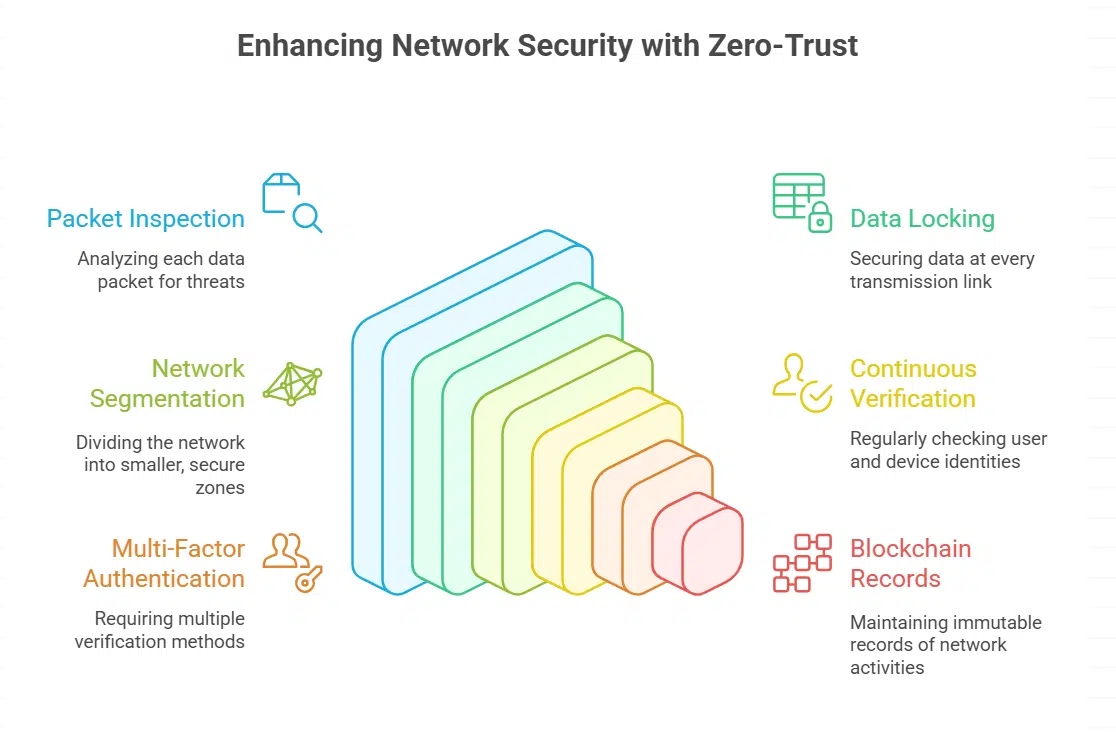
Security teams pull down walls and guard every packet like a hawk. Zero-trust model assumes no trust by default. It forces data locking on every link and splits networks into small zones.
Breaches happen more often and grow more complex.
IT staff apply continuous verification, multi-factor authentication and blockchain records. This method boosts network security and blocks lateral moves during cyberattacks. RADIUS servers verify IoT devices before they join the network.
It also helps meet strict compliance rules.
Integration of AI and Machine Learning for Network Optimization
Big data streams flood routers every second. AI and ML power predictive analytics engines in software-defined networking to watch flow patterns. A bank IT team sees an alert pop up.
That deep learning engine found a loop. That engine triggers an intrusion prevention system and updates access controls in real time. This traffic-shaping trick cuts queue time by half.
IoT gadgets in offices get smoother connections. Network function virtualization helps scale the fix across data centers in minutes.
AI picks the best routing path before traffic jams start. It boosts network performance and cuts packet loss. A financial services firm taps that tech to guard data security and keep its platform uptime above 99.99 percent.
Machine learning algorithms automate routine checks and alert teams to cyber threats fast. Intent based networking links business goals to real time actions. Cloud computing nodes and edge computing hubs share the work.
DevSecOps scripts update security architecture as threats change. Operators gain more control over network management.
Expansion of 5G and Preparation for 6G Technologies
5G launched in 2018 and now spans 70 nations. It delivers rapid throughput, minimal lag, and soaring capacity. Cities tap 5G for IoT sensors that track traffic and air quality, while airports secure passenger data on private slices.
Doctors use AR on private 5G links for remote surgeries. Manufacturers cut downtime as factory floors run real-time monitoring on connected devices.
Engineers map future 6G networks around quantum networking and AI-driven spectrum management. They aim for sub-millisecond response times and terabit-level uplink speeds. Labs in Finland and Japan test prototypes with programmed signal arrays and virtualized services.
That groundwork supports network slicing for custom QoS in telemedicine and VR.
Edge Computing for Reduced Latency and Improved Performance
Sensors, cameras, and IoT devices send data to small data centers near factories or hospitals. Edge nodes run AI and ML models. They spot anomalies in patient monitoring or smart grid flows in real time.
This process slashes delay and boosts network performance. Hybrid cloud links and SDN controls streamline traffic shaping. It cuts congestion and keeps quality of service high for industrial automation.
Freight firms deploy edge computing inside delivery hubs and ports. This move uses network function virtualization and security systems. It gives logistics teams real-time monitoring and predictive analytics.
Content delivery networks and load balancers handle bandwidth loads for AR and digital signage. The cloud still backs storage, but local compute cuts response time. 5G and low latency links support e-commerce apps and secure access service edge rules.
Evolution of SD-WAN into Secure Access Service Edge (SASE)
SD-WAN works like a traffic cop for data. It links devices to applications across any network. Software defined networking and network function virtualization power the setup. The service routes traffic with real-time monitoring to cut latency.
Industry reports show a thirty percent CAGR from 2023 to 2027. IoT expansion leans on this virtual fabric and skilled IT pros. Secure Access Service Edge fuses that mesh with security features.
Components include firewall as a service, secure web gateway and zero trust network access. The design blends network security with cloud computing and digital transformation.
E commerce brands merge SD-WAN with quality of service and real-time monitoring. They tap intrusion prevention systems to block cyber threats early. Machine learning and predictive analytics spot odd traffic spikes.
Edge computing and cloud delivered security stacks push checks close to users for speed. Zero trust network access pairs with multi factor authentication. AI tools ease network management and catch threats in real time.
Operations teams win higher network performance and simpler maintenance. SASE shapes network infrastructure for fast, secure internet services.
Network Automation and Orchestration for Streamlined Management
Engineers use artificial intelligence and machine learning to drive network automation. AI bots craft config scripts for routers and switches, cutting manual tasks in half, slashing error rates.
It feels like a robot butler who never misses a detail. This approach taps real time data processing and predictive analytics to watch for faults before they hit. A small glitch on a fiber link triggers a corrective script from an Ansible playbook, tweaking paths on the fly.
SDN splits control and data planes, using OpenDaylight controllers to centralize network management. ISPs feel more agile, with faster rollout for new services on hybrid clouds. It hooks to edge computing nodes at cell sites for low latency.
Orchestration stacks like Terraform tie together network function virtualization (nfv) on standard servers. These run firewalls, load balancers, and intrusion detectors as virtual apps on OpenStack clusters.
This cuts hardware costs and scales on demand. Engineers spin up or tear down slices in minutes to handle peak traffic, keeping quality of service high. It drives proactive maintenance in content delivery networks, and adapts to more devices on the internet of things.
Satellite internet and low earth orbit constellations plug in with the same tools, cutting costs and boosting performance.
Cloud-Native Networking and AI-RAN Implementation
Cloud-native networking harnesses container orchestration to scale services across multiple clouds. Multi-Cloud Networking spans public and private clouds with clear visibility and fine control.
It automates network function virtualization and software-defined networking tasks. Operators spin up microservices in seconds, cutting low latency and boosting quality of service.
Network as a Service bundles SDN, intent-based networking and ZTN, slicing bandwidth on demand. This model fits digital transformation and hybrid work setups. Teams apply consistent security policies across every environment.
AI-driven Radio Access Network tools tap real-time data processing and predictive analytics to route traffic. AI-RAN from the O-RAN Alliance optimizes resource allocation across cell sites.
It learns patterns in wireless links to cut congestion and lift network performance. Integrating this with cloud computing yields high-speed connections for remote offices and IoT devices.
Teams secure AI models with multi-factor authentication and threat detection. This mix boosts reliability for content delivery networks and low-earth orbit satellite links.
Network Slicing for Customized and Efficient Resource Allocation
Packet slicing uses software-defined networking and network function virtualization to split hardware. It lets providers serve 5G, cloud and IoT traffic on a single tower. It cuts latency for real-time data processing in AR and VR apps at the network edge.
It also gives quality of service control for voice, video and critical sensors. Developers can spin a new slice in minutes, not days.
Isolation blocks cyber threats across slices, boosting security. It keeps content delivery networks apart from smart meter streams. Engineers at Ericsson and Nokia adopted this feature in 2024.
They pair orchestration tools with predictive analytics to shift capacity on demand. Operators cut network congestion and boost performance across mobile and fixed links.
Enhanced Cybersecurity Measures with Blockchain and Multi-Factor Authentication

Blockchain links records with a shared ledger and consensus protocol. It stops tampering on IoT gear. Nodes run cryptographic hashing to seal each entry in real time. AI-driven analytics flag odd spikes fast.
This setup cuts phishing risk, the cause of 41 percent of breaches in 2022.
Service providers lock down sign-in with one-time codes and biometric checks after passwords. Hardware token tools and mobile app prompts serve as a second shield. A 2021 T-Mobile hack led to a $350 million payout.
Companies add multi-factor authentication to plug single-factor holes. Teams also run traffic monitoring, BYOD training, and crisis drills.
Sustainability in Network Architecture: Moving Toward Net Zero
ISPs shape new networks around green goals, cutting waste and costs. They design network architecture around carbon counts, aiming to trim energy consumption. Simplified deployments and hands-on training help teams meet sustainability targets.
Hardware makers now ship energy-saving switches and routers, while software patches add power-saving modes.
Net zero initiatives drive big infrastructure bets, from software-defined networking (sdn) and network function virtualization (nfv) to cloud computing hubs. Internet of things (iot) sensors and real-time monitoring track power in data centers, while artificial intelligence (ai) and machine learning (ml) steer cooling and server loads.
Edge computing cuts data hops, and content delivery networks (cdn) slice network miles to shrink carbon footprints. Automation and virtualization act like digital gardeners, pruning unused cycles for a lean, green network.
Takeaways
This list shows nine big shifts. Teams can use these ideas now. Local computing, secure network service edge, and AI power faster links. Low latency meets network security with network slicing and two-step login.
Take steps, test your setup, and plan for the next-gen network.
FAQs on Emerging Trends In ISP Network Architecture
1. What are the top trends in ISP network architecture for 2025?
Edge computing brings your data close to users. Software defined networking and Network Function Virtualization let providers spin up services fast. Cloud computing and content distribution networks drive digital transformation and drop bottlenecks. Sustainable technologies help reduce power use as demand grows.
2. How does edge computing boost fast internet and network performance?
It cuts travel time for data, that slashes latency and lifts quality of service. IoT devices and distributed workforces see data flick to them in a blink. Cookies load faster, video streams skip less.
3. What role do artificial intelligence and machine learning play in network security and threat detection?
AI and ML scan traffic at lightning speed, spotting odd patterns in logs. They run real time monitoring, anomaly detection, and deep learning to block cyber threats before they bite. It is like having a guard dog on patrol 24 7.
4. How will low earth orbit satellites change internet connectivity and business continuity?
These fast moving satellites beam data anywhere on the planet, even deserts or oceans. They help distributed workforces stay linked, support augmented reality sessions, and back up geostationary satellites for extra cover. They keep the lights on when ground lines fail.
5. Why are zero trust networks and multi factor authentication vital for 2025?
Zero trust networks treat every link as risky, so no one skips checks. Multi factor authentication stops phishing by asking for a second proof, like a code on your phone. Single factor authentication and simple cookies just do not cut it anymore.
6. How do predictive maintenance and real time data processing boost operational efficiency?
Predictive analytics spot worn gear before it breaks. Real time data processing balances loads, so you skip jams in network management. Automating this routine cuts downtime and fuels business continuity, like a finely tuned engine letting you drive all day.