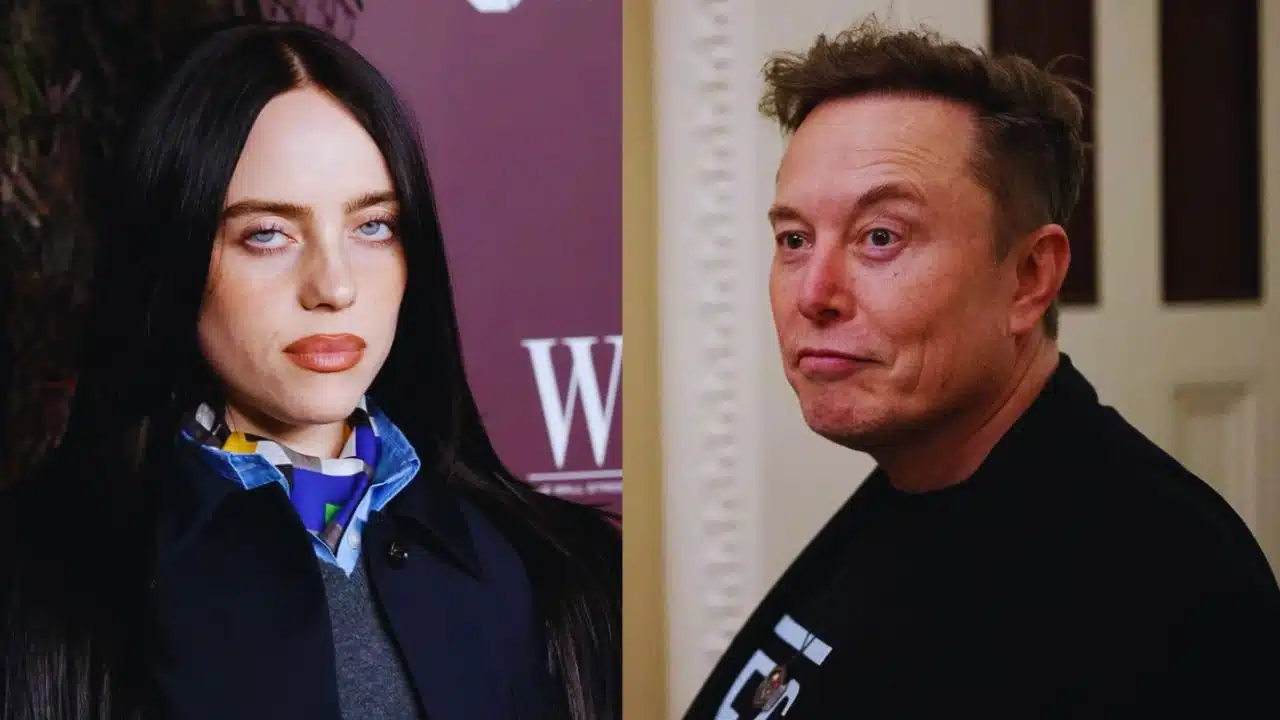
Elon Musk and Billie Eilish are at the center of a heated public clash after the Grammy-winning singer harshly criticized the Tesla CEO’s enormous wealth and accused him of failing to use it for meaningful global good. What began as an infographic shared on social media quickly escalated into a full-blown feud, with Eilish calling Musk “f–king pathetic” and Musk responding in a way many observers described as dismissive and sexist.
Billie Eilish ignited the controversy when she reshared a series of infographics highlighting how Musk—who is already the world’s richest person and could soon become the first trillionaire in history—could use his unprecedented wealth to address some of the world’s biggest humanitarian crises. The graphic outlined what global-impact projects could be funded if Musk devoted even a portion of his fortune toward causes such as eradicating world hunger, solving global water shortages, protecting endangered species, or rebuilding regions devastated by war. The post wasn’t just a casual observation; it was a pointed challenge meant to confront the imbalance between extreme wealth accumulation and urgent global needs.
The context behind Eilish’s critique goes deeper than a single social media post. In recent months, the 23-year-old artist has spoken publicly about growing economic inequality and the moral responsibilities of the ultra-wealthy. At the WSJ Magazine Innovator Awards, where she was honored for her environmental and social impact work, Eilish highlighted that her world tour had raised more than $11.5 million for organizations addressing food insecurity and climate change. While onstage, she urged wealthy attendees—including Meta CEO Mark Zuckerberg, who was present—to use more of their resources for public good. She stated bluntly, without naming names, that billionaires should reconsider why they hold onto so much wealth instead of distributing it to people in need.
Her remarks during the event set the tone for her later posts about Musk. When news broke that he could soon qualify for a historic $1 trillion Tesla stock payout if he meets long-term performance goals, Eilish amplified the infographics that crystallized her concerns. The slides suggested that with sums far smaller than what Musk stands to gain, billions of people’s lives could be significantly improved. One slide estimated $40 billion annually could end global hunger by 2030. Another projected that $140 billion could provide universal safe drinking water for seven years. Additional slides suggested $1–2 billion a year could help prevent more than 10,000 critically endangered species from going extinct by lowering their threat levels, and that roughly $53 billion could help reconstruct Gaza and the West Bank. Eilish presented these figures not as rigid prescriptions but as examples of how transformative Musk’s wealth could be if more of it flowed into direct humanitarian causes.
What truly escalated the moment was Eilish’s follow-up. In a separate Instagram Story, she went beyond the graphics and condemned Musk directly, calling him a “f–king pathetic p–sy b–ch coward,” a comment that spread instantly across social media and was widely discussed in entertainment and tech circles. The harshness of her words reflected her growing frustration with what she sees as a widening gap between the global elite and the struggles of everyday people.
Elon Musk responded in his own way—brushing aside the criticism and taking a personal swipe at Eilish’s intelligence. When asked about her comments, he posted, “She’s not the sharpest tool in the shed,” echoing a style of insult often associated with former President Donald Trump’s dismissive rhetoric toward women who criticize him. The remark was instantly scrutinized for its tone and timing, especially given Eilish’s position as one of the world’s most influential young artists and activists.
Billie talking to billionaires about donating money for causes during her speech at the @WSJ Innovator Awards tonight in New York! 💙 pic.twitter.com/GY5aUQRIdU
— Billie Eilish Tours (@billieeilishtrs) October 30, 2025
Beyond the back-and-forth insults, the situation shines a light on a long-running debate surrounding Musk’s philanthropic practices. Although he has donated billions in Tesla shares to unnamed charities in recent years—including nearly $1.9 billion in 2022 and $5.7 billion in 2021—investigative reporting has raised questions about how effective or transparent his philanthropy really is. Reports noted that much of his giving has been “haphazard” or closely connected to ventures that benefit his businesses. The Musk Foundation, which holds billions in assets, has been criticized for lacking staff, operating with minimal oversight, and failing in recent years to meet even the legal minimum for charitable disbursements tied to its tax-advantaged status. According to analyses of publicly available documents, half of its donations during 2021 and 2022 were linked to Musk himself, his employees, or his companies. One volunteer board member reportedly spent only a few minutes per week on foundation duties, raising further concerns about how seriously the organization is managed.
These revelations didn’t originate from Eilish but significantly amplify the backdrop against which her criticism landed. Her frustration reflects broader public concerns about whether the world’s richest individuals—particularly those in tech, who often promote themselves as innovators solving global problems—are doing enough to address humanitarian and environmental issues with their vast resources.
The clash between Eilish and Musk quickly became more than a celebrity–tech mogul spat. It sparked larger conversations about wealth inequality, the responsibilities of billionaires, and the expectations placed on influential figures in a time of escalating global crises. Musk’s defenders argue that he invests heavily in technological breakthroughs, space exploration, electric vehicles, and infrastructure innovations, which they view as major long-term contributions to humanity. Critics counter that immediate crises—hunger, water access, climate impacts, war devastation, species extinction—require urgent funding and leadership from those who have the means to make a transformative difference.
For Eilish, the moment reinforces her growing identity as an artist deeply engaged with social and environmental activism. For Musk, it underscores the increasingly intense scrutiny he faces as his wealth continues to expand far beyond historical norms.
At the time of the latest reporting, Billie Eilish’s representatives had not issued any further comment regarding Musk’s statement. The controversy remains a vivid example of the tensions surrounding modern ultra-wealth, public accountability, and the role celebrities play in challenging global power dynamics.