When most people pack their bags for a holiday, they are thinking about sandy beaches, mountain hikes, or trying new cuisines. They rarely stop to consider that their vacation is a cog in one of the world’s most powerful industrial engines. While often dismissed as a “soft” industry centered on leisure and fun, the economic impact of tourism is nothing short of foundational to the global financial system.
It is a sector that transfers wealth from high-income nations to developing ones, supports hundreds of millions of livelihoods, and underpins the infrastructure of entire countries. To understand the modern world economy, one must understand tourism. It is not merely a service sector; it is a global export powerhouse that rivals the oil, gas, and automotive industries in scale and influence.
As we move further into a post-pandemic era, the sector has not only recovered but is actively reshaping how nations view growth, employment, and sustainability.
Key Takeaways
-
Global Powerhouse: Tourism contributes $11.1 trillion to the global economy, representing roughly 10% of global GDP.
-
Job Creator: The sector supports 348 million jobs, accounting for 1 in every 10 jobs worldwide.
-
The Multiplier Effect: Tourist spending ripples through the economy, boosting unrelated sectors like agriculture, construction, and retail.
-
Small Business Driver: With 80% of tourism businesses being SMEs, the industry directly empowers local entrepreneurs and communities.
-
Infrastructure Catalyst: Tourism revenue funds essential public infrastructure—roads, airports, and internet—that benefits locals year-round.
The Global Scale: Tourism as an Economic Titan
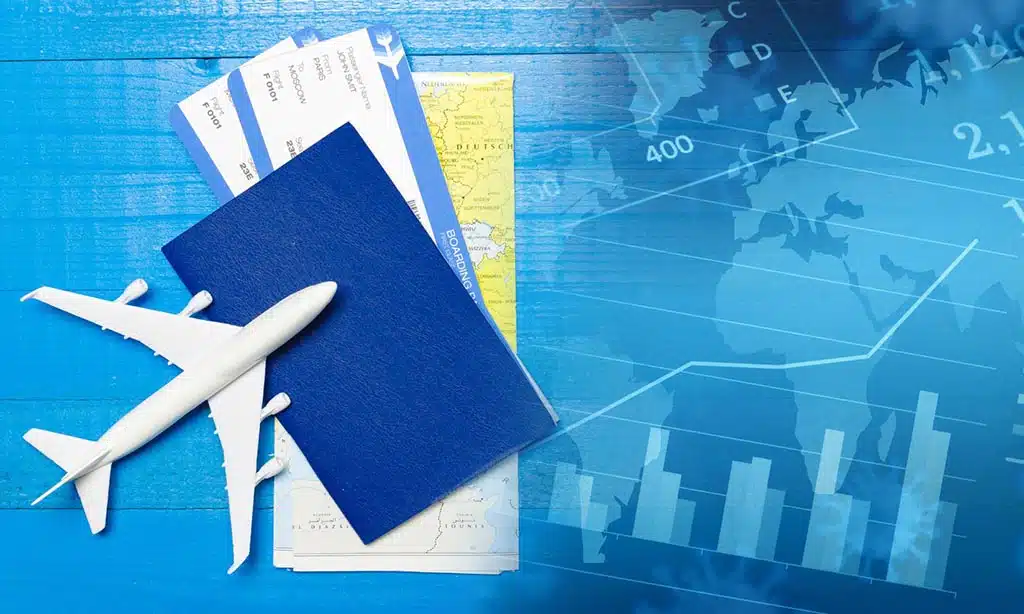
The sheer financial volume of the travel sector is difficult to visualize. To put it into perspective, recent data indicates that the travel and tourism sector contributes approximately $11.1 trillion to the global Gross Domestic Product (GDP). This creates a scenario where roughly 10% of everything the world produces—every dollar, euro, and yen—is tied either directly or indirectly to travel.
This contribution is growing at a rate that outpaces the wider global economy. While general economic growth hovers around moderate percentages, the tourism sector often sees growth rates double that of the general economy in high-demand years. This resilience is driven by a fundamental shift in consumer behavior: a move away from buying “goods” (like electronics or clothing) toward buying “services” and “experiences.”
Visitor Exports: The Hidden Trade Surplus
A critical concept in understanding the economic impact of tourism is “visitor exports.” When a tourist from Germany visits Thailand and spends money on a hotel room, a meal, or a tour guide, economists classify this transaction as an export for Thailand. Even though the product (the hotel room) is consumed locally, the money comes from a foreign source.
For many developing nations, these visitor exports are their largest source of foreign currency reserves. This influx of foreign capital is vital because it allows these nations to pay for essential imports—such as energy, medical equipment, and machinery—that they cannot produce themselves. Without the foreign cash flow generated by tourism, many national currencies would face severe instability.
The Employment Engine: Creating 1 in 10 Jobs
Perhaps the most human element of tourism’s value is its role as a massive employer. The sector currently supports approximately 348 million jobs worldwide. To visualize this, imagine the entire population of the United States—every man, woman, and child—being employed by a single industry. That is the scale of the tourism workforce.
However, the employment story goes deeper than just pilots and hotel receptionists. The jobs created by tourism are categorized into three distinct layers:
1. Direct Employment
These are the visible faces of the industry. They include:
-
Flight attendants and pilots.
-
Hotel staff (housekeeping, concierge, management).
-
Travel agents and tour operators.
-
Restaurant staff in tourist hubs.
2. Indirect Employment
This is where the economic web expands. These jobs exist to supply the tourism industry but are not “tourism jobs” in the traditional sense.
-
Agriculture: Farmers who grow the vegetables served in hotel buffets.
-
Manufacturing: Factories that build the aircraft, cruise ships, and rental cars.
-
Construction: Architects and laborers who build airports, resorts, and access roads.
3. Induced Employment
This is the “ripple effect” of spending. When a hotel manager or a tour guide gets paid, they spend their wages on rent, groceries, school fees, and healthcare. This spending supports jobs in sectors completely unrelated to travel, such as education, retail, and local healthcare services.
The Multiplier Effect: How One Dollar Becomes Three
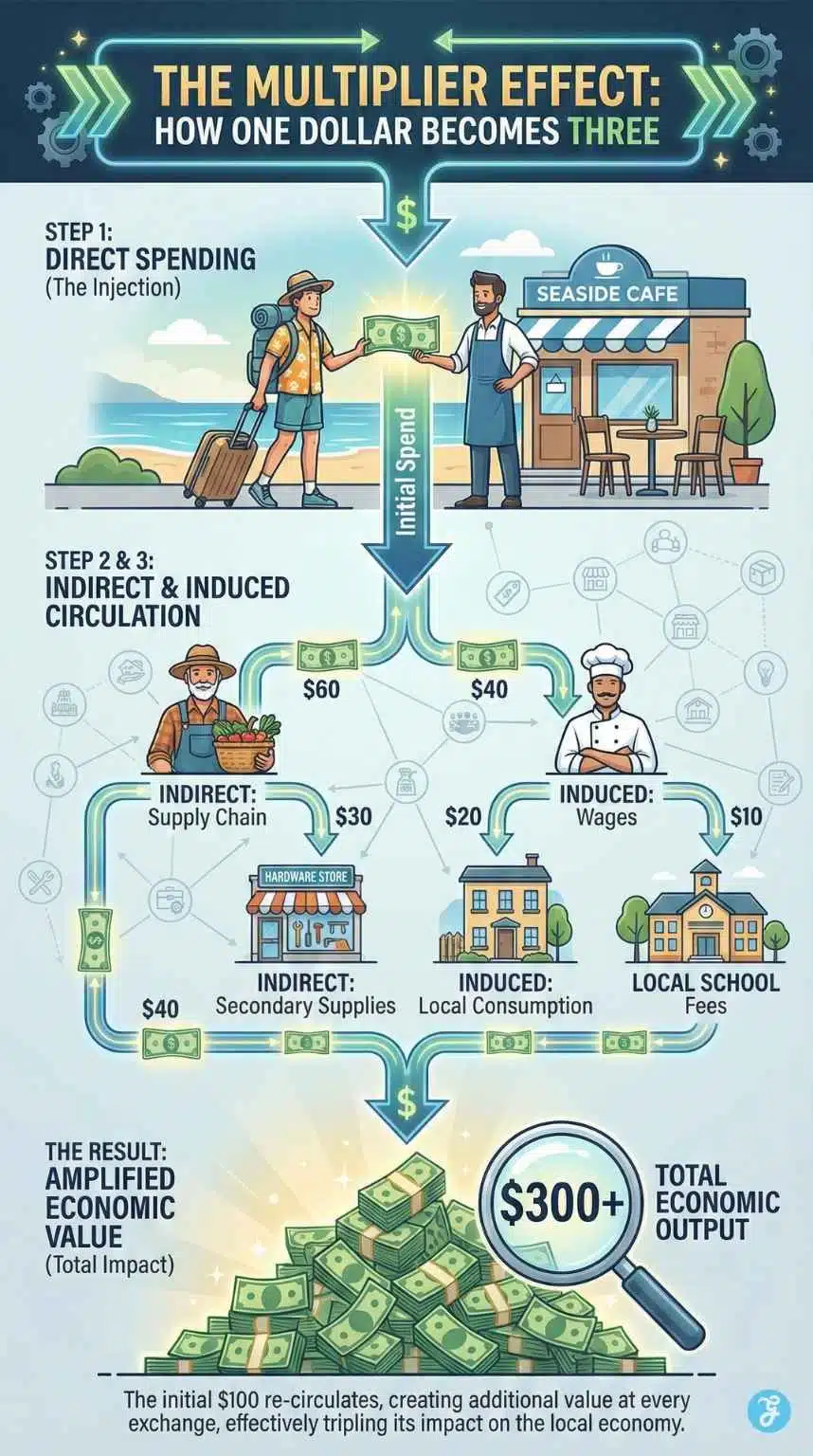
One of the most powerful arguments for the investment in tourism is the “multiplier effect.” This economic phenomenon explains how money spent by a tourist circulates through a local economy, creating value far exceeding the initial transaction.
Imagine a tourist spends $100 on a dinner at a local seafood restaurant in a coastal town.
-
The Direct Impact: The restaurant keeps a portion for profit and wages.
-
The Supply Chain: The restaurant uses part of that $100 to buy fresh fish from a local fisherman.
-
The Secondary Spend: The fisherman uses that money to buy fuel for his boat and new nets from a local hardware store.
-
The Tertiary Spend: The hardware store owner uses that profit to pay for his child’s math tutor.
In this chain, the initial $100 entry has generated several hundred dollars’ worth of economic activity across different sectors. This high multiplier effect is why governments are so keen to attract tourists; the money does not just sit in a bank account—it moves, stimulating growth at every exchange.
Infrastructure and Community Development
A common misconception is that tourism infrastructure only benefits tourists. Critics often point to fancy airports or smooth highways leading to resorts as elitist. However, the reality of the economic impact of tourism is that it often funds the “public goods” that locals use year-round.
Dual-Use Infrastructure
To host international visitors, a destination requires reliable electricity, clean water systems, high-speed internet, and safe roads. Once these are built for the tourism economy, they serve the local population permanently.
-
Airports: An airport expanded for tourists also allows local businesses to export cargo (like fresh fruit or textiles) more efficiently.
-
Telecommunications: 5G networks rolled out for “digital nomad” tourists improve connectivity for local schools and businesses.
-
Healthcare: In many resort towns, world-class hospitals are built to reassure tourists, but these facilities also provide emergency care to the local community.
Tax Revenues and Public Services
Tourists pay a variety of taxes: departure taxes, visa fees, VAT on goods, and “bed taxes” at hotels. This revenue is often significant enough to fund public budgets. In destinations like the Maldives or certain Caribbean nations, tourism taxes fund the lion’s share of public education and healthcare systems, reducing the tax burden on local residents.
Fueling Small Business and Entrepreneurship
Unlike the automotive or aerospace industries, which are dominated by a handful of massive multinational corporations, tourism is highly fragmented. It is the industry of the entrepreneur. Statistics show that approximately 80% of tourism businesses are Small and Medium Enterprises (SMEs).
This includes:
-
Family-owned bed and breakfasts.
-
Local artisan craft shops.
-
Independent freelance tour guides.
-
Street food vendors.
This fragmentation is economically healthy. It means that the profits from tourism are more likely to be retained within the local community rather than siphoned off to a corporate headquarters in a different country. It lowers the barrier to entry for entrepreneurs; a local resident with a spare room or a talent for cooking can enter the tourism economy with very little upfront capital, unlike starting a manufacturing plant.
The Double-Edged Sword: Overtourism and Economic Leakage
While the economic impact of tourism is overwhelmingly positive, it is not without its financial risks. A comprehensive economic analysis must address two critical challenges: “Overtourism” and “Economic Leakage.”
Understanding Economic Leakage
Not every dollar spent by a tourist stays in the local economy. “Leakage” occurs when revenue flows out of the destination to foreign corporations.
-
Import Leakage: This happens when a hotel imports food, drinks, or equipment instead of buying locally. For example, if a resort in the Caribbean imports all its fruit from the US, the money guests pay for that fruit leaves the local economy immediately.
-
Export Leakage: This occurs when international chains (hotels, car rentals) repatriate their profits back to their corporate headquarters abroad rather than reinvesting them in the destination.
-
The Fix: Governments are now prioritizing “local content” policies, incentivizing hotels to source food from local farmers and hiring local staff to reduce leakage and maximize the retention of tourism revenue.
The Cost of Overtourism
When demand exceeds the physical capacity of a destination (like Venice or Barcelona), the economic costs can begin to outweigh the benefits.
-
Strain on Infrastructure: Too many visitors wear down public roads and historical sites, leading to high maintenance costs funded by local taxpayers.
-
Displacement: High demand for short-term rentals (like Airbnb) can drive up local housing prices, forcing residents and the local workforce out of city centers, which paradoxically creates labor shortages for the tourism industry itself.
Emerging Trends: The Future of the Travel Economy
As we look toward the latter half of the decade, the economic impact of tourism is shifting in nature. The industry is evolving from a volume-based model (mass tourism) to a value-based model.
The Rise of “Bleisure”
The boundaries between business and leisure travel are dissolving. The rise of remote work has given birth to “bleisure” travel, where business travelers extend their trips by days or weeks to enjoy the destination.
-
Economic Benefit: Bleisure travelers tend to spend more than typical tourists. They stay longer, occupy accommodation during off-peak weekdays, and spend locally on dining and entertainment while working.
Regenerative Tourism
Sustainability is no longer just a buzzword; it is an economic strategy. “Regenerative tourism” focuses on leaving a place better than it was found.
-
The Economics of Nature: Nature is now viewed as an asset on a balance sheet. A coral reef is worth millions in tourism revenue over its lifetime. This gives governments a financial incentive to protect ecosystems rather than destroy them for short-term extractive gains like mining or logging.
The Experience Economy
Modern travelers are prioritizing “doing” over “having.” Spending is shifting away from duty-free luxury shopping and toward services: cooking classes, cultural immersion, and adventure tours. This shift is economically beneficial for host countries because service-based tourism is labor-intensive (creating more jobs) and relies on local skills and culture, which cannot be outsourced.
Technology as an Economic Accelerator
In the modern era, the economic impact of tourism is being amplified by digital transformation. Technology is no longer just a convenience; it is a revenue maximizer.
-
Yield Management: Airlines and hotels use AI algorithms to adjust prices in real-time based on demand. This ensures that assets (seats and rooms) are sold at the highest possible price the market will bear, maximizing total GDP contribution.
-
The Digital Nomad Economy: High-speed internet allows destinations to tap into a new market of long-term visitors who earn foreign wages but spend locally on housing, food, and leisure for months at a time, providing a steady stream of income outside of traditional holiday seasons.
Economic Resilience and Recovery
The resilience of the travel sector has been proven time and again. Following the global shutdowns of the early 2020s, the speed at which tourism bounced back stunned economists. By 2024, the sector had largely recovered to pre-pandemic levels, and 2025 forecasts suggest record-breaking figures.
Comparative Economic Contribution (Forecast)
| Metric | Pre-Pandemic Benchmark | Current Recovery Phase | Future Forecast |
| Global GDP Contribution | ~$10.0 Trillion | ~$11.1 Trillion | ~$11.7 Trillion |
| Total Jobs Supported | 333 Million | 348 Million | 357+ Million |
| Share of Global GDP | 10.4% | ~10% | >10.3% |
This data confirms that the appetite for travel is inelastic; people view it as a necessity for mental well-being and business connectivity, rather than a discretionary luxury that is the first to be cut during hard times.
Frequently Asked Questions
1. How much does tourism contribute to the global economy?
As of the latest data, the travel and tourism sector contributes approximately $11.1 trillion to the global economy. This represents roughly 10% of global GDP, making it one of the largest industrial sectors in the world, comparable to the size of the global healthcare or construction industries.
2. What is the tourism “multiplier effect”?
The multiplier effect is an economic phenomenon where money spent by a tourist creates a ripple of spending throughout the local economy. For example, when a tourist pays for a hotel room, the hotel uses that money to pay staff, buy food from local farmers, and pay for maintenance. This means the initial dollar spent is re-spent multiple times, generating more total economic value than the original transaction.
3. What is the difference between direct and indirect tourism jobs?
Direct jobs are those that involve immediate contact with tourists, such as pilots, hotel receptionists, and tour guides. Indirect jobs are created in the supply chain to support the tourism industry, such as construction workers building resorts, farmers supplying food to restaurants, and manufacturers building aircraft.
4. Why is tourism critical for developing countries?
For many developing nations, tourism is the primary source of Foreign Direct Investment (FDI) and foreign currency. It allows these countries to export services (hosting visitors) without needing a strong manufacturing base. This foreign currency is essential for stabilizing national currencies and paying for essential imports like energy and medicine.
5. How does “bleisure” travel impact the economy?
“Bleisure” (combining business and leisure) increases the economic yield of business travelers. By extending their stay for leisure, these high-spending visitors occupy hotel rooms on weekends (traditionally slower for business hotels) and spend more on local dining and culture, spreading economic benefits more evenly throughout the week.
Bottom Line: A Sector Too Big to Fail
The economic impact of tourism extends far beyond the transaction of booking a flight or a hotel room. It is a vital artery of the global economy that nourishes developed and developing nations alike. It serves as a mechanism for wealth redistribution, a catalyst for infrastructure development, and the world’s largest generator of employment.
As the industry continues to grow, its importance will only compound. For governments and investors, prioritizing tourism is not just about promoting vacations; it is about securing economic stability. For the traveler, the takeaway is equally powerful: every trip taken is a direct investment in the global economy, supporting livelihoods and communities in ways that are often invisible, but deeply felt.
By understanding the true scale of this industry, we can appreciate that travel is not just a way to escape the world—it is one of the primary forces that keeps the world turning.