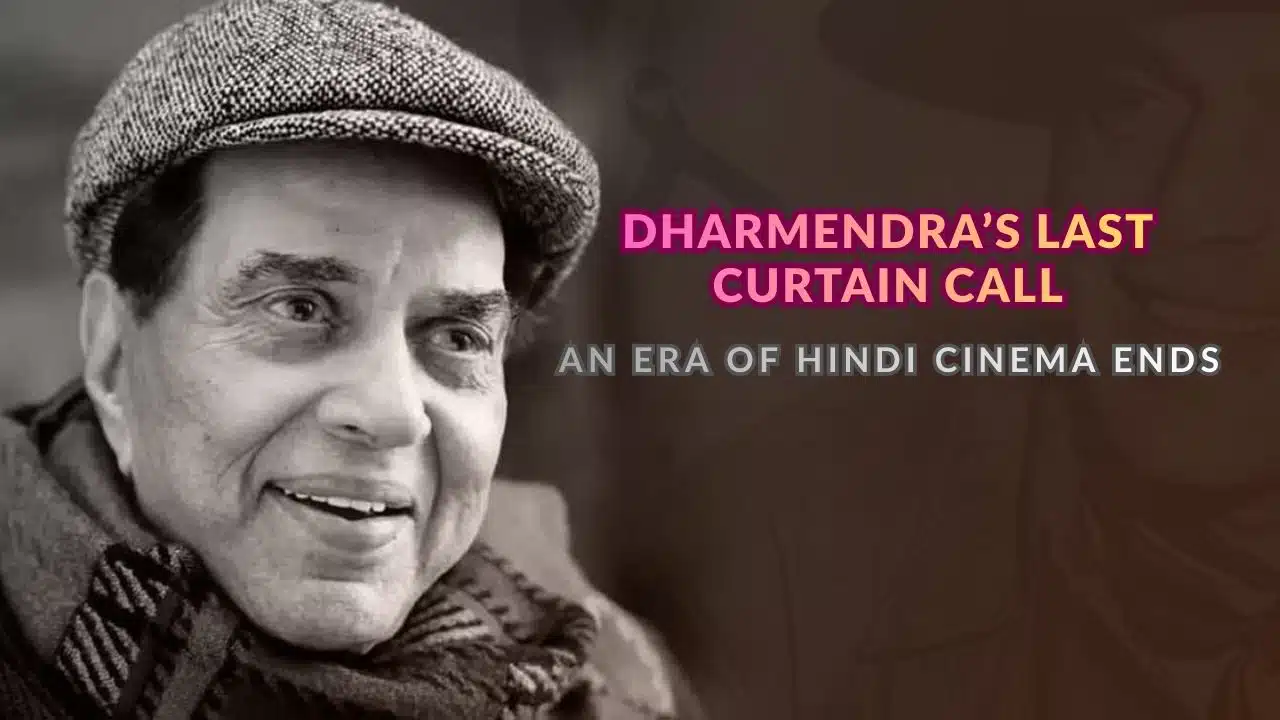
An entire generation suddenly remembered standing in long queues outside single-screen theaters, whistling at the sight of a broad-shouldered hero jumping into a fight, or smiling at that familiar half-shy, half-mischievous grin. Another generation, raised on streaming apps and social media, realized that the man they had seen in clips from Sholay and Chupke Chupke was no longer with us.
Dharmendra Kewal Krishan Deol—the “He-Man of Bollywood,” the evergreen “Garam Dharam”—passed away in Mumbai on 24 November 2025, at the age of 89, after weeks of illness and hospitalization. He would have turned 90 just a fortnight later, on 8 December.
With him goes not just a beloved actor, but a piece of India’s shared memory. For more than six decades, Dharmendra stood at the heart of Hindi cinema—from black-and-white romantic dramas to technicolor action spectacles, from cable reruns to today’s OTT nostalgia binge. In over 300 films, he fought dacoits, flirted with heroines, cracked jokes as a fake driver-professor in Chupke Chupke, and rode into legend as Veeru in Sholay.
Today, the cameras have stopped rolling for him. But the reel of his life—the boy from Punjab, the Filmfare talent-contest winner, the box-office king, the parliamentarian, the father and grandfather, the Padma Bhushan awardee—continues to play on in millions of minds.
Dharmendra, the man, is gone. Dharmendra, the feeling, is not.
Who Was Dharmendra? A Legend of Hindi Cinema
Dharmendra Deol was born on 8 December 1935 in Sahnewal, a village near Ludhiana in Punjab. He grew up in a simple family; his father was a school headmaster. As a young man, he dreamed of films and entered a talent contest run by Filmfare in the late 1950s. Winning that contest brought him to Bombay and to the doors of Hindi cinema.
Over the next sixty-plus years, he acted in more than 250–300 films, across action, romance, comedy and drama.
He became:
- The original “He-Man” action hero
- A romantic lead with unmatched on-screen charm
- A beloved comedian in light-hearted classics
His death is not just the loss of a famous actor. It feels like the closing chapter of a long, golden stretch of Hindi cinema that began in the 1960s and shaped generations.
Quick facts at a glance
| Detail | Information |
| Full name | Dharmendra Singh Deol |
| Popular name | Dharmendra, “He-Man of Bollywood” |
| Birth | 8 December 1935, Sahnewal, Punjab |
| Death | 24 November 2025, Mumbai |
| Age at death | 89 years |
| Occupation | Actor, producer, politician |
| Active years in cinema | Early 1960s–2025 |
| Total films (approx.) | 250–300+ |
| Key honor | Padma Bhushan (2012) |
Early Life and Rise of Dharmendra
Dharmendra’s story begins far from the studios of Mumbai. He grew up in rural Punjab, where cinema was magic on a distant screen.
As a young man, he worked regular jobs and faced money problems. In interviews over the years, he often spoke about sleeping in small rented rooms and doing odd work while chasing film roles.
The Filmfare talent contest changed his life. Winning it gave him a chance to meet producers and get screen tests. Soon, he moved fully to Bombay and started acting in small roles.
Key early-life highlights
| Phase | Details |
| Childhood | Grew up in Sahnewal, Punjab |
| Family | Father was a school headmaster |
| Early work | Struggled with odd jobs in Mumbai/Bombay |
| Big break | Won Filmfare talent contest, late 1950s |
| Move to films | Shifted to Bombay and began auditions and screen tests |
Breakthrough Roles That Made Dharmendra a Star
Dharmendra’s official debut as a hero came with Dil Bhi Tera Hum Bhi Tere (1960). In the early 1960s, he played sensitive, romantic leads in films like Anpadh, Bandini, and Soorat Aur Seerat.
His real star turn came with Phool Aur Patthar (1966). The film was a huge hit and showed him as a strong, silent action hero with a soft heart. This image stayed with him for decades.
Early career milestones
| Film/Event | Year | Why it mattered |
| Dil Bhi Tera Hum Bhi Tere | 1960 | Debut as a leading man |
| Filmfare contest win | ~1958–60 | Entry into Hindi film industry |
| Anpadh, Bandini | Early 1960s | Built his image as a serious, sensitive actor |
| Phool Aur Patthar | 1966 | Big commercial breakthrough: the “He-Man” image born |
The Golden Era—Dharmendra’s Most Iconic Movies
From the late 1960s to the 1980s, Dharmendra became one of Hindi cinema’s biggest box office draws. Fans loved him in action, romance, comedy and family dramas.
Action Hero and the ‘He-Man of Bollywood’
Dharmendra’s physique, energy and screen presence made him perfect for action films. He became famous for tough-guy roles where he still kept a gentle, emotional side.
Key action and drama hits include:
- Phool Aur Patthar (1966)
- Mera Gaon Mera Desh (1971)
- Yaadon Ki Baaraat (1973)
- Sholay (1975)
These films made him the “He-Man of Indian Cinema,” a tag that stayed across his life.
Selected action/drama filmography
| Film | Year | Role type | Why fans remember it |
| Phool Aur Patthar | 1966 | Tough anti-hero | Earned him major stardom |
| Mera Gaon Mera Desh | 1971 | Village defender | Famous for dacoit-fighting action |
| Yaadon Ki Baaraat | 1973 | Action-romantic | Part of a classic masala entertainer |
| Sholay | 1975 | Jai, iconic hero | One of India’s greatest films, cult classic |
The Romantic Dharmendra: Charm, Comedy, and Chemistry
Dharmendra was not just brawn. He was a natural romantic hero, with a playful smile and light comic timing. His on-screen chemistry with Hema Malini, who later became his wife, is legendary.
Popular romantic and comic films include
- Seeta Aur Geeta (1972)
- Sholay (romantic track with Basanti)
- Chupke Chupke (1975)
- Dream Girl (1977)
Dharmendra as a romantic hero
| Film | Year | Co-star | Notable aspect |
| Seeta Aur Geeta | 1972 | Hema Malini | Fun, romantic support to a double role |
| Sholay | 1975 | Hema Malini | Flirty, comic-romantic courtship |
| Chupke Chupke | 1975 | Sharmila Tagore | Classic comedy, gentle professor character |
| Dream Girl | 1977 | Hema Malini | Reinforced their star pairing |
Dharmendra in Cult Classics
If one film defines Indian popular cinema, it is Sholay (1975). Dharmendra’s role as Jai, opposite Amitabh Bachchan’s Veeru, created one of the most loved screen friendships of all time.
He also anchored other cult or much-loved films:
- Satyakam (1969)—a serious, acclaimed drama
- Chupke Chupke (1975)—Hrishikesh Mukherjee’s evergreen comedy
- Shalimar (1978)—stylish caper film
Cult and critically acclaimed works
| Film | Year | Genre | Legacy |
| Satyakam | 1969 | Drama | Often cited as his best serious performance |
| Sholay | 1975 | Action | Longest-running cult classic in Hindi cinema |
| Chupke Chupke | 1975 | Comedy | Benchmark for Hindi situational comedy |
| Shalimar | 1978 | Heist | Remembered for its style and ensemble cast |
Beyond the Screen—The Man Behind the Star
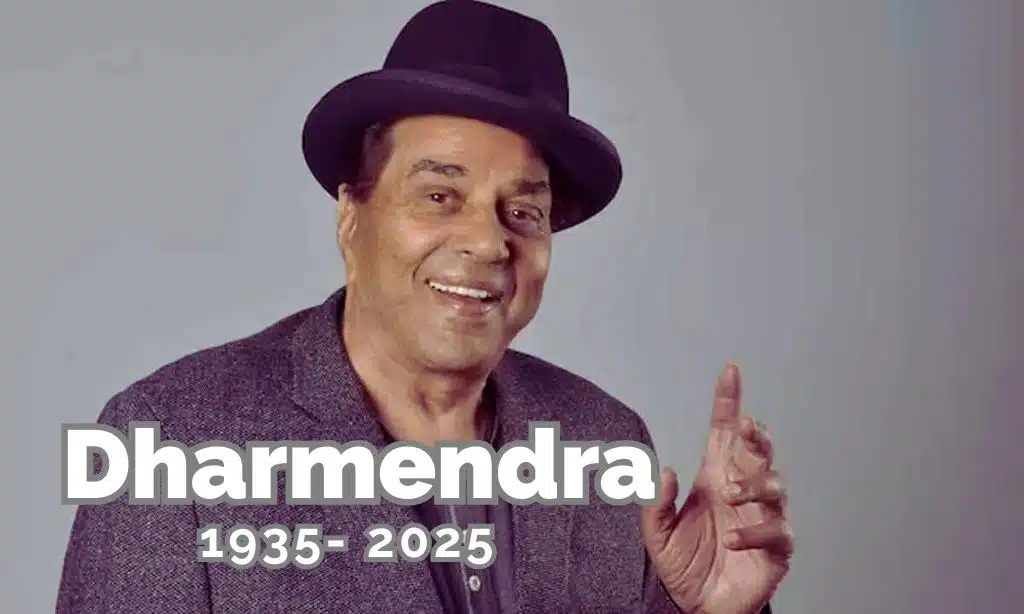
Dharmendra married Prakash Kaur in 1954. The couple had four children, including actors Sunny Deol and Bobby Deol. Later, he married actress Hema Malini. With her, he had two daughters, Esha Deol and Ahana Deol.
Though his personal life was sometimes in the spotlight and at times controversial, his family often appeared united at public events, especially in recent years as he faced health issues.
Family overview
| Relation | Name(s) | Notes |
| First wife | Prakash Kaur | Married in 1954 |
| Second wife | Hema Malini | Iconic actress, married later |
| Sons | Sunny Deol, Bobby Deol | Leading Bollywood actors |
| Daughters | Esha, Ahana, Ajeeta, Vijeta | Two with Hema, two with Prakash (reported) |
Humility, Wit, and Humanity
Co-stars often describe Dharmendra as humble, warm and emotional. Directors and actors have shared stories of him comforting junior artists, cracking jokes between intense scenes, and treating technicians like family.
Even at the height of his fame, he kept a strong connection to Punjab and to his roots. In interviews, he would slip into Punjabi, recall village life, and speak openly about his struggles.
Personality traits remembered by many
| Trait | Example / Description |
| Humility | Spoke warmly of his early poverty and struggles |
| Sense of humor | Known for pranks and jokes on sets |
| Emotion | Often teared up remembering parents and youth |
| Generosity | Helped co-workers and juniors in tough times |
Awards and Achievements—Honors for a Lifetime on Screen
Dharmendra often joked that he never won a competitive Filmfare Best Actor award, despite decades of hit films and massive popularity. Yet, when you look at his list of honors, it tells a different story—that of an artist widely respected by both the industry and the state.
Major National and Civilian Honours
| Award / Honour | Year | For/By | Notes |
| Padma Bhushan (India’s 3rd-highest civilian award) | 2012 | Government of India | Awarded for his outstanding contribution to Indian cinema. |
| National Film Award – Best Popular Film Providing Wholesome Entertainment (producer) | 1990 | Ghayal | As producer, he received the National Award for his son Sunny Deol’s film Ghayal, recognized for its strong theme and wide appeal. |
These honors show how the Indian state itself formally acknowledged that this “mass hero” had become part of the country’s cultural backbone.
Filmfare, IIFA and Other Major Film Awards
| Award | Year | Category / Citation | Film/Work |
| Filmfare Award | 1991 | Best Film (as producer) | Ghayal—Dharmendra produced the film; it became a landmark action drama of the early 1990s. |
| Filmfare Lifetime Achievement Award | 1997 | Career honour | Given for his overall contribution to Hindi cinema. He became emotional receiving it from Dilip Kumar and Saira Banu. |
| IIFA Lifetime Achievement Award | 2007 | Lifetime contribution | International Indian Film Academy honour for his decades on screen. |
| IIFA Honor (2011) | 2011 | Lifetime / special contribution | Another IIFA recognition, underlining his continued influence. |
| Zee Cine Award – Lifetime Achievement | 2005 | Lifetime contribution | Given at the Zee Cine Awards as a salute to his body of work. |
Even before these honors, Dharmendra had been regularly recognized by Filmfare through nominations:
- Filmfare Best Supporting Actor nomination for Ayee Milan Ki Bela (1965)
- Filmfare Best Actor nominations for Phool Aur Patthar, Mera Gaon Mera Desh, Yaadon Ki Baaraat, and Resham Ki Dori in the late 1960s and early 1970s.
Those nominations tell you what critics saw: a star who was not only popular but also capable of serious, layered performances.
Industry Lifetime Honours and International Recognition
Over the years, various industry bodies and festivals honored Dharmendra with lifetime achievement and “living legend” style awards:
| Institution/Event | Type of Award | Note |
| FICCI (Federation of Indian Chambers of Commerce & Industry) | “Living Legend” Award | Given for his outstanding contribution to the Indian entertainment industry. |
| Sansui Viewers’ Choice Movie Awards | Lifetime Achievement | Popular-Choice honour from TV-era viewers in the early 2000s. |
| Zee Cine Awards | Lifetime Achievement Award | Large-scale TV and industry recognition of his career. |
| Pune International Film Festival (PIFF) | Lifetime Achievement | Festival tribute to his standing as a cinema icon. |
| IIFA Awards (International Indian Film Academy) | Lifetime honours | Celebrated his reach among global Indian audiences. |
| State of New Jersey (USA) | Lifetime Achievement (2020) | The state honored him for his contribution to Hindi cinema over six decades and over 300 films. |
Beyond formal awards, Dharmendra carried a unique kind of informal recognition:
- In the 1970s, he was often described as one of the most handsome men in the world, a line repeated by co-stars and journalists over the years.
- Modern stars like Salman Khan and Madhuri Dixit have publicly called him one of the most handsome and charming men they’ve ever seen on screen.
For SEO purposes, this section supports searches like “Dharmendra awards and honors,” “Dharmendra Padma Bhushan and National Award,” “Dharmendra Filmfare Lifetime Achievement,” and “Dharmendra IIFA awards list,” while still reading naturally for human visitors.
Dharmendra’s Impact on Bollywood and Pop Culture
Before Dharmendra, heroes were often either soft romantic leads or serious dramatic figures. He combined:
- Physical strength
- Romantic charm
- Comic timing
This mix helped define the 1970s “masala” Hindi film hero: a man who could fight, love, joke and cry, sometimes in the same film.
How he changed the hero image
| Aspect | Before Dharmendra | After Dharmendra’s rise |
| Body type | Slim, suit-clad heroes | The strong, muscular “He-Man” look becomes popular |
| Role mix | Mostly romance or drama | Action + romance + comedy in one character |
| Screen energy | Controlled, theatrical | Easy, natural, high-energy presence |
Influence on New-Generation Actors
Many modern stars, including Salman Khan, Akshay Kumar, and others, have cited Dharmendra as an inspiration for their action-hero images and emotional styles. His sons Sunny and Bobby Deol built their own careers in his shadow, especially Sunny, who became a major action star in the 1990s.
Influence snapshot
| Who/What | Type of influence |
| Salman Khan, action stars | Shirtless action-hero image, mix of charm and strength |
| Sunny Deol | Strong, emotional action performances |
| Comedy genre | Natural, underplayed comic style |
| OTT/modern audiences | Memes and clips keep his scenes viral |
Dharmendra in the Digital Age
Even younger audiences who never saw his films in theaters know him from:
- YouTube clips of Sholay, Chupke Chupke, Seeta Aur Geeta
- Memes using his dialogues and expressions
- OTT releases of his classics
In recent years, he also appeared in new films and shows, such as Teri Baaton Mein Aisa Uljha Jiya (2024) and the upcoming Ikkis, showing that he was still active, even in his late 80s.
Dharmendra in the online era
| Platform/Space | How he appears today |
| YouTube | Classic scenes and songs from his hits |
| OTT platforms | Old films rewatched by younger viewers |
| Social media | Tributes, memes, fan edits and dialogues |
| New films | Cameo and character roles even in his 80s |
How India Is Mourning Dharmendra
News agencies and national outlets describe a “pall of gloom” at his Mumbai residence, popularly known as Sunny Villa. Celebrities, ordinary fans, and neighbors gathered outside to pay their respects as his body was taken for the last rites.
At the Pawan Hans Crematorium in Vile Parle, many of the biggest names in Hindi cinema were seen:
- Amitabh Bachchan
- Salman Khan
- Aamir Khan
- Sanjay Dutt
- Members of the Deol and Malini families
They stood together not just for a colleague, but for someone who had defined the mainstream Hindi film hero for decades.
Tributes also poured in from Prime Minister Narendra Modi and other political leaders, who praised his contributions both as an actor and as a public representative. International outlets like Reuters and AP framed his death as the loss of one of Indian cinema’s most enduring icons.
| Type of Tribute | Examples |
| Political leaders | The prime minister, president, and other leaders posted condolences highlighting his cultural impact and public service. |
| Film fraternity | Amitabh Bachchan, Karan Johar, and many actors called his death “the end of an era.” |
| Social media trends | “Dharmendra,” “Garam Dharam,” and “Sholay” trended across Indian platforms. |
| Global coverage | Reuters, AP, and Gulf and South Asian outlets carried obituaries for international readers. |
Why Dharmendra’s Death Marks the End of an Era
From Old-World Stardom to Modern Bollywood
Dharmendra’s career stretched from black-and-white films to the streaming age. He belonged to a time when:
- Heroes were discovered through talent contests and studio visits
- Word of mouth, not algorithms, made a film a hit
- Long theatrical runs created cult classics
His passing is one more sign that the original “star system” of Hindi cinema is fading, replaced by a new digital-driven industry.
Then vs now
| Aspect | Dharmendra’s era | Today’s era |
| Film discovery | Theatres, posters, radio | OTT, social media, trailers |
| Star building | Word of mouth, magazines, fan clubs | PR campaigns, online buzz, streaming |
| Film length & pace | Longer, song-heavy, emotional | Faster, more genre-focused |
The Values and Emotions His Cinema Represented
Dharmendra’s films often highlighted:
- Family loyalty
- Village and small-town values
- Courage and sacrifice
- Romantic idealism
For many Indians, especially those who grew up in the 60s, 70s and 80s, his films represented a comforting, hopeful view of life.
Common themes in Dharmendra movies
| Theme | Example |
| Family honor | Protecting village or family from villains |
| Deep friendship | Jai–Veeru bond in Sholay |
| Romantic loyalty | Devoted, often playful romantic leads |
| Justice and courage | Standing up to oppression or injustice |
Can Anyone Replace Dharmendra?
Many actors will continue to play action and romantic heroes. But Dharmendra’s mix of:
- Rustic charm
- Emotional honesty
- Physical presence
- Longevity
…makes him unique.
You can copy the hairstyle, the shirts, and even the lines. But the time and culture that made “Garam Dharam” who he was cannot be repeated.
Uniqueness factors
| Factor | Why it’s hard to copy |
| Era | He rose when Indian cinema was changing shape |
| Mix of skills | Action, romance, comedy, drama in one package |
| Longevity | Stayed active across six decades |
| Emotional connection | Felt like a “hero next door” to many viewers |
Timeless Performances to Revisit in Memory of Dharmendra
If you want to remember Dharmendra today, watching his films is the best tribute. Here are some must-watch titles across genres.
Essential Dharmendra watchlist
| Film | Year | Genre | Why watch it now |
| Phool Aur Patthar | 1966 | Drama | Early, powerful star-making performance |
| Satyakam | 1969 | Serious drama | Deep, moving role critics still praise |
| Mera Gaon Mera Desh | 1971 | Action | Classic village action and heroism |
| Seeta Aur Geeta | 1972 | Comedy | Fun pairing with Hema Malini |
| Yaadon Ki Baaraat | 1973 | Masala | Songs, action, drama, all in one |
| Sholay | 1975 | Action/Drama | Unmissable; one of Indian cinema’s greats |
| Chupke Chupke | 1975 | Comedy | Shows his light, humorous side |
| Dream Girl | 1977 | Romance | Strengthens his romantic-hero image |
| Yamla Pagla Deewana series | 2011–2018 | Comedy | Family fun with sons Sunny and Bobby |
Box Office Power and Records
Trade analysts often point out that Dharmendra’s numbers at the box office are extraordinary, even by today’s standards.
A detailed BoxOfficeIndia retrospective notes that:
- He delivered around 60 jubilee hits and over 100 successful films (including blockbusters, super hits, hits, and above-average performers).
- The year 1973 is described as one of the best ever for any Hindi actor, with multiple blockbusters and hits in a single calendar year.
A 2024 ABP report further highlights that:
- As a lead actor, Dharmendra has around 74 hit films to his name.
- Counting blockbusters, hits, semi-hits, and above-average films, he is credited with about 94 box-office successes, more than any other star in Hindi cinema history, according to that analysis.
| Box Office Snapshot | Approximate Numbers (Trade Estimates) |
| Total credited films | 230–300+ (depending on how guest roles and regional films are counted) |
| Jubilee hits | ~60 films (silver/golden jubilees) |
| Overall successful films | 100+ titles with solid box office performance |
| Lead-role hits | About 74 films where he is the main lead and the film is classified as a hit or better |
| Peak box office year | 1973, with two blockbusters, two super hits, two hits, and another successful film in a single year |
Trade portals often compare his all-India popularity and “poster power” to that of later megastars like Salman Khan. One famous example is a 1976 B-grade film, Apne Dushman, which opened surprisingly strong simply because Dharmendra’s face dominated the posters—an illustration of how his name alone could pull crowds.
Why Dharmendra’s Era of Hindi Cinema Matters
Calling Dharmendra’s death “the end of an era” is not just emotional language. It has a very real historical meaning.
- He bridged the old and new Bollywood
- He started in the black-and-white, studio-era 1960s.
- He dominated during the multi-starrer, single-screen 1970s and 80s.
- He adapted to the multiplex age of the 2000s, streaming-era nostalgia, and cameos in 2020s blockbusters.
- He defined the all-round Hindi film hero
Long before today’s “pan-India” branding, Dharmendra was already an all-India star. BoxOfficeIndia’s analysis notes that his films did repeat runs for years in small towns and rural centers, powered mainly by his presence on the poster. - He balanced masculinity with vulnerability
Unlike some later action stars, Dharmendra’s heroes often cried, apologized, and joked. He could punch a villain through a door, then look almost childlike in a romantic or comic scene. That blend made him feel approachable as well as heroic. - He left a measurable legacy in numbers
With 90+ successful films and decades of box office dominance, he stands near the top in almost every “most hits” list compiled by trade observers.
| Aspect of Legacy | Why It’s Important |
| Longevity | Over 60 active years in film—from 1960s black-and-white to 4K streaming. |
| Genre range | Successful in romance, action, thriller, comedy, family drama, and regional cinema. |
| Cultural presence | Dialogues, memes, and scenes from films like Sholay, Chupke Chupke, and Mera Gaon Mera Desh remain part of everyday language. |
| Industry statistics | Unmatched combination of total hits and long-term audience loyalty. |
| Family legacy | Created a multi-generation film family that is still active in cinema and politics. |
Final Words: When the Lights Go Down, the Legend Stays
There is a moment in every cinema show when the lights come back on, the crowd gets up, and the magic breaks. Dharmendra’s death feels a little like that moment for the generation that grew up with him.
The man who once leaped from moving trains, fought entire gangs with his bare hands, and flirted shamelessly from atop a water tank is now part of history. Yet, even as we write the words “Dharmendra is no more,” something inside quietly refuses to believe it.
Perhaps it is because he never belonged only to one time. He was the shy young man of Anupama, the gritty hero of Mera Gaon Mera Desh, the funny professor of Chupke Chupke, the tender Veeru of Sholay, the aging father of Apne, and the soft-eyed dadaji of Rocky Aur Rani Kii Prem Kahaani.
Across those roles, he carried the same simple core: a big-hearted man from Punjab, who laughed loudly, loved deeply, and never forgot where he came from. Even at award functions, after the Padma Bhushan and Lifetime Achievement trophies, he would often say with folded hands that he had received “much more love than he ever deserved.”
It is tempting to call Dharmendra the “last” of something—the last great matinee idol, the last true single-screen superstar, the last hero who could do romance, comedy and action with equal ease. But that would miss the point. Legends like him don’t disappear with a date in a newspaper; they spread. A favorite scene is shown to a younger cousin. A meme keeps a comic line alive. A film like Sholay is watched again in a new format, on a new device, by a new heart.
So what do we do with a loss this big? Maybe we do what his films taught us to do.
We stand by our people. We crack a joke even when life is heavy. We stay loyal to our friends. We cry freely, and we get back up again. And, once in a while, on a slow evening, we put on an old Dharmendra film, hear that familiar voice, and let the past sit beside us for a few hours.
The curtains have fallen on Dharmendra’s earthly stage. But in living rooms, on phone screens, and in village video halls, film clubs and archives, the show goes on.
Somewhere, Veeru is still shouting from the tank. Somewhere, a young professor is still pretending to be a driver. Somewhere, Garam Dharam is still turning toward the camera, eyes shining, asking us to believe in heroes one more time.
And we do. Because for many of us, he was the first hero we ever believed in.