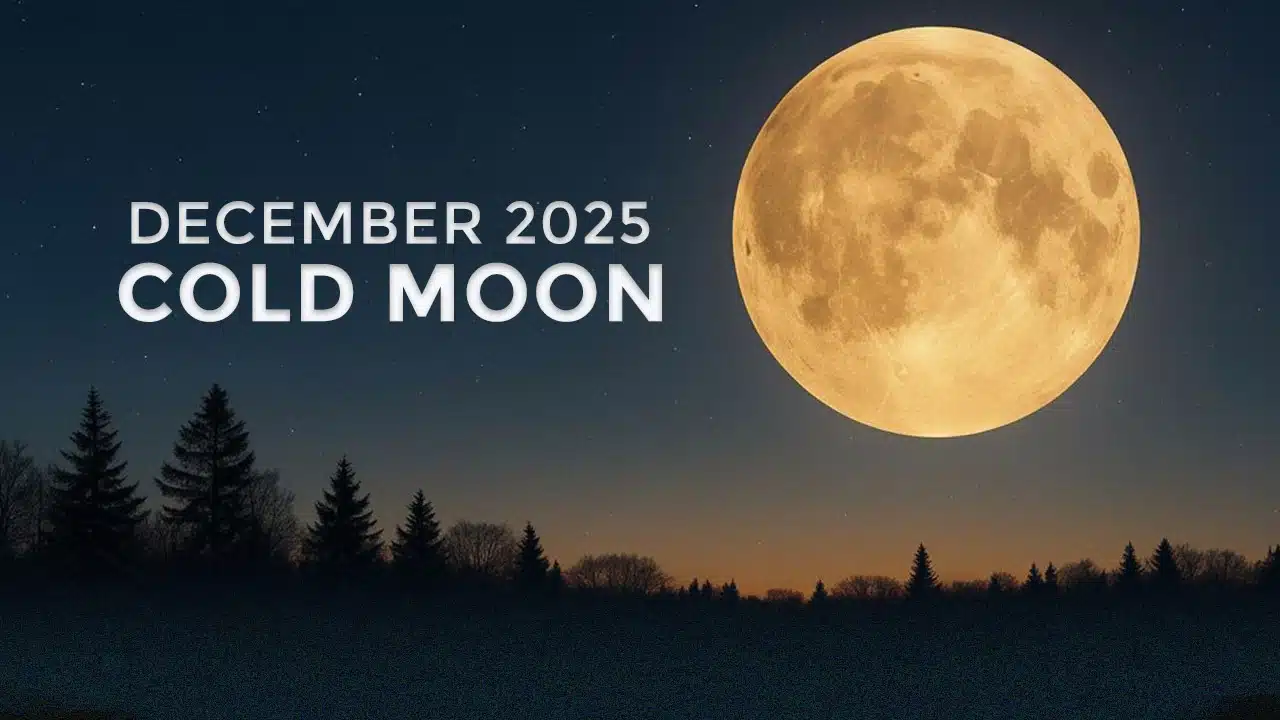
The final full moon of the year will rise on Thursday, 4 December 2025, and it is no ordinary Moon. December’s Cold Moon will also be the last supermoon of 2025, reaching peak illumination at 23:14 UTC (6:14 p.m. EST) as it lines up opposite the Sun.
Astronomers say this full Moon will appear slightly larger and brighter than usual because it occurs close to the Moon’s perigee, the closest point in its orbit to Earth. In 2025, it is the third in a series of three full supermoons in October, November and December, and the last one before a new series begins in 2026.
What is happening – key facts at a glance
| Key point | Detail |
| What | December 2025 Cold Moon, also a supermoon |
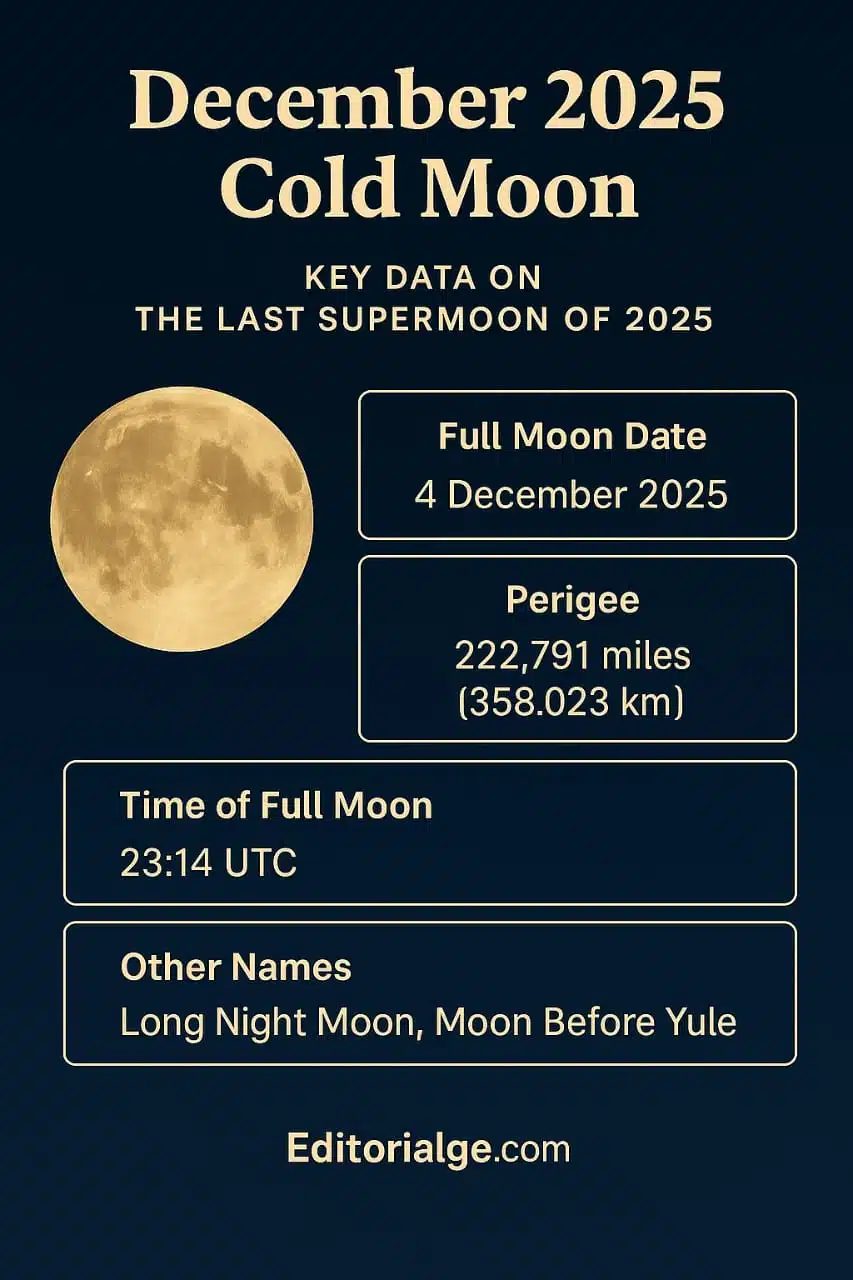
| When (astronomical full) | 4 December 2025, 23:14 UTC |
| Local time examples | 6:14 p.m. EST (New York), 11:14 p.m. GMT (London), ~5:14 a.m. IST/5:44 a.m. Dhaka on 5 Dec (derived from UTC) |
| Moon phase | Full Moon in the constellation Gemini |
| Type | Final full supermoon of 2025 |
| Other 2025 full supermoons | 7 Oct, 5 Nov, 4 Dec 2025 |
| Common names | Cold Moon, Long Night Moon, Oak Moon, Moon Before Yule |
Astronomy writer Marion López sums it up: “It’s the brightest full Moon of early winter and the last supermoon of the year – a natural full-stop on 2025’s night sky.”
Why this full Moon counts as a supermoon
A supermoon is not an official astronomical category, but it is widely used to describe a full (or new) Moon that occurs within about 90% of the Moon’s closest distance to Earth.
Because the Moon’s orbit is elliptical, its distance from Earth changes throughout the month. When a full Moon occurs near perigee, it can appear up to around 7–14% larger in apparent diameter and up to 25–30% brighter than a far-away “micromoon” at apogee.
In 2025, calculations compiled by NASA-affiliated and independent ephemeris tables show:
| Supermoon date (2025) | Type | Notes |
| 7 October 2025 | Full Moon | First full supermoon of 2025 |
| 5 November 2025 | Full Moon | Brightest and closest full Moon of the year |
| 4 December 2025 | Full Moon | Last full supermoon of 2025 – “Super Cold Moon” |
Astronomer Fred Espenak’s supermoon tables, summarised by several astronomy outlets, place 4 December as the third and final full supermoon of the year, confirming its status in global supermoon calendars.
When and where you can see December’s Cold Moon
Global timing and visibility
Precise timing varies by time zone, but the moment of full phase is the same worldwide: 23:14 UTC on 4 December.
| Region / City | Local date & time of full Moon | Viewing notes |
| New York (EST) | Thu 4 Dec, 6:14 p.m. | Moon already rising in the east near sunset |
| London (GMT) | Thu 4 Dec, 11:14 p.m. | High in the southeast at mid-evening |
| Berlin/Rome (CET) | Fri 5 Dec, 00:14 a.m. | Near midnight, high and bright in winter sky |
| Delhi (IST) | Fri 5 Dec, ~4:44 a.m. | Low in the western sky before dawn |
| Dhaka (approx. UTC+6) | Fri 5 Dec, ~5:14 a.m. | Bright setting Moon in the west before sunrise (derived from UTC) |
For most observers, the Moon will look full for at least two to three nights, from 3–5 December, even though the exact full moment is on the 4th.
Best way to watch
Astronomy guides and meteorological outlooks recommend:
| Tip | Why it matters |
| Look just after moonrise | The “moon illusion” makes the low Moon appear larger near the horizon. |
| Find an unobstructed eastern horizon | Buildings and trees can block the first, most dramatic view. |
| Avoid bright street lights | Darker surroundings help your eyes adapt and reveal more detail. |
| Use binoculars or a small telescope | Craters along the terminator (the light–dark line) show more contrast. |
| Check local cloud forecast | Cloud cover in parts of the South and Pacific Northwest (US) could block the view. |
A NASA lunar scientist quoted by several outlets notes that even a smartphone on a tripod can capture surprisingly detailed images if you tap to focus on the Moon and reduce exposure to avoid over-exposed white blobs.
Why it’s called the Cold Moon – and other traditional names
The December full Moon is widely known as the Cold Moon, a name rooted in Native American and European seasonal traditions that mark the arrival of long, dark and cold winter nights.
Other traditional names recorded by almanacs, ethnographers and modern astronomy guides include:
| Name | Origin / meaning |
| Cold Moon | Used by Mohawk and other Indigenous peoples; linked to early winter cold. |
| Long Night Moon | Refers to the near-solstice timing and the longest nights of the year. |
| Oak Moon / Moon Before Yule | Found in some European pagan and Celtic traditions around the midwinter period. |
| Margashirsha Purnima | In the Hindu lunar calendar, this full Moon falls in the sacred month of Margashirsha, associated with spiritual reflection. |
Although spiritual and astrological interpretations are popular, astronomers stress that the physical Moon is the same: only its distance, angle and cultural stories change.
How much bigger and brighter will this supermoon look?
Because this Cold Moon occurs close to perigee, it will be noticeably bright, though the size difference is subtle to the naked eye. Astronomy references estimate:
| Comparison | Approximate difference |
| Apparent diameter vs. an average full Moon | Up to 7–8% larger |
| Brightness vs. a micromoon (most distant full Moon) | Up to 25–30% brighter |
| Distance from Earth at perigee vs. apogee | Roughly 43,000 km closer at perigee on average |
In practical terms, most casual observers will notice the brightness, especially if the sky is clear and dry. The size change is easier to detect by comparing photographs or when you remember a particularly small “micromoon” earlier in the year.
Connected sky events: Pleiades, planets and meteor showers
December’s Cold Supermoon does not happen in isolation. Several sky events add context for skywatchers:
- Near the Pleiades star cluster: On the nights of 3–4 December, the nearly full Moon passes close to the Pleiades (M45) in Taurus. In some regions, there will be a lunar occultation, where the Moon briefly covers some of the cluster’s stars.
- High winter arc: In the Northern Hemisphere, the December full Moon climbs higher in the sky than most other full Moons of the year, because it is opposite the low winter Sun.
- Geminid meteor shower: Roughly a week later, the Geminids peak around 13–14 December, when the Moon will be a waning crescent, so moonlight interference will be limited.
These alignments make early December a particularly rich period for back-yard astronomy, even with simple equipment.
Why this supermoon matters scientifically
From a scientific perspective, this event is part of larger patterns in the Earth–Moon system:
- Supermoon clustering: Supermoons typically occur in clusters of three to four because the cycles of full moons and perigee are slightly misaligned. December 2025 closes a three-supermoon cluster that began in October.
- Tides and perigean spring tides: When a full Moon happens near perigee, ocean tides can be slightly higher than normal – known as perigean spring tides. These can enhance high-tide flooding in low-lying coastal regions by a modest amount, especially when combined with storms or strong onshore winds. Meteorological agencies generally monitor these periods but do not expect major tidal disasters solely due to a supermoon.
- No proven link to earthquakes or volcanoes: Despite popular myths, studies have found no strong statistical evidence that supermoons trigger major earthquakes or volcanic eruptions.
- End of a “major lunar standstill” period: Some astronomy writers note that the 2025 Cold Moon is one of the last full Moons in a cycle where the Moon reaches unusually high and low declinations in the sky, a pattern tied to the 18.6-year lunar nodal cycle. The December 2025 supermoon is described as one of the last “extreme” full Moons before the geometry gradually relaxes through the 2030s.
How to observe safely and photograph the event
While the Moon is safe to view with the naked eye or through binoculars, astronomers offer practical advice for getting the most out of it:
| Activity | Practical tips |
| Naked-eye viewing | Step away from street lights; give your eyes 10–15 minutes to adapt. |
| Binoculars | 7×50 or 10×50 binoculars reveal craters and mare (dark “seas”) along the edge. |
| Telescopes | Use a neutral-density or Moon filter to reduce glare; keep magnification moderate. |
| Smartphone photos | Mount the phone on a tripod, tap on the Moon to focus, and lower exposure. |
| Long-lens photography | Use a telephoto lens (200mm+) and include buildings, trees or horizons for scale. |
No special eye protection is required for viewing the Moon, unlike solar eclipses.
What comes next after December’s last supermoon?
Once the December 2025 Cold Supermoon passes, skywatchers will have to wait until January 2026 for the next supermoon, sometimes called the Wolf Moon.
Looking further ahead:
| Upcoming notable lunar events | Expected date* | Notes |
| Next full supermoon | 13 January 2026 | Wolf Moon supermoon in mid-winter |
| Total lunar eclipse | March 2026 | Visible in parts of the world (details vary by region). |
| Partial solar eclipse | 12 August 2026 | Not total in most locations, but part of a busy eclipse year. |
Dates based on current ephemeris data; always check updated local predictions closer to the time.
For astronomers and casual observers alike, December’s Cold Moon functions as a natural year-end marker: a reminder of the regular rhythm of lunar cycles and of how much of our calendar, culture and even language still follow the phases of our nearest celestial neighbour.