
Europe is currently enduring a devastating early summer heatwave that has already claimed at least eight lives, triggered widespread wildfires, shut down nuclear power reactors, and disrupted public life across multiple countries. The soaring temperatures are affecting millions, forcing governments to implement emergency measures and intensifying concerns about the growing threat of climate change.
Heat-Related Deaths Across Multiple Countries
As temperatures surged far beyond the seasonal average, several European countries began reporting fatalities and serious heat-related illnesses. Spain has witnessed four confirmed heat-related deaths so far. Among these, two individuals lost their lives while attempting to flee a massive wildfire in the northeastern region of Catalonia. The fire spread rapidly due to dry conditions and strong winds. Two more deaths occurred in the southern and western regions of Cordoba and Extremadura, where elderly citizens reportedly collapsed during peak temperature hours.
France has also been severely impacted. At least two individuals died from heat-induced conditions, while emergency services reported over 300 hospitalizations linked to dehydration, heatstroke, and respiratory complications. Hospitals in regions like Occitanie and Provence-Alpes-Côte d’Azur have been on high alert, especially for vulnerable populations like the elderly, children, and people with chronic illnesses.
Italy, meanwhile, is experiencing some of the most extreme temperatures in the continent. Two elderly men collapsed and died on a beach in Sardinia, where local thermometers recorded over 42°C. Italian emergency authorities have placed 18 cities, including Rome, Bologna, and Florence, under a “red alert” status—indicating the highest level of heat risk.
Germany has also seen record-breaking temperatures, with some regions expected to reach as high as 40°C, making it the hottest day of the year in the country. Public health officials have issued heat advisories and encouraged citizens to remain indoors during midday hours.
Nuclear Reactors Shut Down Due to Overheated Rivers
The heatwave’s impact isn’t limited to human health—it is also threatening infrastructure. In Switzerland, one of the reactors at the Beznau Nuclear Power Plant had to be shut down entirely, and the other had to reduce its output. This emergency action was taken because the temperature of the nearby river used to cool the reactors rose beyond safe levels. River water that exceeds regulatory temperature limits can no longer be used safely for cooling, as it risks both damaging equipment and causing environmental harm when released back into ecosystems.
Similar warnings were issued in France and Germany, where several nuclear facilities were forced to monitor river temperatures closely. In previous years, high water temperatures during summer months have already led to similar shutdowns, showing how critical energy infrastructure is vulnerable to rising climate extremes.
Wildfires Rage Across Southern and Central Europe
The intense and prolonged heat has created the perfect conditions for wildfires to erupt across the continent. In addition to the deadly fire in Catalonia, Spain, fires were also reported in other parts of the country, overwhelming firefighting units who are battling under dangerous conditions. Water-dropping aircraft and thousands of emergency personnel have been deployed.
In Turkey, blazes erupted in Izmir province, forcing the evacuation of multiple villages and thousands of residents. Local authorities confirmed the death of an 81-year-old man due to smoke inhalation and injuries. Emergency teams, including helicopters, worked around the clock to control the flames.
Eastern Germany is also facing forest fires, with dry landscapes and persistent drought making containment difficult. Firefighters are operating in high-risk zones to prevent the fires from spreading to residential areas.
On the Greek island of Crete, a large wildfire broke out near Ierapetra, prompting the evacuation of more than 5,000 people, including local residents and tourists. Over 230 firefighters were dispatched, supported by ground vehicles and firefighting planes. The fire was fueled by intense winds and dry terrain.
Severe Storms and Infrastructure Damage in France
As if the heat wasn’t enough, parts of France experienced violent storms triggered by the extreme weather conditions. These storms led to destructive mudslides and flash floods in mountainous regions. Rail connections between Paris and Milan were temporarily suspended due to debris on the tracks and weather-induced damages.
Transport authorities had to cancel multiple high-speed train routes, leaving travelers stranded or facing long delays. Emergency road closures were implemented in affected areas.
Tourist Attractions Partially Closed for Safety
Popular European tourist destinations have also taken precautionary steps due to the heatwave. In Paris, the Eiffel Tower shut down its upper observation decks earlier than usual to prevent tourists from overheating during the climb. Brussels’ famous Atomium landmark also restricted access to its top floors to ensure visitor safety.
Elsewhere, local authorities have urged tourists to avoid sightseeing during peak daylight hours and emphasized the importance of hydration and shade. Tour operators have reported cancellations and rescheduling of daytime tours as visitors choose to stay indoors.
Economic Impact: Heatwave Affects Businesses
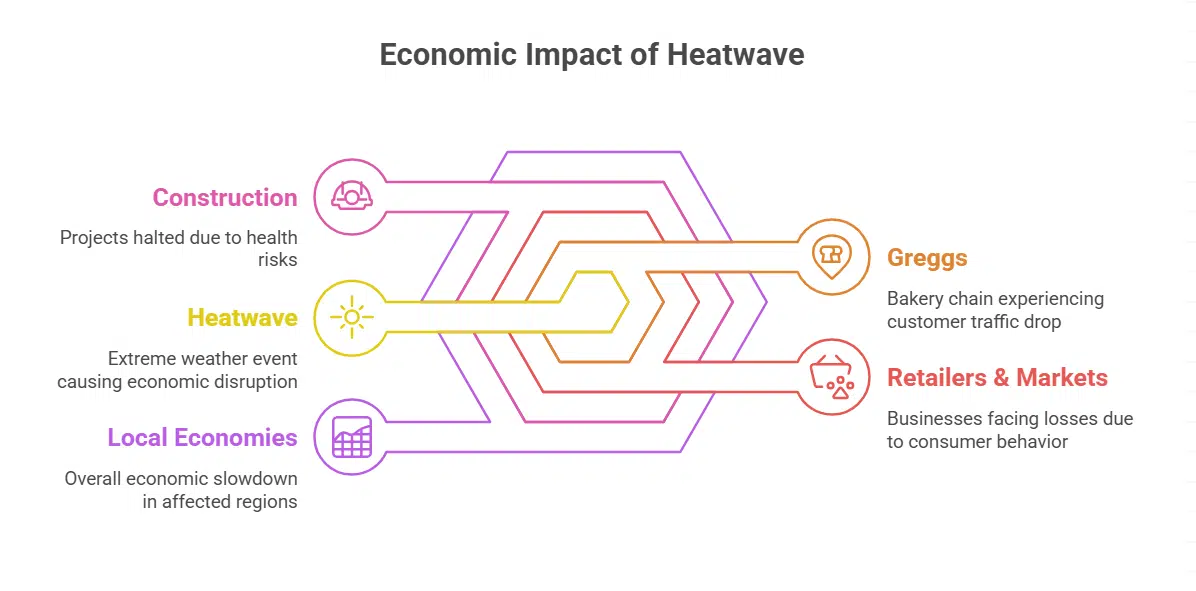
The economic cost of the heatwave is beginning to show. In the United Kingdom, the popular bakery chain Greggs reported a noticeable drop in customer traffic during the extreme heat. Shoppers chose to stay indoors rather than venture out for snacks or baked goods, leading to a decline in profits despite overall year-on-year sales increases.
Retailers, outdoor markets, and entertainment venues across Europe are also facing losses as extreme weather affects consumer behavior. Construction projects have been temporarily halted in some regions due to health risks to workers, further slowing down local economies.
Scientists Link Heatwave to Climate Crisis
Climate scientists have identified this heatwave as a direct result of intensifying global warming. According to recent assessments, the phenomenon was exacerbated by a “heat dome” created from unusually high sea surface temperatures in the Atlantic and Mediterranean. This dome trapped hot air over Europe, leading to temperature spikes up to 10°C above seasonal norms.
The pattern is consistent with what scientists predict will become more common in coming decades. Rising carbon emissions, urban heat islands, deforestation, and unsustainable land use practices have all contributed to the climate system becoming increasingly unstable. Europe, which is warming faster than the global average, is now facing heat extremes more regularly and earlier in the year.
UN and Climate Experts Urge Urgent Adaptation
Experts from the United Nations and climate research institutions are calling for urgent adaptation strategies to combat the growing threat of heatwaves and related disasters. These strategies include updating city infrastructure, expanding green cover, improving emergency preparedness, and transitioning to clean energy to reduce emissions.
They warn that without immediate and coordinated action, the impact of climate change will worsen, putting more lives, economies, and ecosystems at risk. Cities and nations must invest in climate-resilient urban design, efficient public cooling systems, and education campaigns to protect citizens during extreme weather.
This deadly heatwave, coming so early in the summer, is another stark reminder that climate change is not a distant threat—it is happening now. The tragic loss of lives, the strain on health and energy systems, and the economic disruption underscore the urgent need for both mitigation and adaptation. Governments, businesses, and individuals must all play their part in addressing the climate crisis before such events become the norm rather than the exception.