
Most people still think 6G is far away. That’s understandable because 5G is still expanding in many regions. But the real 6G competition started years before consumers will see a “6G” icon on a phone. It begins in research labs, pilot networks, chip development, and the global standards process.
The countries leading the 6G race are not only chasing speed. They are aiming to shape the next platform for connectivity, automation, industrial systems, and emerging services. In many cases, the early advantage comes from coordination. Governments, universities, operators, and vendors have to move together. If they don’t, progress becomes scattered and slow.
This article is a neutral, practical guide. It explains what 6G is likely to become, how national leadership is measured, and which 10 countries are showing the strongest signals today. You’ll also see what to watch from 2026 to 2030 so you can separate real progress from marketing.
| What You’ll Learn | Why It Helps |
| What 6G is expected to improve beyond 5G | It prevents hype-driven assumptions |
| How “leading” is measured in 6G | It makes comparisons fair and logical |
| 10 country profiles with key strengths | It helps you track progress clearly |
| Timeline signals through 2030 | It shows what milestones matter most |
What Is 6G And How Is It Different From 5G?
6G is the next phase of mobile networks after 5G, but it is better understood as a broader technology system than a single “faster network.” It is expected to combine connectivity with intelligence, sensing, and tighter integration with satellites and other non-terrestrial platforms. That makes it relevant to far more than phones.
In simple terms, 6G aims to reduce friction in communication. It may support more reliable coverage, smarter routing of data, and new ways of managing networks using automation. Many expectations focus on AI-native operation, better energy efficiency, and new radio techniques. The most important point is this: 6G is likely to be designed for a world where machines, factories, and digital systems depend on constant connectivity.
It also changes how we think about the “network edge.” With 6G, more computing may happen closer to users and devices. That could support advanced robotics, real-time digital twins, and safer connected transport systems. However, these benefits require complex engineering tradeoffs, especially around power use, security, and cost.
Finally, 6G is expected to evolve alongside 5G-Advanced. That means businesses may adopt “pre-6G” capabilities gradually before full 6G arrives. So the race is not only about who launches first. It is about who defines what becomes normal across the world.
| Topic | 5G Today | Likely 6G Direction |
| Core value | Faster data + lower latency | Intelligence + integration across systems |
| Coverage | Mostly terrestrial | More planned non-terrestrial support |
| Operations | Many manual processes remain | More automation and AI-assisted control |
| Use cases | Mobile, IoT, private networks | Industrial autonomy, sensing, large-scale machine ecosystems |
How We Chose The “Leading” Countries
It is easy to call a country a “leader” based on one headline or a single trial result. But that approach is unreliable. A trial can be impressive and still not scale. A patent surge can look strong and still fail to produce deployable technology. So this list uses multiple signals that together show durable leadership.
First, we looked for clear national intent. That includes government strategy, ongoing funding, and public programs that last more than a year or two. A short-term initiative may produce a demo, but 6G requires a long runway.
Second, we considered ecosystem strength. Countries with global vendors, strong operators, large research universities, and chip or device industries have an advantage. They can build full pipelines from concept to production.
Third, we included standards influence and international collaboration. 6G must work across borders. Countries that consistently contribute to global standards and participate in international projects are more likely to shape the final result.
Lastly, we weighed testbeds and real experimentation. Pilots are not proof of commercial readiness, but they show engineering seriousness. A strong testbed culture also attracts talent and partners.
| Leadership Signal | What It Indicates | What It Doesn’t Guarantee |
| National roadmap + funding | Commitment and coordination | Fast consumer rollout |
| Strong vendor/operator ecosystem | Ability to scale products | Global standards dominance |
| Standards participation | Ability to shape interoperability | Market success in every region |
| Testbeds and pilots | Practical engineering progress | Affordable nationwide deployment |
Countries Leading The 6G Race

The next sections profile 10 countries showing strong, consistent indicators across strategy, research, industry, trials, and influence. For each country, you’ll see why it matters and what to watch next. This section also includes practical context so you can compare nations fairly.
You should also keep one reality in mind. 6G leadership is not one straight line. One country may lead in research. Another may lead in mass manufacturing. Another may lead in early field trials. Over time, these lanes can merge, but they don’t always.
This is why the countries leading the 6G race should be viewed as an evolving list, not a permanent ranking. New funding can change momentum. A breakthrough chip design can shift the timeline. A stronger standards position can reshape markets.
To keep the article easy to scan, each country follows a similar structure. That makes it simpler to compare who is strong in what area.
| What This List Prioritizes | What It Avoids |
| Long-term programs and credible ecosystem signals | Declaring a single “winner” today |
| Repeatable progress indicators | One-off marketing claims |
| Standards + testbeds + industry balance | Overreliance on patents alone |
United States
The United States remains central to 6G because it combines wide research capacity with a massive commercial ecosystem. It has global operators, chip companies, cloud platforms, leading universities, and a large defense-adjacent R&D layer. These pieces matter because 6G is not only telecom hardware. It is also software, security, automation, and computing integration.
In many ways, the U.S. advantage is the breadth of its innovation pipeline. It can fund early research, build prototypes, test them at scale, and then integrate them into products. It also has strong influence through alliances and industry groups that coordinate efforts across companies and institutions.
Another important factor is the U.S. focus on resilient infrastructure. Future networks will support critical services, and that pushes security and reliability higher up the priority list. This may shape U.S. preferences in standards and architecture.
What to watch next is how effectively coordination turns into long-term execution. The U.S. can be strong at innovation but fragmented in deployment. If its programs stay aligned, it can remain highly influential in early 6G specifications.
Why The U.S. Is A Front-Runner
The U.S. benefits from the world’s largest tech ecosystem and strong capital markets. It also leads in advanced semiconductors, cloud-native software, and AI research. Those strengths fit 6G’s direction toward intelligence-driven network control.
The U.S. also has a strong culture of large-scale experimentation. When testbeds become open platforms, they attract global partners and speed up development. That helps the U.S. maintain relevance even when other countries move faster in centralized coordination.
What To Watch Next
- Funding continuity over multiple budget cycles
- Larger, shared testbeds that multiple companies can use
- Stronger alignment between research breakthroughs and standards proposals
- Practical work on energy efficiency and security-by-design
| U.S. Snapshot | Notes |
| Core strength | Ecosystem breadth and innovation pipeline |
| Typical advantage lane | Software, chips, AI integration, standards influence |
| Key risk | Fragmentation across stakeholders |
China
China is often discussed as a 6G leader because of scale and coordination. It has very large operators, major telecom vendors, and a strong national ability to align research, industry, and policy goals. That structure can speed up progress, especially when targets are set clearly and pursued over many years.
China’s scale also matters for testing. When a country has large networks and dense urban environments, it can run field trials in varied conditions. This helps validate performance beyond labs. It also supports faster learning cycles.
Another major factor is ambition in global influence. Standards shape markets, and China has strong incentives to participate deeply in that process. Even when global politics complicate collaboration, technical standards remain an arena where influence matters.
The most practical way to follow China’s 6G momentum is to watch repeatable trials, open publications, and standards contributions. Marketing claims can be loud in any country. The deeper signals are sustained programs and measurable engineering outcomes.
Why China Is A Front-Runner
China’s telecom sector has the ability to align operators, vendors, and research institutions. That coordination can reduce delays and keep work focused. China also has strong manufacturing capability, which helps move from prototype to hardware at scale.
It also has a growing advanced chip ecosystem and strong talent pipelines. For 6G, talent may be the limiting factor more than money. Countries that can train and retain researchers at scale gain long-term advantage.
What To Watch Next
- Interoperability focus and cross-border collaboration where possible
- Consistent progress from trials to large pilots
- How research directions align with global standards pathways
- Energy and cost efficiency improvements for higher-frequency systems
| China Snapshot | Notes |
| Core strength | Scale, coordination, manufacturing capacity |
| Typical advantage lane | Rapid pilot expansion and ecosystem mobilization |
| Key risk | Global interoperability and geopolitical friction |
South Korea
South Korea stands out because it has a proven pattern of early adoption and fast commercialization in mobile generations. It also has a powerful combination of operators and global device makers. That matters because device ecosystems often decide how fast a network technology becomes mainstream.
Korea’s approach is also shaped by export competitiveness. If Korean companies can lead in components, radios, and consumer devices, they benefit from global demand, not only local rollout. This creates strong incentive to be early and influential.
South Korea also tends to invest heavily in advanced infrastructure. Dense urban environments can be challenging, but they are also ideal for testing new network designs. That helps refine real-world performance.
The key question for South Korea is how it balances aggressive timelines with global standardization and energy constraints. If higher-frequency systems raise power demands, efficiency could become a major battleground.
Why South Korea Is A Front-Runner
Korea’s strength lies in its tight feedback loop. R&D can move into devices and networks quickly, and operators can validate performance in demanding markets. That shortens the distance between lab and reality.
It also benefits from global recognition in electronics manufacturing. When a country helps build the next generation of devices, it often influences the network design itself.
What To Watch Next
- Testbeds that expand beyond labs into multi-city pilots
- Progress in energy-efficient radio designs
- New device prototypes that support early 6G features
- Standards participation that matches the country’s commercialization pace
| South Korea Snapshot | Notes |
| Core strength | Device + operator ecosystem, speed to market |
| Typical advantage lane | Trials-to-commercial pipeline |
| Key risk | Energy efficiency and cost at scale |
Japan
Japan’s 6G position is strongly research-driven. It has large telecom players, world-class labs, and deep experience in hardware design and advanced electronics. It also has a long history of exploring future network visions that go beyond consumer usage.
Japan tends to focus on “systems thinking.” That means it considers how networks connect to society, industry, and future services. This is important because 6G may become an enabling layer for robotics, automation, mobility, and advanced sensing.
Another advantage is Japan’s ability to create high-quality technical roadmaps. Clear visions help align research priorities and attract partners. They also make it easier to measure progress.
Japan’s challenge is not technology ambition. It is turning cutting-edge R&D into products at scale while remaining aligned with global standards. That requires strong international collaboration.
Why Japan Is A Front-Runner
Japan excels at deep research and long-horizon planning. It also has strong electronics manufacturing and a mature telecom sector. These strengths support robust experimentation and high-quality prototypes.
Japan also has strong industrial use case potential. Factories, logistics, mobility systems, and robotics provide real environments where advanced wireless can prove value.
What To Watch Next
- Joint trials with international partners
- Progress in non-terrestrial integration and industrial automation
- Clearer mapping of research into standards proposals
- Hardware breakthroughs that improve reliability and power efficiency
| Japan Snapshot | Notes |
| Core strength | Advanced research and systems planning |
| Typical advantage lane | Future architecture and industrial use cases |
| Key risk | Scaling prototypes into broad commercial ecosystems |
Finland
Finland is a major name in 6G because it has one of the most visible long-running 6G research ecosystems. It is not a large country by population, but it punches above its weight in telecom innovation. The reason is focus: strong universities, strong research programs, and a deep telecom legacy.
Finland’s advantage is foundational work. In early generations, the countries that define architecture and concepts can shape what becomes standard later. Finland’s research culture is built for that stage of the race.
Finland also benefits from a collaborative mindset. Many Finnish programs work with international partners, which helps ideas spread into broader projects and standards discussions.
The most useful way to track Finland is to watch research outputs that turn into prototypes, then into testbed measurements. That’s how early concepts become real engineering.
Why Finland Is A Front-Runner
Finland leads through concentrated research excellence. It has programs designed around the 2030 timeframe, which fits the expected 6G horizon. It also has deep telecom expertise that can guide practical tradeoffs.
This approach matters because 6G is still a “definition” phase in many areas. Research leaders can influence how other countries frame their goals.
What To Watch Next
- Research translating into reusable testbed platforms
- Leadership in sustainability and energy-efficient architectures
- International partnerships that expand Finland’s influence
- Contributions that move from papers to standard-ready proposals
| Finland Snapshot | Notes |
| Core strength | Foundational research leadership |
| Typical advantage lane | Architecture, prototypes, early testbeds |
| Key risk | Commercial scaling depends on broader partners |
Sweden
Sweden is tightly linked to 6G because of its global telecom equipment leadership. When a country hosts a major network vendor ecosystem, it often has disproportionate influence on what becomes widely deployed. Vendor research can shape technical direction, network architecture choices, and implementation approaches.
Sweden’s advantage is also international collaboration. When vendor-driven research connects with global partners, it accelerates adoption and increases standards relevance. Sweden’s role is less about being the first market to launch and more about shaping the equipment and technology used worldwide.
Another key theme for Sweden is trust and resilience. Future networks will be critical infrastructure, and secure deployments will matter. Countries that can build trusted equipment and processes may gain market advantage.
Sweden’s challenge is ensuring continued leadership in a world where supply chains and geopolitics add complexity. Maintaining openness and global relevance will be critical.
Why Sweden Is A Front-Runner
Sweden’s influence is strongly tied to telecom equipment research and export. If a major part of the world’s networks uses vendor technology shaped in Sweden, Sweden matters in the 6G story.
It also has a strong research ecosystem and experience in large-scale telecom deployments. That helps keep innovation practical, not only theoretical.
What To Watch Next
- Vendor-led trials that become reference implementations
- Energy efficiency and sustainability work in network design
- Security-by-design approaches that support trusted deployments
- Deep participation in global standards and multi-country projects
| Sweden Snapshot | Notes |
| Core strength | Vendor-driven global influence |
| Typical advantage lane | Equipment design, implementation pathways |
| Key risk | Geopolitics and supply chain complexity |
Germany
Germany’s 6G strength often comes from structured national coordination and strong industrial alignment. Germany is also a manufacturing powerhouse. That matters because future networks will support industrial automation, logistics, robotics, and large-scale machine coordination.
Germany’s biggest advantage is the real-world environment it can offer for industrial trials. If 6G is expected to support ultra-reliable systems, factories and industrial campuses are the right place to test value. Germany can validate use cases that other countries talk about only in theory.
Germany also has strong engineering culture and respected research institutions. When that research is coordinated through national platforms, it can become more effective.
Germany’s risk is that industrial-grade requirements can be expensive. A strong industrial focus must still connect to broader consumer and enterprise markets.
Why Germany Is A Front-Runner
Germany’s role is essential if 6G becomes a platform for industrial digitalization. It can set requirements and prove benefits in real industrial settings. That can influence standards and vendor priorities.
Germany also benefits from strong EU collaboration. Regional coordination can strengthen standards influence and reduce fragmentation.
What To Watch Next
- Industrial pilots that demonstrate measurable ROI
- Private network evolution and large enterprise adoption patterns
- Collaboration with vendors and EU-wide research programs
- Progress on security, reliability, and compliance frameworks
| Germany Snapshot | Notes |
| Core strength | Industrial alignment and structured programs |
| Typical advantage lane | Industrial use cases and reliability focus |
| Key risk | Cost and complexity of industrial-grade deployments |
United Kingdom
The UK remains prominent in 6G due to strong research universities, visible strategy efforts, and a growing interest in large-scale experimentation platforms. Research leadership matters because 6G is still being defined in many areas, and early research can shape global direction.
The UK also has a clear incentive to convert research into commercialization. Countries that do not build domestic ecosystems can struggle to capture value even if they produce great research. So the UK’s success depends on building bridges between labs and industry.
Another UK strength is its ability to convene partners. Collaborative research programs can attract global companies and ensure UK work stays aligned with real-world needs.
The UK must also balance innovation with security and infrastructure resilience. As networks become more critical, governance and trust become part of leadership.
Why The UK Is A Front-Runner
The UK’s advantage lies in research depth and innovation networks. It can create advanced prototypes and contribute to the global knowledge base. If that research is paired with strong commercialization pathways, it can remain influential.
The UK also has global reach through partnerships, which can increase the impact of its research outcomes.
What To Watch Next
- Growth of national testbeds and open experimentation
- Commercialization of research into products and services
- Stronger standards participation and international influence
- Talent retention and long-term funding stability
| UK Snapshot | Notes |
| Core strength | Research excellence and collaboration |
| Typical advantage lane | Prototypes, experimentation platforms |
| Key risk | Capturing commercial value at scale |
India
India is increasingly important in the 6G landscape because of scale, talent, and growing policy momentum. It has one of the world’s largest mobile user bases and rapidly expanding digital infrastructure. That gives it a strong incentive to shape future connectivity.
India’s advantage is not only domestic demand. It also has a deep engineering talent pool and a growing technology startup ecosystem. If India builds stronger links between research, trials, and domestic manufacturing, it can capture value across the supply chain.
India’s progress should be measured by practical steps: testbeds, trials, standards engagement, and local ecosystem growth. Large vision statements are useful, but execution matters more.
India also has a unique chance to focus on affordability and coverage. If 6G must work beyond wealthy urban centers, India’s priorities could influence cost-efficient design.
Why India Is Emerging In The 6G Race
India’s combination of talent and market scale can create momentum. When a large country commits to long-term wireless evolution, it attracts partners and investment. India is also positioned to focus on practical deployment challenges that matter globally.
As manufacturing ecosystems grow, India may increase its influence over devices and network components as well.
What To Watch Next
- Testbeds that involve universities, startups, and operators
- Manufacturing and supply chain progress for future network hardware
- Deep standards participation and international technical collaboration
- Use cases tied to rural coverage, industry, and smart infrastructure
| India Snapshot | Notes |
| Core strength | Market scale and engineering talent |
| Typical advantage lane | Affordability focus and ecosystem growth |
| Key risk | Coordinating many stakeholders consistently |
United Arab Emirates
The UAE stands out because it often moves quickly in advanced pilots and international partnerships. It is not a large country, but it has the ability to invest strategically and create high-visibility demonstrations. That can attract talent, research partners, and new business activity.
The UAE’s role in the 6G ecosystem is likely to be defined by testbeds, pilot networks, and regional leadership. If it builds open experimentation platforms, it can become a hub for innovation, even if manufacturing happens elsewhere.
The strongest UAE signal is speed of execution. When research institutions and operators align, pilots can happen fast. That creates learning cycles that help refine technology.
The main question is sustainability. One pilot is impressive, but leadership requires ongoing programs, repeatable results, and deeper engagement in the standards pathway.
Why The UAE Is A Fast-Moving Contender
The UAE uses targeted investment and partnerships to move quickly. It can run ambitious pilots and then scale them into larger experiments. This approach can build a reputation as a place where advanced wireless innovation happens in practice, not only on paper.
It also benefits from being a regional technology and business center, which can amplify impact.
What To Watch Next
- More pilots across environments, not just controlled settings
- Long-term research programs beyond one-off demos
- Broader ecosystem building, including startups and academic pipelines
- Stronger global standards engagement and collaboration
| UAE Snapshot | Notes |
| Core strength | Fast pilots and partnership execution |
| Typical advantage lane | Testbeds and high-visibility demonstrations |
| Key risk | Turning pilots into sustained long-term programs |
Side-By-Side Comparison: Who Leads In Which Lane?
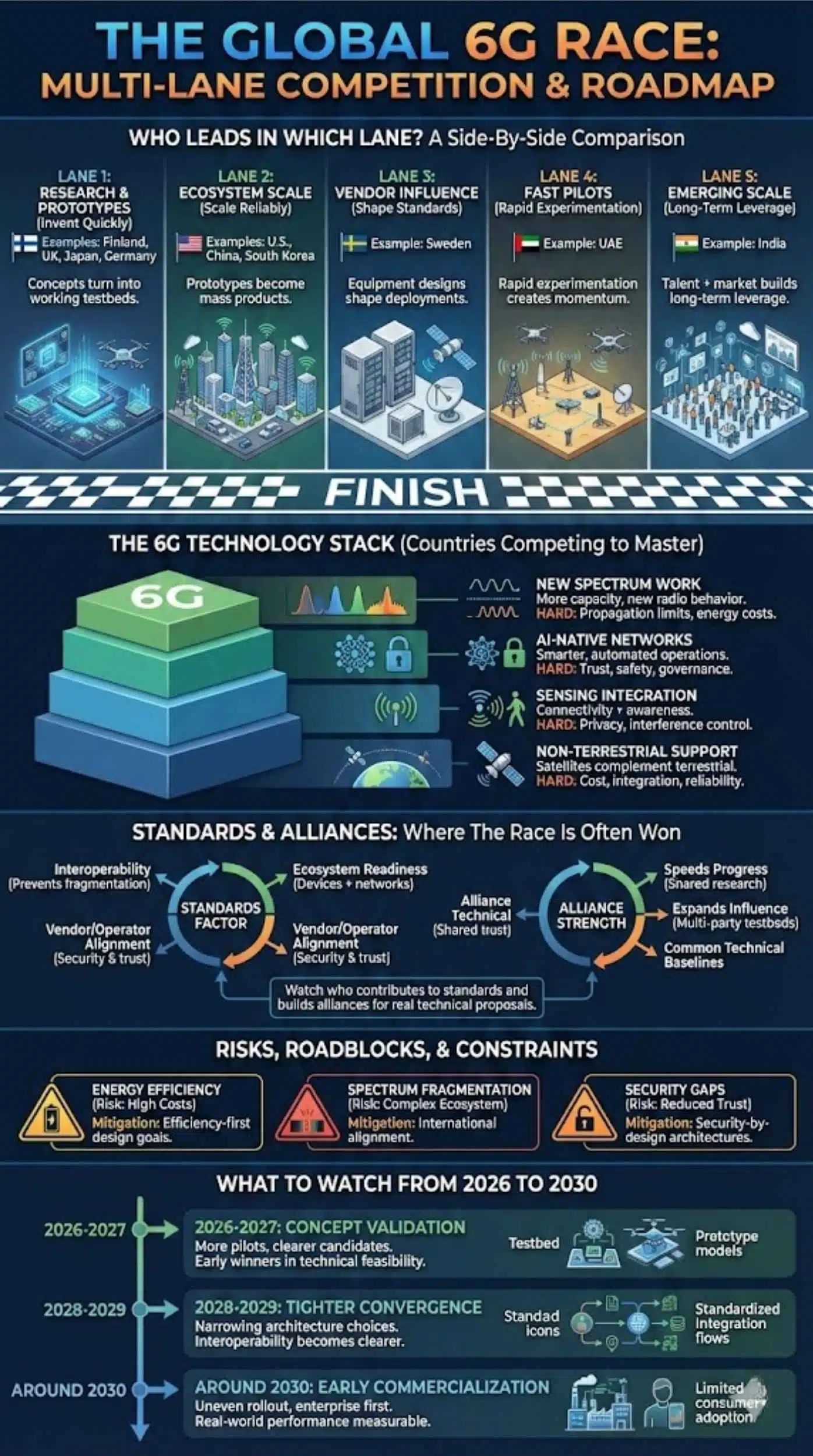
This is where the story becomes clearer. The countries leading the 6G race are often leading in different ways. You can think of this as a multi-lane competition, not a single race track.
Some countries lead in foundational research and prototypes. Others lead in ecosystem scale and commercialization. Others lead through vendor influence in global network deployments. These lanes can overlap, but they are not identical.
A useful way to compare is to ask three questions:
- Who can invent and prototype quickly?
- Who can scale and manufacture reliably?
- Who can shape the standards that govern interoperability?
When you use these questions, the ranking becomes less emotional and more practical. It also becomes easier to predict how leadership might shift over time.
| Lane | Strong Examples | What “Winning” Looks Like |
| Research and prototypes | Finland, UK, Japan, Germany | Concepts turn into working testbeds |
| Ecosystem scale | U.S., China, South Korea | Prototypes become mass products |
| Vendor influence | Sweden | Equipment designs shape deployments |
| Fast pilots | UAE | Rapid experimentation creates momentum |
| Emerging scale | India | Talent + market builds long-term leverage |
The 6G Technology Stack Countries Are Competing To Master
6G is not one technology. It is a stack of innovations that must work together. Countries that lead will often invest across several layers at once because weaknesses in one layer can limit everything else.
One key layer is spectrum. Future systems may explore higher frequency ranges, but that adds challenges like shorter range, higher power needs, and harder hardware design. Another layer is intelligence. If networks become more automated, they must be trustworthy and controllable.
Another important layer is sensing. If networks can “sense” environments, they could support safer mobility and smarter industrial systems. But sensing integration raises questions about privacy, security, and regulation.
Finally, non-terrestrial integration is becoming more important. Satellite and high-altitude platforms can expand coverage, but they introduce new complexity in handovers, latency, and economics.
| Stack Layer | What It Means | Why It’s Hard |
| New spectrum work | More capacity and new radio behavior | Propagation limits and energy costs |
| AI-native networks | Smarter, more automated operations | Trust, safety, and governance |
| Sensing integration | Connectivity plus awareness | Privacy and interference control |
| Non-terrestrial support | Satellites complement terrestrial | Cost, integration, and reliability |
Standards And Alliances: Where The 6G Race Is Often Won
A country can build brilliant prototypes and still lose influence if it does not shape standards. Standards decide how devices and networks talk to each other. They also decide what features become normal and what features remain niche.
That is why standards participation is a quiet but powerful form of leadership. When countries and companies contribute early, they can guide architecture choices, technical priorities, and evaluation methods. Over time, this becomes market influence.
Alliances also matter because 6G is expensive and complex. Multi-country projects allow research teams to share results, compare approaches, and reduce duplication. They also create larger blocks of influence during standard-setting.
For readers, the most practical takeaway is this: if you want to predict 6G leadership, track who is present and active in standards work and who is building alliances that produce real technical proposals.
| Standards Factor | Why It Matters | What To Watch |
| Interoperability | Prevents fragmented markets | Common technical baselines |
| Ecosystem readiness | Enables devices and networks together | Vendor and operator alignment |
| Security and resilience | Builds trust in critical infrastructure | Security-by-design proposals |
| Alliance strength | Speeds progress and expands influence | Multi-party testbeds and outcomes |
Risks, Roadblocks, And Constraints That Could Slow 6G
Even strong leaders face hard constraints. 6G may push into more complex radio design and denser infrastructure needs. That can increase cost, power usage, and operational complexity.
Energy efficiency is one of the biggest risks. If 6G requires significantly more power, it will face sustainability pushback and higher operating costs. That can slow adoption even if performance is strong.
Spectrum policy is another risk. If countries choose different bands and strategies, the global device ecosystem becomes fragmented. That raises costs and reduces interoperability.
Security is also non-negotiable. Future networks will support more sensitive workloads, and security weaknesses can destroy trust. Countries that lead must demonstrate credible security and resilience design.
| Risk | Why It Can Slow 6G | Practical Mitigation Direction |
| Energy and sustainability | High operating costs and pressure | Efficiency-first design goals |
| Spectrum fragmentation | Devices become expensive and complex | International alignment where possible |
| Security gaps | Reduced trust and delayed adoption | Security-by-design architectures |
| Pilot trap | Hype without scalable rollout | Repeatable, multi-environment tests |
What To Watch From 2026 To 2030
The best way to follow 6G is to watch milestones that cannot be faked. Marketing is easy. Standards contributions, repeatable test results, and scaled pilots are harder.
From 2026 to 2027, expect more concept validation. Technologies will compete for attention. Some will fade. Others will become core building blocks. This is the phase where prototypes and testbeds matter most.
From 2028 to 2029, expect tighter convergence. The industry will narrow down architecture choices, radio designs, and integration pathways. Large alliances and vendors will play a big role in what becomes mainstream.
Around 2030, early commercialization will become more visible. However, rollout will still be uneven. Some regions may see early enterprise deployments first, especially in industrial zones, before broad consumer adoption.
| Period | What You’ll Likely See | What It Means |
| 2026–2027 | More pilots and clearer candidates | Early winners in technical feasibility |
| 2028–2029 | Convergence and stronger standards readiness | Interoperability becomes clearer |
| Around 2030 | Early commercialization signals | Real-world performance becomes measurable |
Final Thoughts: The Countries Leading The 6G Race Will Shape More Than Mobile
The countries leading the 6G race are shaping the next infrastructure layer for the digital world. This is not only about streaming faster video. It is about building networks that support automation, resilient systems, and new categories of connected services.
The smartest way to view leadership is to track lanes. Research leaders may define the concepts. Ecosystem leaders may scale the products. Vendor leaders may shape how networks are deployed globally. And fast pilot hubs may accelerate learning through experimentation.
If you want one clear rule, it is this: follow sustained programs, standards influence, and repeatable testbed results. Those signals matter more than isolated records. Over the next few years, you will likely see leadership shift and merge as the path to 2030 becomes more defined.
Countries Leading The 6G Race will remain a moving story, and the most credible leaders will be the ones that balance ambition with execution, efficiency, and global interoperability.
| Key Takeaway | Why It Matters |
| Leadership is multi-lane | It prevents oversimplified rankings |
| Standards shape markets | It explains long-term influence |
| Testbeds prove seriousness | It separates engineering from hype |
| Efficiency and security decide adoption | It determines whether 6G scales |
FAQs
Which Country Is Leading The 6G Race Overall?
There is no single clear winner today because leadership depends on the lane you measure. The U.S., China, and South Korea show strong ecosystem strength. Finland, Japan, Germany, and the UK show strong research and testbed momentum. Sweden influences the vendor lane, while the UAE stands out for fast pilots. India is a strong rising contender due to scale and talent.
When Will Consumers Actually Use 6G?
Many credible roadmaps link early commercialization to the 2030 timeframe, but consumer availability will differ by country. Early adoption may appear first in enterprise and industrial deployments, with broader consumer rollout later.
Is 6G Only About Faster Speed?
No. Speed is one part. The larger shift is toward smarter networks, stronger automation, sensing integration, and better coordination between terrestrial and non-terrestrial systems.
Will 6G Replace 5G?
6G is expected to build on and coexist with 5G for a long time. Like past generations, adoption will be gradual. Many “6G-like” capabilities may appear through upgrades before full 6G branding becomes common.
What Should I Watch To Spot Real Progress?
Watch repeatable test results, scaled pilots, published technical contributions, and serious long-term funding. These signals matter more than one-off headlines.