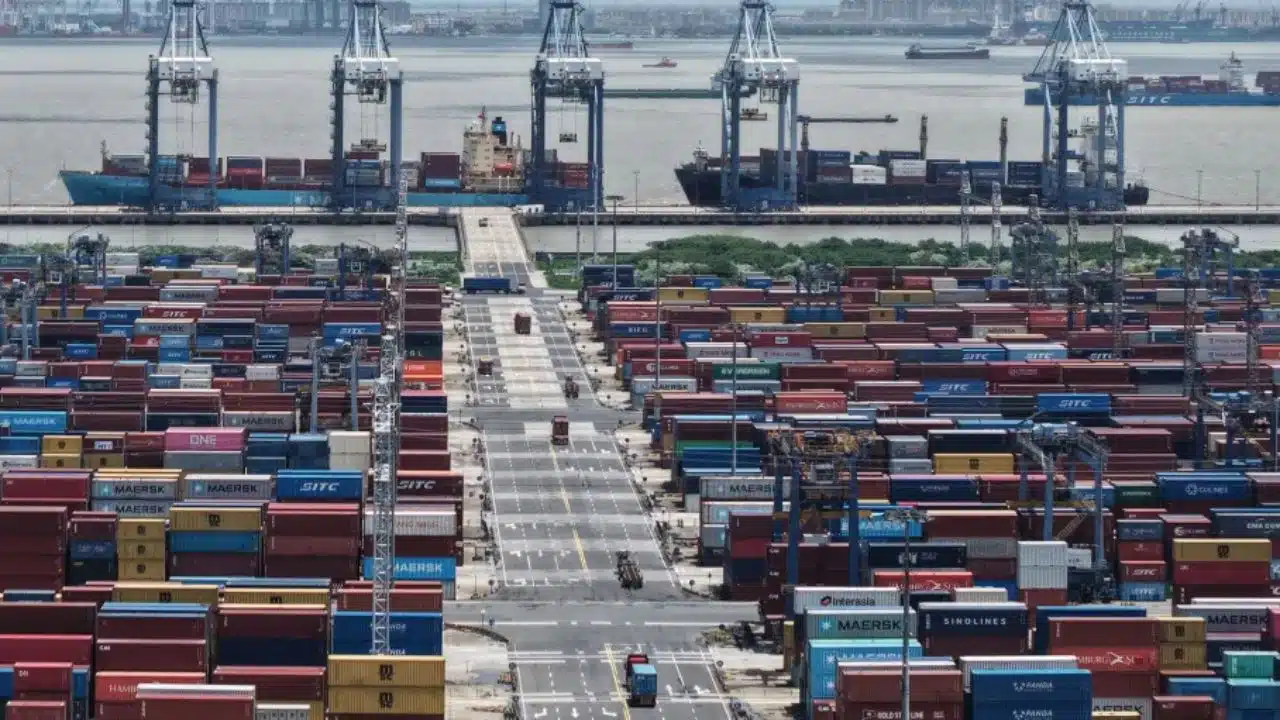
China’s export engine roared back to life in the final quarter of 2025, posting a robust 5.9% year-on-year increase, the fastest pace of growth since mid-2022. The surge highlights a broader realignment of global trade as Chinese manufacturers deepen ties with emerging markets across Asia, the Middle East, and Latin America—sidestepping dependence on the U.S. market amid ongoing geopolitical strains.
The latest customs data, released by China’s Ministry of Commerce in early December, show a rebound in both exports and industrial output, signaling that the world’s second-largest economy is regaining momentum after months of mixed performance. Analysts see the turnaround not as a short-term spike but part of a strategic diversification of trade flows—a restructuring that could reshape global commerce in the decade ahead.
A Remarkable Recovery Amid Global Headwinds
China’s total exports reached approximately $313 billion in November 2025, up from $296 billion a year earlier. Importantly, the gains came despite global demand fluctuations, high shipping costs, and weak U.S. retail figures, underscoring China’s effort to buffer its economy against Western economic uncertainty.
Sectors that led this rebound included:
-
Automobiles and EVs: Chinese electric vehicle shipments rose by 35% year-on-year, fueled by demand in Southeast Asia and Europe.
-
Consumer Electronics: Exports of smartphones, semiconductors, and digital devices climbed 8%, reversing declines seen earlier in the year.
-
Machinery and Renewable Equipment: Shipments of solar panels, energy storage batteries, and construction machinery rose sharply, supporting infrastructure projects across Africa and the Gulf.
“China’s exporters have adjusted swiftly to structural changes in global demand,” said Chen Shaohua, an economist at the Shanghai Academy of Social Sciences. “The diversification toward non-U.S. markets has reduced vulnerability and created new growth corridors in the Global South.”
The U.S. Declining as China’s Core Export Destination
While China’s overall exports grew, shipments to the United States fell by 3.4%, marking the seventh consecutive quarterly decline. The trend reflects the continuing decoupling between the two economic superpowers, as Washington intensifies restrictions on high-tech goods and pushes supply chain diversification through initiatives such as “friend-shoring” and “nearshoring” to Mexico and Southeast Asia.
Yet, the decline in U.S.-bound trade has been offset by soaring exports to other destinations:
-
ASEAN (Association of Southeast Asian Nations) markets grew by 12.6%.
-
The Middle East saw export growth of 11.9%, driven by energy collaboration and infrastructure projects.
-
Latin America, particularly Brazil and Mexico, posted a 9.7% increase.
-
Africa, boosted by the Belt and Road Initiative, witnessed a 14.2% surge in Chinese exports.
This shift underlines China’s effort to bypass Western trade bottlenecks and secure long-term partnerships in regions less influenced by U.S. trade policies.
“China’s trade pattern is undergoing a quiet revolution,” remarked Li Dawei from the Chinese Academy of International Trade. “Trade with developing nations is no longer complementary—it’s strategic.”
Belt and Road Initiative Fuels New Export Corridors
Since its inception, the Belt and Road Initiative (BRI) has evolved into a key driver of China’s external trade strategy. In 2025, the program entered its second decade with expanded infrastructure, logistics, and digital connectivity projects linking Asia, Africa, and Europe.
Recent highlights include:
- The China–Laos Railway, which boosted cross-border trade by 40%, connecting Kunming to Southeast Asia’s landlocked economies.
- Expanded export hubs in Pakistan and the UAE, turning Gulf ports such as Khalifa and Jebel Ali into key re-export centers for Chinese goods.
- Digital Silk Road developments facilitating cross-border e-commerce through Alipay, WeChat Pay, and logistics platforms like Cainiao.
BRI partner countries accounted for nearly 46% of China’s total external trade in 2025, up from 39% three years earlier. This growing proportion reflects how the initiative has eased dependency on Western consumption while driving industrial engagement with developing nations.
Europe’s Mixed Stance: Opportunities and Tensions
Europe remains an important but complicated market for Chinese exporters. The continent saw a 4.1% growth in Chinese imports, largely from electric vehicles, batteries, and solar components.
However, political scrutiny has intensified. The European Commission announced in November a preliminary anti-subsidy probe into Chinese EV manufacturers, alleging unfair state support. This investigation could lead to higher tariffs in early 2026, posing fresh challenges for China’s automotive sector.
Still, China’s appeal to European markets remains strong due to its price competitiveness and technological agility. German automakers continue to rely on Chinese supply chains, while energy firms in Spain, Italy, and the Netherlands are expanding renewable collaborations.
Domestic Policy Support: Stabilizing the Export Engine
Beijing’s government has made export diversification a top economic priority. Faced with slowing domestic consumption, high youth unemployment, and a fragile real estate sector, authorities increasingly rely on foreign trade to sustain GDP growth.
Several policy actions taken in 2025 contributed to the export recovery:
-
Export Tax Rebates and Financing Support: The State Council expanded tax refund channels and provided low-interest loans for small and medium-sized exporters.
-
Renminbi Stabilization: The People’s Bank of China kept the yuan within a controlled range, maintaining competitiveness without triggering currency volatility.
-
Trade Digitalization: Customs efficiency was improved through electronic clearance systems, shortening export processing time by up to 30%.
-
Industrial Upgrading Funds: Aid for EVs, semiconductors, and environmental tech industries promoted high-value exports.
These measures boosted confidence among manufacturers and allowed companies to absorb external shocks. “China’s export policy environment is now the most supportive in a decade,” said Zhu Haibin, chief China economist at JPMorgan Chase.
Key Industry Highlights: What’s Driving the Export Boom
1. Electric Vehicles (EVs)
China’s EV exports surpassed 1.4 million units between January and November 2025, a record high, as global buyers increasingly turn to affordable yet efficient Chinese brands like BYD, NIO, and XPeng. Demand surged particularly in Europe, Russia, and Southeast Asia, where governments are phasing out fossil-fuel vehicles more aggressively.
BYD’s Dolphin and Seal models became top-selling EVs in Thailand and Brazil, reflecting how Chinese companies are localizing production and establishing assembly facilities abroad to bypass potential tariff barriers.
2. Green Technology
China dominates global exports of solar panels, lithium batteries, and wind turbines, posting a 22% year-on-year rise in these sectors. Nations across the Middle East and Africa, seeking renewable diversification, are fueling orders for China-made modules and storage components.
3. Electronics and AI Hardware
Smartphones and AI chip exports saw a modest revival of 6.3%, led by high-performance processors from Huawei and SMIC’s push into global midrange sectors. Although U.S. sanctions have constrained access to certain advanced technologies, domestic innovation continues to fill the gap.
The Rise of the “South-South” Trade Network
Economists describe China’s trade pivot as part of a larger South-South trade movement—intensifying commerce among developing nations without Western intermediation.
In 2025 alone:
-
Trade between China and ASEAN exceeded $1.2 trillion, cementing ASEAN as China’s largest trading bloc partner for the fourth consecutive year.
-
China–Middle East trade rose above $550 billion, propelled by digital infrastructure and green energy investments.
-
China–Africa trade hit an all-time high of $330 billion, with major growth in minerals, construction materials, and telecom equipment.
This network reflects Beijing’s long-term bet on multipolar globalization—a system less reliant on Western demand cycles and more grounded in cooperative production ecosystems across emerging markets.
Global Implications: Redefining Power in Trade
China’s success in diversifying exports underscores an evolving geopolitical and economic balance. For decades, global trade revolved around Western consumer markets. Now, the center of gravity is tilting toward Asia, the Middle East, and Latin America, reshaping how goods, energy, and capital move across borders.
For Western economies, particularly the U.S., this transformation raises challenges:
- Diminished leverage in global supply chains, especially for intermediate goods and green technologies.
- Reduced dependence on Chinese imports but increased costs and inflation risks from sourcing alternatives.
- Strategic realignment, as allies like Mexico and Vietnam benefit from Western reshoring efforts.
At the same time, China’s success in cultivating new trade corridors could limit the impact of Western sanctions and tariffs—a strategic shield against geopolitical pressure.
Risks Ahead: Protectionism and Overcapacity
While the numbers are encouraging for Beijing, risks remain substantial. Analysts warn of potential overcapacity in key sectors such as EVs, steel, and solar, where domestic production far exceeds global demand. This imbalance could lead to pricing pressures and dumping accusations abroad.
Additionally, trade tensions with the U.S. and EU may deepen. Possible tariff escalations on Chinese goods in 2026, particularly in high-tech industries, could curb export momentum.
Domestically, weak consumer demand and a fragile property sector could reduce the ability of manufacturers to sustain production without external growth stimuli. As a result, many exporters remain dependent on state-backed orders and subsidies.
China’s Changing Export Model: From Low-Cost to High-Tech
A defining feature of 2025’s export surge is the shift toward high-value manufacturing. China is no longer primarily the world’s assembly line for cheap products—it’s emerging as a technology powerhouse.
Data from the Ministry of Industry and Information Technology show that high-tech products accounted for nearly 42% of total exports, up from 35% in 2022. This includes EV components, AI chips, telecommunications equipment, and smart manufacturing tools.
This transformation aligns with Beijing’s “Made in China 2025” strategic vision, aiming to dominate advanced sectors like robotics, aerospace, and renewable energy.
The Yuan’s Role in Global Trade Settlements
Another key shift accompanying this export rise is the growing use of the Chinese yuan in cross-border trade settlements. Driven by currency swap agreements and regional trade pacts, more countries are settling deals in yuan instead of the U.S. dollar.
In 2025, nearly 28% of China’s trade was invoiced in yuan, a record high, reducing exposure to dollar fluctuations. The figure is expected to surpass 35% by 2027 if current trends continue.
Countries like Saudi Arabia, Indonesia, and Argentina have joined China’s Cross-Border Interbank Payment System (CIPS), an alternative to the Western SWIFT network, reinforcing Beijing’s ambitions to internationalize its currency and reduce dependency on U.S. financial systems.
What the Export Surge Means for China’s Economy
The export uptick injects vital momentum into China’s slowing economy, contributing nearly 1.3 percentage points to projected GDP growth in 2025, which is expected to close around 5.1%.
Beyond statistics, the rebound also brings psychological renewal to a country navigating complex domestic and international challenges. It demonstrates Beijing’s ability to adapt its economic model and reaffirm its influence in global trade networks despite political friction.
“China’s trade resilience shows that global supply chains can evolve without major decoupling,” observed Rajiv Biswas, Asia-Pacific chief economist at S&P Global. “The world is not deglobalizing—it’s reorganizing.”
The Road Ahead: Global Integration on China’s Terms
Looking to 2026, China appears poised to deepen economic ties with Asia, Africa, and the Middle East while cautiously managing relations with Western economies. Strategic initiatives such as BRICS+ trade integration, digital yuan cross-border trials, and green infrastructure investments will reinforce Beijing’s long-term goal: to lead a multipolar trade system centered around emerging economies.
Still, sustaining export momentum will depend on global stability, technological innovation, and continued economic reforms at home.
For now, China’s 5.9% export surge offers not just an economic victory—but a glimpse into the next phase of globalization, one where Beijing’s trade routes and industrial ecosystems increasingly shape the world’s economic geography.