The global push for sustainability has placed net-zero supply chains at the heart of environmental and business strategies. From multinational corporations to small manufacturers, everyone is being urged to reduce carbon emissions and meet climate targets. But despite ambitious pledges and green policies, progress remains slow—and uneven. Why? Because the challenges to achieving net-zero supply chains are far more complex than they appear. Supply chains span continents, involve countless third-party vendors, and rely heavily on fossil-fueled transportation and energy-intensive processes. Companies must grapple with a lack of standardized carbon tracking, high implementation costs, outdated infrastructure, and supplier non-compliance.
In this article, we explore five major hurdles that make the net-zero transition difficult. By understanding these challenges and how to tackle them, organizations can take realistic steps toward a cleaner, more responsible future.
How can companies set realistic and achievable carbon targets?
Companies pick a baseline year and measure scope 1, 2 and 3 emissions. Firms align targets with Science Based Targets initiative and follow the Greenhouse Gas Protocol. They break large cuts into yearly goals, bit by bit.
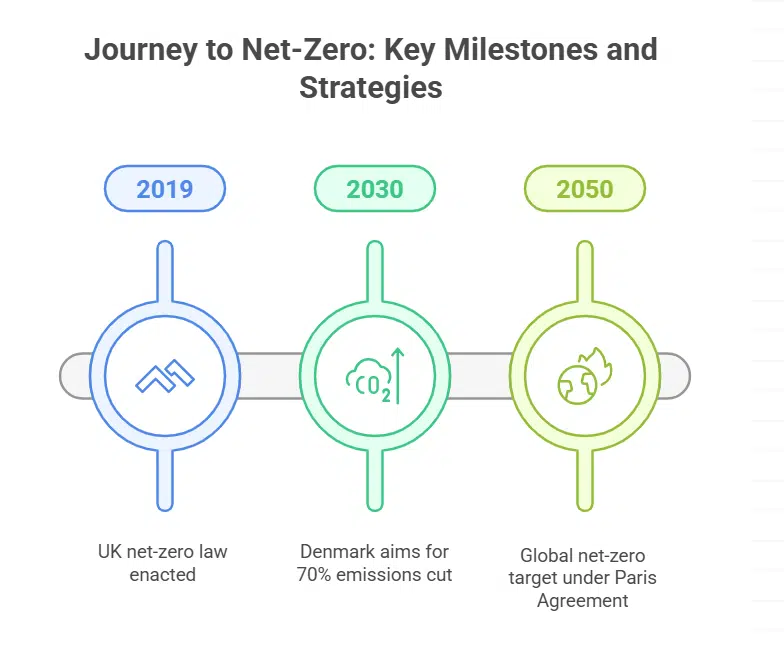
They track progress with a greenhouse gas emission calculator. They tie goals to the Paris Agreement and the UK net-zero law of 2019, aiming for net-zero by 2050. They note Denmark’s drive to cut 70 percent of emissions by 2030, from 1990 levels.
They plan carbon removal to balance residual carbon dioxide emissions.
Virgin Atlantic shows airlines can cut carbon footprint through public pledges and partnerships. Roles in supply chain sustainability include switching to renewable energy sources and electric vehicles.
Teams share data via Carbon Disclosure Project reports. They add carbon offset credits and nature-based solutions in forest management and carbon storage projects. Such steps curb greenhouse gas emissions and steer companies toward net-zero carbon emissions.
What are the financial and budget challenges in reducing supply chain emissions?
Tight budgets can stall green shifts. CFOs face high upfront costs in tracking scope 3 emissions. Many lack a carbon accounting platform. Adopting a lifecycle evaluation tool eats cash.
GHG Protocol standards demand staff training, audits, and tech upgrades. India feels the heat most. It risks $274 billion in export losses as buyers demand greener processes. Factories must swap fossil fuels for clean energy, or lose clients.
Power plants produce half of global carbon emissions. Transportation and steel mills add big chunks. Many lenders now weigh climate change risks. Paris Agreement goals strain tight ledgers.
They push firms toward green bonds and carbon credit schemes. These financial tools carry fees and rules. Cutting carbon footprints there drains funds fast. Firms juggle fuel bills, new gear, and carbon capture pilots.
Some tap government grants, others borrow at high rates. This tug of war can slow net zero emissions drives. Tough budgets can drag on climate change goals.
What operational obstacles hinder carbon reduction efforts?
Managers resist change, and studies show they block green plans. A study using decision analysis pinned this hurdle at 0.11 on the alpha scale. A classification tool flagged poor carbon accounting as the biggest snag for scope 3 emissions tracking.
Without solid reporting, teams can’t shrink their carbon footprint.
Consumer desire for next day shipping ramps up fuel use and emissions. Smart factories try IoT sensors and machine learning to cut carbon, but policy gaps slow the shift. Market rules for green electricity and battery storage confuse many firms.
These gaps hinder supply chain sustainability.
Strategies for streamlining and decarbonizing complex supply chains
Layer in life cycle assessment tools, a GHG calculator, and IoT sensors, to find big scope 3 emissions. Then swap diesel trucks for electric ones, tap wind and solar farms, or test carbon capture, to shrink your chain’s carbon footprint, and lean into circular economy ideas.
How can supply chain complexity be managed to reduce emissions?
Supply chains drive over 90% of a firm’s greenhouse gas emissions, while transport adds 14% more. Global warming risks climb, with mean air temperatures set to rise by 1.5°C around 2052 and possibly jump 3°C to 4°C by 2100.
- Map tiers with life cycle assessment software to track carbon footprint in scope 3 emissions and spot high-impact hotspots.
- Secure data on a distributed ledger to boost supply chain sustainability and cut gaps in carbon accounting software.
- Simplify supplier counts to reduce transport legs, curbing vehicle emissions that make up 14% of total U.S. greenhouse gases.
- Deploy a virtual model to run route trials, trimming fuel waste and cutting carbon dioxide emissions on each leg.
- Switch diesel rigs to electric vehicles or hydrogen fleets, tapping clean energy sources and slashing fossil fuel use.
- Install IoT sensors on factory lines to flag leaks in boilers or chillers and speed carbon removal in production.
- Align supplier contracts with 2030 Paris Agreement targets, tying bonuses to net-zero emissions goals.
- Set up a public dashboard for carbon data, raising transparency and driving circular economy reporting.
What are effective methods for decarbonizing supply chain processes?
Cutting carbon in supply chains demands bold moves. Teams can pick smart tools or new methods.
- Track emissions with software like SINAI to log third party outputs. That paints a clear data picture for brands like Siemens Energy and Harley Davidson.
- Apply a bottom-up lean carbon management tactic using material flow study to sharpen carbon footprint data. That cuts out guesswork in audits.
- Swap to renewable energy with solar and wind in factories. Follow South Korea’s zero emission buildings plan that uses efficient water systems.
- Link payments to green bonds in line with India’s 2022 budget push for carbon neutrality and emissions reduction. That funds new clean tech.
- Shift trucks to electric fleets and boost rail use to curb transportation emissions. Help limit global warming in every haul.
- Aim for net zero carbon emissions in every node of your chain. That makes your network feel lighter.
- Use carbon capture and storage in key plants to pull carbon out of the atmosphere. Think of it like a giant vacuum.
- Work with small vendors to set clear scope 3 emissions targets and share green process tips. That gets every partner to pull in the same direction.
How can transparency be ensured in measuring and reporting carbon progress?

Real time emissions tallies build trust, no smoke and mirrors. Firms share data on carbon footprint online, so all parties spot gaps fast. A blast furnace ironmaking audit found errors of 5.23% in CO2 and 6.77% in CO.
Teams apply DEMATEL and structural modeling to map linkages and weak spots. They post labels for scope 1, scope 2, indirect emissions, and net zero goals. Third party auditors sign off on each figure.
Road maps guide partners toward carbon neutrality and SDGs.
Vendors post monthly dashboards on a shared platform. Readers track emissions reduction steps and renewable energy use. Supply chain sustainability gains traction with open logs. Companies link each update to Paris Agreement targets and global warming limits.
These moves step up climate change mitigation and curb greenhouse gas emissions, helping to fight the climate crisis.
Takeaways
Leaders know carbon accounting matters. A process audit framework fills gaps. Plan outlines guide each step. Causal mapping tools spot barrier links. Teams map and rank hurdles. Teams roll up sleeves fast.
Decision-modeling techniques speed choices. Scope 3 emissions drop quickly. Companies trim footprints daily. Bold moves lock net zero.
FAQs on Challenges to Achieving Net-Zero Supply Chains
1. What makes direct emissions and scope 1 and 2 emissions so hard to cut in a supply chain?
Direct emissions from our own factories and trucks eat up budgets. They rely on fossil fuels. They need new gear, and that takes time and cash.
2. Why are scope 3 emissions a big hurdle for net zero goals?
Scope 3 emissions hide in your suppliers, shipping, and product use. You must chase data across miles. Many partners lack it, so your carbon footprint stalls, and that blocks supply chain sustainability.
3. How does removing carbon from the atmosphere help reach net zero?
Removing carbon, through carbon removal or nature, cuts lingering greenhouse gas emissions. It makes up for hard-to-slice bits. It pushes you toward carbon neutrality.
4. How can firms limit global warming by shifting to renewable energy?
Shifting to renewable energy slashes carbon emissions from coal or gas plants. You buy wind or solar power, you ride the tailwinds of cleaner power, you limit global warming, and you work toward net zero.
5. What role does green infrastructure play in supply chain sustainability?
Green infrastructure, like wetland buffers and urban forests, soaks up storm water, cushions extreme weather events, and locks away carbon. It backs ecosystem management and shores up your net zero plan.
6. How do pledges under the Paris Agreement guide companies toward net zero?
The Paris Agreement and each nation’s nationally determined contributions set targets for emissions reduction. These guides nudge your plans for cutting greenhouse gas emissions, meeting carbon neutrality goals, and boosting climate change mitigation.