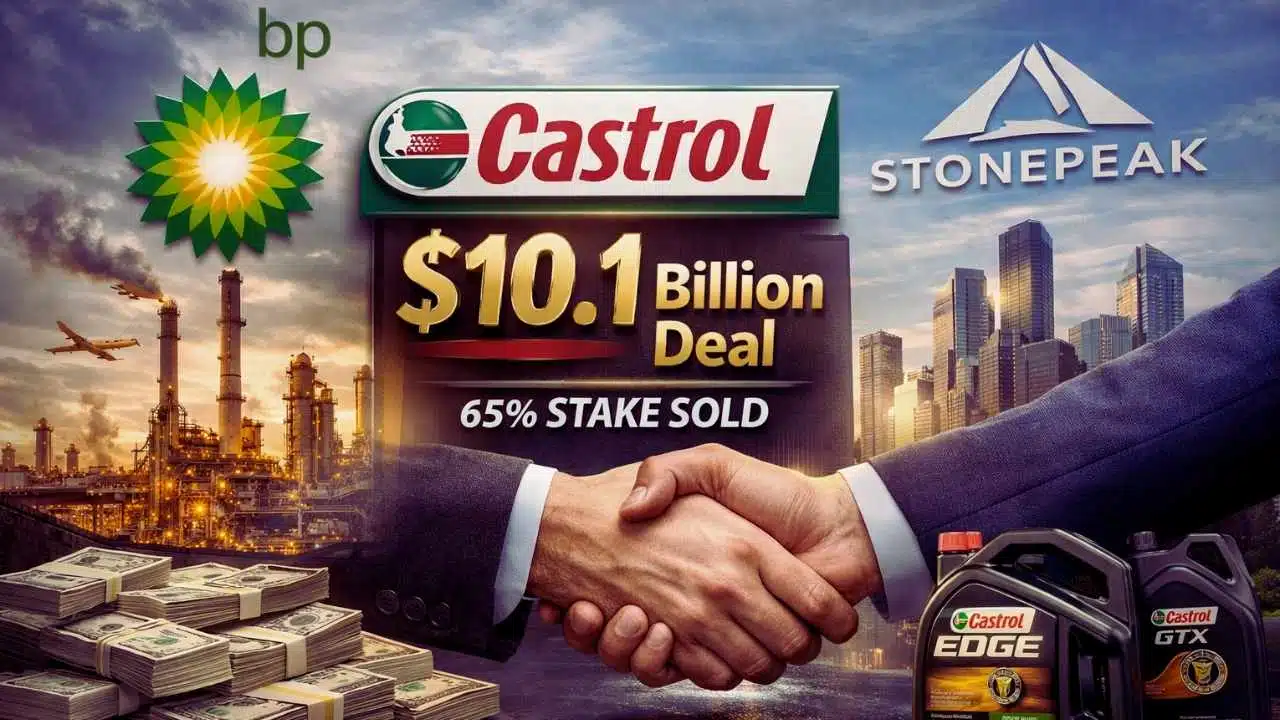
BP Castrol stake sale: BP agreed on December 24, 2025, to sell 65% of Castrol to Stonepeak for about $6 billion, valuing the lubricants business at $10.1 billion, as BP targets lower net debt and a simpler portfolio.
What was announced and what the deal includes?
BP said it will sell a 65% controlling stake in Castrol to Stonepeak, an investment firm known for infrastructure-focused deals. The agreement values Castrol at about $10.1 billion, making this one of BP’s largest strategic transactions in recent years.
BP is not fully exiting. It plans to keep a 35% minority stake, which means it will still benefit if Castrol grows, but Stonepeak will take majority control. This structure is designed to give Castrol more operational and financial flexibility while allowing BP to raise significant cash.
The transaction also includes a co-investment component. Canada Pension Plan Investment Board (CPP Investments) said it intends to invest up to $1.05 billion for an indirect stake in Castrol alongside Stonepeak. That type of partnership is common in large acquisitions, where a lead investor brings operational plans and capital, and long-term institutions participate for stable returns.
A key number in the announcement is the proceeds to BP. Public deal reporting described net proceeds of around $6 billion to BP, which includes about $800 million linked to accelerated dividend payments as part of the deal’s structure. While the exact mechanics can be complex, the headline takeaway is that BP expects substantial cash inflow and plans to use it primarily to reduce net debt.
Deal snapshot table
| Item | Details |
| Seller | BP p.l.c. |
| Buyer | Stonepeak |
| Business | Castrol (global lubricants brand) |
| Stake sold | 65% (majority control) |
| Stake retained by BP | 35% |
| Enterprise value | ~$10.1 billion |
| Cash proceeds to BP (reported) | ~$6 billion (includes ~$800 million linked to accelerated dividend payments) |
| Co-investor | CPP Investments up to $1.05 billion (indirect stake) |
| Expected closing | By end of 2026 (subject to approvals) |
This deal still needs regulatory approvals and other standard closing steps. The expected closing window runs through the end of 2026, which reflects the cross-border nature of Castrol’s operations and the multiple jurisdictions that may review the transaction.
Why BP is selling down Castrol and what it signals about strategy?
BP has been balancing two competing pressures: maintaining investment in its core energy businesses while responding to investors who want stronger cash flow, tighter capital discipline, and a clearer balance-sheet plan. Selling a majority stake in a mature, recognizable consumer-and-industrial brand like Castrol helps on several fronts.
First, it is a direct way to raise cash without issuing equity or increasing borrowing. BP has indicated that reducing net debt is a priority, and proceeds from large divestments are a straightforward tool to do that. Net debt matters because it affects credit metrics and the company’s flexibility to invest across cycles.
Second, the structure suggests BP sees Castrol as valuable but wants to unlock that value in a different ownership model. Retaining 35% keeps BP connected to Castrol’s future performance. At the same time, majority ownership by Stonepeak can allow faster decision-making, targeted capital spending, and potentially more aggressive expansion in selected markets.
Third, this transaction fits a broader trend in the energy industry: companies increasingly treat non-core downstream brands and specialty units as assets that can be partially monetized while still preserving strategic exposure. For an oil major, lubricants can be a stable cash generator, but the market often values “pure-play” or independently run businesses differently than when they sit inside a diversified group.
From Stonepeak’s perspective, the appeal is also clear. Lubricants tend to be recurring-demand products tied to transport and industrial activity. Even when economic conditions soften, large installed bases of vehicles and equipment still require maintenance fluids. That helps explain why financial buyers often view large-scale lubricants businesses as resilient, cash-generative assets.
Castrol’s business footprint and why investors still back lubricants?
Castrol is widely known for automotive engine oils, but it is also a large supplier of industrial fluids and greases used across manufacturing, heavy equipment, marine operations, and other commercial applications. Stonepeak described Castrol as serving customers in about 150 countries through a production and distribution network that includes roughly 20 blending plants and more than 100 third-party facilities and warehouses.
That footprint matters because lubricants are partly a logistics-and-brand business. Product performance and approvals are important, but so are reliable delivery, distributor relationships, and deep penetration in repair shops, fleets, and industrial procurement channels. A global presence can translate into pricing power in premium segments and strong share in high-volume markets.
Investors are also watching how Castrol positions itself as vehicle technology changes. Electric vehicles do not use engine oil in the same way internal combustion engines do, but they still require fluids and greases in areas like thermal management, driveline components, and manufacturing processes. In parallel, industrial segments remain significant, and some new demand is linked to fast-growing data-centre infrastructure that needs advanced cooling and thermal solutions.
The transition is not immediate. Internal combustion vehicles still dominate the global installed base in many regions, and even in markets where EV sales are rising, the legacy fleet keeps lubricant demand elevated for years. That “long tail” often makes lubricants attractive to long-term capital, especially when combined with strong brands and distribution reach.
Castrol footprint table (as described publicly)
| Category | What’s described |
| Global reach | Products sold in ~150 countries |
| Blending plants | ~20 |
| Third-party facilities and warehouses | 100+ |
| Key product lines | Automotive engine oils, industrial fluids, greases |
| Demand drivers highlighted by investors | Traditional vehicle maintenance, industrial activity, emerging applications (EV-related fluids, data-centre uses) |
For customers, the major question is continuity. In transactions like this, buyers typically emphasize “business as usual” for customers and distributors, while gradually rolling in operational improvements. For employees, market watchers often look for signals on restructuring, investment plans, and future leadership decisions. At this stage, public statements focus on growth and investment rather than cost-cutting, though operational changes often follow after closing.
What it could mean for Castrol India and other markets with takeover rules?
One of the most closely watched implications is in India, where Castrol India Limited is publicly traded and has a large public shareholder base. Stonepeak said that alongside the global transaction announcement, a mandatory tender offer process for Castrol India’s public shareholders was also announced, and that it would occur only after the broader Castrol transaction is completed.
India’s takeover framework is designed to protect public shareholders when an acquisition triggers a change in control or a major shift in ownership. In simple terms, when control changes—directly or indirectly—rules may require an open offer so public shareholders can choose to sell shares at a regulated price.
Public reporting on the deal indicated an offer price of ₹194.04 per share for an open offer related to Castrol India, described as being launched in connection with Indian takeover rules following the global transaction announcement. The open offer process, timing, and final documentation are usually handled with formal filings, which spell out the acquirer, indirect ownership chain, pricing basis, offer period, and settlement details.
For investors, two practical issues stand out.
The first is sequencing. The India process is linked to completion of the global transaction. That means the timetable for any open offer can depend on approvals and closing steps outside India as well, not just local steps.
The second is how markets price in the offer. When an open offer is announced, trading prices often react based on the premium to the current market price and the probability of completion. However, open offers do not always result in full acceptance, and shareholders weigh factors like the offer price, future business prospects, and expectations about dividends or strategic changes.
India-linked developments table
| Topic | What investors are watching |
| Trigger | Indirect change of control from the global transaction |
| Mechanism | Mandatory tender/open offer process for public shareholders |
| Reported offer price | ₹194.04 per share (as publicly reported) |
| Timing | After completion of the broader Castrol transaction |
| Key variables | Offer documentation, acceptance levels, market price vs offer price, regulatory timelines |
Beyond India, other jurisdictions may also require notifications or approvals, especially where Castrol has large market shares or critical supply chains. Even if the business does not raise competition issues in most places, the deal’s global scope means compliance work can be substantial.
Timeline, closing conditions, and what to watch next?
Stonepeak expects the transaction to close by the end of 2026, subject to regulatory approvals and customary closing conditions. For readers, that long runway is important. It means the headline terms are set, but many details—governance, financing drawdowns, and downstream offer mechanics—will become clearer over time.
Here’s a practical way to think about “what happens next” without overcomplicating it:
- Regulators in relevant jurisdictions review the transaction.
- The parties finalize remaining operational and legal documentation.
- The deal closes, ownership changes, and the new governance model starts.
- Market-specific processes (such as India’s open offer) proceed after the global closing, with formal filings and offer windows.
Transaction timeline table
| Stage | What it usually involves | Status based on public statements |
| Announcement | Parties disclose headline terms and valuation | Completed (December 24, 2025) |
| Approvals phase | Regulatory reviews and filings in multiple jurisdictions | Pending |
| Pre-close preparations | Governance setup, transition planning, financing readiness | Ongoing/expected |
| Closing | Ownership transfer and control changes | Expected by end of 2026 |
| Post-close actions | Integration/operating changes; market-specific tender processes | Expected after closing |
For BP, the biggest financial watchpoint is how quickly the cash proceeds translate into net debt reduction and how the retained 35% stake is handled over time. Public reporting suggested BP may have a pathway to sell its remaining stake after a lock-in period, which could create another future event for markets to price.
For Stonepeak and its partners, the focus will be the growth plan: defending Castrol’s premium brand position, expanding in high-growth geographies, and building a credible strategy for new fluid applications linked to evolving vehicle and industrial technology.
For consumers and industrial buyers, the key concern is product continuity and service quality. Large brand transitions are usually designed to be smooth, but any shift in distribution or pricing strategies can matter to fleets, workshops, and procurement teams.