Factory audio used to be a “nice-to-have” badge. Now it can be a real buying reason. Automakers design cabins around screens, microphones, and speakers more than ever. That means better placement, better tuning, and fewer compromises than older stock systems.
If you’re hunting for the best factory sound system in new cars, you’re also shopping for a better daily experience. The right system makes traffic calmer, commutes less boring, and long drives feel shorter. The wrong one makes you fight harsh treble, muddy vocals, and weak bass.
This guide is built for normal drivers, not engineers. You’ll see what matters, what doesn’t, and how to compare systems quickly. You’ll also get a short listening routine you can do in five minutes on a dealership lot.
Most importantly, this article stays brand-neutral. A great system can show up in a luxury sedan, a family SUV, or a near-luxury crossover. Your ears and your music taste should decide, not the logo on the speaker grille.
| What this article helps you do | Why it matters |
| Understand what makes factory audio “good” | Prevents paying for a badge |
| Compare 10 standout systems | Saves hours of research |
| Test sound quality on a quick drive | Avoids buyer’s remorse |
| Match a system to your listening style | Helps you choose confidently |
How We Chose the 10 Best Factory Audio Systems
Choosing the “best” isn’t about chasing a single number. A system with fewer speakers can beat a bigger system if the tuning is smarter. A high watt rating can still sound rough if the cabin is noisy or the processing is heavy-handed.
We focused on real-world listening. That means clarity at normal volume, bass control without rattles, and a stable stereo image that doesn’t collapse when you change seats. We also looked at how easy the system is to live with every day, including EQ controls, audio source handling, and whether the system stays pleasant on podcasts and phone calls.
We also kept availability in mind. Some incredible systems exist only on rare trims. Those can be great, but a list should include options people can actually shop. So this mix includes top-tier luxury systems and strong “value premium” systems you’ll find on more affordable new cars.
Another rule: we avoided systems that are famous only for being loud. Loud is easy. Clean is hard. The best systems stay smooth as volume rises and don’t turn cymbals into hiss or vocals into a shout.
Finally, we designed this list for buyers. Each entry tells you what to listen for, what kinds of music it suits best, and what to verify on the window sticker so you don’t pay for the wrong package.
| Our selection rule | What it protects you from |
| Prioritize tuning and balance | Avoids harsh or boomy upgrades |
| Include real buyer-available systems | Avoids “unicorn” trim lists |
| Consider cabin integration | Avoids systems that rattle at bass hits |
| Focus on everyday usability | Avoids confusing audio interfaces |
What Makes a Factory System Sound Great in Real Life
Cars are tough listening rooms. Glass reflects sound. Seats absorb sound. Road noise masks detail. That’s why “good car audio” is more about how the whole cabin works than how fancy the speaker brand sounds.
The best systems get the midrange right first. Midrange is where vocals, guitars, piano, and most podcast voices live. If midrange is clean, everything feels more natural. If it’s muddy, no amount of extra bass or sparkle will fix it.
Bass is the next deal-breaker. A great factory subwoofer doesn’t just thump. It produces different bass notes clearly and stops quickly. That “tight” bass makes music feel controlled and premium. Bad bass sounds like one note, shakes panels, and hides the kick drum.
Then there’s imaging. Imaging is the sense that the singer is in front of you, not inside the door. A stable center image makes music feel expensive. The best systems do this with careful speaker placement, a good center channel, and restrained processing.
Surround and 3D modes can be impressive, but only when done subtly. Overprocessed surround can smear vocals, push highs too hard, and make the sound feel artificial. The best systems give you space without turning everything into an echo.
One more factor people forget: the cabin itself. A quiet cabin can make a “pretty good” system sound great. A loud cabin can make a great system sound average. Tires, insulation, and wind noise matter more than most shoppers realize.
A simple 5-minute test-drive routine that works anywhere
Start with a neutral setup so you can hear what the system is truly doing. Set EQ to flat. Turn off surround or 3D modes at first. Use the same 2–3 songs on every test drive so your brain compares fairly.
First, play a vocal-heavy track at low volume. If you can still hear words clearly, the midrange tuning is strong. Then raise volume to your normal level. Listen for harsh “S” sounds, shouty vocals, or cymbal fizz. Those are signs of aggressive treble tuning.
Next, play one bass track. Good systems separate bass notes. Bad systems just thump. If you hear rattles, it may be a trim issue or a system pushing too hard. Finally, play a simple acoustic track. This exposes fake surround, smeared detail, and a weak center image.
If the system sounds enjoyable at low volume and stays composed when you turn it up, it’s a good sign. If it only sounds “fun” when loud, it may be hiding problems behind volume.
| Sound quality clue | What it usually means |
| Clear vocals at low volume | Strong midrange tuning |
| Bass hits without buzzing | Better sub integration |
| Center image stays in front | Good placement and processing |
| No harshness as volume rises | Cleaner amplification and EQ |
| Surround feels subtle | Smarter 3D tuning |
The Best Factory Sound System in New Cars: The Top 10 You Should Shop

This section is the heart of the guide, and it’s where most buyers get value. Instead of chasing “the most expensive system,” think about which system fits your music and your driving style. A system that’s perfect for podcasts and acoustic music may not be the one you’ll love for EDM and bass-heavy hip-hop.
Also, remember that factory packages vary by trim, market, and model year. The same brand name can come in multiple tiers. That’s why each entry includes a “what to confirm” checklist. Those details protect you from paying for a label while getting a lower-tier configuration.
You’ll notice a pattern across the best systems. They tend to have a real multi-channel amplifier, a true subwoofer, and smart tuning that respects the cabin. They also tend to offer useful controls so you can tailor the sound without needing an audio engineering degree.
Another pattern: the best systems sound good at low volume. That’s the test most people don’t do. If you enjoy the system while driving quietly, you’ll enjoy it every day.
Below are the 10 systems worth putting on your shortlist. Treat this like a “shopping map.” If your preferred car offers one of these systems, it’s a strong sign you’re looking at an audio upgrade that’s more than marketing.
| What to do in this section | Best buyer move |
| Compare the system “personality” | Match to your playlist |
| Verify what the package includes | Avoid wrong-tier upgrades |
| Use the listening routine | Hear differences fast |
| Check how controls feel | Live with it every day |
1. Bowers & Wilkins (Volvo/Polestar)
Bowers & Wilkins factory setups are known for detail, clean vocals, and a wide soundstage. They often shine because many of the cars that offer them are already quiet, which helps you hear micro-details without turning volume up.
The “feel” of this tuning is controlled and refined. You can listen for long periods without fatigue. That matters if you drive daily or use your car for calls and podcasts.
What to listen for is separation. On a good B&W setup, instruments feel like they have their own space. Vocals stay centered, and bass doesn’t invade the midrange.
What to confirm on the sticker: system tier name and whether the package includes any special tuning modes. Also confirm subwoofer presence and speaker count if listed.
Best for:
- Detail lovers
- Acoustic, jazz, classic rock, vocals
- Drivers who prefer clean sound over “extra bass”
2. Bowers & Wilkins Diamond Surround (BMW flagship setups)
This is the “big theater” version of B&W in cars. In certain BMW flagships, it’s designed to deliver a huge, immersive sound with strong output headroom. It can feel like the music is bigger than the cabin.
The key here is headroom. A system like this can stay composed at volumes that would distort smaller setups. If you like dynamic music and turn it up often, that matters.
Listen for control at higher volume. If vocals remain smooth and cymbals don’t become sharp, it’s doing its job. If it feels bright and aggressive, the system may be set to an extreme sound profile.
Confirm:
- The exact tier name (BMW can offer multiple variants)
- Whether surround effects are adjustable
- Speaker placement features (like headliner speakers)
Best for:
- Luxury buyers who want maximum impact
- Big orchestral sound, live recordings, cinematic tracks
3. Burmester 3D Surround (Mercedes-Benz)
Burmester systems are often tuned for a smooth, upscale presentation. The goal is polish, not aggression. That makes them popular with listeners who hate harsh treble and want a relaxed sound.
A great Burmester setup makes vocals feel “forward but soft.” It can also be impressive with strings and piano because it keeps the upper mids clean. Many owners like it because it sounds premium without demanding constant EQ tweaks.
The 3D/surround part can be excellent, but only if you use it lightly. Try it both on and off during your test. If you notice vocals getting hollow or too wide, dial the effect back.
Confirm:
- Whether it is “Surround” or “3D Surround”
- Subwoofer presence and tuning controls
- Any immersive audio mode options
Best for:
- Smooth listening over long drives
- Pop, R&B, vocals, classical
4. Bang & Olufsen 3D (Audi)
Audi’s higher-tier Bang & Olufsen systems often aim for crisp detail and spacious staging. In the best implementations, height speakers and clever processing can make the sound feel tall and wide.
This kind of system can be thrilling on well-produced tracks. It can also expose poor recordings, because high detail means you hear flaws. If your playlist includes older, rough mixes, you may want to reduce treble a touch.
Listen for how the system handles busy music. A strong B&O setup keeps layers separate during loud choruses. Weak setups turn loud passages into a bright wall of sound.
Confirm:
- Whether it’s standard B&O or the top-tier 3D version
- Speaker count and whether height speakers are included
- Adjustability of the 3D effect
Best for:
- Modern pop, EDM, detailed mixes
- Drivers who want a “wow” soundstage
5. Meridian Signature (Land Rover/Range Rover)
Meridian tuning often leans smooth and spacious, which works well in large SUVs. Big cabins can swallow sound. A well-tuned Meridian system fills space without turning sharp.
This is a system type that can make quiet listening feel rich. That’s rare in large vehicles where road noise and cabin volume can flatten music. Meridian setups often manage to keep vocals clear even when the cabin is busy.
Listen for stability. In a large SUV, a weak system makes vocals drift and bass become slow. A strong system keeps the center image stable and bass controlled.
Confirm:
- The exact Meridian tier
- Subwoofer location and size if listed
- Whether the system includes advanced surround modes
Best for:
- Long-distance comfort
- Mixed playlists, podcasts, family driving
6. McIntosh (Jeep Grand Wagoneer and select trims)
McIntosh-branded factory systems are built for bold sound. In vehicles that offer the top package, you usually get strong amplification, a serious subwoofer, and the ability to play loud without falling apart.
The personality here is “big and powerful.” If you love bass and listen at higher volumes, this is a great match. The cabin size also helps, because large SUVs can support deeper bass without feeling cramped.
Listen for bass control. Good McIntosh implementations hit hard but remain clean. If bass feels loose or boomy, adjust EQ and confirm the subwoofer is working properly.
Confirm:
- The system name and tier
- Subwoofer size and location
- Whether the system has dedicated tuning profiles
Best for:
- Hip-hop, EDM, big live recordings
- Drivers who like concert energy
7. Revel Ultima 3D (Lincoln)
Revel systems are often praised for balance and a natural midrange. That makes them excellent for vocals and acoustic instruments. In the best versions, you also get a spacious surround that feels room-like rather than artificial.
This is the type of system that can make “normal” music sound more expensive. It doesn’t rely on boosted bass or extra sparkle. Instead, it builds a wide stage and keeps voices realistic.
Listen for vocal realism. A great Revel setup makes spoken word and singing sound believable. You should hear texture without harsh edges.
Confirm:
- Whether the package is standard Revel or Ultima
- How many speakers are included
- Surround/3D processing settings
Best for:
- Vocals, podcasts, jazz, acoustic
- Buyers who want balanced tuning
8. ELS Studio 3D (Acura)
ELS Studio 3D is one of the best “value premium” systems because it often delivers an expensive sound without requiring a flagship luxury badge. The tuning frequently prioritizes clean mids and stable imaging.
If your daily listening includes podcasts, YouTube, news, and lots of vocals, this system can feel instantly right. It tends to keep speech clear without harshness, and it doesn’t need loud volume to sound full.
Listen for center image strength. A good ELS setup makes vocals lock to the center of the dash. It should feel like the singer is in front of you, not floating.
Confirm:
- Whether it’s ELS Studio or ELS Studio 3D
- Amplifier and speaker count if listed
- Height speakers inclusion for 3D modes
Best for:
- Speech clarity and balanced music
- Buyers who want premium sound without ultra-premium pricing
9. Harman Kardon Surround (BMW and other brands)
Harman Kardon systems can vary, but in many models they offer a strong mid-premium upgrade. When tuned well, they provide clear vocals and solid bass without the sticker shock of top-tier systems.
This is a practical choice if the highest tier is too expensive or forces you into a trim you don’t want. It can also be a smart pick for leases, because it adds daily enjoyment without massive cost.
Listen for harshness in the upper mids. Some setups can be slightly bright. If you hear “shouty” vocals, reduce treble or try a different sound profile.
Confirm:
- Speaker count and subwoofer presence
- Whether there is an external amplifier
- EQ controls and sound profiles
Best for:
- Good sound at a reasonable upgrade price
- Mixed listening in daily driving
10. Bose Premium (Mazda and mainstream options)
Bose is widely available, and its best factory implementations can be very enjoyable. These systems often aim for a fun, engaging sound that works well at normal volumes.
You may not get the same “audiophile neutral” tuning as some ultra-premium systems. But you can get clean vocals, satisfying bass, and a sound that’s easy to like. For many buyers, that’s the real goal.
Listen for bass balance. Some Bose systems can emphasize bass. Make sure bass doesn’t cover vocals. If it does, a small EQ adjustment often fixes it.
Confirm:
- Speaker count and subwoofer presence
- Whether the upgrade includes an external amp
- Whether the car offers a higher tier beyond the basic Bose package
Best for:
- Value-focused buyers
- Daily commuting playlists, pop, radio, podcasts
| System | Best “sound personality” match | What to confirm |
| Bowers & Wilkins | Detailed, refined, wide stage | Tier name, subwoofer, tuning modes |
| B&W Diamond (BMW) | Maximum impact and headroom | Tier, surround settings, speaker layout |
| Burmester 3D | Smooth and upscale | Surround vs 3D tier, controls |
| Bang & Olufsen 3D | Spacious, crisp, immersive | 3D tier, height speakers |
| Meridian | Smooth, big-cabin coverage | Tier name, surround mode options |
| McIntosh | Powerful, bass-capable | Sub size, amp tier, rattle control |
| Revel Ultima 3D | Balanced, vocal-realistic | Ultima tier, 3D settings |
| ELS Studio 3D | Clear mids, great speech | 3D tier, height speakers |
| Harman Kardon | Practical premium | Sub/amp presence, brightness control |
| Bose Premium | Easy-to-like fun sound | Sub/amp, bass balance |
How to Pick the Best Factory Sound System for Your Taste
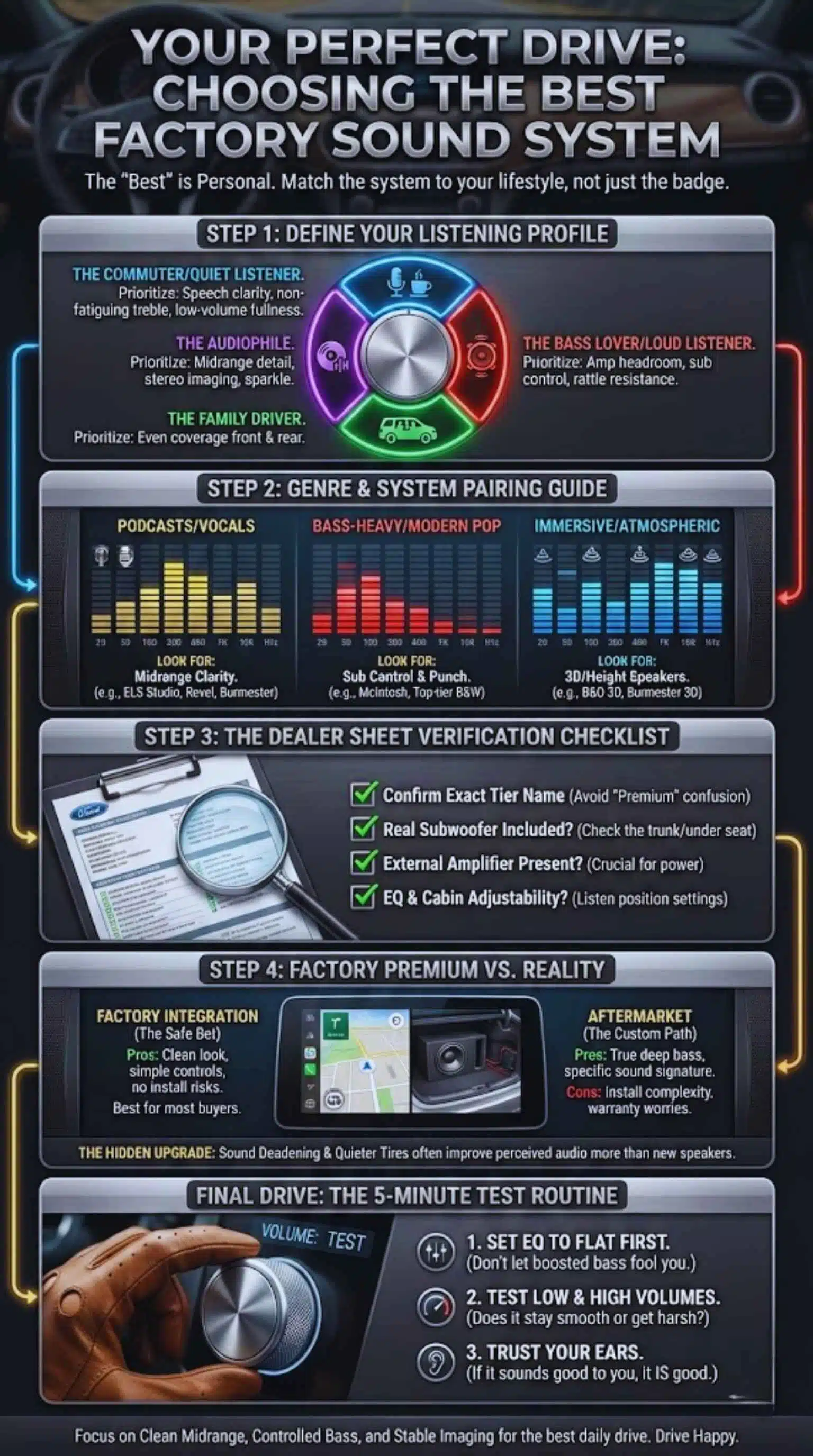
People often ask for “the best” as if one system wins for everyone. In reality, the best system is personal. Some listeners want clean vocals. Others want deep bass. Some want surround effects. Others want a simple, natural stereo image.
Start with your listening habits. Do you mostly play podcasts and calls? Do you listen quietly with the windows up? Do you blast music on highways? Your habits decide what matters most.
Next, think about your music. A bright, high-detail system can be amazing for modern pop, but it can make rough recordings feel annoying. A smooth system can be relaxing, but it might feel less exciting if you love sharp punch and sparkle.
Also consider the cabin type. A small sedan can sound great with fewer speakers. A large SUV often needs more help to fill space evenly. If you carry passengers often, cabin coverage matters more than absolute detail.
Finally, consider your budget strategy. Sometimes the best move is choosing the trim you want and then selecting the best available audio upgrade in that trim. Do not buy an entire trim level only for audio unless you are sure you want the other features too.
The focus keyword test: best factory sound system in new cars for your lifestyle
If your goal is the best factory sound system in new cars, your “best” should be based on a simple rule. Pick the system that sounds great at your normal volume with your normal music. Not the one that wins on paper.
Use this lifestyle matching approach:
- Quiet listeners: prioritize midrange clarity and low-volume fullness
- Loud listeners: prioritize headroom, sub control, and rattle resistance
- Family drivers: prioritize even coverage front and rear
- Commuters: prioritize speech clarity and non-fatiguing treble
Then do a fast A/B comparison if possible. If the dealer has two trims, test both back-to-back. Your brain will notice differences instantly.
| Your listening style | What to prioritize | Systems that often fit |
| Podcasts, speech, vocals | Midrange clarity, stable center | ELS Studio 3D, Revel, Burmester |
| Bass-heavy music | Sub control, amp headroom | McIntosh, top-tier B&W |
| Immersive “theater” feel | Height speakers, subtle 3D | B&O 3D, Burmester 3D, Revel 3D |
| Value upgrade | Balanced tuning per dollar | Bose, Harman Kardon, ELS |
What to Verify on the Dealer Sheet Before You Pay
Factory audio packaging can be confusing on purpose. Brands reuse names across tiers. Automakers bundle audio with unrelated options. Some trims change speaker counts without changing the audio brand badge.
That’s why you should verify what you are paying for. Do this before you sign anything. If a salesperson can’t clearly explain the tier, ask to see the build sheet or window sticker details.
Start with the tier name. “Surround” and “3D Surround” can be different products. “Premium” can mean anything. Make sure you’re getting the higher configuration if that’s what you want.
Next, confirm the basics: does it include an external amplifier and a real subwoofer? Many base “upgrades” are just different speakers with light tuning. The true jump usually comes from the amp and sub integration.
Also check control features. Some systems include better EQ, listening position settings, and processing adjustments. Those features matter because they help you tune the sound to your taste without distortion.
Finally, if possible, check how the system behaves with different audio sources. Bluetooth quality varies. Wired connections can sound better. Native streaming apps in the car may behave differently than your phone.
| Verification item | Why it matters |
| Exact package tier name | Avoids paying for the wrong version |
| External amp present | Big difference in clarity and headroom |
| Subwoofer included | Big difference in bass depth and control |
| Speaker count/layout | Impacts imaging and cabin coverage |
| Adjustability | Helps you tailor sound without harshness |
Factory Premium vs Aftermarket: What Makes Sense in 2026
Aftermarket audio can be amazing, but it isn’t always the best answer. Today’s premium factory systems have better cabin integration than ever. The speakers are placed during vehicle design, wiring is clean, and the tuning is done for that exact cabin shape.
Factory systems also protect convenience. You keep warranty simplicity, factory controls, and a stock look. You also avoid install mistakes that can cause rattles or electrical issues.
That said, aftermarket still wins in a few areas. If you want true sub-bass depth, factory systems often stop short. If you want a specific sound signature, aftermarket gives you full control. If your car’s factory options are weak, aftermarket can be a major upgrade.
There’s also a middle path that many people ignore. Sound deadening and better tires can reduce cabin noise. That can make a factory premium system sound dramatically better without changing a single speaker.
If you’re buying new and want simple, factory premium is usually the safer bet. If you already own the car and love it, aftermarket can be worth it. Just plan carefully and choose a reputable installer.
| Option | Best for | Tradeoff |
| Factory premium audio | Clean integration and resale comfort | Often bundled and pricey |
| Aftermarket upgrade | Maximum customization | Install quality varies |
| Middle path | Better quietness and perceived audio | Requires planning and effort |
Final Thoughts
The smartest way to buy audio is simple. Pick the car you love first, then choose the best audio package available in that car. Do not let a speaker badge push you into a trim that doesn’t fit your life.
Your ears are the final judge. Use the five-minute routine. Keep EQ flat first. Compare two trims if you can. If the system sounds good at low volume and stays smooth when you turn it up, it’s a strong contender.
Also remember the hidden factor: cabin noise. A quiet cabin makes everything better. If you’re deciding between two cars, the quieter one may deliver better perceived sound even with similar audio hardware.
If your goal is the best factory sound system in new cars, focus on three things: clean midrange, controlled bass, and stable imaging. Those three traits give you enjoyment across every genre and every daily drive.
Choose confidently, verify the package, and trust what you hear. When you get it right, your new car doesn’t just drive better. It sounds like a place you want to be.
FAQs About Factory Sound Systems
Factory audio shopping creates the same questions over and over. That’s normal, because buyers rarely get clear explanations at dealerships. These answers are designed to be practical and easy to use.
What is the best factory sound system in new cars right now?
There isn’t one single winner for everyone. The best choice depends on whether you want detail, bass, or immersive surround. For maximum “wow,” flagship luxury systems tend to deliver huge staging. For everyday value, strong near-luxury systems can deliver excellent clarity with less cost.
It’s worth it if you listen daily and care about sound. It may not be worth it if you mostly listen to talk radio at low volume. Also, it’s less worth it if the package forces you into a trim with features you don’t want.
How many speakers do I need for great sound?
You don’t need a massive number. Tuning and placement matter more. More speakers can help fill the cabin evenly, especially in large vehicles, but only if the system is tuned well.
Do 3D and surround modes make music better?
Sometimes. When the processing is subtle, it can add space. When it’s aggressive, it can smear vocals and make music sound fake. Always test with surround on and off.
What should I test on a dealer drive to judge audio fast?
Use one vocal track, one bass track, and one simple acoustic track. Keep EQ flat first. Listen for clear vocals at low volume, bass without rattles, and stable imaging.
Can I upgrade later if I buy a base system now?
Usually yes, but results vary. Some cars are easy to upgrade, others are complicated because of integrated electronics. If upgrades are likely, ask an installer about your exact model before you buy.