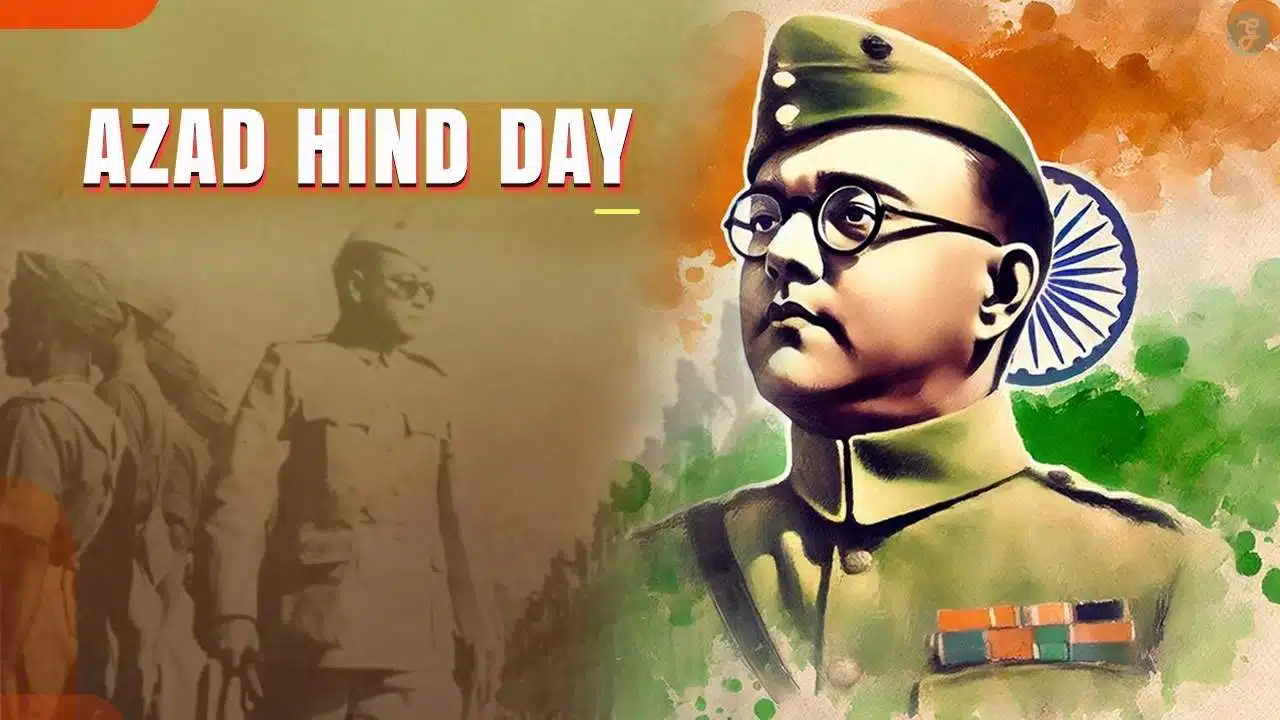
On October 21, 1943, while the world was engulfed in the chaos of World War II, a bold voice from the East declared something extraordinary—the birth of the Provisional Government of Free India (Arzi Hukumat-e-Azad Hind). This declaration, made in Singapore under the leadership of Netaji Subhas Chandra Bose, was not a symbolic gesture; it was a revolutionary act of defiance that proclaimed India’s independence—four years before 1947.
Azad Hind was a government without territory but rich in purpose. It represented the unity of Indians across continents and the will to fight colonial subjugation through courage and sacrifice. In an era dominated by empires, Bose envisioned a sovereign India that would stand with dignity among free nations.
As India marks Azad Hind Day 2025, it’s not merely a commemoration of the past—it’s a moment to reflect on the audacity of one man and the collective courage of thousands who believed that freedom must be seized, not begged for.
Quick Facts: The Azad Hind Legacy
| Year | Event | Significance |
|---|---|---|
| 1941 | Bose escapes British surveillance | Begins global campaign for independence |
| 1943 | Provisional Government of Free India established | First Indian government in exile |
| 1944 | INA’s Imphal Campaign | Attempt to liberate Indian territory |
| 1945 | INA Trials at Red Fort | Sparks national unity and rebellion |
| 2018 | Government declares Azad Hind Day | Formal national recognition of Bose’s legacy |
The Historical Context: When the World Was at War
The 1940s were a period of convulsion. The Second World War had fractured the global order, and colonial empires faced unprecedented strain. In India, the Quit India Movement (1942) had been crushed, and hopes for independence through peaceful protest were fading.
Netaji Subhas Chandra Bose, once a rising star in the Indian National Congress, had grown frustrated with what he saw as the slowness and moral limitations of nonviolence. Escaping British surveillance in 1941, he traveled across continents—from Calcutta to Berlin, then Tokyo—determined to find allies willing to recognize and support India’s struggle for freedom.
In Southeast Asia, Bose found fertile ground. Thousands of Indian soldiers captured by Japan during the war were reorganized into the Indian National Army (INA). The region’s Indian diaspora—workers, traders, and intellectuals—rallied to his cause. On October 21, 1943, in Singapore, Bose formally announced the establishment of Azad Hind, marking India’s first independent government in exile.
The Provisional Government of Free India: A Nation in Exile
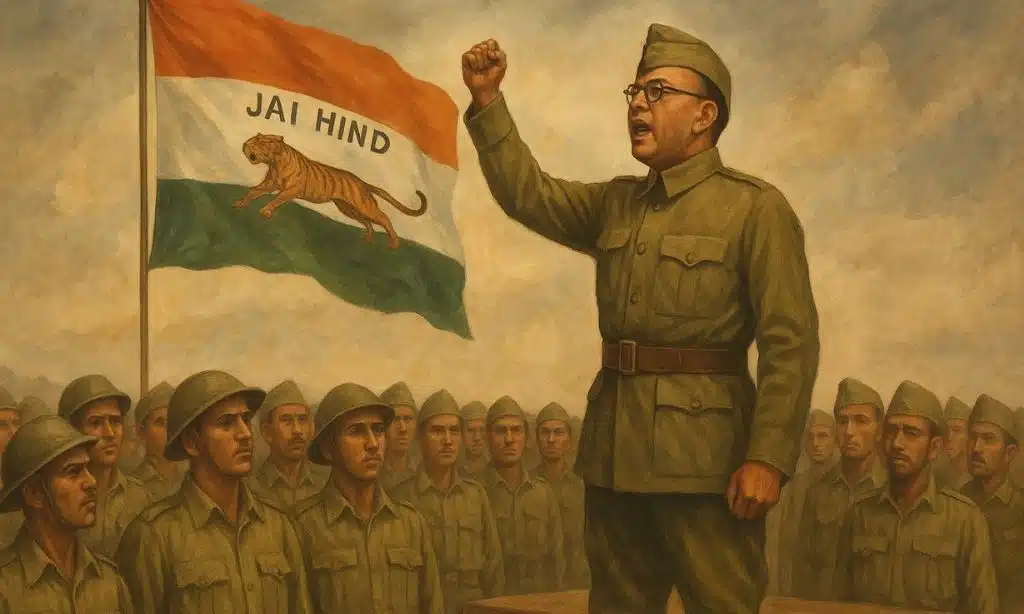
Azad Hind wasn’t just a declaration; it was a functioning government modeled on modern nationhood. Netaji Subhas Chandra Bose served as Head of State, Prime Minister, and Supreme Commander of the Indian National Army. Ministers were appointed for key portfolios—defense, finance, foreign affairs, and propaganda.
Its ideological foundation rested on four pillars: unity, equality, secularism, and social justice. Azad Hind envisioned an India where every citizen, irrespective of religion or caste, would be equal—a vision decades ahead of its time.
The symbols of this government reflected its legitimacy:
-
Flag: The tricolor of saffron, white, and green with a springing tiger—symbolizing power and self-determination.
-
Anthem: “Qadam Qadam Badhaye ”Ja”—the INA’s marching song that stirred hearts across Asia.
-
Currency and Stamps: Issued as sovereign emblems of a free India.
When Bose proclaimed, “It is not enough to say Jai Hind—we must live it,” he captured the essence of the Azad Hind dream—courage as a way of life.
The Indian National Army: The Sword of Azad Hind
The Indian National Army (INA) became the military backbone of Azad Hind. Originally formed by Rash Behari Bose and reorganized by Subhas Chandra Bose in 1943, it united over 45,000 soldiers drawn from Indian prisoners of war and the Southeast Asian diaspora.
Its ranks transcended religion, class, and region—a living embodiment of the inclusive nationalism Bose envisioned. Among its most remarkable features was the Rani of Jhansi Regiment, an all-women combat unit led by Captain Lakshmi Sahgal—one of the earliest female military formations in modern history.
Under Bose’s leadership, the INA launched campaigns in Burma (Myanmar) and northeastern India with the rallying cry “Chalo Dilli” (March to Delhi). Though the military advance eventually faltered due to lack of supplies and Japan’s defeat, the INA’s existence shook the foundations of colonial rule.
For the British, it wasn’t just an army; it was an idea that refused to die—proof that Indian soldiers could turn their guns not for empire but for their own nation.
Diplomacy and Global Strategy: The Vision Beyond Battlefields
Subhas Chandra Bose was not merely a revolutionary; he was a strategist with a clear sense of global politics. He understood that freedom movements needed international legitimacy.
Azad Hind was officially recognized by countries such as Japan, Germany, Italy, Croatia, and the Philippines and maintained semi-official relations with others. Bose negotiated tirelessly to ensure that India’s independence became part of the wartime diplomatic discourse.
Through Radio Azad Hind and extensive propaganda networks, he communicated directly with Indians at home and abroad, calling on them to rise. His diplomatic approach wasn’t ideological alignment with the Axis but a realist maneuver to exploit the enemy of his enemy—a risky, pragmatic move rooted in geopolitical calculation, not blind allegiance.
This was perhaps India’s first attempt at parallel diplomacy—asserting its identity on the global stage decades before joining the United Nations.
Trials, Triumphs, and the End of a Dream
By 1945, the dream began to collapse. Japan’s surrender changed the course of the war, and Azad Hind lost its crucial support base. Bose, refusing to surrender, boarded a Japanese plane from Saigon on August 18, 1945—never to return. His death in a plane crash in Taihoku (Taipei) remains one of modern history’s enduring mysteries.
In India, the British captured and prosecuted INA officers at the Red Fort Trials (1945–46). But the outcome backfired. Indians across the country—from students to soldiers—rallied behind the INA heroes. Even British Indian soldiers began to revolt, most notably in the Royal Indian Navy Mutiny (1946).
As British historian Hugh Toye observed, “The INA failed militarily but succeeded politically.” The trials turned Bose’s legacy into a catalyst that accelerated India’s final march to independence.
Azad Hind’s Legacy in Independent India
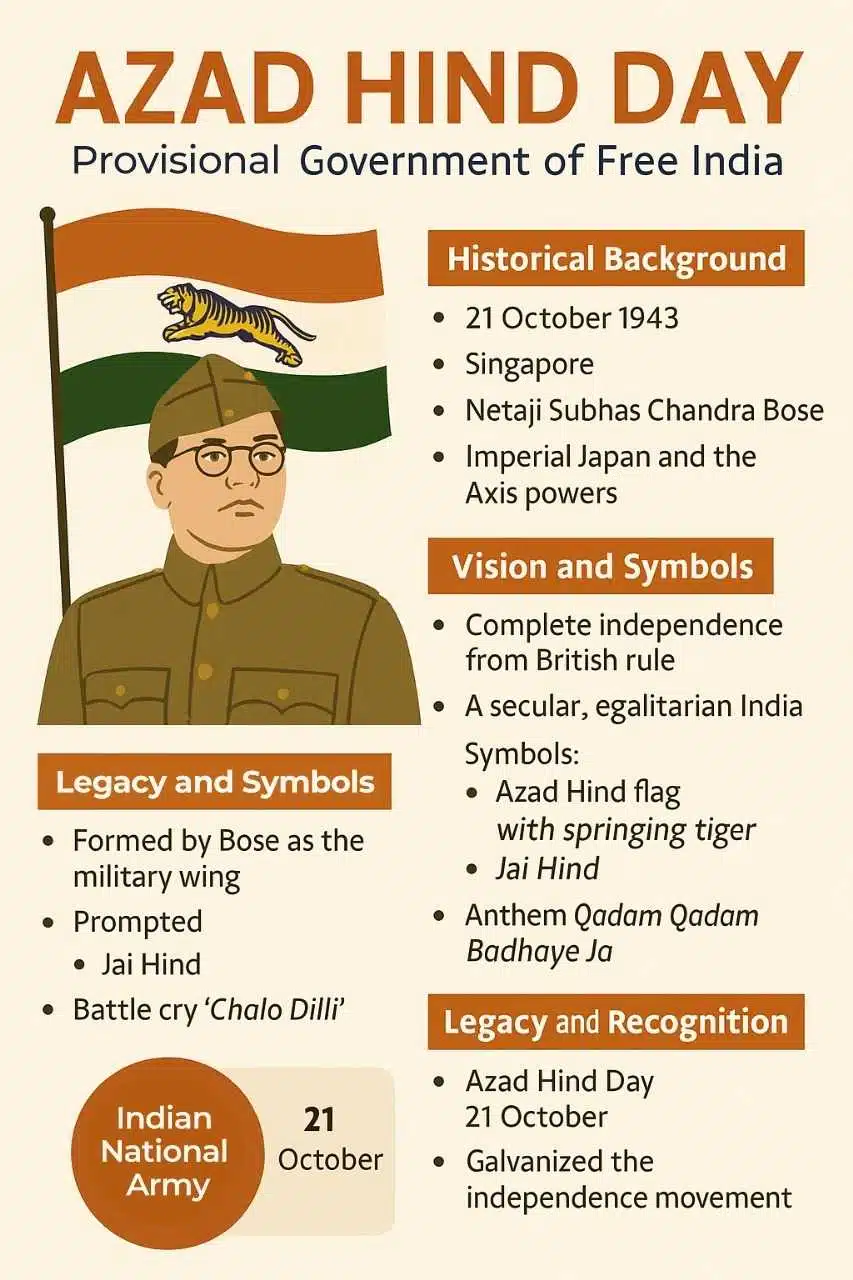
After 1947, Azad Hind’s vision lived on in subtle but profound ways. The Indian armed forces inherited not only the structure but also the spirit of unity and discipline championed by Bose. The greeting “Jai Hind,” once a wartime slogan, became the national salutation of a free India.
Independent India gradually recognized Bose’s contributions:
-
INA veterans were honored and granted pensions.
-
Memorials and stamps commemorated Azad Hind’s milestones.
-
The Andaman and Nicobar Islands, briefly liberated under Azad Hind in 1943, now host the Netaji Subhas Chandra Bose Island as tribute.
Beyond politics, Bose’s ideals continue to shape India’s strategic identity—self-reliant, inclusive, and assertive on the global stage.
Azad Hind Day 2025: Commemoration and Reflection
In 2018, the Government of India officially declared October 21 as “Azad Hind Government Day” to honor this revolutionary moment in history. Each year, the Prime Minister hoists the national flag at the Red Fort, the very site where INA soldiers were once tried—turning a place of colonial judgment into a symbol of justice restored.
The 2025 commemoration carries the theme “Courage Beyond Borders,” highlighting the global dimension of Bose’s vision and the diaspora’s continued role in nation-building. Across Indian embassies and cultural centers worldwide, digital exhibits, documentaries, and youth events will retell the Azad Hind story in new formats—from VR recreations to interactive archives.
For the digital generation, these commemorations bridge the gap between history and inspiration, reminding Indians that courage and conviction are timeless virtues in nationhood.
Lessons for Today’s India
The story of Azad Hind is not just about war—it’s about leadership, conviction, and moral clarity in moments of crisis. Bose exemplified what modern strategists call “visionary pragmatism”—the rare ability to dream boldly while acting with precision.
Key lessons for 2025 and beyond:
-
Leadership under adversity: Bose built a government, army, and diplomatic network from exile—a masterclass in resourcefulness.
-
Unity without uniformity: He transcended divisions of religion, language, and region long before such ideas became constitutional ideals.
-
Courage as a civic duty: True freedom, as Bose taught, requires continuous moral and civic courage, not passive pride.
-
Global Indianism: His outreach to the diaspora prefigured today’s “Global Bharat” vision—Indians contributing to world progress while rooted in their heritage.
In an age of economic and digital revolutions, Azad Hind’s message resonates: nation-building begins with the courage to imagine differently.
Takeaways
Eighty-two years after its founding, the Provisional Government of Free India remains one of the boldest political experiments in modern history—a nation conceived not on soil, but in spirit.
Azad Hind Day is not just a remembrance; it’s a challenge—to every Indian, at home and abroad, to live with courage, unity, and purpose.
In 2025, as India steps deeper into the global century, remembering Azad Hind is not nostalgia. It’s moral renewal—a reminder that courage built our freedom, and courage must sustain it.