
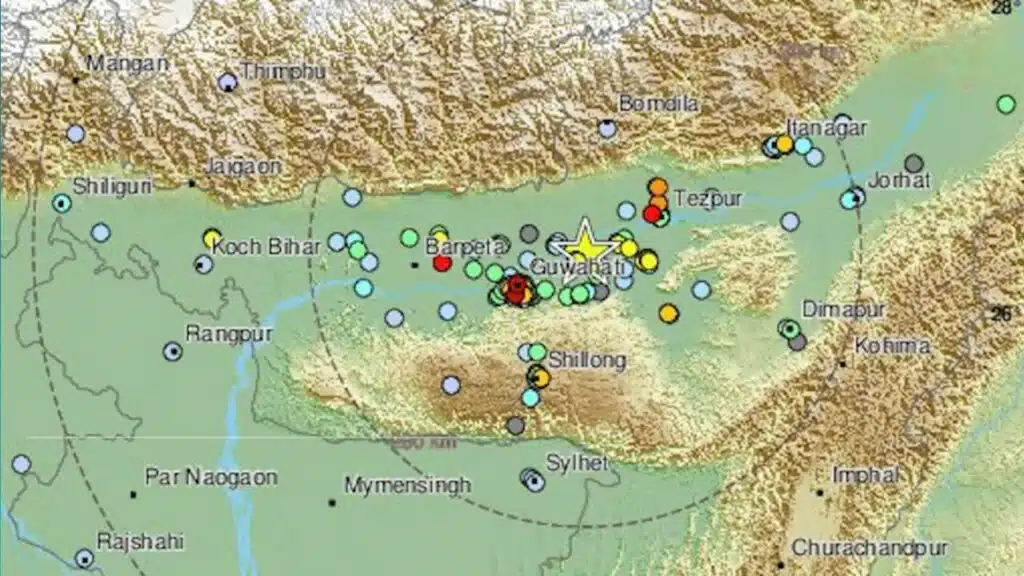
A 5.8-magnitude earthquake shook large parts of Assam on Sunday afternoon, sending waves of tremors across the region. The quake struck at 4:41 pm and was felt strongly in Guwahati, the state’s largest city. Residents reported sudden vibrations that lasted for a few seconds, enough to cause panic and drive people out of homes and offices.
According to officials, the epicentre of the earthquake was located in Udalguri district, an area known for its seismic sensitivity. The quake originated at a shallow depth of just 5 kilometres, which made the tremors sharper and more noticeable on the surface.
Tremors Felt Beyond Assam
The impact of the quake was not limited to Assam. Tremors were reported from North Bengal, particularly in districts close to the Assam border. Residents in parts of Bhutan also felt the ground shaking, underlining how quakes in this part of India often affect neighbouring countries due to shared geological fault lines.
Eyewitness accounts from across the region described the ground rumbling, windows rattling, and furniture shaking briefly. Many residents rushed outdoors in fear, although calm was quickly restored once the tremors passed.
No Reports of Damage or Casualties
So far, authorities have confirmed that there are no reports of injury or property damage. Emergency services and local administrations have been placed on alert, but no major incidents have been recorded. The quick response from state agencies ensured monitoring of vulnerable areas, including old buildings and bridges.
Officials have advised citizens to remain cautious in the hours ahead, as aftershocks are sometimes felt following a moderate earthquake.
Assam’s Vulnerability to Earthquakes
Assam is among India’s most earthquake-prone regions, lying in what experts classify as Seismic Zone V, the highest category of risk. Several geological features make the region particularly vulnerable:
- Plate boundaries: Assam sits near the meeting point of the Indian Plate and the Eurasian Plate. The constant push of the Indian Plate beneath the Eurasian Plate creates enormous stress, often released in the form of earthquakes.
- Eastern Himalayan Syntaxis: This is the sharp bend in the Himalayan mountain chain, where complex fault lines intersect. It makes Assam and the wider northeast one of the world’s most seismically active zones.
- Past history: The region has witnessed devastating earthquakes in the past, including the Great Assam Earthquake of 1897 (magnitude 8.1) and the Assam–Tibet Earthquake of 1950 (magnitude 8.6), which caused widespread destruction.
Because of this history, even moderate quakes like the one recorded on Sunday attract serious attention.
A Reminder of Recent Seismic Activity
The latest quake comes only days after another 3.5-magnitude tremor struck Sonitpur district in Assam on September 2. While that event was smaller and largely unnoticed, it serves as a reminder that the region frequently experiences earthquakes of varying intensity.
Scientists have long warned that these frequent smaller quakes do not reduce the risk of larger earthquakes in the future. Instead, they highlight the ongoing build-up of geological stress in the area.
Public Reaction and Precautionary Measures
In Guwahati, many people were taken by surprise when buildings shook. Residents from high-rise apartments in the city’s Beltola, Zoo Road, and Dispur areas reported feeling the tremors clearly. In towns closer to Udalguri, such as Mangaldai and Tezpur, people briefly gathered outdoors to ensure safety.
The Assam State Disaster Management Authority (ASDMA) has urged citizens to stay calm but alert. They advised households to:
- Avoid using elevators immediately after a quake.
- Stay away from fragile structures.
- Keep emergency kits with essentials ready.
- Follow official updates in case of aftershocks.
Broader Context: Why Earthquake Awareness Matters
Earthquakes in the northeast are a matter of concern not only for Assam but also for neighbouring states and countries. The proximity of international borders means tremors can easily extend into Bhutan, Nepal, Bangladesh, and Myanmar. This highlights the importance of regional cooperation in disaster preparedness and response.
Urbanisation in Assam has increased rapidly, with more high-rise apartments and commercial buildings being constructed. Experts stress that earthquake-resistant construction and strict compliance with safety codes are essential to minimise risks in the future.
A Wake-Up Call Without Major Harm
The 5.8-magnitude earthquake in Assam’s Udalguri district serves as a strong reminder of the state’s position in one of the world’s most active seismic zones. While this event fortunately caused no casualties or damage, it reinforces the urgent need for preparedness, awareness, and resilient infrastructure in the northeast.
For the people of Assam, North Bengal, and Bhutan, Sunday’s quake was another brush with nature’s unpredictability — a moment of fear that ended safely, but one that underlines the fragile balance between life and the restless Earth beneath.