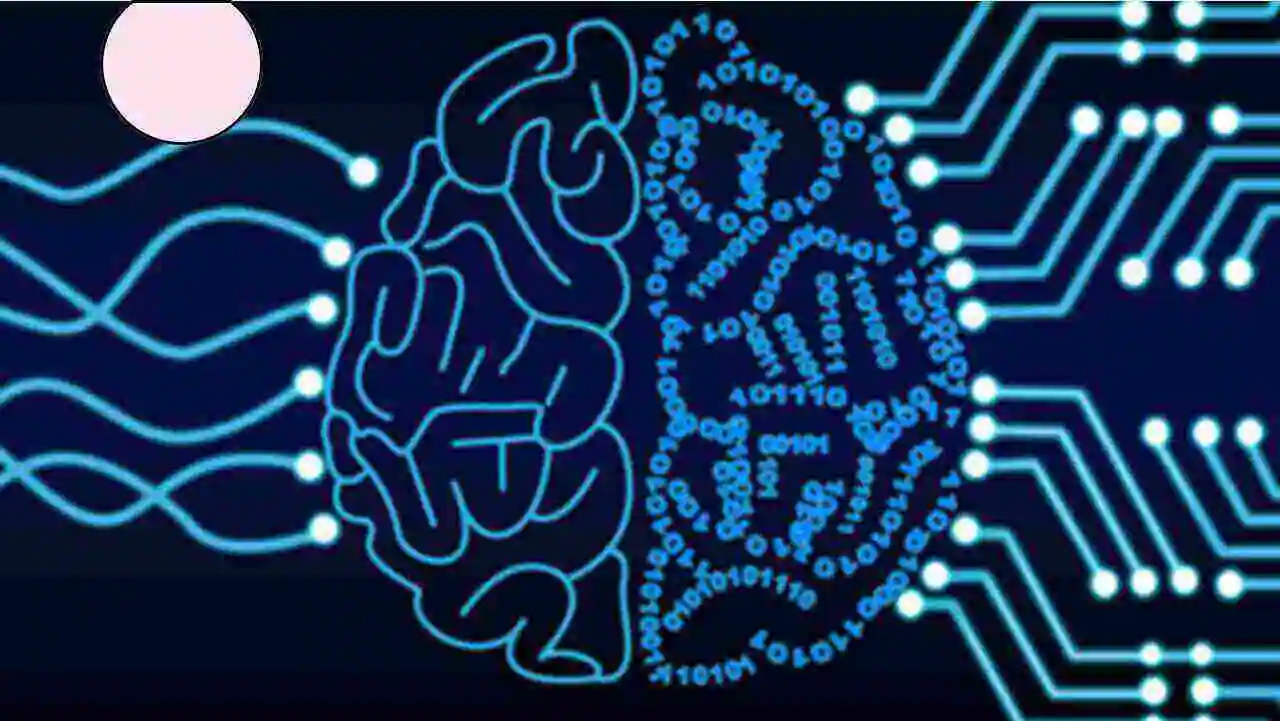
Scientists have created a device that can mimic the cognitive actions of the human brain and emulate artificial intelligence more effectively than conventional methods while improving computational speed and energy efficiency.
Artificial intelligence has become part of our daily lives, from email filters to intelligent responses in communications, to help in the fight against the Covid-19 pandemic. But artificial intelligence can do much more, such as facilitating autonomous driving in cars, augmented reality in healthcare, drug development, Big Data processing, real-time image recognition, real-world problem solving, etc.
This can be achieved by a neuromorphic device that can mimic the synapses of the human brain to create efficient brain-inspired computing capabilities. The human brain is composed of nearly one hundred billion neurons made up of axons and dendrites. These neurons connect to each other through axons and dendrites to form colossal connections called synapses. This complex bioneural network is believed to be the source of higher cognitive abilities.
Software-defined artificial neural networks (ANNs) can beat humans in games (AlphaGo and AlphaZero) or help in Covid-19 situations. However, the power-hungry von Neumann computer architecture (in megawatts) slows down ANNs due to the presence of serial processing, while the brain does the job with parallel processing, consuming only 20 watts.
The brain is supposed to consume 20% of the body’s energy. Converted into calories (https://hypertextbook.com/facts/2001/JacquelineLing.shtml), that’s 20 watts. In contrast, conventional computing platforms consume megawatts, or 10 lakh watts of energy, to mimic basic human cognition.
About Artificial Synaptic Network
To overcome this bottleneck, the hardware solution involves an artificial synaptic device that, unlike transistors, can replicate the function of synapses in the human brain. Scientists have long been trying to develop a synaptic device that can mimic complex psychological behaviors without the help of external support circuits (CMOS).
To solve this problem, scientists at the Jawaharlal Nehru Centre for Advanced Research in Bengaluru, an autonomous institute under the Indian Ministry of Science and Technology, have developed a new method to fabricate an artificial synaptic network (ASN) that resembles a biological neural network using a simple self-forming method (the building block structure forms itself when heated). This work was recently published in the journal Materials Horizons.
In an effort to develop a synaptic device for neuromorphic applications with a modest fabrication method, the JNCASR team investigated a material system that mimics neuronal bodies and axonal network connections as in a biological system. To implement such a structure, they found that the self-forming process is simple, scalable, and inexpensive.
In their study, the JNCASR team dehydrated silver metal (Ag) to form branched islands and nanoparticles with nanoreactors similar to neurons and neurotransmitters, where dehydration is the process of breaking a continuous film into detached/isolated islands or spherical particles. This architecture allows the emulation of multiple higher-order cognitive activities.
The artificial synaptic network (ISS) generated consisted of a network of silver (Ag) clusters separated by nanocapsules filled with isolated nanoparticles. They found that dehydration of the Ag film at higher temperatures results in the formation of island structures separated by nano-lattices, which resemble a bio-neuronal network.
Using programmed electrical signals as the actual stimulus, this hierarchical framework simulated different types of learning, such as short-term memory (STM), long-term memory (LTM), potentiation, depression, associative learning, interest-based learning, observation, etc. Synaptic fatigue due to excessive learning and its self-regeneration was also simulated. Synaptic fatigue due to excessive learning and its self-regeneration was also simulated.
Surprisingly, all of these behaviors can be emulated in a single hardware system without the aid of external CMOS circuitry. A prototyping kit has been developed to emulate Pavlovian behavior in dogs, demonstrating the potential of this device for neuromorphic artificial intelligence. By arranging a nanomaterial that resembles a biological neuronal substance, the JNCASR team is one step closer to achieving advanced neuromorphic artificial intelligence.
“Nature has had an incredible amount of time and diversity to create all new forms and functions through the evolutionary process. Learning and mimicking new processes, technologies, materials, and devices from nature and biology is an important avenue for meaningful future progress that increasingly integrates the living world with man-made technologies,” said Professor Ashutosh Sharma, Secretary of DST.