Many brands struggle to stand out with dull online ads and flat screens. Poland hosts 12 AR and VR startups that craft immersive experiences and offer ar/vr development, mobile app development, and custom software development.
We will profile each startup and show how they use mixed reality, Meta Quest 3 headsets, and AWS cloud to make marketing, training, and design pop. Keep reading.
Key Takeaways
- Poland hosts 12 AR/VR startups founded from 2008 (Lune.xyz) to 2020 (InnoMate).
- Teams range from 2–9 experts at Feeling Digital and Lune.xyz up to 1,000–9,999 at Vention.
- Project budgets start at $1,000 (Lune.xyz) and $5,000–$10,000 for most, rising to $25,000+ at nomtek and Vention.
- Clients rate services from 4.1 to 5.0 stars (for example, 4Experience scores 4.9/4.7/4.8/4.9).
- Startups use ARKit, ARCore, Unity, Unreal Engine, Meta Quest 3, HTC Vive, Apple Vision Pro, AWS, and AI for training, healthcare, industrial, real estate, and marketing solutions.
How Does 4Experience Provide Immersive AR/VR Solutions for Businesses?
4Experience began work in 2015 in Bielsko-Biała, Poland. Teams span four offices, in Johnsburg (IL), Dubai, and Whittlesey (England). They list 50 to 249 staff, with strong skills in mixed reality and custom software development.
NATO EOD COE tapped them to train bomb squads in a virtual environment. They use an augmented reality toolkit, ARKit, on mobile devices, plus a game engine and mobile app development to craft 3D content.
Engineers test scenarios on VR headsets, like the HTC Vive. Clients rate 4Experience 4.9 for timeliness, 4.7 for service, 4.8 for value, and 4.9 for recommend. Project budgets start at $10,000.
Staff pair digital environments with real gear to form immersive experiences. Trainees sort parts under virtual bombs, or run virtual reality drills in mixed reality. 4Experience adds data tags, avatars, and live feedback to each session.
This model boosts skill gain while cutting risk. Businesses spot clear gains in safety, cost, and time. This approach showcases XR solutions for training, demos, and design reviews.
How Is Giant Lazer Revolutionizing Education and Training with VR?
Giant Lazer started in 2015 in Wrocław. A 10 to 49 member team builds VR training modules. Learners step into simulated environments with virtual labs. They blend mobile and wearable application development with VR headsets.
Clients face a minimum project cost of $10,000 plus. Three perfect 5.0 reviews confirm their skill.
Team crafts immersive experiences in the education sector. XR solutions and solid UX/UI design blend in each module. Students solve tasks in simulated environments with virtual labs.
Trainers test skills with VR and mixed reality games. Wrocław base fuels local ties. Staff mix creative developers, XR designers, and subject experts. Each module adapts to learner pace to boost retention.
They pack each session with gamified challenges, so learners stick and laugh. VR tools let teachers track real-time data, so they spot trouble fast.
What Custom AR/VR Development Services Does Crystal Apps Offer?
Crystal Apps crafts AR/VR solutions from their Warszawa hub. The 2018 startup builds mobile applications and custom software for virtual and mixed reality. Their team of 10 to 49 experts uses agile project management, ux/ui design, and devops practices.
They also set up virtual labs, digital twins, and immersive training rooms for Philip Morris International and IQOS. They start projects at $10,000+. They meet timeliness and value rates near five stars.
Crystal Apps builds augmented reality campaigns and virtual reality games. They run system tests with devops pipelines, then refine code with automated tools. Agile methodology cuts delays and boosts feedback loops.
Projects drive digital transformation for brands. Small and mid size teams feel the impact in education, marketing, or healthcare. VR headsets link to mobile applications with no lag.
Clients praise fast delivery, clear communication, and steady support.
How Can Feeling Digital Enhance Marketing Campaigns Using AR/VR?
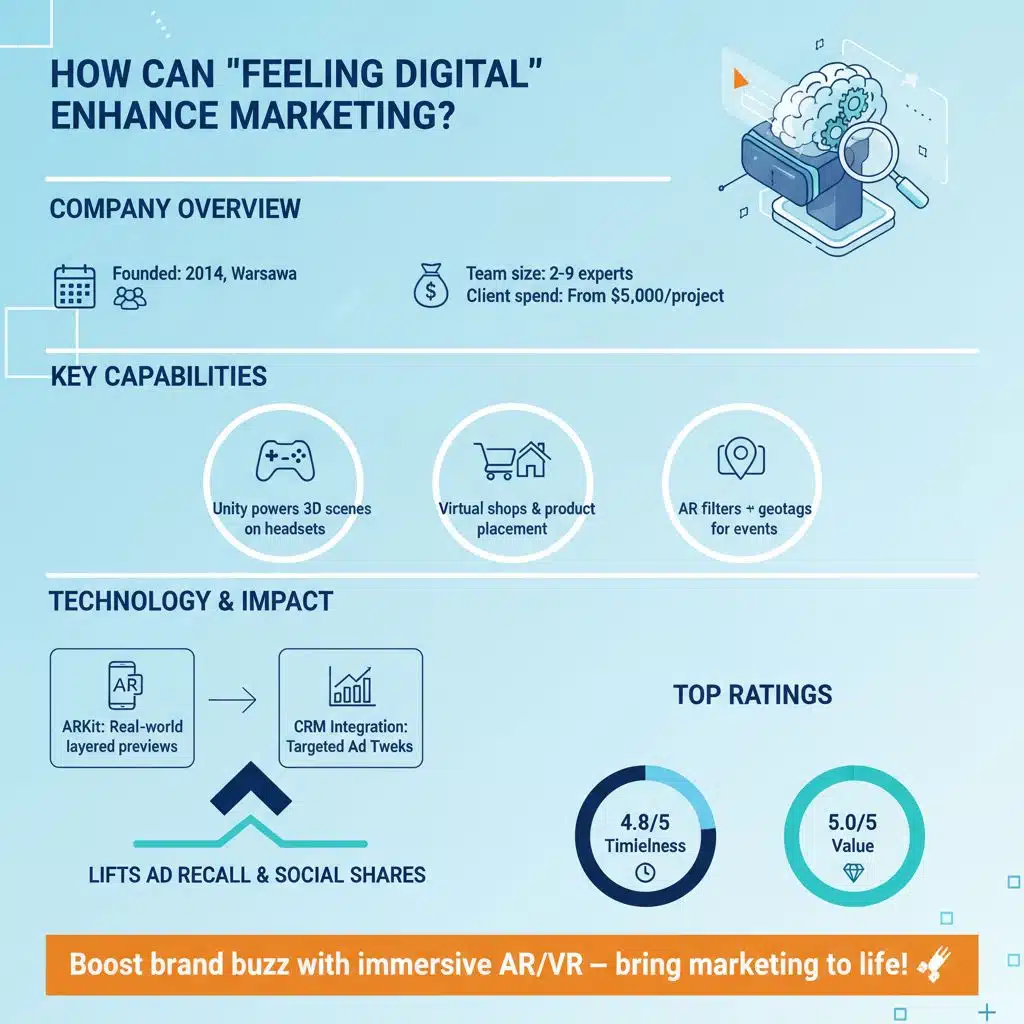
Feeling Digital opened in 2014 in Warszawa and runs a close team of 2 to 9 experts. They push AR/VR development and mobile app creation to sharpen brand campaigns. Clients invest at least $5,000 per project.
The company gets 4.8 on timeliness and 5.0 on value. A game engine like Unity turns 3D models into live scenes on a headset device. Marketers let customers walk around a virtual shop or place a product on their kitchen table.
They also mix augmented reality filters with geotags at events. A developer uses ARKit or a similar platform to layer previews in real space. This blend grabs attention, fuels social shares, and lifts ad recall.
Data flows into a CRM console so teams can tweak ads that hit the mark. Immersive tech shifts customer view and steers digital transformation.
What Makes nomtek a Leader in Augmented Reality Experiences?
nomtek formed in 2009. It runs offices in Wrocław, London, and Berlin. The crew numbers 50 to 249. Clients award 4.9 stars for timeliness and 4.8 for value. Those scores come from 42 reviews.
PONS hired nomtek for a key AR app. Minimum projects start at $25,000. They blend mobile app development with custom software development. They shape mixed reality and virtual world projects.
Teams use ARKit on iPhones and ARCore on Android. They add depth sensor fusion to boost real world mapping. Creative coders merge immersive technologies with UX/UI design. They build virtual reality applications and AR games.
That mix uplevels marketing, training, and therapy tools. nomtek ranks among Poland’s top AR/VR firms in the last 12 months.
How Does Toucan Systems Innovate AR/VR for Industrial Use?
Toucan Systems began in Gdańsk in 2012. A tight crew of 10 to 49 experts crafts AR/VR, AI, and custom software. They serve cultural, scientific, and interactive agencies, and they push industrial use of augmented reality and virtual reality.
Clients find entry at $5,000 per project. Reviewers give 4.8 for timeliness, 4.6 for service, 4.1 for value, and 4.8 for recommendations, a sign of strong digital transformation work.
The team layers XR solutions, digital twins, live IoT feeds, spatial mapping, and BIM models. Technicians slip on AR glasses powered by Unity or Unreal Engine. A mixed reality cockpit shows hot spots, wiring, or pipe runs.
Workers roam virtual environments to learn procedures without risk. Such immersive experiences speed repairs, slash errors, and spark safety. The result feels like a video game, yet it solves real world problems.
How Is Vention Redefining Healthcare with Virtual Reality Tools?
Vention crafts immersive experiences for therapy suites in hospitals across New York and London. Their team builds custom software that uses VR headsets, like Meta’s headset and Apple Vision Pro, to guide systematic desensitization for phobias and PTSD.
Nurses and therapists use virtual reality to run eye movement desensitization and reprocessing sessions and relaxation exercises. Such digital transformation brings mindfulness modules into rehab wards.
Clients pay at least $25,000 for AR/VR development that integrates with existing medical records. Vention employs 1,000 to 9,999 experts, and boasts 95 reviews, with ratings of 4.9 in timeliness, 4.8 in service, and 5.0 in recommendations.
IBM, PayPal, and PwC tap their mobile app development and deep coding know-how. Hospitals see faster patient recovery and better data tracking with these tools.
What Advanced Engineering Solutions Does xBerry Offer with AR/VR?
xBerry uses augmented reality and virtual reality to build digital twins for factories. The team merges a 3D engine, CAD software, and motion trackers. It crafts interactive maintenance manuals.
IoT sensors end up in virtual space. Engineers test new machine setups before installation. The mixed reality interface runs on headsets and mobile devices. Training speeds up and error rates plummet.
Staff augmentation keeps projects lean. Custom software development starts at $5,000. This model suits small to mid-size companies.
Wroclaw hosts this startup since 2014 with 16 experts on board. Coco Delivery stands as a notable client. Service gets 5.0, timeliness 4.8, and value 5.0. Augmented reality blends with mobile app development and cloud analytics.
XR solutions boost productivity on every level. One operator cut setup time by 30 percent. Teams share immersive experiences on headsets. Digital transformation meets human touch, with a dash of humor in every session.
How Does InnoMate Deliver Engaging Virtual Reality Content?
InnoMate crafts virtual reality content from Warsaw, with a small crew that values creativity. The startup launched in 2020. Its two to nine team members tweak every pixel. Clients rate their work five stars across seven reviews.
Core services cover ar/vr development and graphic design. They start projects at a $5,000 minimum budget. Pracuj.pl trusts them to build immersive experiences. They blend custom software development with user-friendly ux/ui design.
Sketches on paper become life in a game engine. The team drapes each scene with high-res 3D models that pop off the screen, delivering immersive experiences. They test on a virtual reality headset instead of staring at a dull desktop.
Motion tracking and spatial positioning map real moves into vivid training labs. Code wraps in xr solutions, linking a virtual world to real tasks. Client feedback arrives each week, so tweaks land fast.
What Innovations Does Lune. xyz Bring to AR/VR Entertainment?
Lune.xyz formed in 2008 in Wrocław. Its team spans 2 to 9 specialists. It blends virtual reality and augmented reality to craft immersive experiences for advertising, arts, and entertainment clients.
Its AR/VR development and mobile app development services shine with a 5.0/5 rating, 11 Google reviews, and rates at $49 per hour for budgets of $1,000 to $10,000.
Game engines power new demos. A blend of generative AI and spatial audio shifts stories in real time. Smartphone AR kits unlock mixed reality on phones, while eye tracking on premium headsets reads user gaze.
Haptic devices and simple UX/UI design guide each interaction in XR solutions.
How Does ESQRD Use AR/VR for Real Estate Visualization?
A Warsaw studio founded in 2014 crafts immersive experiences for real estate with virtual reality headsets and mobile devices. Designers feed floor plans into Unity and Unreal Engine to create mixed reality tours.
Teams deploy ARKit on iPhones and ARCore on Android devices. Artists blend 3D modeling, texture maps and building information modeling data. Buyers strap on a headset to walk through flats that do not exist yet.
Projects begin at $5,000 and run smooth across platforms. Brands like McDonald’s, Formula 1 and Captain Morgan praise their work with a 5.0 rating.
Sales teams walk clients through virtual showrooms, pointing at details, switching materials, and resizing walls on demand. A browser tool links floor maps to 3D models so agents can demo homes on a tablet.
Developers build augmented reality filters that place couches in living rooms and scale decor to room size, boosting visualisation. Clients share sessions in real time across locations, cutting travel and improving conversion rates.
ESQRD blends web, video production and AR/VR modules into one package. A team of 10 to 49 handles custom software development, mobile app development and XR solutions.
How Does Actum Lab Bridge Technology and Creativity?
Actum Lab is based in Gdańsk near the Baltic coast, and it runs on a tight crew of under forty-nine pros. It charges a flat rate of $50 per hour and sets budgets at $10k to $25k per project.
The team blends AR/VR development and custom software development to build mixed reality demos, and they list three wins on DesignRush. Creatives sketch dreams on paper, then developers weave computer vision, Unity, and ARKit code like a magic carpet ride.
Clients see ideas jump off screens in immersive experiences that sparkle with playful twists and solid tech chops.
Small studio life sparks quick chats, tight deadlines, and fearless tests with VR headset kits. Designers scribble storyboards on napkins, while coders tap into Unreal Engine and generative AI to shape playful therapy sessions and virtual labs.
Marketing teams get custom apps to wow customers, and health pros trial AR/VR tools that might boost mental health. Project managers handle mixed reality tasks like a conductor guiding an orchestra of screens, sensors, and mobile app development frameworks.
Takeaways
These 12 startups spark fresh energy in XR solutions across Poland. They use Apple’s ARKit and Google’s ARCore, Unity and Unreal Engine, plus generative AI to shape immersive experiences.
You see virtual labs change training and therapy with VR apps. The game moves fast, and each new project beats the last. Poland leads with bold ideas in ux/ui design and custom software development.
Pick a team and step into tomorrow’s digital world.
FAQs on AR/VR Startups in Poland
1. What do AR/VR startups in Poland do?
They shape immersive experiences, they blend virtual reality (VR) and augmented reality (AR). They build mixed reality XR solutions, custom software development and mobile app development. They also bake in generative AI for smarter interactions.
2. How do they serve the education sector?
They bring immersive technology to the education sector. They build virtual labs and educational technologies for schools and universities. They let students walk through history, dive into cell structures, all in digital space.
3. Can they help the construction industry?
They boost the construction industry with augmented reality development and mixed reality overlays. They project building plans on real sites for real time checks, they speed problem-solving, they cut costly errors.
4. Do they work on mental health treatment?
They tackle mental health treatment with VR tools. They craft software for EMDR (eye movement desensitization and reprocessing), anxiety and depression therapy. They partner with mental health professionals, they test immersive environments for calm focus.
5. What about games and the metaverse?
They play in the metaverse and design augmented reality games, they explore non-fungible tokens. They build parts of anything world, to tease your brain and spark fun.
6. Do they work on apple’s vision pro and web development?
They test apple’s vision pro, they fine tune XR solutions for new headsets. They also handle web development, energy-efficient designs. They keep apps lean, fast, ready for smart, autonomous use.