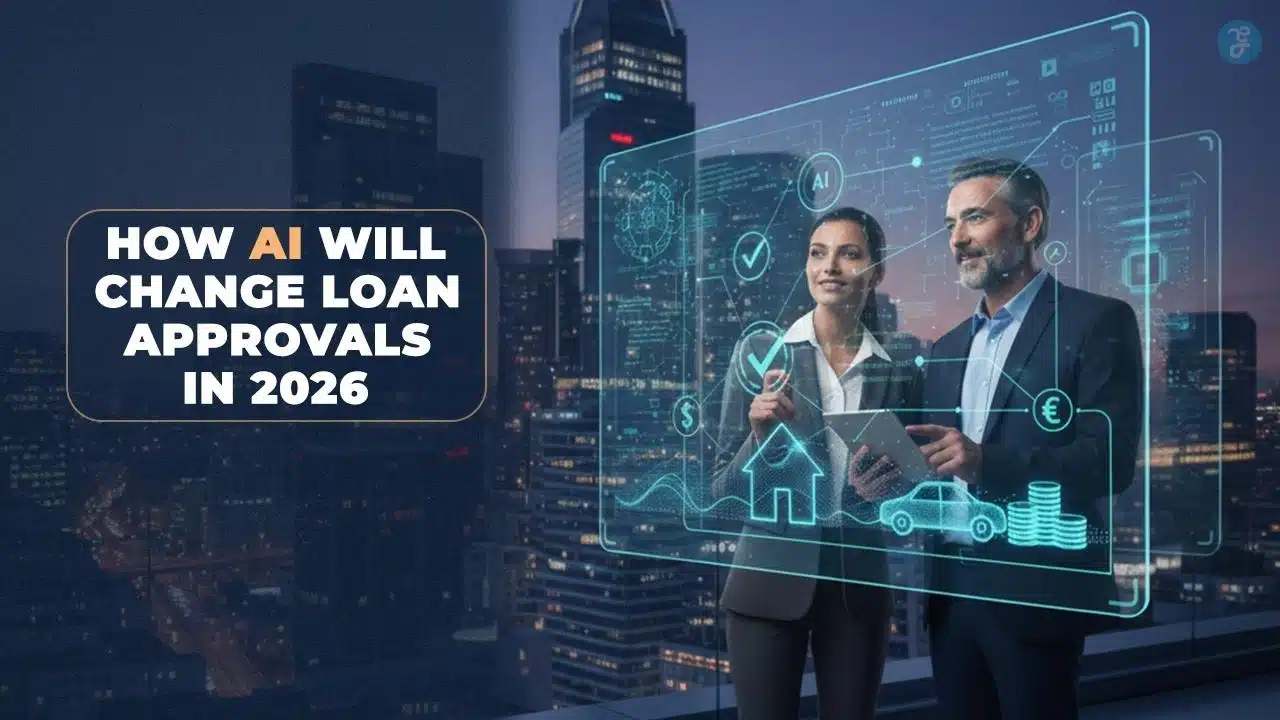
Credit approvals are moving into a decisive new phase. For decades, lenders relied on forms, paper files, and static credit scores to decide who deserved a loan. In 2026, those foundations start to give way to a more dynamic system, where artificial intelligence processes data in real time, flags risk earlier, and shapes offers in far more granular ways.
As AI loan approval systems mature, the stakes rise for banks, fintechs and borrowers. Faster decisions will no longer be a novelty. They will be the baseline expectation. At the same time, regulators and the public will press harder on fairness, transparency, and accountability. Understanding how AI will change loan approvals in 2026 means looking at technology, regulation, and human behaviour together, not in isolation.
From Paper Files to Pipelines – Where Loan Approvals Stand Today
Traditional underwriting and its bottlenecks
Conventional underwriting still dominates much of the world’s lending. A loan officer gathers payslips, bank statements and identification. Credit bureau scores and standard ratios drive the decision. The process often depends on rigid rules and individual judgment.
This model creates predictable bottlenecks. Decisions can take days or weeks. Applicants with thin credit files or irregular income struggle to fit the templates. Human bias can creep in when two similar applicants get different outcomes based on how a file lands on a desk. The underlying tools were designed for a slower, less digital economy.
What AI already does in loan approvals
AI has already started to loosen some of these constraints. Many lenders now use algorithms to read documents, extract data, and pre-score applications. Machine learning models analyse transaction histories, spending patterns, and other signals to estimate default risk more precisely.
In some markets, this has reduced decision times from days to minutes for standard products. Operating costs fall when fewer staff handle routine files. Early deployments also suggest that, with careful monitoring, AI models can match or improve on default rates produced by traditional scorecards. Yet these gains are uneven and often limited to specific segments such as consumer instalment loans, buy-now-pay-later offers, or digital small-business lending.

How AI Will Change Loan Approvals in 2026: From Scores to Systems
AI credit scoring moves beyond static ratings
The familiar credit score condenses a person’s financial history into a single number. AI in loan underwriting 2026 pushes past this idea. Instead of one static rating, lenders begin to rely on systems that generate a richer picture of creditworthiness.
Machine learning models can process thousands of variables at once. They capture how income flows vary over time, how often customers dip into overdraft, how they handle multiple accounts, and whether their financial behaviour is improving or deteriorating. Rather than a simple snapshot, AI produces a moving risk profile that shifts as new data arrives.
Alternative data and cash-flow analytics at the core of AI loan approval 2026
A central feature of AI loan approval 2026 is the use of alternative data and detailed cash-flow analytics. Traditional credit bureaus struggle with borrowers who have limited formal borrowing history, such as young adults, gig workers, or small firms in emerging markets.
AI systems can incorporate rental payments, utility records, telecom data, e-commerce behaviour, and open-banking feeds. When combined with standard credit information, these signals help build a more complete view of ability and willingness to pay. For borrowers with thin files, this can open doors that older models kept shut.
However, the use of such data raises important questions. Borrowers may not realise how many aspects of their lives feed into a score. Consent mechanisms, data minimisation, and retention policies move from technical details to front-page issues. Lenders who push too far risk reputational damage and regulatory scrutiny.
Explainable AI to support fair and transparent decisions
The more complex the models become, the more pressure grows for explainability. Regulators and consumers are less willing to accept “the computer says no” without a clear reason. In 2026, explainable AI becomes a practical necessity rather than a research topic.
Lenders increasingly adopt tools that show which factors influenced a decision and by how much. They document data sources, model choices, and limitations. Credit officers gain dashboards that translate technical outputs into business language. This attention to explainability not only satisfies regulatory demands. It also helps risk teams catch model weaknesses early and adjust policies before problems scale.
AI in Loan Underwriting 2026: Automation Across the Credit Journey
From application to instant decision
As AI spreads, the biggest visible change for borrowers is speed. End-to-end AI workflows can verify identity, pull data from bank accounts, check credit reports, score risk, and propose a decision in a single flow. Many consumer and small-business loans will move to near-instant approvals whenever the data is clear.
Human underwriters still handle complex or borderline cases. Yet routine files will rarely wait on a person’s desk. This frees specialists to focus on policy, portfolio trends, and emerging risks rather than repetitive checks. For lenders facing strong competition from digital players, automation is no longer optional; it becomes essential to stay in the game.
Fraud detection and anomaly spotting inside underwriting
Fraud and credit risk are closely linked. AI allows lenders to treat them as part of the same pipeline. Models can examine device fingerprints, location patterns, behavioural biometrics, and historical transactions. They flag suspicious combinations in real time.
This integrated approach means loan approvals in 2026 are not just faster but also more resilient. Previous generations of fraud systems relied on static rules that criminals quickly learned to circumvent. AI-based systems adapt as patterns change. At the same time, lenders must ensure these systems do not unfairly disadvantage certain groups or regions by over-blocking legitimate applications.
Dynamic limits and pricing powered by AI
Another shift lies in how much borrowers can access and at what price. Instead of setting a line of credit once and revisiting it infrequently, AI can update limits and pricing more often. It tracks income, spending, repayment behaviour, and macro conditions.
For reliable customers, this may translate into higher limits and better rates over time. For those whose risk profile worsens, adjustments can happen sooner, potentially preventing deeper distress. However, frequent changes also raise questions about predictability and transparency. Borrowers will need clear communication about why a limit changed or a rate moved up or down.
Regulation, Risk, and 2026 as a Turning Point
High-risk AI and credit scoring under the EU AI Act
In parallel with technological change, regulation is tightening. The European Union’s AI framework classifies credit scoring and underwriting as high-risk uses of AI. That label carries specific obligations on data quality, documentation, testing, human oversight, and transparency.
Key deadlines around 2026 push banks and fintechs in Europe to upgrade their AI governance. Lenders must show how they manage model risk, assess bias, monitor performance, and provide meaningful information to customers affected by automated decisions. Vendors that supply AI tools to financial institutions face similar duties, from technical documentation to post-market monitoring.
These rules influence global practice, not just European markets. International banks tend to harmonise their standards, aligning branches and subsidiaries with the strictest regimes to simplify operations.
US regulators and AI-driven denials
In the United States, agencies such as the Consumer Financial Protection Bureau treat AI-driven lending decisions through the lens of existing fair-lending and consumer-protection laws. Guidance over recent years has sent a blunt message: using complex AI models does not relieve lenders of the duty to explain adverse actions.
When a lender declines an application or reduces a limit, it must still give specific, understandable reasons. Vague statements that “a model determined you are too risky” do not meet the standard. This stance pushes institutions towards models and tools that can translate technical outputs into clear, borrower-facing explanations.
Model risk, audits, and human-in-the-loop controls
By 2026, model risk management will become central to board-level oversight. Banks and fintechs need clear inventories of AI models, defined responsibilities, and documented validation processes. Independent teams test models for performance, stability, and fairness before deployment and at regular intervals after.
Crucially, many supervisors insist that humans remain in the loop for significant decisions. AI can propose an outcome, but a responsible person or committee should oversee edge cases, interpret unusual results, and approve policy changes. This hybrid approach aims to combine the speed and consistency of automation with human judgment and accountability.
What Borrowers Will Experience When AI Loan Approval 2026 Arrives
Faster, mobile-first approvals become the norm
From the borrower’s perspective, the first change is convenience. Applications that once required branch visits, printed documents, and long waits increasingly move to mobile apps and embedded finance flows. A customer may request credit while shopping online, booking travel, or running a business dashboard, and receive a decision within moments.
For simple products, such as personal loans and small working-capital lines, this speed becomes expected. Lenders that cannot respond quickly risk losing business to more agile competitors.
More personalised offers – and more data questions
AI allows lenders to move away from one-size-fits-all products. Offers can be tuned to an individual’s repayment capacity, spending profile, and risk appetite. Two customers with similar incomes may see different limits or structures based on how they manage money.
Personalisation can help borrowers by aligning payments with cash flow and avoiding over-extension. Yet it can also feel intrusive if customers do not understand why they are getting one offer and not another. Expect more public debate about where to draw the line between helpful customisation and over-targeted credit.
New transparency and dispute rights for AI loan approvals in 2026
Regulatory emphasis on transparency means borrowers should receive clearer explanations when something goes wrong. If an application is declined, the lender will need to provide concrete reasons. “Insufficient income stability” or “recent delinquency on other accounts,” for example, rather than opaque references to an algorithm.
Borrowers will also have stronger paths to challenge decisions. They can ask lenders to review a result, correct errors in their data, or clarify how certain factors were weighed. Institutions that handle such interactions well may find that trust becomes a competitive advantage alongside price and speed.
Strategic Choices for Banks and Fintechs Before 2026
Build or buy AI in loan underwriting 2026?
As the deadline for deeper AI adoption approaches, institutions face a structural choice. Some build their own AI loan approval stacks. They assemble teams of data scientists, engineers, and risk specialists and develop proprietary models. This route offers tight control and differentiation but requires substantial investment and strong governance.
Others choose to buy AI underwriting platforms from specialised vendors. They plug these engines into existing loan-origination systems through APIs. This approach shortens time to market and taps external expertise, but it also creates dependencies. Lenders must still understand how models behave, even when third parties supply them.
Data partnerships, open banking, and ecosystems
Data strategy sits at the heart of AI in loan underwriting 2026. Lenders that rely only on bureau scores and internal records risk falling behind. Many now explore open banking connections, payroll data links, and partnerships with e-commerce or platform companies to enrich their view of borrowers.
These arrangements can improve risk prediction and widen access to credit. However, they also increase complexity. Institutions must manage consent carefully, limit sharing to what is necessary, and maintain robust security. Public tolerance for data misuse is low, and breaches in the financial sector carry heavy consequences.
Culture, talent, and cross-functional AI teams
Technology and regulation matter, but culture decides how they work in practice. Banks and fintechs need people who can bridge disciplines: risk experts who understand data science, engineers who respect compliance, and product managers who can translate policy into customer journeys.
Cross-functional teams must collaborate from design to deployment. Ethics and governance boards can review major AI projects, test them against inclusion and fairness goals, and set guardrails for acceptable use. Institutions that treat AI as a pure technical add-on, rather than a reshaping of the business, will struggle to capture its full value.
Beyond 2026 – Building Trustworthy AI Credit Systems
Continuous monitoring and recalibration
Launching an AI model is no longer the end of the story. It is the start of a monitoring cycle. Economic conditions change, customer behaviour shifts, and fraud patterns evolve. Models that performed well at launch can drift over time.
Lenders need dashboards and processes that track accuracy, stability, and fairness. They must be ready to recalibrate models, retrain them with new data, or even switch them off if performance deteriorates. This continuous attention turns AI from a one-off project into an enduring capability.
Aligning AI loan approval 2026 with long-term inclusion goals
Used thoughtfully, AI can widen access to credit. Alternative data and refined risk estimates help lenders serve customers who previously fell outside strict score cut-offs. Yet the same tools can also entrench disadvantage if they reflect biased data or reward already privileged groups.
Institutions have to decide what they optimise for. Purely short-term default reduction may not align with social and policy goals around inclusion. Some lenders, therefore, set explicit objectives to expand safe access for underserved communities and then tune models and policies in line with those goals.
Why trust will decide who wins the AI lending race
By the time 2026 unfolds, many lenders will offer fast, AI-driven credit decisions. Speed and pricing will matter, but they may not be enough to stand out. Trust will become the decisive factor.
Borrowers will ask whether a lender treats their data with respect, explains decisions clearly, and offers fair recourse when disputes arise. Regulators will look for consistent governance and honest engagement with their expectations. Institutions that can show they use AI to enhance, rather than erode, fairness and transparency are likely to gain a durable advantage.
In that sense, how AI will change loan approvals in 2026 is not only a story about smarter models. It is a story about how finance chooses to balance innovation with responsibility. The institutions that get that balance right will shape the next chapter of lending.
Conclusion
AI is set to redefine loan approvals in 2026, shifting the process from static scoring to dynamic, data-rich evaluation. Borrowers will experience faster decisions, clearer explanations, and more personalised offers, while lenders navigate greater regulatory oversight and higher expectations around fairness.
As automation expands and governance strengthens, the institutions that balance innovation with transparency and trust will shape the next era of credit.