Personalized learning is teaching that responds to what a student knows, needs, and learns next. A teacher may adjust the explanation, practice, support, or pace. A student may help set a goal or choose how to show what they have learned. Technology can help with some of this, but it is only one way to do it.
I think about my nephew when I hear the phrase. He once needed an adult beside him during letter-tracing activities. Later, he could manage familiar activities independently and began noticing letters in books. Alphabet learning apps gave him practice, but books, toys, and preschool were part of his learning too. I cannot credit one tool for that change.
What I could see was that his need for help changed. That is the question at the heart of personalized learning: when a student shows what they can and cannot do, does the teaching change in a useful way?
What does personalized learning look like?
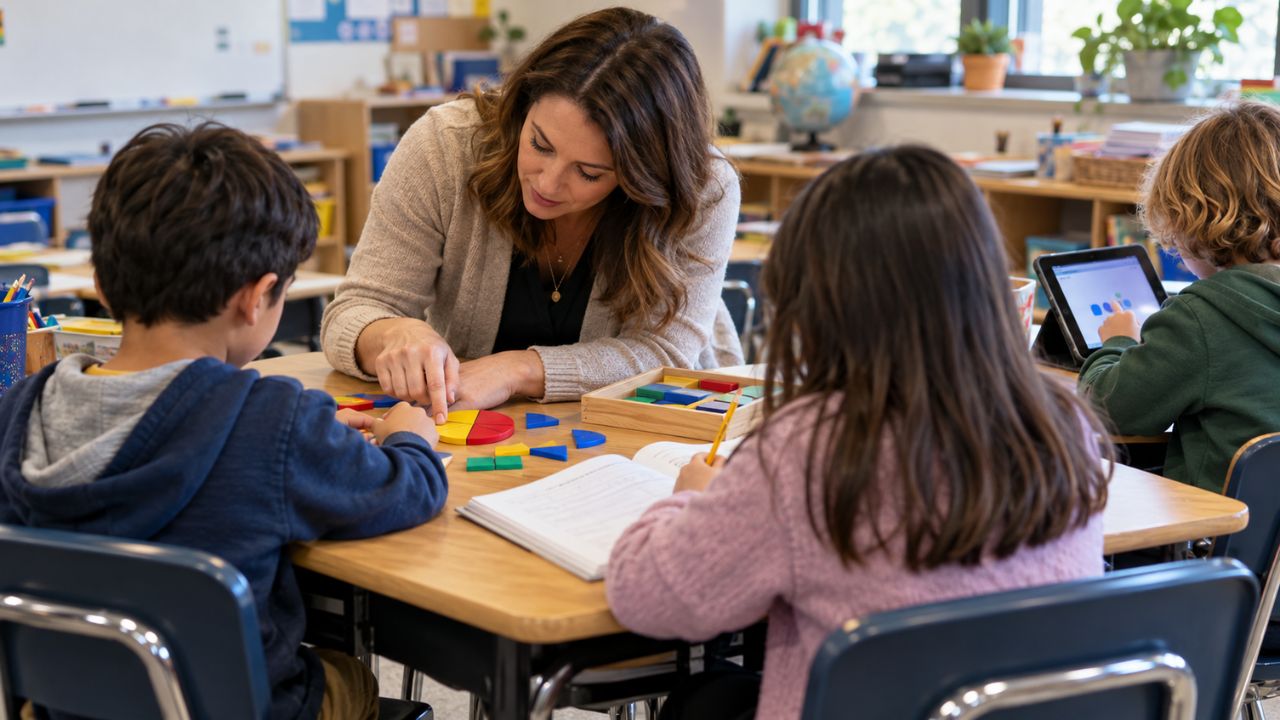
Picture a class working on fractions. A short exercise shows that some students can calculate an answer but struggle to explain what the fraction means. Others understand the idea but make errors when adding fractions.
The teacher brings the first group together to use a visual model. The second group gets guided practice. Students who are ready tackle a harder problem. Afterward, the teacher checks whether each group can use the skill in a new task.
Everyone is working toward meaningful maths goals. They do not all need the same help at the same moment.
That example follows a practical cycle: find out what students understand, respond to a specific need, give feedback, and check again. Personalization is strongest when the last step informs the next lesson. A completed activity tells the teacher less than a child who can explain an idea and use it independently.
Personalized, differentiated and adaptive learning
The terms are often used together, but they describe different parts of teaching.
| Term | What it usually describes |
| Differentiated instruction | A teacher adjusts activities or support for groups with different current needs. |
| Individualised instruction | Tasks and support are tailored more closely to one student’s needs or pace. |
| Adaptive learning software | A program changes questions, practice, or feedback in response to a learner’s answers. |
| Personalized learning | A broader approach in which teaching responds to a learner’s progress and may give them a role in setting goals or choosing a path. |
The boundaries are not always clear-cut. A teacher may use all four approaches in one week. The distinction worth keeping is between a tool that changes the next question and teaching that changes what happens after a student needs help.
The promise and the conditions behind it
Personalized learning speaks to a real classroom problem. Children in the same grade can have very different levels of understanding. A fixed pace may move on before one student has grasped a foundation, while another is ready for more demanding work.
| The promise | What has to happen in practice |
| Close learning gaps early | A teacher identifies the particular gap and has time and materials to address it. |
| Let students progress at a suitable pace | Extra time comes with feedback, a better explanation, or targeted practice. |
| Give students more ownership | Choices connect to a clear learning goal and suit the student’s age. |
| Use technology to reach more learners | The tool provides useful information, students can access it, and a teacher acts on what it shows. |
There is evidence behind some of these ideas. Teaching at the Right Level, an approach developed by the Indian organisation Pratham, uses simple assessments to find children’s current reading and maths skills. Children receive teaching aimed at those skills for part of the day, and their progress is checked so they can move forward. Evaluations across multiple settings have found gains in foundational learning.
The important feature is the response to what children can currently do. It does not depend on every child having an AI tutor.
Pace helps when support changes too
A student may need longer to understand a concept. Giving them longer to repeat the same exercise may achieve little if they keep making the same mistake.
The Education Endowment Foundation (EEF) finds that mastery approaches depend on checking progress and providing additional help before students move on. Its evidence review also finds weaker results when students are simply left to work at their own pace. “Learn at your own pace” sounds reassuring; what happens during that extra time matters more.
Choice needs a purpose
Student choice can make learning more engaging. An older learner might choose a research question or decide how to demonstrate an understanding of a topic. A younger child may benefit from choosing between two suitable activities with an adult’s guidance.
Choice should help the student work toward the goal. Picking an appealing activity is a small part of learning to plan, reflect, and take responsibility for progress.
Does personalized learning actually work?
Some approaches improve learning. Others show little or no measurable benefit. The phrase covers too many different practices to carry one reliable promise about results.
EEF estimates that studies of individualised instruction show an average of four additional months of progress. It rates the certainty of that broad estimate as limited, and results vary substantially between studies. Individualised instruction is one part of the wider personalized learning picture. That average is not a prediction for a particular classroom or app.
A 2026 World Bank working paper reviewed randomized studies of adaptive and AI-enabled learning interventions. Across 14 studies in ten economies, it found a small positive average effect on learning. The researchers did not find evidence in that sample that generative AI tools outperformed earlier technologies. They also noted that the evidence covered a limited range of settings and included little information about costs.
Individual program trials tell a similarly mixed story. In a large English school trial, struggling Year 2 readers offered the adaptive program Lexia Core5 made an estimated two additional months of reading progress compared with similar pupils in comparison schools. Teachers and teaching assistants supported the sessions and used the program’s resources.
In a 2025 randomized trial, students using MathSpring, an intelligent maths tutoring platform, showed no overall improvement in maths achievement or attitudes toward maths compared with students receiving usual instruction.
Those findings concern different programs, students, and subjects. They show why a product’s ability to adapt its questions is a feature to examine, rather than proof of better learning. A school needs to ask what the program teaches well, who benefited in a credible study, and what adults must do to make it useful.
Where can personalized learning go wrong?
A lesson can look tailored while missing what a student actually needs. Endless practice, fixed labels, and too little teacher time can turn a promising approach into another obstacle to learning.
A learning path becomes a stream of exercises
An app may respond to an incorrect answer with an easier question. That can be useful practice. It may also leave the misunderstanding untouched.
If a child repeatedly makes the same error, they may need someone to explain the concept differently, ask what they were thinking, or show them how to apply it away from the screen. Progress data is most useful when it prompts that kind of response.
Flexible groups become permanent labels
Short-term groups can help a teacher focus on a skill. The groups should change as students learn.
Fixed grouping by attainment is a different approach. EEF finds little average benefit from consistently placing students in separate sets or streams and raises concerns about outcomes for lower-attaining pupils. A child’s current difficulty with a topic should guide the help they receive, not define what adults think they can achieve.
Teacher time is treated as unlimited
Individual tasks take work to prepare, explain and monitor. EEF notes that individualised instruction can leave teachers spending more time organising activities and less time in high-quality teaching interactions.
A workable model gives teachers useful assessments, well-designed materials and room to respond. It also protects the shared teaching and discussion that every student needs.
Personalization is confused with “learning styles”
A child does not need to be labelled permanently as a “visual” or “auditory” learner. EEF finds very little sound evidence for matching teaching to fixed learning-style categories and warns that the labels can limit students.
Teachers have better questions to ask: What does this student already know? Which part is difficult? What explanation, accessible format, or practice will help them learn this particular skill?
What role should AI and adaptive software play?
Digital tools can give students practice at different levels, provide immediate feedback, and help teachers see patterns in answers. AI may offer another explanation or help prepare materials. Each use should be judged by whether it improves a specific part of learning.
A teacher sees things a program may miss. A student might get the right answer by following hints without understanding why it works. Another might understand the task but be unwilling to ask a question in front of classmates. A conversation can reveal what the answer data cannot.
Access also affects results. Students need suitable devices, connectivity, and content they can understand. Some may need audio, adjustable text or another accessible way to participate. Schools need to examine what information a tool collects about children and how it is used.
UNESCO’s guidance on education technology calls for decisions based on learning, equity and student well-being, with teachers and human relationships central to the process. That is a sensible test for AI too.
How can parents and teachers judge a personalized approach?
A strong approach should make it easy to answer five questions:
- What is the learning goal? The student should gain a skill or understanding that matters beyond completing activities.
- How is the need identified? A brief assessment, discussion, or piece of work should reveal more than a label such as “behind.”
- What changes when the student struggles? Look for an explanation, feedback, targeted practice, or help from a person.
- How is progress checked? Can the student explain and use the skill in a new task, including away from the app?
- Can the support change again? Students should be able to move forward without being held in a fixed group or path.
Parents do not need a dashboard full of scores to have a useful conversation with a teacher. They can ask what their child is working on, what has become easier, and where support is still needed.
The question worth asking
Personalized learning has a worthwhile aim: help a student get the teaching they need when they need it. The research suggests that targeted support can improve learning, while the results of digital programs vary and implementation takes real work.
I would judge a classroom approach by what happens after a student gets stuck. Does someone notice the problem? Does the explanation or support change? Can the student eventually use the skill independently?
That is a more useful measure than how personal the software claims to be.
Frequently asked questions on Personalized Learning
1. Does personalized learning require technology?
No. A teacher can assess a need, work with a small group, give feedback, and check progress without a device. Technology is useful when it improves one of those steps.
2. Does every child need a separate lesson plan?
No. Students can share important learning goals and much of the same teaching. Their practice, support, or level of challenge can change when needed.
3. Is personalized learning the same as self-paced learning?
No. Flexible pacing may be part of it, but students also need effective teaching and feedback. More time with the same misunderstanding will not reliably solve it.
4. Is an adaptive app personalized learning?
It can be one part of it. The stronger test is whether its activities meet a real learning need and whether someone checks that the student can use what they have practised.
5. Can AI replace a teacher?
The evidence discussed here does not support that conclusion. AI can assist with defined tasks. Teachers remain responsible for understanding students, judging the quality of their learning, and deciding how to help them move forward.