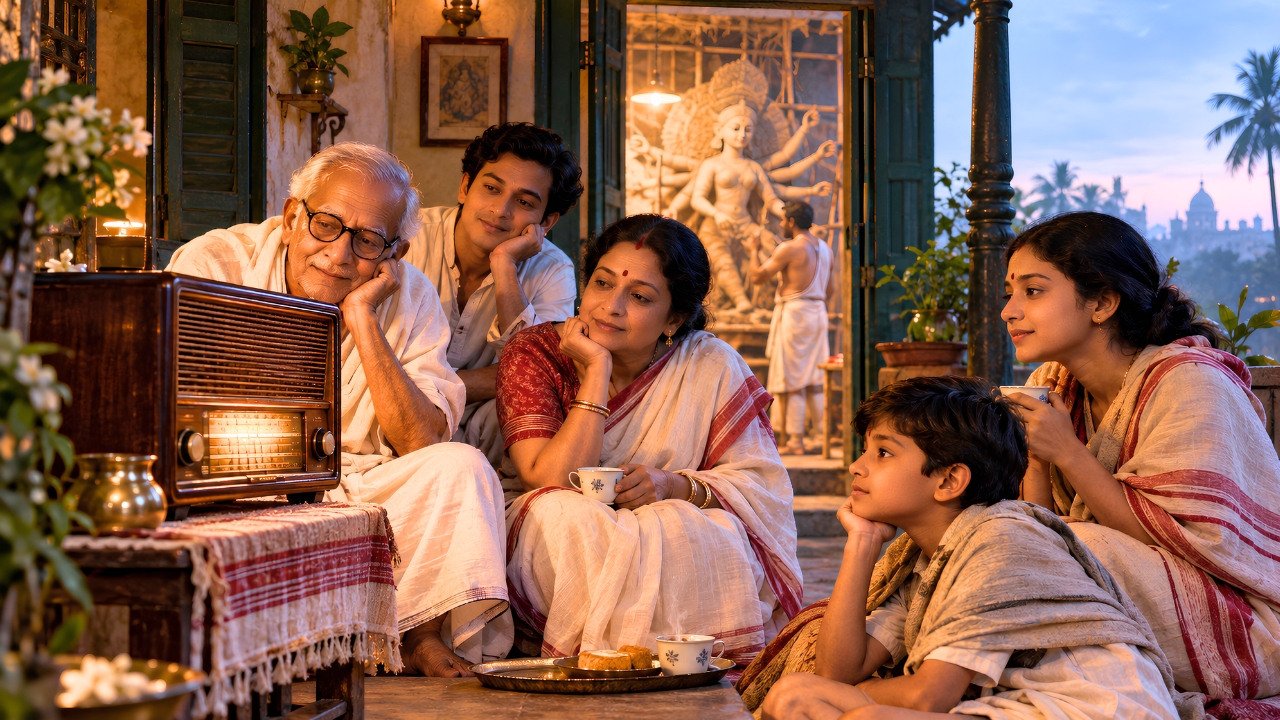
Every year, millions of Bengalis wake up before sunrise on Mahalaya to hear the same old radio program. Most people see it as a Hindu ritual, and in many ways it is. But the story of that famous broadcast tells us something more. Mahalaya belongs to everyone, because the people who built it came from different castes, faiths, and languages.
In 2026, Mahalaya falls on Saturday, October 10. Before you press play at 4 a.m., here is who made that morning and why so many people feel it is theirs.
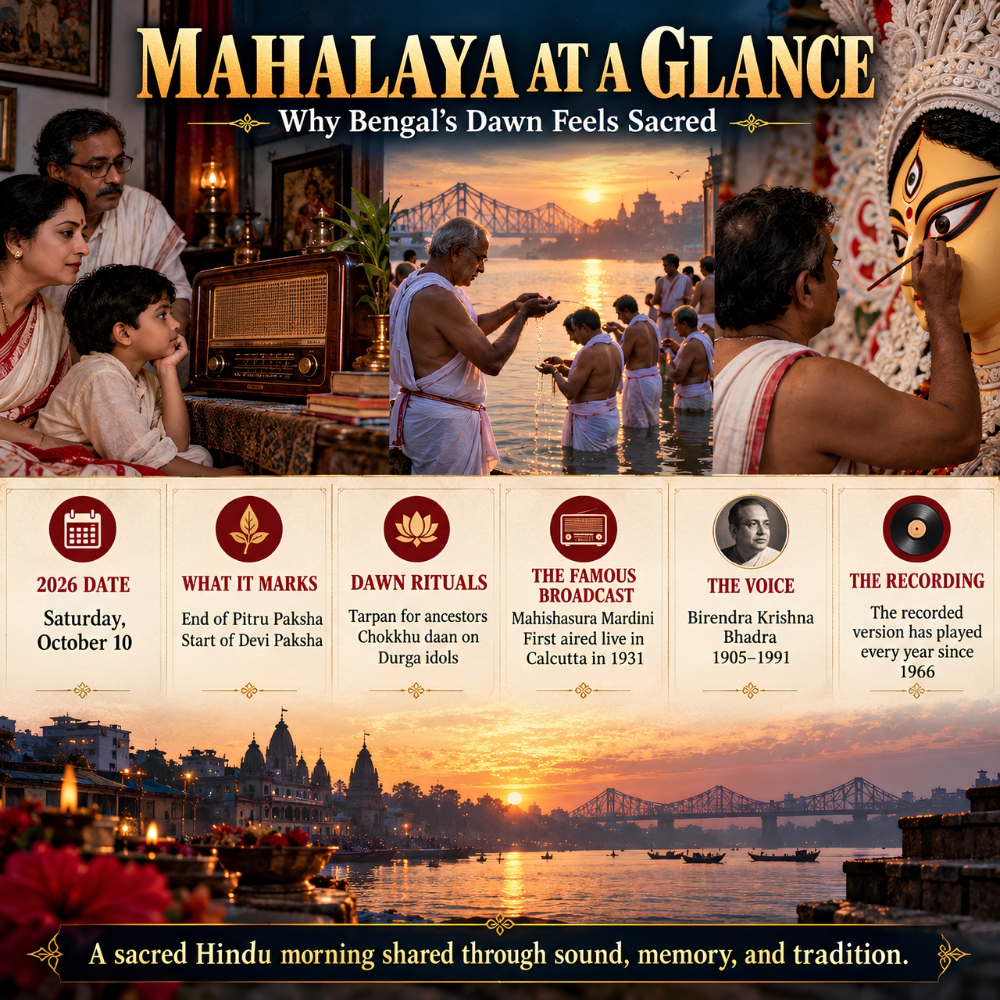
Mahalaya at a glance
- Date in 2026: Saturday, October 10
- What it marks: the end of Pitru Paksha and the start of Devi Paksha, about a week before Durga Puja
- The famous broadcast: Mahishasura Mardini, first aired live on All India Radio in Calcutta in 1931
- The voice: Birendra Krishna Bhadra, who lived from 1905 to 1991
- The recording: the same recorded version has played every year since 1966
What Mahalaya Means
Mahalaya is the new moon day at the end of Pitru Paksha. That is a period of about two weeks when Hindu families remember their parents, grandparents, and older relatives who have died. On Mahalaya morning, many people stand in a river and offer water in their names. This ritual is called tarpan.
The same morning opens Devi Paksha. Bengalis believe Goddess Durga starts her journey home to Earth on this day. Artists who make Durga idols often paint her eyes on Mahalaya, a step known as chokkhu daan. About a week later, Durga Puja begins.
So the day holds two feelings at once. People miss the ones they lost, and they also get ready for the biggest festival of the year. You can read more about the rituals in our guide to the significance of Mahalaya.
The prayers and tarpan belong to Hindu families. The music, the early wake up, and the feeling in the air are a different matter. When we say Mahalaya belongs to everyone, we mean that shared part of the morning.
The Voice That Some People Did Not Want
The heart of Mahalaya morning is a radio program called Mahishasura Mardini. It runs for about 90 minutes. It mixes Sanskrit verses from the Chandi with Bengali songs and music. Bani Kumar wrote the script. Pankaj Kumar Mullick led the music. Birendra Krishna Bhadra read the verses and told the story.
Here is the part many people do not know. Bhadra was a Kayastha, not a Brahmin. When the program started in 1931, some orthodox Brahmins in Bengal protested. They said a man of his caste had no right to recite the Chandi on air. A senior official at the radio station was against it too.
Bani Kumar did not give in. He kept Bhadra.
That one decision shaped the next 95 years. Bhadra’s deep, trembling voice became the sound of Mahalaya itself. The program aired live for its first 34 years. In 1966, All India Radio moved to a recorded version, and that recording still plays today. Bhadra died in 1991, yet his voice still wakes up homes across Bengal.
A man some priests tried to keep out became the voice of the whole day. That is the strongest proof that Mahalaya belongs to everyone. For more on his life and the habit of listening at dawn, read about the Mahalaya ritual with Birendra Krishna Bhadra.
Musicians of Every Faith
The singers were big names of their time, including Pratima Bandopadhyay, Dwijen Mukhopadhyay, Supriti Ghosh, and Shyamal Mitra. Behind them sat an orchestra that writers describe as made up of musicians of every faith. Many of the players were Muslim. Two names that come up often are Khushi Mohammad on the harmonium and Ali on the cello.
Some accounts say several musicians spoke Urdu and may not have followed Bhadra’s Bengali words. They followed the power of his voice instead and played to match the drama.
Picture that studio. A prayer to the goddess, read by a man some priests rejected, set to music by people who did not all share his faith or his language. And it became the most loved broadcast in Bengal.
That mix was there from the very first years. Mahalaya belongs to everyone partly because everyone was already in the room when it was made.
The Year Listeners Said No
In 1976, All India Radio tried to replace the old program. The new version was called Durga Durgatiharini. The narrator was Uttam Kumar, the biggest film star in Bengal, and Hemanta Mukhopadhyay made the music.
Listeners did not accept it. The station got angry phone calls, and people protested in public. The next year, in 1977, Bhadra’s version came back.
This story shows who really owns the program. The radio station could not decide what Mahalaya should sound like. Ordinary listeners did. People from many homes and many backgrounds stood up for a voice they loved. When the public protects a tradition like this, Mahalaya belongs to everyone who kept it alive, not to one office or one star.
Mahalaya Beyond Kolkata
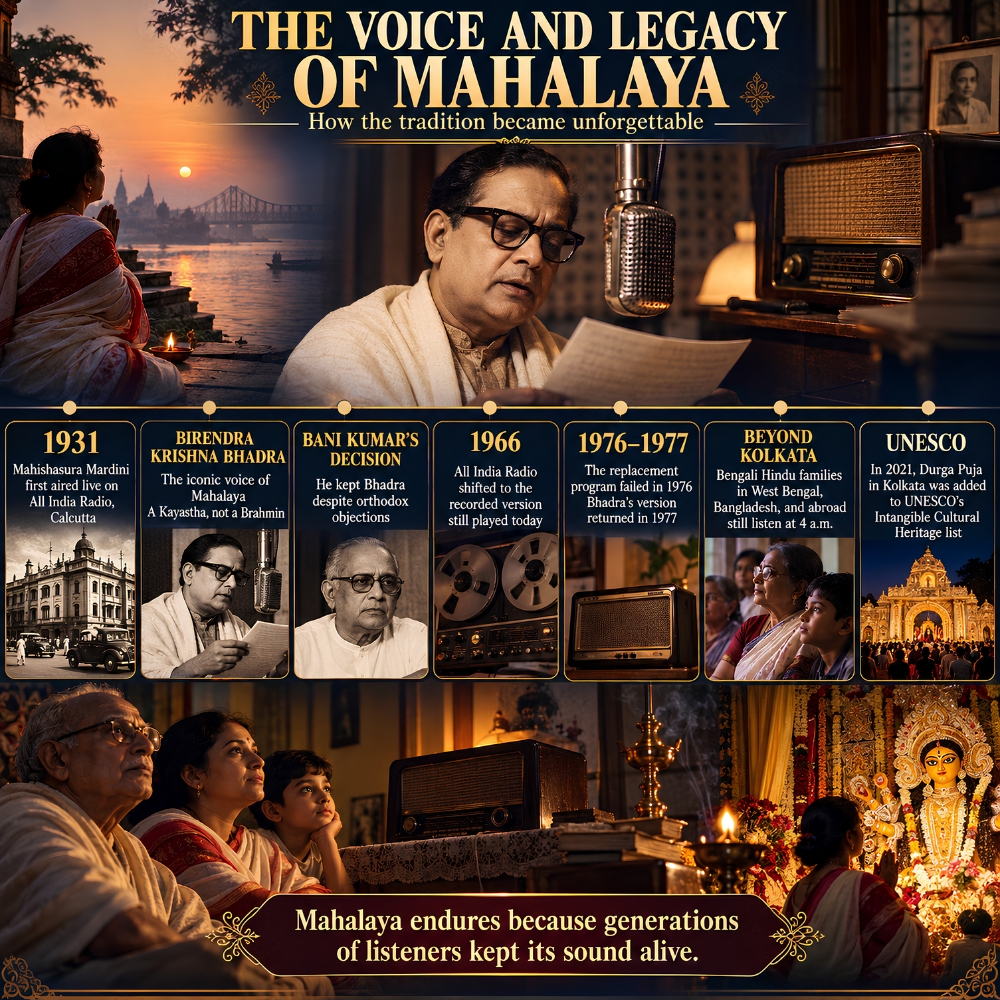
The morning has spread far past the city where it began. In December 2021, UNESCO added Durga Puja in Kolkata to its list of the Intangible Cultural Heritage of Humanity. Mahalaya opens that festival. So the idea that Mahalaya belongs to everyone is now more than a nice phrase. The world has called this heritage its own.
In Bangladesh
In Bangladesh, Bengali Hindu families play the recorded Mahishasura Mardini before dawn, just like families in West Bengal. Dhakeshwari National Temple in Dhaka holds a special program at dawn, and puja committees around the country do the same.
Daily Star journalist Partha Pratim Bhattacharjee once put it in three words: “Mahalaya means Bengali nostalgia.” He did not say Hindu nostalgia. On both sides of the border, Mahalaya belongs to everyone who grew up with that sound in the dark before sunrise.
Far From Home
Bengalis abroad keep the morning too. On October 10, 2026, the Greater Manchester Bengali Hindu Cultural Association in the UK is holding a Mahalaya evening with Mahishasura Mardini, songs, and recitations. Many families who cannot gather simply stream the recording on YouTube at dawn, wherever they live. Even thousands of miles away, Mahalaya belongs to everyone who carries a little of Bengal with them.
Sharing a tradition is good. Sharing it carelessly is not. Mahalaya belongs to everyone, but some parts of it need more care than others. A few simple habits help:
- Invite someone to listen. Ask a friend from another faith to hear the broadcast with you. Tell them the story as it plays. The music carries the story even if you do not know Sanskrit.
- Respect tarpan. It is a family’s private moment of grief. If you visit a river ghat, watch quietly from a distance. Do not take close photos of people without asking.
- Choose the original recording. Many remakes exist online. The one most Bengalis mean is the Bhadra recording.
- Be gentle with greetings. Some people feel “Shubho Mahalaya” is wrong for a day of remembering the dead. If you are not sure, a simple “Mahalaya greetings” works fine.
Want to know why this morning hits so hard for so many? Read about the emotional power of Mahalaya.
Frequently Asked Questions (FAQs)
Why do people say Mahalaya belongs to everyone?
The famous broadcast was voiced by a man who was not a Brahmin, played by musicians of many faiths, and saved by ordinary listeners after 1976. Its music and mood are shared by Bengalis of all backgrounds, even though tarpan stays a Hindu family ritual.
Was Birendra Krishna Bhadra a Brahmin?
No. He was a Kayastha. Some orthodox Brahmins objected to him reciting the Chandi, but the program’s writer kept him.
Can someone who is not Hindu listen to Mahishasura Mardini?
Yes. Anyone can listen. It is part of Bengali culture, not only a temple service.
What time is Mahishasura Mardini played?
All India Radio plays it at 4 a.m. on Mahalaya morning. You can also find the recording on YouTube.
Final Thoughts
Mahalaya is a Hindu day, and its rituals deserve respect. But its most famous sound was made by a man some priests rejected, played by musicians of many faiths, and protected by listeners who refused to let it go. That history is why Mahalaya belongs to everyone.
This Saturday, set your alarm for 4 a.m. If you can, invite someone who has never heard it. Let Bhadra’s voice do the rest.