October 4 has witnessed many remarkable moments throughout history, from major political and cultural events to scientific breakthroughs and milestones that changed the world. It is also the birthday of notable figures from different fields, while the date marks the deaths of people whose contributions continue to be remembered.
In this article, we look back at what happened on October 4, including important historical events, famous birthdays, notable deaths, and other significant global milestones. Whether you are a history enthusiast or simply curious about the stories connected to this date, these events offer an interesting glimpse into the past and the people who helped shape it.
October 4 at a Glance: Key Historical Snapshots
| Year | Event Type | Historical Event / Significance | Region / Sphere |
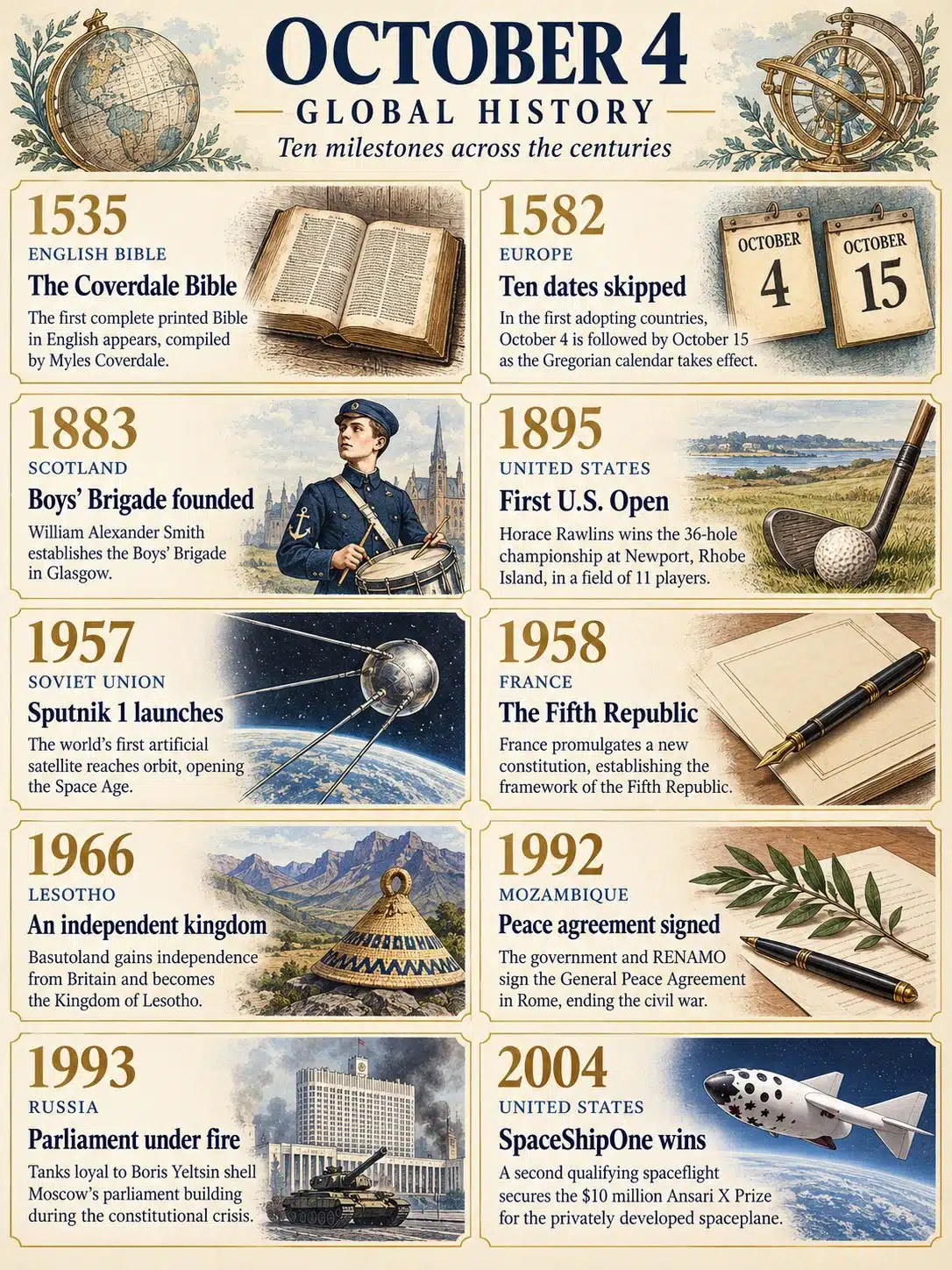
| 1535 | Literature / Religion | Myles Coverdale prints the first complete English translation of the Bible | United Kingdom / Europe |
| 1582 | Science / Calendar | Pope Gregory XIII decrees the Gregorian calendar; 10 days are erased | Europe (Global Impact) |
| 1857 | Freedom Movement | Birth of Shyamji Krishna Varma, founder of London’s India House | Indian Subcontinent |
| 1895 | Sports History | First U.S. Open Golf Championship is played in Newport, Rhode Island | United States |
| 1931 | Music & Culture | Birth of legendary Bengali classical vocalist Sandhya Mukhopadhyay | Bangalee Sphere |
| 1957 | Space & Technology | USSR launches Sputnik 1, initiating the Cold War Space Race | Russia (USSR) / Global |
| 1958 | Politics & Law | France establishes the Fifth Republic under a new constitution | Europe |
| 1966 | Independence | Lesotho officially gains independence from the United Kingdom | Africa |
| 1977 | Diplomacy | Atal Bihari Vajpayee delivers the first UN General Assembly address in Hindi | India / Global |
| 1992 | Peace Treaty | Rome General Peace Accords end the 15-year Mozambican Civil War | Africa |
| 1993 | Political Crisis | Russian military tanks shell the White House parliament building in Moscow | Russia |
| 2004 | Aerospace | SpaceShipOne wins the Ansari X Prize, opening commercial spaceflight | United States |
| 2018 | Social Policy | Bangladesh issues gazette abolishing the 56% civil service quota system | Bangalee Sphere |
The Bangalee Sphere & Indian Subcontinent
The history of the Bengal region and the broader Indian subcontinent on October 4 reflects a continuous journey of intellectual resistance, cultural dominance, and administrative evolution.
Historical Milestones & Political Shifts
-
2018 — The Bangladesh Quota Reform Gazette: On October 4, 2018, following months of intense nationwide student-led demonstrations, the Ministry of Public Administration of Bangladesh officially issued the historic circular abolishing the long-standing 56% quota system for first and second-class government jobs. This decision redirected recruitment toward merit-based selection and represented one of the most substantial policy shifts in the nation’s post-independence civil service reform.
-
1977 — Historic Hindi Address at the United Nations: India’s Minister of External Affairs (later Prime Minister) Atal Bihari Vajpayee made history on October 4, 1977, by becoming the first leader to deliver an official address to the United Nations General Assembly in Hindi. The speech championed non-alignment, global nuclear disarmament, and anti-apartheid struggles, asserting the linguistic and cultural sovereignty of the Indian subcontinent on the global diplomatic stage.
-
1857 — Foundation of Overseas Indian Revolutionary Networks: The birth of Shyamji Krishna Varma on October 4, 1857, in Gujarat laid the foundation for anti-colonial political organization abroad. Varma later established India House and the Indian Home Rule Society in London. These institutions served as critical hubs, funding, housing, and organizing Indian revolutionaries, including Bengali political exiles operating in Europe during the anti-partition agitation of Bengal.
Cultural & Artistic Contributions
-
Sandhya Mukhopadhyay (1931–2022): Born in Dhakuria, Kolkata, on October 4, 1931, Sandhya Mukhopadhyay (Mukherjee) became one of the defining voices of Bengali music in the 20th century. Trained under classical legends like Ustad Bade Ghulam Ali Khan, her iconic duets with Hemanta Mukherjee defined the golden era of Bengali cinema, particularly for films starring Suchitra Sen and Uttam Kumar. During the 1971 Bangladesh Liberation War, she joined Bengali artists in raising funds and awareness for refugees, broadcasting songs through Swadhin Bangla Betar Kendra.
-
Dinabandhu Mitra’s Enduring Legacy: While dramatist Dinabandhu Mitra passed away in November 1873, October 4 is traditionally associated with literary commemorations across West Bengal recognizing his 1860 masterpiece Nil Darpan (The Indigo Mirror). The play exposed the brutal exploitation of Bengali farmers by British indigo planters, prompting Reverend James Long to publish its English translation (translated by Michael Madhusudan Dutt), which galvanized regional anti-colonial sentiment.
Global History
United States
-
1895 — Inaugural U.S. Open Golf Championship: Held at the Newport Country Club in Rhode Island, the first U.S. Open was played as a single-day, 36-hole competition. Twenty-one-year-old English golfer Horace Rawlins won the title, taking home $150 and a gold medal from a field of just 11 players.
-
2004 — The Dawn of Commercial Spaceflight: Scaled Composites’ experimental spaceplane SpaceShipOne, designed by Burt Rutan and financed by Microsoft co-founder Paul Allen, successfully completed its second spaceflight within two weeks. By reaching an altitude exceeding 100 kilometers, it won the $10 million Ansari X Prize, proving that non-governmental private entities could achieve human space travel.
Russia / USSR
-
1957 — Launch of Sputnik 1: At 10:28 PM Moscow time on October 4, 1957, the Soviet Union launched Sputnik 1, the world’s first artificial satellite, from the Baikonur Cosmodrome in Kazakhstan. The metallic sphere, measuring 58 centimeters in diameter, orbited the Earth every 96 minutes, transmitting a rhythmic radio signal at 20.005 MHz. This single technological breakthrough shocked the Western world, shattered the perceived technological monopoly of the United States, and officially initiated the Cold War Space Race.
-
1993 — Moscow Constitutional Crisis Bombardment: Tensions between Russian President Boris Yeltsin and the Supreme Soviet reached a violent climax on October 4, 1993. Following days of armed standoffs, military tanks loyal to Yeltsin fired directly upon the Russian Parliament building (the White House) in Moscow. The assault crushed the parliamentary uprising, leaving over 140 people dead and consolidating executive presidential power in post-Soviet Russia.
United Kingdom
-
1535 — Printing of the Coverdale Bible: Produced by English reformer Myles Coverdale and printed in continental Europe, October 4, 1535, marked the completion of the first complete printed translation of the Bible into English. Coverdale incorporated William Tyndale’s translated New Testament and translated the remaining Old Testament portions from Latin and German texts, laying the foundation for modern English religious literature.
-
1883 — Foundation of the Boys’ Brigade: Sir William Alexander Smith founded the Boys’ Brigade in Glasgow, Scotland. Combining Christian values with military-style drill and discipline, it became the world’s first voluntary uniformed youth organization, directly inspiring Lord Baden-Powell to create the Boy Scout movement decades later.
Europe
-
1582 — Erasing Ten Days: The Gregorian Calendar Shift: On October 4, 1582, Pope Gregory XIII issued a papal bull replacing the ancient Julian calendar with the Gregorian calendar to rectify inaccuracies in calculating the vernal equinox and Easter. To correct a 10-day drift accumulated over centuries, the decree specified that Thursday, October 4, 1582, would be immediately followed by Friday, October 15, 1582. Catholic nations including Spain, Portugal, Italy, and Poland implemented the jump overnight.
-
1958 — Formation of the French Fifth Republic: France officially promulgated its modern Constitution on October 4, 1958, following a national referendum. Spearheaded by General Charles de Gaulle, the new constitution replaced the parliamentary instability of the Fourth Republic with a strong presidential system, forming the political architecture of contemporary France.
China & East Asia
-
1950 — Early Diplomatic & Military Realignment: Following the formal establishment of the People’s Republic of China (PRC) in October 1949, early October 1950 saw intense top-level political consultations in Beijing regarding Chinese entry into the Korean War. On October 4, 1950, Chairman Mao Zedong and the Politburo convened crucial meetings that ultimately authorized the deployment of the Chinese People’s Volunteer Army across the Yalu River.
Canada & Australia
-
1992 — NAFTA Negotiations Finalized (Canada): Canadian trade representatives completed critical negotiations alongside their American and Mexican counterparts, finalizing the text for the North American Free Trade Agreement (NAFTA). The economic pact created one of the world’s largest free-trade zones upon its formal implementation in 1994.
-
1950s–Present — Daylight Saving Protocol (Australia): Historically, October 4 frequently marks the transition date for Australia’s southern states (New South Wales, Victoria, South Australia, Tasmania, and ACT) as they implement Daylight Saving Time, reshaping agricultural schedules and interstate corporate operations across the continent.
Rest of World
-
1966 — Lesotho Gains National Independence: The Kingdom of Lesotho officially achieved full independence from Great Britain on October 4, 1966, ending 82 years as the British protectorate of Basutoland. Constitutional monarch King Moshoeshoe II assumed executive leadership of the landlocked nation.
-
1992 — Rome General Peace Accords (Mozambique): President Joaquim Chissano of Mozambique and Afonso Dhlakama, leader of the RENAMO rebel movement, signed a peace agreement in Rome on October 4. The treaty ended the 15-year Mozambican Civil War, which had resulted in over one million casualties and displaced millions across Southern Africa.
Famous Birthdays (October 4)
| Name | Born | Nationality | Profession / Primary Legacy | Key Awards / Recognized Achievements |
| Rutherford B. Hayes | 1822 | American | 19th President of the United States | Oversaw the end of Reconstruction Era; Civil War General |
| Shyamji Krishna Varma | 1857 | Indian | Revolutionary, Lawyer, Nationalist Journalist | Founder of India House & The Indian Sociologist |
| Acharya Ramchandra Shukla | 1882 | Indian | Literary Historian, Hindi Scholar, Critic | Formulated the historic structural periodization of Hindi literature |
| Buster Keaton | 1895 | American | Silent Film Actor, Director, Comedian | Academy Honorary Award (1960); Silent cinema pioneer |
| Vitaly Ginzburg | 1916 | Russian / Soviet | Theoretical Physicist & Astrophysicist | Nobel Prize in Physics (2003); Pioneer of superconductivity theory |
| Charlton Heston | 1923 | American | Academy Award-Winning Actor | Oscar for Best Actor (Ben-Hur, 1959); Presidential Medal of Freedom |
| Sandhya Mukhopadhyay | 1931 | Indian (Bengali) | Classical Vocalist & Playback Singer | National Film Award (1970); Banga Bibhushan (2011) |
| Anne Rice | 1941 | American | Author of Gothic Fiction & Fantasy | Author of Interview with the Vampire; sold over 100M books |
| Susan Sarandon | 1946 | American | Film & Television Actress, Activist | Academy Award for Best Actress (Dead Man Walking, 1995) |
| Derrick Rose | 1988 | American | Professional Basketball Player | Youngest MVP in NBA History (2011) |
Rutherford B. Hayes (1822–1893)
Born in Delaware, Ohio, Hayes served as an officer in the Union Army during the American Civil War, rising to the rank of brevet major general. Elected as the 19th U.S. President in the disputed election of 1876, his administration oversaw the withdrawal of federal troops from the Southern states, effectively ending the Reconstruction Era. Hayes advocated for civil service reform, financial stability based on gold, and expanding educational opportunities across racial lines.
Buster Keaton (1895–1966)
Joseph Frank “Buster” Keaton was born into a vaudeville family in Piqua, Kansas. Known universally as “The Great Stone Face” for his deadpan facial expression during complex physical stunts, Keaton created cinematic masterpieces including The General (1926) and Sherlock Jr. (1924). His visual storytelling, physical acrobatics, and early cinematic techniques earned him recognition as one of the influential figures in the history of worldwide comedy and filmmaking.
Vitaly Ginzburg (1916–2009)
A theoretical physicist who lived through the rise, fall, and aftermath of the Soviet Union, Ginzburg made contributions to quantum mechanics, astrophysics, and radio astronomy. He co-developed the Ginzburg-Landau theory of superconductivity, which provided a mathematical framework for understanding physical properties at extremely low temperatures. In 2003, he was awarded the Nobel Prize in Physics alongside Alexei Abrikosov and Anthony James Leggett.
Famous Deaths (October 4)
| Name | Died | Nationality | Profession / Primary Legacy | Cause / Notable Circumstances |
| Rembrandt van Rijn | 1669 | Dutch | Painter & Printmaker of Dutch Golden Age | Natural causes; died in poverty in Amsterdam |
| Frédéric Auguste Bartholdi | 1904 | French | Sculptor, Designer of Public Monuments | Tuberculosis; Designer of the Statue of Liberty |
| Max Planck | 1947 | German | Theoretical Physicist; Father of Quantum Theory | Natural causes (Age 89); Nobel Prize Winner (1918) |
| Janis Joplin | 1970 | American | Rock, Soul, & Blues Vocalist | Accidental heroin overdose (Age 27) |
| Graham Chapman | 1989 | British | Comedian, Actor, Writer (Monty Python) | Tonsillar cancer (Age 48) |
| Gordon Cooper | 2004 | American | Astronaut; NASA Mercury Seven Pioneer | Heart failure (Age 77); Flew Faith 7 mission |
| Ken Hensley | 2020 | British | Singer-Songwriter, Keyboardist (Uriah Heep) | Brief illness (Age 75) |
Rembrandt van Rijn (1606–1669)
Rembrandt is widely considered one of the greatest visual artists in human history. His mastery of chiaroscuro (the dramatic use of light and shadow) and his empathetic portrayals of human emotion defined the Dutch Golden Age.
Despite early financial success with works such as The Night Watch (1642) and numerous self-portraits, Rembrandt suffered financial mismanagement and severe personal losses late in life. He passed away on October 4, 1669, in Amsterdam and was buried in an unmarked pauper’s grave in the Westerkerk.
Max Planck (1858–1947)
The German theoretical physicist Max Planck revolutionized human understanding of atomic and subatomic processes. In 1900, while attempting to understand black-body radiation, he proposed that energy is emitted in discrete units called “quanta” ($E = h\nu$), where $h$ is Planck’s constant.
This discovery broke with classical physics and laid the foundation for quantum mechanics. Planck received the 1918 Nobel Prize in Physics. He passed away in Göttingen on October 4, 1947, at the age of 89.
Janis Joplin (1943–1970)
Janis Joplin emerged as one of the definitive rock vocalists of the 1960s, gaining international acclaim with her emotional performance at the 1967 Monterey Pop Festival and her work with Big Brother and the Holding Company. Hits like Piece of My Heart, Ball and Chain, and her posthumously released Me and Bobby McGee demonstrated her unique vocal style. Her death on October 4, 1970, at age 27, placed her among the artists of the “27 Club.”
International Observances & Global Holidays
World Animal Day
Established during an international animal protection congress in Florence, Italy, in 1931, World Animal Day aims to improve animal welfare standards across the globe. October 4 was chosen because it coincides with the feast day of Saint Francis of Assisi, the patron saint of ecology and animals. Environmental organizations, wildlife shelters, and community groups host educational drives and fundraising efforts on this day.
World Space Week (Day 1: October 4)
Declared officially by the United Nations General Assembly in December 1999, World Space Week runs annually from October 4 to October 10. The start date (October 4) honors the 1957 launch of Sputnik 1, while the end date (October 10) marks the entry into force of the Outer Space Treaty in 1967. It serves as the largest worldwide public event dedicated to space science and technology education.
Lesotho Independence Day
A national public holiday across the Kingdom of Lesotho celebrating its official liberation from British colonial rule in 1966. Parades, traditional Basotho musical performances, and political addresses take place in the capital city of Maseru.
“Did You Know?” Historical Trivia
-
The Day Millions Went to Bed on October 4 and Woke Up on October 15:
When Pope Gregory XIII shifted Europe to the Gregorian calendar on October 4, 1582, the calendar was falling out of sync with the solar year. To realign the solar equinoxes, the entire calendar was shifted forward by 10 days. Citizens in Italy, Poland, Portugal, and Spain went to sleep on Thursday, October 4, and woke up the next morning on Friday, October 15, 1582. No events legally took place between October 5 and October 14, 1582, in those jurisdictions.
-
A Simple Radio Beep That Created NASA:
Sputnik 1 carried no advanced cameras or scientific sensors; its primary payload was a simple, battery-operated radio transmitter that output a steady, repeating sound (beep-beep-beep). The fact that Soviet technology could broadcast a radio signal over American territory caused public concern in the US. This concern directly led President Dwight D. Eisenhower to sign the National Aeronautics and Space Act, establishing NASA in 1958.
-
Printing Bibles Was Once a Capital Offense:
When Myles Coverdale finished the first full printed English Bible on October 4, 1535, he had to work in secret in continental Europe (likely Zurich or Antwerp). Under King Henry VIII, printing vernacular Scripture in English without royal permission was considered treason, punishable by death at the stake—the fate that met Coverdale’s mentor, William Tyndale, just one year later.
Quote of the Day
“A new scientific truth does not triumph by convincing its opponents and making them see the light, but rather because its opponents eventually die, and a new generation grows up that is familiar with it.”
— Max Planck
(German Theoretical Physicist, Nobel Laureate in Physics; Passed Away October 4, 1947)
Final Thoughts
October 4 is a date filled with moments that have shaped history, from major global events and scientific achievements to the births and deaths of influential figures. Looking back at what happened on this day offers a chance to understand how individual lives and historic events have influenced the world we know today. Whether you are interested in history, famous personalities, science, culture, or world events, October 4 provides plenty of stories worth remembering. As each year adds new milestones to the calendar, this day continues to hold an important place in history.