You can answer messages, attend meetings, clear small requests, and remain visibly busy all day, then realize the work requiring real thought is still untouched. The productivity statistics behind modern burnout help explain that contradiction. People are not necessarily working less. Many are trying to produce more while their attention, time, and recovery are steadily being reduced.
The World Health Organization describes burnout as an occupational phenomenon resulting from chronic workplace stress that has not been successfully managed. Its three main features are exhaustion, growing mental distance or cynicism toward work, and reduced professional effectiveness. Burnout is not classified as a medical condition, and it should not become a casual label for depression, anxiety, or ordinary tiredness.
The statistics below do more than count how many employees feel burned out. Together, they show how rising expectations, fragmented attention, job insecurity, long hours, and weak recovery can turn productivity into something people struggle to sustain.
10 Productivity Statistics That Reveal Why Work Feels Unsustainable
No single number can explain burnout. These ten statistics are useful because they reveal the pressures behind it, from crowded workdays and unused leave to the health consequences of sustained overwork.
1. 80% of Workers Lack Time or Energy, While 53% of Leaders Want More Productivity
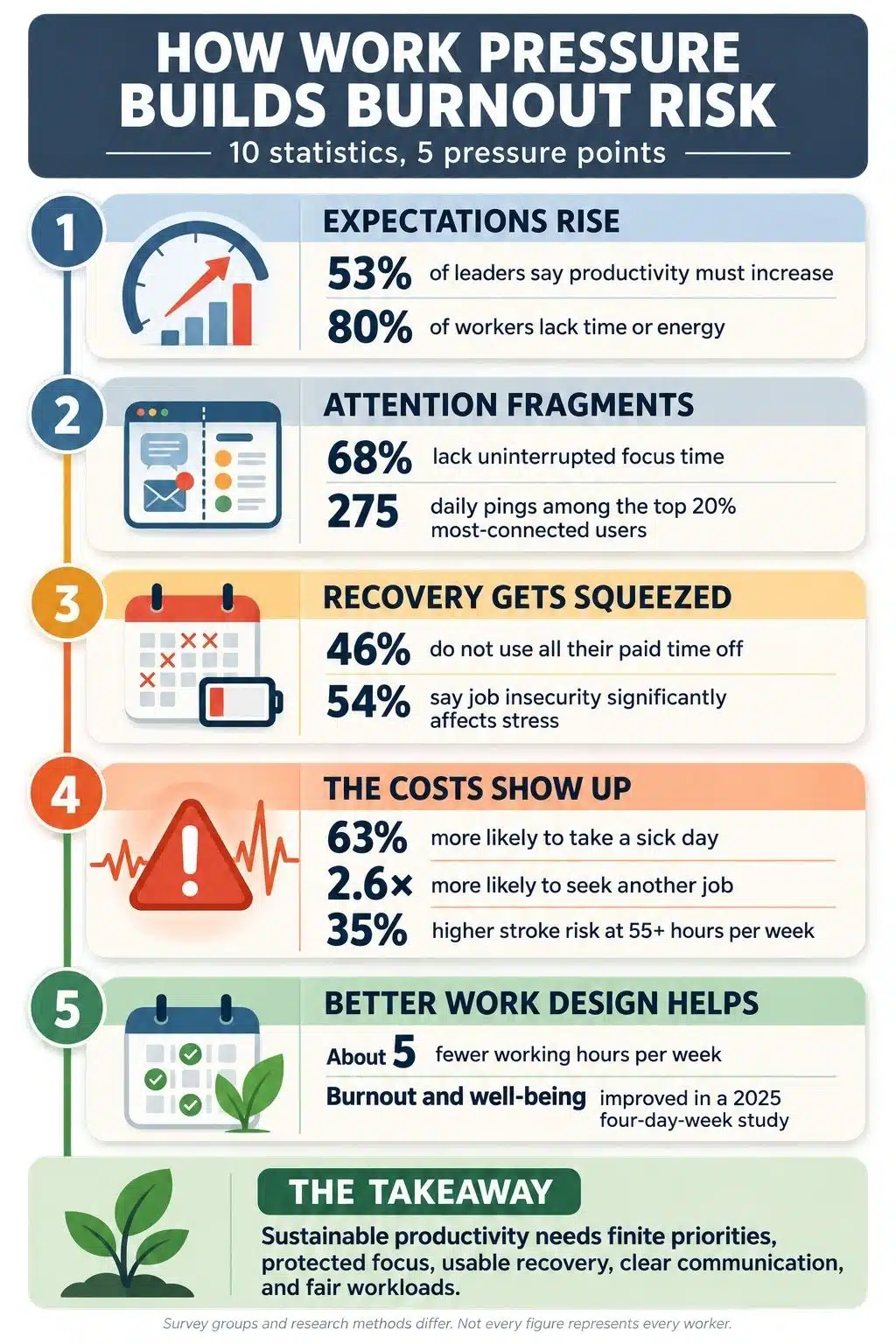
Microsoft’s 2025 Work Trend Index found that 53% of surveyed leaders believed productivity needed to increase. At the same time, 80% of the surveyed workforce said they lacked the time or energy needed to do their work.
I keep coming back to this mismatch because it captures the problem more clearly than another lecture about personal discipline. Employees are being asked for more output when many already feel they do not have enough capacity for their existing responsibilities.
The survey covered 31,000 full-time or self-employed knowledge workers across 31 markets, so it does not represent every occupation. Still, the management lesson is difficult to ignore. If output must rise, leaders need to decide what will stop, which priorities matter most, and where additional capacity will come from. “Work smarter” is not a substitute for those decisions.
2. 68% of Workers Say They Lack Uninterrupted Focus Time
In Microsoft’s 2023 workplace research, 68% of respondents said they did not get enough uninterrupted focus time during the workday. Within activity recorded across Microsoft 365 apps, 57% of time went toward communication and 43% toward creation.
Communication is real work, especially in management, healthcare, customer service, and other collaborative roles. The problem begins when someone is expected to communicate continuously and still produce several hours of concentrated writing, analysis, planning, design, or problem-solving.
That deeper work often moves into early mornings, evenings, or the gaps between meetings. The employee stays active but ends the day feeling as if nothing important moved forward. A personal calendar block can help, but teams also need fewer unnecessary meetings, realistic response-time expectations, and permission to use asynchronous updates.
3. The Most Heavily Connected Workers Receive 275 Pings a Day
Microsoft reported that the top 20% of users by ping volume received 275 meetings, emails, and chat notifications a day. That is roughly one ping every two minutes across an eight-hour workday. The same analysis found that after-hours chats had risen by 15% year over year.
This is not the average for every worker, and a notification does not prove that someone opened it or abandoned a task to respond. It does show how intense digital work can become at the upper end.
The real cost is not just the few seconds needed to read a message. Each ping creates a decision: Is it urgent? Does it change my priorities? Should I answer now or remember it for later? Repeating that process throughout the day makes sustained attention harder. Teams do not need silence, but they do need clear rules about which channels are urgent and when a response is genuinely expected.
4. 46% of Eligible Workers Do Not Use All Their Paid Time Off
Pew Research Center found that 46% of U.S. workers with paid time off took less leave than their employer allowed. Among those who left time unused, 49% worried about falling behind, while 43% felt bad about coworkers absorbing extra work.
That gap matters. Offering leave is not the same as making it usable. If taking a week off creates a backlog, burdens an already stretched colleague, or requires several frantic days of preparation, the policy does not provide much recovery.
Managers were also more likely than nonmanagers to leave paid time unused. When leaders rarely disconnect, employees can read constant availability as the real rule, regardless of what the handbook says. Useful leave requires backup coverage, documented responsibilities, adjusted workloads, and a culture that does not punish people with an overflowing inbox when they return.
5. 65% of AI Users Fear Falling Behind If They Do Not Adapt Quickly
Microsoft’s 2026 Work Trend Index surveyed 20,000 AI-using knowledge workers across ten countries. It found that 65% feared falling behind if they did not adapt quickly. Yet only 13% said they were rewarded for reinventing work when those experiments failed to produce the expected results immediately.
This creates a double workload that is easy to overlook. People must continue delivering their current responsibilities while learning new tools, checking AI-generated work, changing established processes, and proving that adoption produces value.
AI may save time on individual tasks, but implementation still requires attention. There is also a risk that every saved hour becomes justification for more work. Responsible adoption means providing paid learning time, defining acceptable uses, setting quality standards, and removing outdated processes. Otherwise, transformation becomes another obligation layered onto an already crowded job.
6. Job Insecurity Significantly Affects Stress for 54% of U.S. Workers
The American Psychological Association’s 2025 Work in America survey found that 54% of U.S. workers said job insecurity had a significant effect on their stress.
Uncertainty changes workplace behavior. Someone worried about layoffs or replacement may hesitate to decline meetings, question an impossible deadline, use sick leave, or admit that the workload is no longer manageable. Constant availability can begin to feel like job protection.
This is why two employees with similar task lists may experience work very differently. Financial insecurity, low control, and fear of speaking honestly can make an ordinary deadline feel threatening. Employers cannot promise certainty, but they can communicate changes clearly, explain priorities, and avoid using vague threats to drive performance. Silence rarely removes anxiety. It leaves people to imagine the worst.
7. Having Enough Time Is Associated With About 70% Less Burnout
Gallup found that employees who often or always had enough time to complete their work were about 70% less likely to experience high burnout. The same research found that employees who frequently experienced unfair treatment were 2.3 times more likely to report high burnout.
The research is older and based on associations, so it does not prove that either factor independently caused burnout. Even so, it challenges the idea that hours alone tell the whole story.
People can handle demanding periods when expectations are clear, decisions feel fair, and the pressure has an endpoint. What wears people down is the combination of impossible deadlines, unexplained priority changes, and the sense that doing good work will only earn them more work. A useful manager makes trade-offs visible, clarifies what “good enough” means, and challenges requests that the team cannot realistically absorb.
8. Frequently Burned-Out Employees Are 63% More Likely to Take a Sick Day
Gallup also found that employees who frequently experienced burnout were 63% more likely to take a sick day, 2.6 times as likely to look for another job, and 13% less confident in their performance.
These figures reveal the productivity trap. An organization pushes harder for output. Burnout contributes to absence, lower confidence, disengagement, and turnover. The remaining employees inherit more work, placing them at greater risk of entering the same cycle.
A sick day is not evidence of poor commitment, and a resignation is not necessarily a failure of loyalty. Both may be late signals that the working arrangement has become unsustainable. Earlier signs are often quieter: slower decisions, emotional detachment, more mistakes, less initiative, or a shift from improving the work to merely surviving it.
9. Working 55 Hours or More Is Associated With Serious Health Risks
A joint analysis by the World Health Organization and International Labour Organization found that working 55 hours or more per week was associated with a 35% higher risk of stroke and a 17% higher risk of dying from ischemic heart disease than working 35 to 40 hours.
The organizations attributed 745,000 deaths from those conditions in 2016 to long working hours. That is a historical estimate, not a current annual count, and the study examined cardiovascular outcomes rather than burnout itself.
Even with those limits, the finding puts long-hours culture into perspective. Occasional intense periods may be unavoidable. The danger is allowing exceptional hours to become the normal way a team operates.
10. Cutting the Workweek by About Five Hours Improved Burnout
A 2025 study followed a six-month four-day-week intervention involving 2,896 employees at 141 organizations. Average working time fell by about five hours per week, and employees reported improvements in burnout, job satisfaction, mental health, and physical health. The same changes were not found in 12 comparison companies.
The organizations did more than remove a day from the calendar. They reorganized work beforehand to improve efficiency and collaboration. That distinction matters. Compressing five days of disorganized work into four longer days could create a different form of exhaustion.
The study has real limitations. Participating companies volunteered, the sample largely consisted of smaller organizations in English-speaking countries, and the well-being measures were self-reported. It also did not directly establish that company productivity remained unchanged.
Still, the result is valuable because the intervention changed how work was designed. It did not ask employees to squeeze another wellness exercise into an overcrowded day.
What Sustainable Productivity Actually Requires
I do not think the answer is to reject ambition, technology, meetings, or demanding work. The problem begins when every gain in speed is used to justify another increase in volume.
Sustainable productivity depends on a few practical conditions:
- Finite priorities: When everything is urgent, people cannot make sensible trade-offs.
- Protected attention: Focus time should not depend on an employee repeatedly defending a calendar.
- Usable recovery: Leave, evenings, and weekends need practical protection, not just supportive policy language.
- Clear communication norms: People should know what is urgent, where it belongs, and when a response is expected.
- Fairness and control: Work is easier to sustain when decisions are transparent and employees have some influence over how it gets done.
Personal habits still matter. Muting unnecessary notifications, taking breaks, setting boundaries, and planning the day can reduce friction. What they cannot do is manufacture enough capacity for six competing priorities, continuous interruptions, and permanent availability.
Modern burnout is not proof that people have stopped caring about work. Often, it appears after they have cared for too long inside a system that keeps consuming more than it restores. These productivity statistics point toward a better response: redesign the conditions of work before asking employees to become better at enduring them.
Frequently Asked Questions on Productivity Statistics
1. What is modern workplace burnout?
It is persistent exhaustion, growing cynicism or distance from work, and reduced professional effectiveness linked to workplace stress that has not been successfully managed. It is more serious than feeling tired after a difficult week.
2. Can productivity tools cause burnout?
The tools are rarely the only cause. Problems arise when they add notifications, monitoring, communication channels, or workload without replacing older processes.
3. Is burnout caused mainly by working long hours?
Long hours are an important risk, but they are not the whole explanation. Low control, unfair treatment, job insecurity, interruptions, unclear expectations, and unrealistic deadlines can also make work unsustainable.
4. Does remote work increase burnout?
Not automatically. Remote work can improve autonomy and remove commuting, but it can blur boundaries when teams expect immediate responses at all hours. Management practices usually matter more than location alone.
5. Can a four-day workweek reduce burnout without hurting productivity?
Research shows promising improvements in burnout and well-being when organizations reduce hours and redesign inefficient work. However, results depend on the role and implementation, and the major 2025 study did not directly prove that productivity remained unchanged.