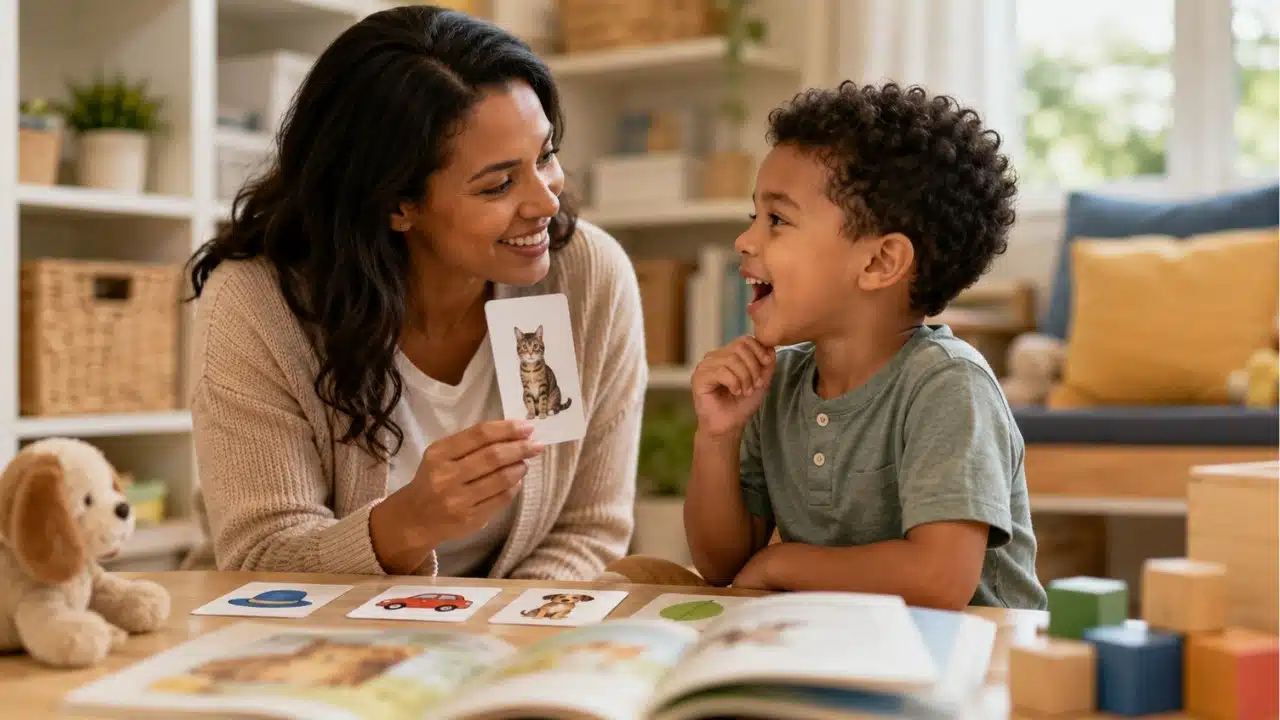
When we teach children to read, our immediate instinct is often to pull out letter flashcards or sit down with decodable books. We point to the letter B, teach the sound it makes, and ask the child to repeat it back to us. But long before a child can make sense of squiggles on a page, their brain needs to learn how to process the hidden sounds of spoken language.
When a child struggles to sound out simple words in kindergarten or first grade, the bottleneck is rarely a visual memory problem. Far more often, it is an auditory processing gap. The child has not yet learned to break down the spoken words they hear into smaller sound pieces. Understanding the importance of rhyming in phonics helps explain why simple sound play is not just a preschool pastime, but an essential step toward reading printed text.
Why Sound Processing Comes Before Letter Recognition
Before children learn phonics, which connects written letters to spoken sounds, they need a solid foundation in phonological awareness. Phonological awareness happens entirely through the ear. You can practice it in the dark, in the car, or with eyes closed because it requires zero printed text.
When toddlers and preschoolers first learn language, they treat words as complete units tied to meaning. The word dog refers to a furry animal that barks. The word banana refers to a yellow fruit. At this early stage, children do not hear the individual phonetic pieces packed inside those words.
Rhyming forces a fundamental shift in how a child listens to speech. It encourages them to stop focusing exclusively on what a word means and start paying attention to how a word is built. When a child realizes that cat, bat, and sat share an ending sound, they stop treating language purely as a communication tool and start analyzing it as an object made of moveable parts. This shift in perspective is essential because phonics demands that a child take words apart and put them back together.
Understanding Onsets and Rimes in Early Words
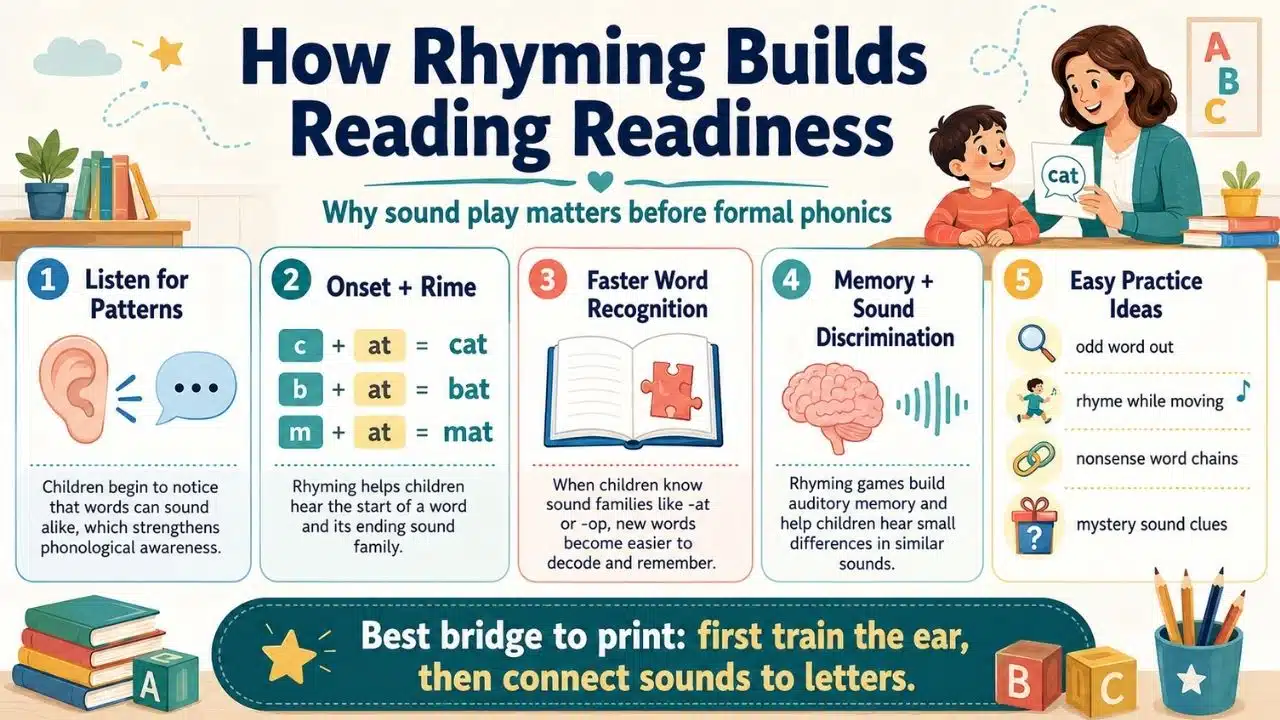
In early literacy, single-syllable words break down into two core structural units known as the onset and the rime. The onset is the initial consonant sound before the vowel, while the rime consists of the vowel and any consonant sounds that follow it.
In the word top, the sound /t/ is the onset, and /op/ is the rime. In the word shop, the sound /sh/ is the onset, while /op/ remains the rime.
When children play rhyming games, they practice holding the rime steady while changing the starting sound. This exercise teaches them that spoken words belong to predictable sound families.
The importance of rhyming in phonics becomes obvious as soon as children transition from listening to reading. A child who can swap /m/ for /t/ orally can easily apply that same pattern matching when looking at print. Instead of treating every word on a page as an isolated puzzle, they start spotting recurring letter patterns.
How Rhyming Patterns Speed Up Word Recognition
Early reading instruction relies heavily on word families such as -at, -in, -op, or -uck. These recurring patterns form the core of early decodable books and classroom reading lists.
When children have extensive experience with spoken rhymes, their brains map written letter combinations much faster. Through a process called orthographic mapping, the brain locks recognized letter sequences into long-term memory for instant retrieval. Once a child connects the spoken rime sound /an/ with the written letters a-n, every word in that spelling family becomes much easier to recognize.
Consider how a child approaches a word like stand on a page. A child without strong sound-pattern awareness might try to decode five separate letter sounds individually: /s/, /t/, /a/, /n/, /d/. That level of letter-by-letter blending takes heavy mental effort, which slows down reading pace and hurts comprehension. A child fluent in rhyming patterns breaks the word into two manageable pieces: the blend /st/ and the familiar rime /and/. By reducing the mental effort needed to decode, the child can read smoothly and keep their focus on understanding the story.
Building Auditory Memory and Sound Discrimination
Reading printed text demands strong auditory working memory. When a beginning reader looks at an unfamiliar word like flip, they have to identify the sound for f, hold it in mind while looking at l, hold both sounds while processing i and p, and then blend all four sounds together in order without dropping any of them.
Rhyming games exercise this exact cognitive process. During a rhyming activity, a child keeps a target word like ring in short-term memory, isolates its ending sound /ing/, searches their mental vocabulary for words with matching endings, and tests potential options like king, sing, or thing.
Sound play also sharpens auditory discrimination, which is the ability to hear subtle differences between similar speech sounds. Many young readers struggle because vowel sounds, particularly short /i/ as in pin and short /e/ as in pen, sound almost identical to an untrained ear. Regular rhyming practice trains the brain to pay close attention to those small vowel shifts, preventing common reading and spelling confusion later on.
Practical Sound Play for Home and Classroom
Integrating effective rhyming practice into daily routines does not require expensive materials or formal lesson plans. The most impactful activities are quick, oral, and active.
Odd Word Out
Give a child three words, two of which rhyme, such as duck, truck, and fish. Ask them to identify which word does not belong with the others. To increase the difficulty, use words with closer acoustic profiles, like pot, hot, and pet.
Mystery Sound Clues
Incorporate rhyming clues into daily routines or classroom transitions. You might say, “Please pick up the item on the floor that rhymes with rock,” pointing toward a block. This activity forces the child to hold an auditory sound pattern in mind while visually searching their environment.
Nonsense Word Chains
Build long strings of rhyming words that include made-up words. Start with a real word like cab and alternate turns generating rhymes like tab, mab, zab, and pab. Nonsense words work well because children cannot rely on memorized vocabulary; they have to process the sound structure directly.
Movement and Sound Matching
Combine physical movement with listening tasks. Have kids jump, clap, or take a step forward whenever they hear two words that rhyme, and freeze when a word breaks the pattern. Adding physical movement helps keep young learners engaged while reinforcing sound processing skills.
Bridging Oral Sound Play to Printed Letters
While sound play is critical, rhyming alone will not teach a child to read print. Systematic phonics instruction, where children explicitly learn which letters represent specific sounds, remains essential.
However, attempting to teach phonics to a child who cannot hear or manipulate spoken sounds creates unnecessary friction and frustration. The importance of rhyming in phonics lies in its role as a supportive bridge. Oral sound games prepare the ear so that when formal letter instruction begins, the brain is ready to map those visual shapes onto a clear auditory foundation.
By prioritizing simple, consistent sound games during early childhood, parents and teachers give young readers the confidence and cognitive tools they need to master printed text.
Linking Sound Play to Hands-On Digital Learning
While spoken rhyming games sharpen a child’s ear for language, well-designed educational apps help bridge the gap between oral sound patterns, written letters, and early math concepts.
123 Magic Phonics
Developed by Edutorial for iOS and Android devices, 123 Magic Phonics gives young learners a safe, interactive space to build early literacy and counting skills side by side. By turning oral rhyming exercises and basic math into guided touchscreen activities, the app helps children translate auditory speech patterns into letter recognition, handwriting confidence, and number sense.
-
Teacher-Certified Safety Standard: Holds the Google Play Teacher Approved badge, meeting strict guidelines for child privacy, educational value, and age-appropriate design.
-
Dual Literacy & Math Focus: Combines rhyming sound matches, letter-sound decoding, and rime identification with number tracing (1 to 50) and foundational counting tasks.
-
Designed for Young Learners: Features intuitive navigation, clean visual prompts, and encouraging feedback that allow children to practice independently while building healthy screen habits.
Building the Foundation for Lifelong Reading
Teaching children to read does not start with print on a page; it begins in the ear. While systematic phonics remains the ultimate goal for decoding written text, attempting to map letters to sounds without a strong auditory foundation creates unnecessary friction and frustration. Simple, consistent rhyming play equips young learners with the auditory memory, pattern recognition, and sound-blending confidence needed to transition smoothly into formal reading. By making space for daily sound games during early childhood, parents and educators lay the exact foundation required for a lifetime of fluent, effortless reading.