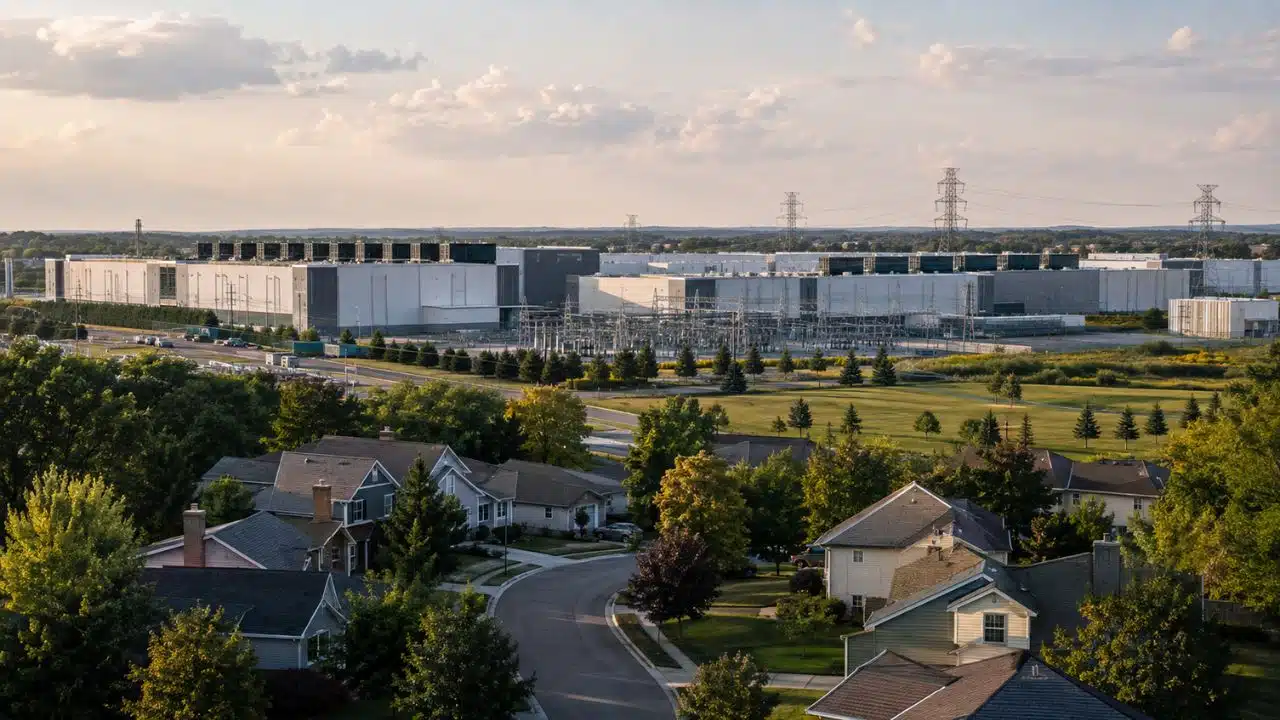
When residents question a proposed data center, they are often described as resistant to progress. Their concerns about electricity, water, public money, or noise get reduced to a simpler accusation: they are afraid of AI. That label avoids the actual argument.
A community can support technological development without accepting every project placed before it. It can welcome investment while refusing to subsidize one of the wealthiest industries in the world. It can also decide that a proposed location would disrupt too many lives, regardless of how impressive the investment figure looks in a press release.
I see nothing anti-AI about asking who pays, who benefits, and what nearby residents will have to live with once the ribbon-cutting is over.
AI Infrastructure Has a Physical Cost
AI may feel like an entirely digital product, but the infrastructure behind it is physical. Data centers need large sites, transmission lines, substations, cooling systems, backup generators, and electricity around the clock.
Berkeley Lab estimates that data centers could account for around 11.8% of US electricity consumption by 2030. The national figure matters, but it can also hide the local pressure. That demand will be concentrated in particular utility territories, sometimes arriving faster than new generation and transmission infrastructure can be built.
A project that appears manageable on a national chart may place serious pressure on one town’s water supply or one region’s power grid. Residents asking whether their community can support that demand are raising ordinary planning questions. AI does not make those questions less legitimate.
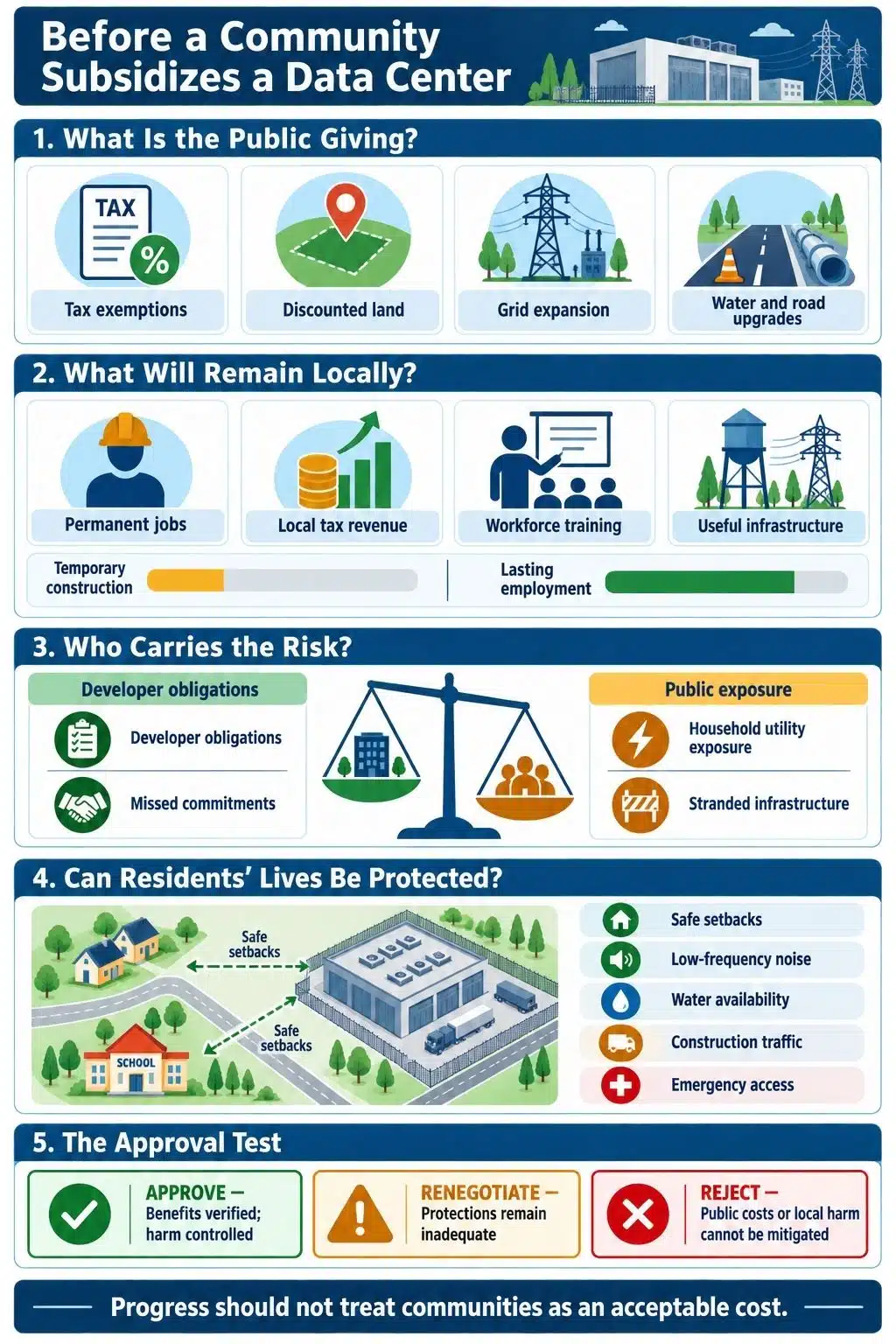
Data Center Subsidies Must Earn a Public Return
At least 38 US states offer dedicated tax incentives to data centers. These commonly cover servers, cooling equipment, construction materials, property, or electricity.
Governments describe these exemptions as tools for attracting investment. That can be true. However, an exemption is still revenue the government has decided not to collect. It should be judged against what the public receives in return.
Virginia provides a useful example. Data centers and their tenants reported receiving $928.6 million in sales-tax savings in fiscal 2023. The state portion was approximately $683 million, making it Virginia’s largest economic-development incentive by a considerable margin.
Virginia’s nonpartisan legislative review found that the program produced moderate economic benefits. It also estimated that the state recovered only 48 cents in revenue for every dollar spent through the exemption.
This does not prove that the incentive was worthless. Data centers have helped Virginia build a major technology market, supported construction businesses, and produced substantial property-tax revenue for some local governments.
It does show why the size of a company’s investment cannot be the only measure of success. Spending billions on servers does not mean the host community receives billions in lasting value.
The Job Numbers Need More Honesty
Construction activity is one of the clearest benefits. A large data-center project can put around 1,500 people to work at its busiest stage. Those jobs matter, particularly to contractors, electricians, engineers, and skilled tradespeople. The long-term employment picture is smaller.
Virginia’s review found that a typical 250,000-square-foot facility may employ approximately 50 full-time workers, about half of whom are contractors. Updated Brookings research estimated that a county receiving its first large data center gained roughly 100 to 200 jobs over its first decade, depending on the type of facility. Average wages did not increase, while home prices rose by an estimated 2% to 5%.
Data centers create employment, but they do not employ people at the scale their buildings and investment announcements might suggest.
Before offering a subsidy, officials should separate temporary construction work from permanent positions. They should also disclose how many jobs will go to contractors, what those positions will pay, and whether local workers are likely to qualify for them.
If public money is justified with promises of employment, the public deserves precise numbers.
Residents Should Not Pay Twice
Tax revenue is only one part of the cost. A large facility may require new power generation, transmission lines, substations, water infrastructure, and road improvements.
Residents should not give up tax revenue through a subsidy and then pay again through their utility bills.
The current evidence requires some care. Virginia’s 2024 review found that existing data centers were paying the costs allocated to them under the electricity rates examined. It would be inaccurate to claim that every facility is automatically being subsidized by residential customers.
The same review warned about future financial risk. Utilities may build infrastructure around projected data-center demand that arrives late, uses less power than expected, or never materializes. If a project is cancelled or closes, the cost of that unused capacity can remain on the system for decades.
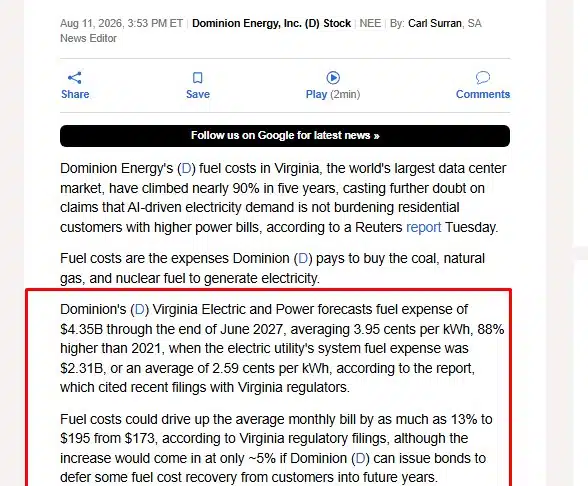
Recent Virginia regulatory filings show how that wider pressure can reach households. Data-center-driven demand has increased the state utility’s reliance on volatile wholesale electricity. Fuel costs could raise an average residential bill by as much as 13%, although the immediate increase may be lower and the industry disputes responsibility for recent household bill increases.
Virginia has since created a separate rate class for its largest electricity users. From 2027, affected customers will have to pay minimum portions of their contracted generation, transmission, and distribution demand even when they use less power.
That approach is more credible than a corporate assurance. Long-term contracts and minimum-payment requirements reduce the chance that households will inherit infrastructure costs if a project changes course.
Quality of Life Is Part of the Calculation
The effect of a data center depends heavily on its location and design. Water use offers a good example.
Virginia data centers used an estimated 2.1 billion gallons of water in 2023. That represented less than 0.5% of statewide withdrawals, and more than one-third came from reclaimed water. Those figures do not support the claim that every facility is draining the state’s water supply.
Conditions differed at the local level. Data centers accounted for as much as 21% of demand within one of the utility systems reviewed. Eleven buildings used more than 50 million gallons each, while one used 243 million gallons.
A statewide average cannot tell residents whether a specific project will compete with future housing, agriculture, or other businesses for limited water. Local officials need facility-level estimates before granting approval, including expected demand during droughts and the cost of expanding the water system.
Noise requires the same site-specific judgment. Most Virginia data centers had not generated recorded complaints. Around 10% of operational sites, however, had created problems for people living nearby.
The issue was often a continuous low-frequency hum. It was generally not loud enough to damage hearing or violate conventional limits, but affected residents reported interrupted sleep, difficulty concentrating, and an inability to enjoy their outdoor spaces. Existing ordinances were often poorly designed to measure that kind of sound.
Almost 29% of Virginia’s operational data-center properties were within 200 feet of residentially zoned land. As suitable industrial sites become harder to find, developers may push closer to homes and schools.
A facility cannot be called locally beneficial if nearby families must accept years of construction or permanent industrial noise to make the deal work. If setbacks, sound controls, and better design cannot prevent that disruption, rejecting the location is reasonable.
The Industry Has a Fair Defence
There are strong reasons to build data centers. They support cloud services, communication, cybersecurity, research, and the AI systems that businesses and governments increasingly use.
They can generate substantial property-tax revenue, strengthen fiber networks, create specialist employment, and bring valuable construction work. Countries also have strategic reasons to develop domestic computing capacity instead of depending entirely on infrastructure elsewhere.
These benefits make data centers worth considering. They do not make every subsidy necessary or every proposed site appropriate.
The industry has begun to recognize the need for stronger protections. Under the 2026 Ratepayer Protection Pledge, major technology companies committed to paying for new electricity generation and delivery infrastructure, using separate rate structures, and paying for contracted capacity even when they do not use it.
Those are sensible principles. They should be written into enforceable utility tariffs and public agreements rather than left as voluntary commitments.
What Responsible Approval Should Require
I am not calling for a blanket ban. I want data-center proposals to receive the level of scrutiny their size demands.
Before granting a subsidy or permit, governments should require:
- Public estimates of the facility’s electricity and water requirements
- Separate electricity rates that protect households and small businesses
- Long-term payment obligations for infrastructure built for the project
- Honest distinctions between construction, permanent, and contract jobs
- Tax incentives with expiration dates and clawbacks when commitments are missed
- Appropriate distance from homes, schools, and other sensitive locations
- Sound modelling that measures persistent low-frequency noise
- Binding community protections developed with local residents
- Public reporting after the facility begins operating
Some projects will not meet those conditions. Approval should depend on evidence that a facility can provide meaningful local value without transferring its costs to people who receive little of the financial benefit.
Asking Who Pays Is Not Anti-AI
I do not believe communities should reject data centers simply because the facilities support AI. Fear of technology is not a sound development policy. Blind enthusiasm is not one either.
When officials offer data center subsidies, they are deciding who receives public support, what revenue will be unavailable elsewhere, and which risks residents may have to carry. People deserve more than a large investment figure and a promise that the benefits will eventually reach them.
A commercially valuable project should be able to pay for the infrastructure it requires, provide honest employment figures, disclose its resource needs, and operate without making life worse for the people living nearby.
Communities that insist on those conditions are not standing in the way of progress. They are asking for progress that does not treat them as an acceptable cost.