Here’s the honest answer first: it depends on your product, and the data proves it. I’ve watched teams run this exact debate for years, and most of them pick a model by copying whatever the market leader does. That’s a mistake. Freemium converts around 3 to 5 percent of free users to paid. Free trials convert 10 to 25 percent of trial users. But when you count signups, freemium often wins the overall funnel, because far more people sign up for free tiers than for trials.
The 2026 SaaS Conversion Report from ChartMogul, Growth Unhinged, and ProductLed puts the median free-to-paid conversion at 8 percent across all products, then immediately warns that almost no product actually sits at 8 percent. This guide breaks down the real numbers, shows you when each model wins, and helps you pick the right one for your product. Spoiler: the answer is rarely either-or, and pretending it is will cost you revenue.
The Headline Numbers
Start with the conversion rates you’ll see quoted everywhere. The numbers below come from First Page Sage’s 2026 report on 80-plus SaaS clients:
| Model | Signup rate | Free-to-paid conversion |
| Traditional freemium | 13.7% of visitors | 3.7% of free users |
| Opt-in free trial | 7.8% of visitors | 17.8% of trial users |
| Opt-out free trial, credit card required | 2.4% of visitors | 49.9% of trial users |
Read those rows carefully and you’ll spot the pattern. Freemium isn’t a worse deal. It’s a volume bet. Freemium gets four times the signups of an opt-in trial and nearly six times an opt-out trial. But each individual signup converts at a much lower rate. The model you choose is really a bet on volume versus intent.
The ChartMogul report adds a useful layer: for freemium, 3 to 5 percent is a good conversion rate and 8 to 12 percent is great. For a free trial without a credit card, good is 4 to 6 percent and great is 10 to 15 percent. Require a credit card on the trial and good jumps to 25 to 35 percent, with great at 50 to 60 percent. The numbers change dramatically based on how much friction you put in front of the free experience, and friction is a choice you make, not something the market hands you.
The Trap of Averages
The 8 percent median sounds like a useful target. It isn’t. ChartMogul surveyed 200 B2B products in January 2026 and found a 10x conversion difference between the top 20 percent of self-serve products and the bottom 20 percent. Twenty percent of free trial products convert below 2.5 percent. Another 23 percent convert above 25 percent. Almost nobody sits at the median.
That bimodal spread is the first thing to understand about SaaS conversion benchmarks. Averages hide the shape of the data. Your competitor’s 18 percent trial conversion rate tells you almost nothing about what your product can achieve, because activation quality, time-to-value, and audience intent vary wildly. Benchmarks are useful for sanity checks. As targets, they’re useless. I’ve seen a team celebrate a 12 percent trial conversion while their activation rate collapsed, and the celebration didn’t last long.
What matters more than the headline number is the direction of the trend. If your free trial conversion is climbing quarter over quarter, you’re doing something right. If it’s flat at a number that looks good on paper, that’s the signal to dig into activation. Patting yourself on the back is what the people below 2.5 percent do.
What Each Model Actually Does
Freemium gives users a free tier that works forever, with limits. Paid tiers add more features, higher limits, or team access. Slack is the canonical example: free teams use the product, and when they hit limits or need admin controls, they upgrade. Canva runs the same play at enormous scale, reaching more than 100 million users through its free tier.
Free trials give users full access for a limited window, usually 14 days. The most common trial length in ChartMogul’s report is 14 days, used by 62 percent of products, followed by 7 days and 30 days at 14 percent each. The trial creates urgency: use the product, feel the value, and decide before the clock runs out.
On paper the two models look similar. In practice they pull user behavior in opposite directions. Freemium users convert over months, because they build habits and accumulate data until they hit a limit. Notion reports that 30 to 40 percent of its paid conversions happen more than 90 days after the initial signup, per IdeaPlan’s 2026 comparison. Trial users decide in days. SaaSFactor’s analysis puts trial time-to-paid at 12 to 18 days, versus 90 to 180 days for freemium.
The 1,000 Visitor Math
This is the table that should end the argument, honestly. ChartMogul ran the numbers for 1,000 website visitors:
| Model | Free signups | Paying customers |
| Freemium | 90 | 5.0 |
| Free trial, no card | 45 | 3.6 |
| Ungated freemium, no account needed | 70 | 5.6 |
| Free trial, credit card required | 35 | 10.5 |
Freemium produces 90 signups and 5 paying customers from the same 1,000 visitors. A standard free trial produces 45 signups and only 3.6 paying customers. Per signup, the trial looks better. Per visitor, freemium wins.
The credit-card-required trial flips everything: 35 signups, but 10.5 paying customers. That’s why ChartMogul found trials with a required credit card convert at 30 percent, more than five times the rate of trials without one. The card is a quality filter. It kills casual signups and keeps people who came to buy. It’s annoying to lose signups, but it’s worth it when the ones who stay actually pay.
When Freemium Wins
Freemium shines when your product has network effects, low marginal cost per user, or a huge addressable market.
Slack is the textbook case. Free teams invite paid teams, and the product spreads through organizations without a sales team. OpenView estimates Slack converts 30 to 40 percent of teams with more than ten active users to paid plans, far above the industry average, per the American Impact Review’s 2026 analysis. Spotify hit a reported 46 percent conversion in 2019 through personalized recommendations that made the premium tier feel essential.
Slack
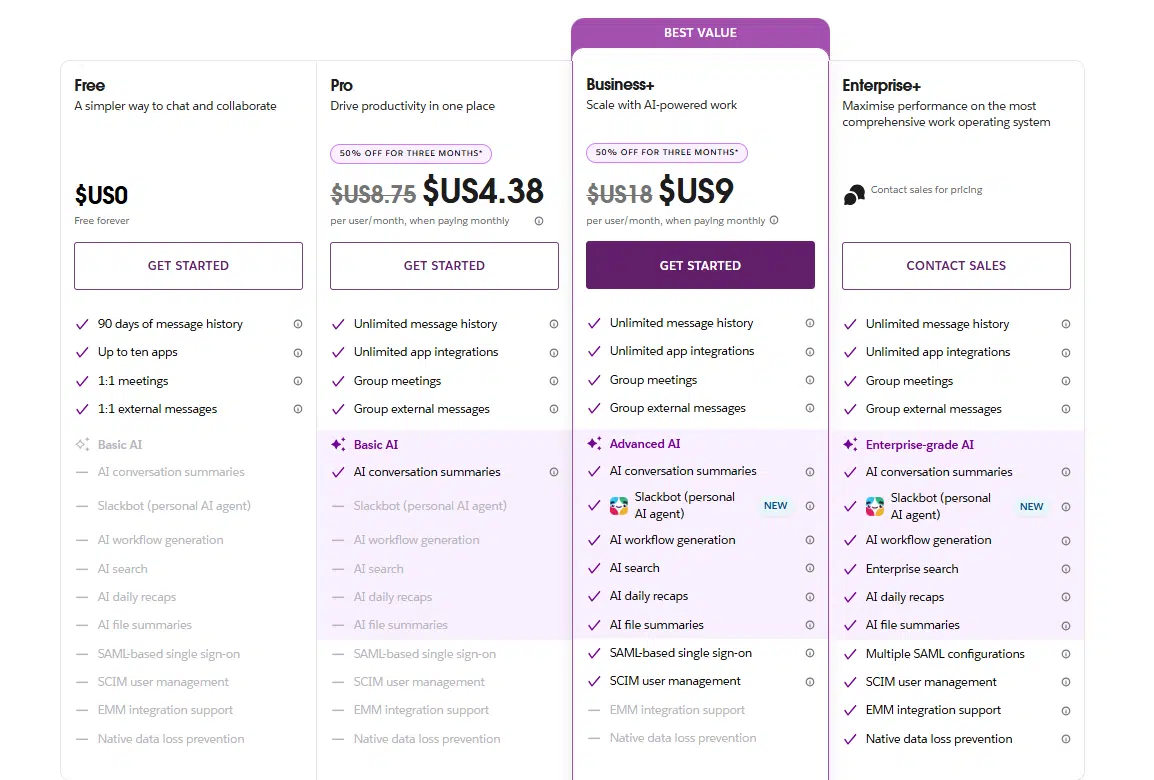
Slack’s pricing page is the classic freemium structure: a free plan that works forever, paid tiers that raise the limits, and a monthly/annual toggle built for upgrade moments. Screenshot: slack.com, captured August 2026.
Zoom
Zoom’s free plan caps group meetings at 40 minutes, which is exactly the kind of limit that turns heavy free users into paid accounts. Screenshot: zoom.us, captured August 2026.
Freemium also wins when your free tier is genuinely useful. First Page Sage data shows freemium signup rates of 12 to 15 percent across industries, because zero-friction entry captures everyone from students to freelancers. The catch is you need volume. Lots of it. If your total addressable market wouldn’t fill a stadium, the 3 percent math won’t feed you. Freemium products need 20 to 50 times the user volume of trial products to generate equivalent revenue, per SaaSFactor’s analysis. If your market is small, that math doesn’t work.
When Free Trials Win
Free trials win when each customer is worth a meaningful amount of money, when the product needs real evaluation, or when time-to-value is fast.
Enterprise SaaS with contracts of $10,000 or more per year should usually run a trial, per IdeaPlan. Buyers need to test against their own requirements, and the countdown creates urgency to complete the evaluation. Salesforce, HubSpot, and Figma all lead with trials because their products are bought by teams that need to verify fit.
The urgency effect is real, and it does the selling for you. Users who procrastinate on a freemium product are forced to decide inside a trial window. SaaSFactor’s funnel data shows opt-in trials converting 17 to 18 percent of trialists to paid, with CRM tools averaging 29 percent and enterprise software at 18.6 percent, per Userpilot’s analysis. That’s a much more concentrated revenue path than waiting months for freemium users to hit their limits.
The Credit Card Question
The single biggest lever in trial design is whether you ask for a credit card upfront.
ChartMogul’s numbers are stark. Trials with a required card convert at 25 to 35 percent as a good rate, and 50 to 60 percent as great. Trials without a card convert at 4 to 6 percent good and 10 to 15 percent great. That’s a five-to-tenfold difference, which is about as big as a lever gets in SaaS.
The tradeoff is signup volume. Only 20 percent of trial products in the ChartMogul report require a card, and that friction costs you signups. First Page Sage found opt-out trials get only 2.4 percent of visitors to sign up, versus 7.8 percent for opt-in trials. But the users who do sign up arrive with buying intent, which is why the overall funnel still comes out ahead in the 1,000 visitor math.
Honestly, the right answer depends on your product’s activation curve. If users can feel value in a single session, a card requirement mostly filters, not deters. If value takes days to appear, a card upfront will scare away people who might have converted after experiencing the product.
Reverse Trials: The Middle Path
There’s a third option that fixes the weaknesses of both models: the reverse trial.
A reverse trial gives new users full premium access for 14 to 30 days, then downgrades them to a free tier instead of locking them out. Users experience the full product, build workflows around it, and feel the loss when premium features disappear. That loss aversion drives conversion. Airtable, Loom, Notion, and Miro all use this pattern.
Reverse trials keep the long conversion window of freemium. Users who don’t convert still keep a functional free tier and their data, so they stay in your ecosystem and can upgrade later. Early reports put reverse trial conversion at 15 to 30 percent, above traditional freemium, per IdeaPlan. The tradeoff is complexity: you’re managing two product experiences and making sure the downgrade path doesn’t feel punishing.
A Decision Framework for Your Product
Stop copying your competitor. I get why you do it, it’s comfortable, but it skips the only analysis that matters. Answer these four questions instead:
How big is your market? Below roughly a million potential users, freemium’s 3 to 5 percent conversion rarely generates enough revenue. Above it, the volume play starts to work.
What is your cost to serve a free user? If infrastructure and support costs are meaningful per user, freemium means subsidizing people who may never pay. If marginal cost is near zero, the free tier is cheap marketing.
Does your product have network effects? If value grows with other users on the platform, freemium compounds. Slack, Dropbox, and Zoom all prove this.
How fast is time-to-value? If users feel value in one session, a trial converts fast. If value takes weeks of accumulated data, you need a free tier that keeps them around while they build toward the paid moment.
Here’s the general rule from the data, and it’s simpler than you’d think: consumer-friendly products with big markets and low marginal cost should lean freemium. Enterprise products with high contract values should lead with a trial, ideally with a card requirement. And if you’re genuinely unsure, start with a reverse trial. It preserves both paths and gives you time to learn.
Real-World Case Studies
The theory lands harder with numbers from companies that ran these models at scale.
Dropbox: the referral flywheel. Dropbox grew from 100,000 to 4 million users in 15 months, a 3,900 percent jump, powered by a double-sided referral program that rewarded both sides with free storage. At its peak, 35 percent of daily signups came from referrals, and the program cut customer acquisition costs by about 60 percent versus paid advertising, per Waitlister’s growth analysis. Referred customers also stuck around: they had roughly 18 percent higher retention and spent about 25 percent more. That’s the freemium flywheel at its best, where free users become the acquisition channel.
Slack: the team expansion play. Slack’s free tier lets teams start without friction, and the product spreads because every invite brings more of the team into the workspace. OpenView estimates Slack converts 30 to 40 percent of teams with more than ten active users to paid plans, per the American Impact Review’s analysis. The free tier isn’t a demo. It’s a working product that creates the upgrade moment naturally when teams hit limits.
Zoom: the 40-minute wall. Zoom’s free plan allows meetings up to 40 minutes for groups, per zoom.us and Zoom’s own support documentation. That limit is a deliberate conversion lever. Free users hit the wall exactly when a meeting matters, and the upgrade to a paid plan removes it. Zoom proved a single, well-placed limit can convert millions without a hard paywall.
Calendly: free scheduling as a habit. Calendly’s freemium model lets anyone start booking meetings for free. The free tier builds the scheduling habit, and teams hit the need for automation, team features, and integrations that live in paid plans. It’s the same pattern as Zoom: give the core job away, charge for the parts of the job that scale.
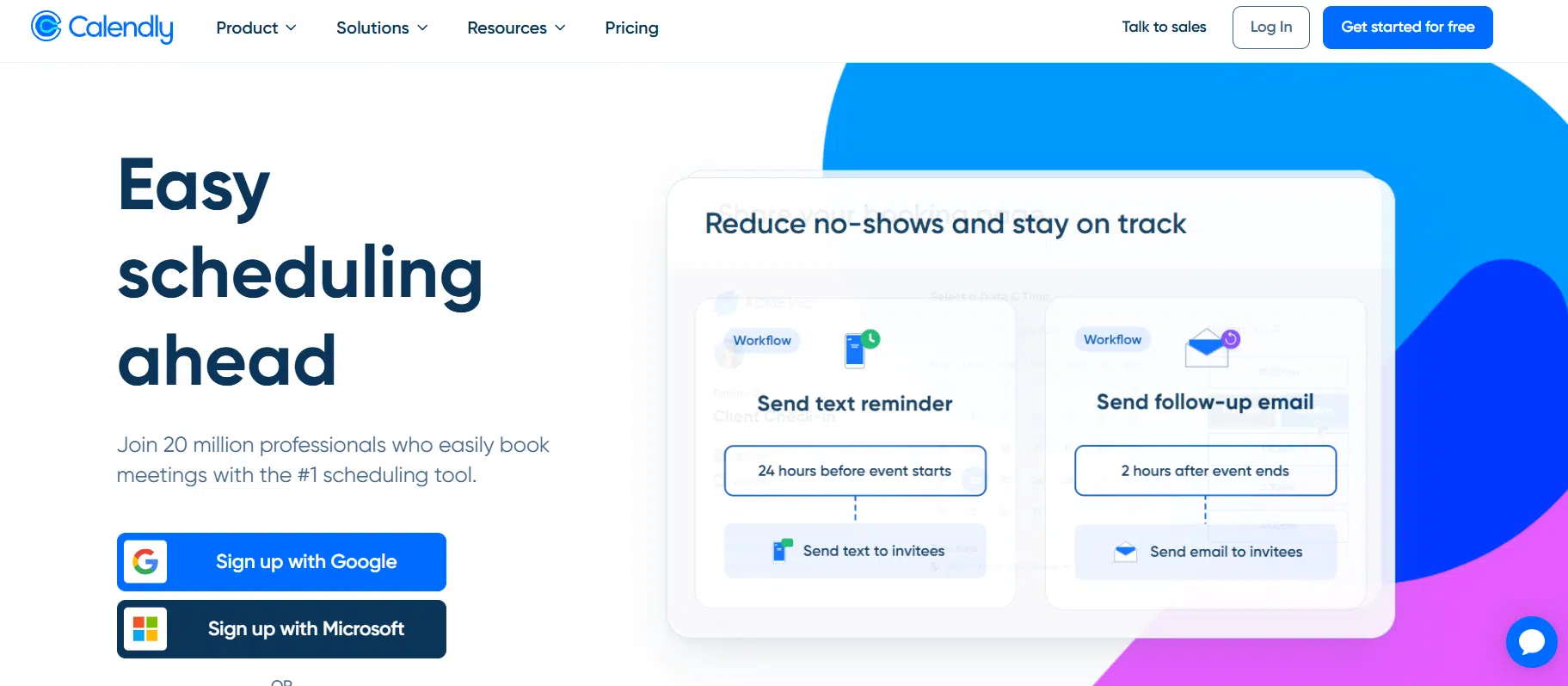
Calendly’s homepage drops you straight into a working scheduling flow with clickable time slots, which is the whole freemium pitch: try the core job before you create an account. Screenshot: calendly.com, captured August 2026.
The Ai-Native Twist
The 2026 data adds a wrinkle worth watching if you’re building anything with AI.
ChartMogul found that AI-native products and SaaS-AI hybrids convert at slightly higher rates than traditional SaaS. A good conversion rate for AI products is 6 to 8 percent, and great is 15 to 20 percent, per the 2026 report. AI-native products are also more likely to be freemium, and the median conversion is higher despite that mix shift.
The reason is the ungated experience. Many AI tools let users try the product before creating an account, like ChatGPT, Perplexity, Lovable, and Replit. ChartMogul reports that freemium products with this ungated, no-account-required experience convert at 7 to 9 percent as a good rate, versus 3 to 5 percent for traditional freemium. Removing the account wall before value is a powerful pattern when time-to-value is measured in seconds.
If your product is AI-native, the freemium math improves. The value demonstration is faster, the marginal cost of serving a free user is often lower, and the habit loop is stronger. That combination pushes the decision framework toward freemium, especially when your free tier lets people feel the product before they hand over an email.
Common Pricing Model Mistakes
- Making the free tier too generous. If free users get 95 percent of what they need, only 1 to 2 percent will upgrade, per IdeaPlan.
- Making the free tier too restrictive. If it feels like a demo, users leave instead of converting.
- Passive upgrade nudges. Freemium conversion needs contextual prompts at the moment a limit blocks the user, not a hidden pricing page.
- Ignoring activation. A 14-day trial with a 10 percent conversion rate and a trial where users never reach the value moment are different products.
- Copying competitors without math. What works for Slack’s network effects won’t work for a niche B2B tool.
- Treating the median as a target. The 8 percent median is a bimodal artifact, not a goal.
Final thoughts
Freemium versus free trial is the wrong question, and the 2026 data says so directly. The real question is how your product delivers value, how big your market is, and whether your unit economics can carry free users. Freemium wins the overall funnel on volume. Trials win on intent per signup. Credit-card-required trials win on revenue per visitor.
Pick the model that matches your product’s value pattern. Then spend your energy on activation and time-to-value. In my experience those two levers move conversion more than the model choice itself ever will. A 1 percentage point improvement in free-to-paid conversion translates to roughly 15 percent more new revenue per trial, per Userpilot. That’s where the compounding gains live, and it’s the part most founders ignore.
Frequently Asked Questions About Freemium vs Free Trial for SAAS
1. Which converts better, freemium or free trial?
Depends what you mean by better. Per signup, free trials win, at 10 to 25 percent versus freemium’s 2 to 5 percent. Per website visitor, freemium often wins overall, because it gets so many more signups. ChartMogul’s 2026 report puts it at 5 paying customers per 1,000 visitors for freemium versus 3.6 for a standard free trial.
2. What is a good free trial conversion rate?
For a trial without a credit card, 4 to 6 percent is good and 10 to 15 percent is great. With a required card, good jumps to 25 to 35 percent and great to 50 to 60 percent, per the 2026 ChartMogul report.
3. Why do credit-card-required trials convert so much higher?
The card acts as a quality filter. It stops casual signups and keeps users who came with buying intent. ChartMogul found card-required trials convert at 30 percent, more than five times the rate of trials without one, though signups drop.
4. How long should a free trial be?
14 days is the industry standard, used by 62 percent of products. Use 7 days for products with single-session value, 14 days for products needing onboarding and team invites, and 30 days for products that require data migration or organizational buy-in.
5. What is a reverse trial?
A reverse trial gives new users full premium access for a limited period, then downgrades them to a free tier instead of locking them out. Airtable, Loom, Notion, and Miro use it. Early data suggests 15 to 30 percent conversion, and it preserves the long freemium conversion window.