I think one of the easiest mistakes in studying is confusing familiarity with knowledge. A page starts to look familiar after two or three readings. The explanation seems obvious while the book is open. Then the notes are closed, and the answer becomes surprisingly difficult to produce.
That gap is exactly what active recall and spaced repetition are designed to expose. Active recall asks you to retrieve information without looking at the source. Spaced repetition brings you back to it after enough time has passed for the next attempt to require genuine effort.
Together, the methods can make study time far more useful. But they are not shortcuts or merely flashcard techniques. A reliable system still needs understanding, feedback, correction, and practice that resembles the final task.
Active Recall and Spaced Repetition Are Different Parts of the Same System
The terms are often grouped together, but they describe different decisions.
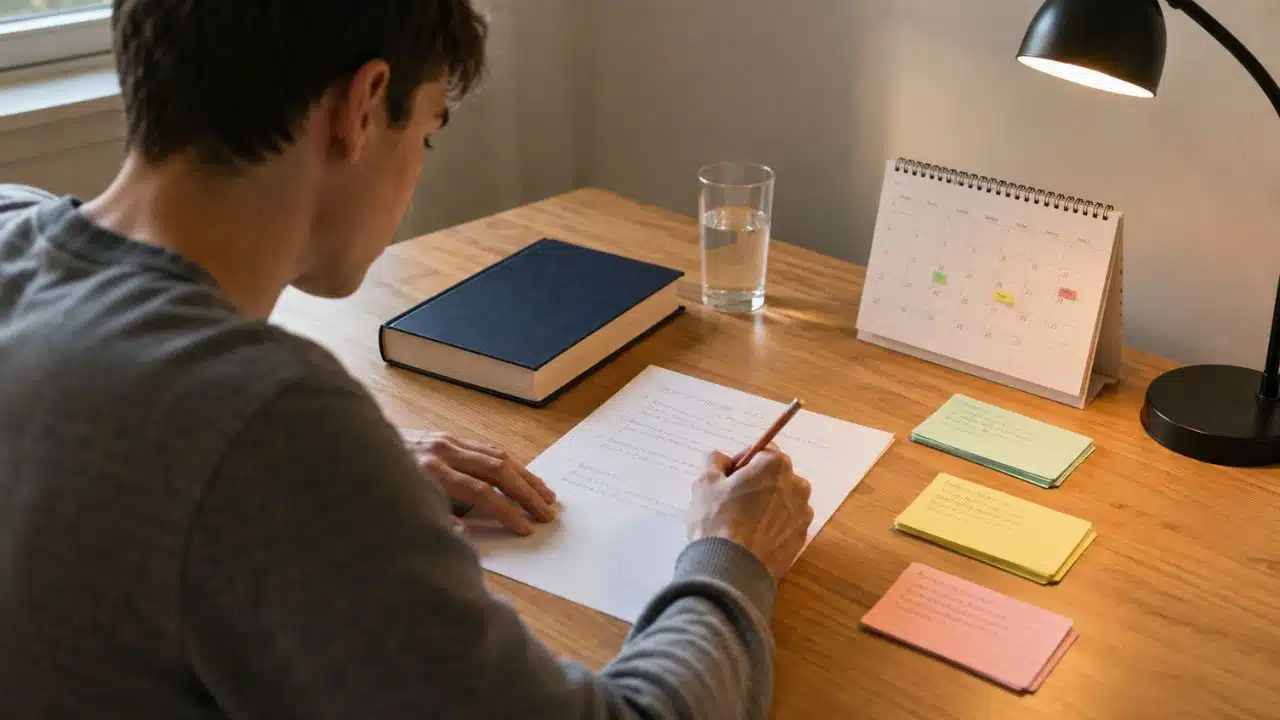
Active recall is the study activity: You close the book, hide the answer, and try to produce what you know. That could mean answering a question, drawing a diagram, solving a problem, reconstructing a timeline, or outlining an argument from memory.
Spaced repetition is the timing: Instead of repeating the same material several times in one sitting, you return to it over separate sessions. The delay tests whether the knowledge is still available after the immediate lesson has faded.
Spacing alone does not guarantee active learning. Reading the same chapter on five different days is spaced, but it is still rereading. Answering with the notes open also says little about what you could produce independently.
In practical terms, active recall determines what you do during a review. Spaced repetition determines when you do it.
Why Active Recall and Spaced Repetition Work Well Together
Rereading is not useless. It helps when you first meet unfamiliar material and need to understand its language, logic, or context. The trouble starts when recognition is treated as proof of learning. Recognizing an answer is much easier than producing it from memory.
Retrieval practice makes the gaps visible. You may remember a definition but not its significance. You may know a formula yet forget when to use it. Once those weaknesses are clear, the next study decision becomes more precise.
Spacing adds a more demanding question: can you still retrieve the knowledge tomorrow, next week, or next month? Recalling an answer three times within ten minutes does not test the same thing as recalling it after a meaningful delay.
Research on retrieval and distributed practice generally supports both approaches, although results vary with the material, feedback, question type, repetition, and final assessment. No schedule works equally well for every learner or subject.
The combined approach is sometimes called successive relearning. You retrieve the material correctly, return later, and work back to accurate recall. The goal is independent access over time, not simply seeing the content often.
Feedback is what keeps this process accurate. Every meaningful attempt should end with a comparison against a reliable source, followed by correction where needed.
How to Study With Active Recall and Spaced Repetition
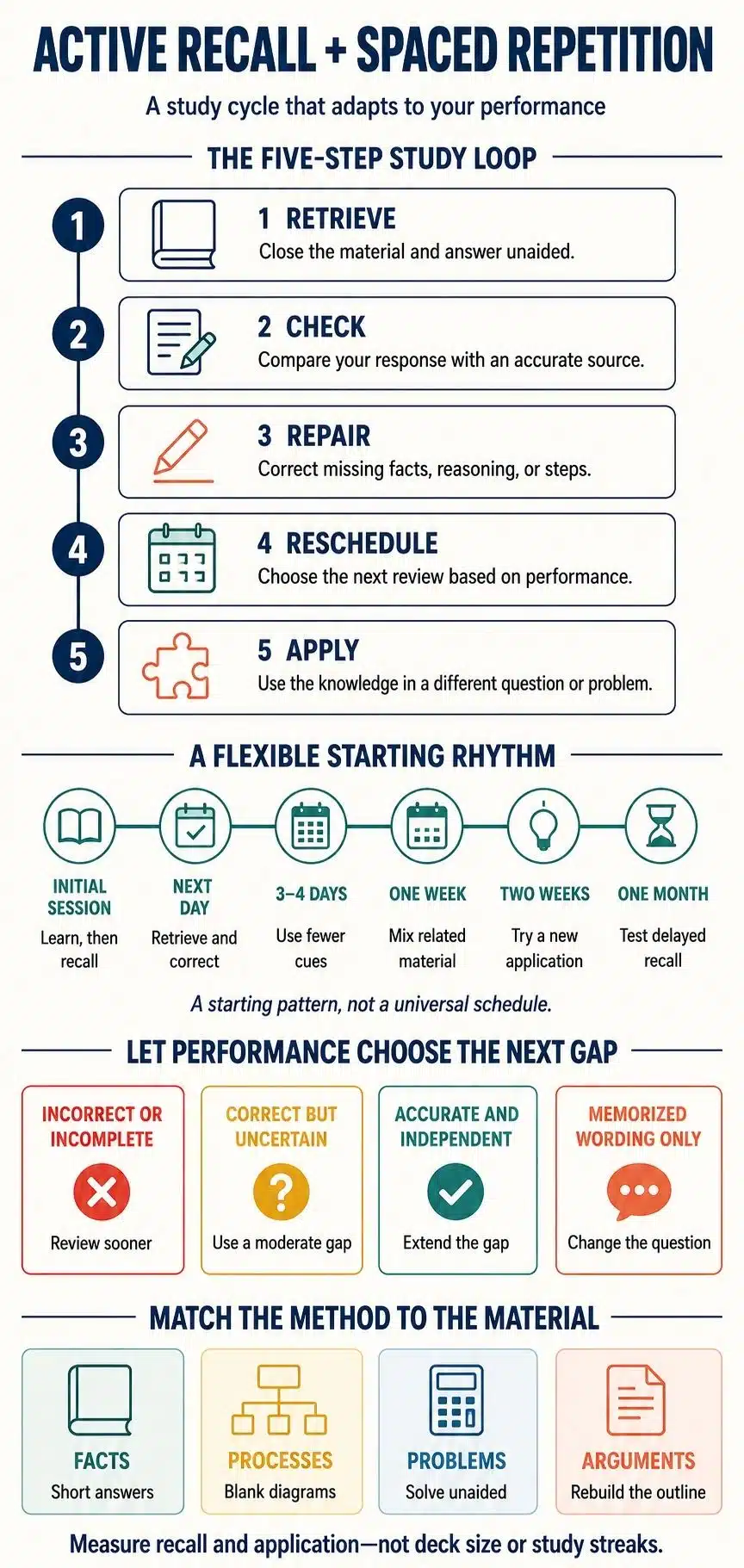
You do not need a complicated app or a large flashcard deck to start. Choose one topic and work through the following cycle.
1. Start with the result you need
Before creating questions, look at what the course or exam expects you to do. Are you required to define, compare, calculate, diagnose, evaluate, or construct an argument?
The answer should shape your practice. A definition card will not prepare you for a multi-step calculation. If the exam asks you to compare two theories, practise building that comparison without notes. If it asks you to solve equations, retrieve the method by solving equations rather than reciting the formula alone.
2. Learn the material before trying to retain it
Active recall does not replace the first stage of learning. Read the explanation, follow the lecture, study the worked example, and clarify unfamiliar terms. Try to explain the central idea in your own words before turning it into a review prompt.
You do not need perfect understanding before your first attempt. In fact, early recall can reveal where your understanding is weak. But memorizing a sentence you cannot explain usually leaves you with fragile knowledge tied to one wording.
3. Write prompts that require a real answer
A useful prompt tells you what to produce without quietly giving the answer away.
- Weak prompt: “Review the causes of inflation.”
- Better prompt: “What causes demand-pull inflation, and how does the process unfold?”
- Weak prompt: “Study photosynthesis.”
- Better prompt: “Draw the process of photosynthesis and explain what enters, what leaves, and where the stages occur.”
Do not turn every sentence into a card. A few strong questions can test a page of notes better than a deck of isolated facts. Include explanation, comparison, and application alongside basic recall.
4. Remove the source and make a genuine attempt
Close the notes or cover the answer. Write, speak, draw, or calculate from a blank starting point. The format is less important than removing the cue.
Allow enough time to search your memory, but do not spend several minutes inventing an answer that is not there. If you cannot retrieve anything useful, return to the source, study the missing part, and try again.
This stage should feel more difficult than rereading. That difficulty is informative, but it only helps when the answer is checked and corrected.
5. Check the answer and repair the gap
Compare your response with the textbook, lecture material, marking guide, or worked solution. A simple right-or-wrong judgment is often too crude. Look at what actually happened:
- Did you omit an important step?
- Was the explanation accurate but vague?
- Did you reach the correct result for the wrong reason?
- Could you explain why the answer is correct?
Correct the missing or inaccurate part, then attempt the answer again. I would not leave a serious misunderstanding untouched until the next scheduled review. Repair it while both the error and the source are clear.
6. Decide when the material should return
Weak material should return sooner. Knowledge that you retrieved accurately and independently can wait longer.
If the answer was wrong or seriously incomplete, correct it and review it again soon. If it was correct but slow or uncertain, use a moderate interval. If you explained it clearly without cues, extend the gap.
A schedule gives you a starting point, but your performance should determine the next review.
7. Change the question before calling the topic secure
Repeating one memorized answer is not the same as understanding the material. Change the example, combine the topic with related ideas, or practise it in the format the exam will use.
A student may recite a formula yet fail to recognize when it applies. Another may remember historical facts but struggle to use them as evidence in an essay. Application reveals whether the knowledge can survive beyond the original prompt.
An Adjustable Spaced Repetition Schedule
Popular schedules such as 1–3–7–14 days can be useful templates, but they are not universal rules. Suitable gaps depend on the difficulty of the material, the quality of the last attempt, the time available, and how long the knowledge must be retained.
The following schedule is a reasonable place to begin:
| Study point | What to do |
| Initial session | Learn the material, then complete one closed-book recall |
| Next day | Retrieve it again and correct the gaps |
| Three or four days later | Repeat the recall with fewer cues |
| One week later | Mix it with related topics or question types |
| Two weeks later | Use a new example, problem, or application |
| One month later | Check whether you can still produce it independently |
Treat every interval as editable. A ten-day exam plan needs shorter gaps. Knowledge needed for professional practice may eventually be reviewed over months.
I find three simple ratings more useful than trying to calculate a perfect interval:
- Incorrect or substantially incomplete: Correct it, retrieve it again, and bring it back soon.
- Correct but hesitant: Keep the next interval moderate.
- Accurate, clear, and independent: Extend the gap.
If you can repeat the wording but cannot answer a rephrased question, the topic is not secure yet. Change the prompt instead of extending the interval.
Using Active Recall for Different Subjects
Active recall is often presented as a flashcard technique, but that is too narrow. The retrieval method should match the kind of knowledge or performance the subject requires.
| Subject or task | Useful retrieval practice |
| Facts and terminology | Short-answer questions or focused flashcards |
| Biology and anatomy | Blank diagrams, labeling, and process reconstruction |
| Mathematics and physics | Solving problems without viewing worked steps |
| Languages | Producing vocabulary in both directions, creating sentences, and speaking from memory |
| History and law | Rebuilding timelines, issue outlines, comparisons, and evidence-based explanations |
| Essay subjects | Reconstructing claims, evidence, counterarguments, and structure from a blank page |
| Practical procedures | Verbal walkthroughs, simulations, and physical performance practice |
The closer the practice is to the final demand, the more useful it becomes. Multiple-choice questions can help, particularly when the assessment uses that format, but the answer options also provide cues. If the exam requires an unaided written answer, some of your practice should do the same.
How to Make Flashcards That Test More Than Recognition
A good flashcard tests one clear idea or a small connected group of ideas. A card with a five-part answer is difficult to judge and easy to postpone.
Prompts should require production. Instead of showing a familiar term and asking whether you recognize it, ask for a definition in your own words, a consequence, a distinction, or an example.
At the same time, cards can become too small. Breaking a subject into hundreds of fragments may separate facts from the process or argument that gives them meaning. If one card asks for the function of a cell structure, another might ask how that function contributes to the wider biological system.
Some tasks should not be reduced to cards at all. Multi-step calculations, essays, diagrams, and practical procedures need room for full practice. A card can prompt the task, but it should not replace it.
Be selective when building a deck. Card creation can feel productive because it produces something neat and countable. Meanwhile, the actual practice is delayed. If reviews are becoming unmanageable, stop adding low-value cards and prioritize important topics and recurring errors.
Do You Need a Spaced Repetition App?
No. Paper cards, a notebook, a calendar, or a simple spreadsheet can support the method. Write the next review date beside each topic and move it according to your performance.
Software becomes useful when the amount of material is too large to schedule manually. It can track due items, record responses, and adjust intervals. It cannot decide whether a card is accurate, whether you genuinely understand it, or whether the question matches the assessment.
Verify AI-generated questions and answers against the course source. A polished but inaccurate card can create confidence in information that was wrong from the beginning.
I would start manually with one chapter before building a larger system. A short trial usually reveals whether the real problem is scheduling, weak questions, poor feedback, or simply inconsistent study time.
Final Thoughts
I would not begin with an elaborate schedule or hundreds of cards. Choose one important topic and use the method for a week: learn it, retrieve it without help, check the answer, repair the gaps, return after a meaningful delay, and apply it in a different form.
The schedule does not need to be perfect. What matters is whether accurate knowledge is available when the notes are closed, and whether you can still use it when the question no longer looks familiar.
Frequently Asked Questions on Active recall and spaced repetition
1. Should I use active recall and spaced repetition together?
Yes. Active recall determines how you review, by retrieving information without looking, while spaced repetition determines when you review it. Together, they create a more effective study cycle than either method alone.
2. What is the best spaced repetition schedule?
There is no perfect schedule for everyone. A practical starting point is to review after one day, three or four days, one week, two weeks, and one month. Bring difficult material back sooner and extend the interval when recall becomes accurate and confident.
3. Can I use active recall without flashcards?
Absolutely. You can answer closed-book questions, reconstruct a diagram, explain a concept aloud, solve a problem from scratch, or write an essay outline from memory. Flashcards are useful for short prompts, but they are only one form of active recall.
4. Is active recall effective if I do not understand the topic yet?
Not usually. Begin by learning and understanding the material, then close your notes and attempt to retrieve it. Testing yourself too early can reveal confusion, but repeated guessing without checking and correcting your answer will not produce reliable learning.
5. Do I need a spaced repetition app?
No. A calendar, spreadsheet, notebook, or set of paper cards can work perfectly well. An app becomes helpful when you have a large amount of material and want the review dates scheduled automatically, but the quality of your questions still matters more than the software.