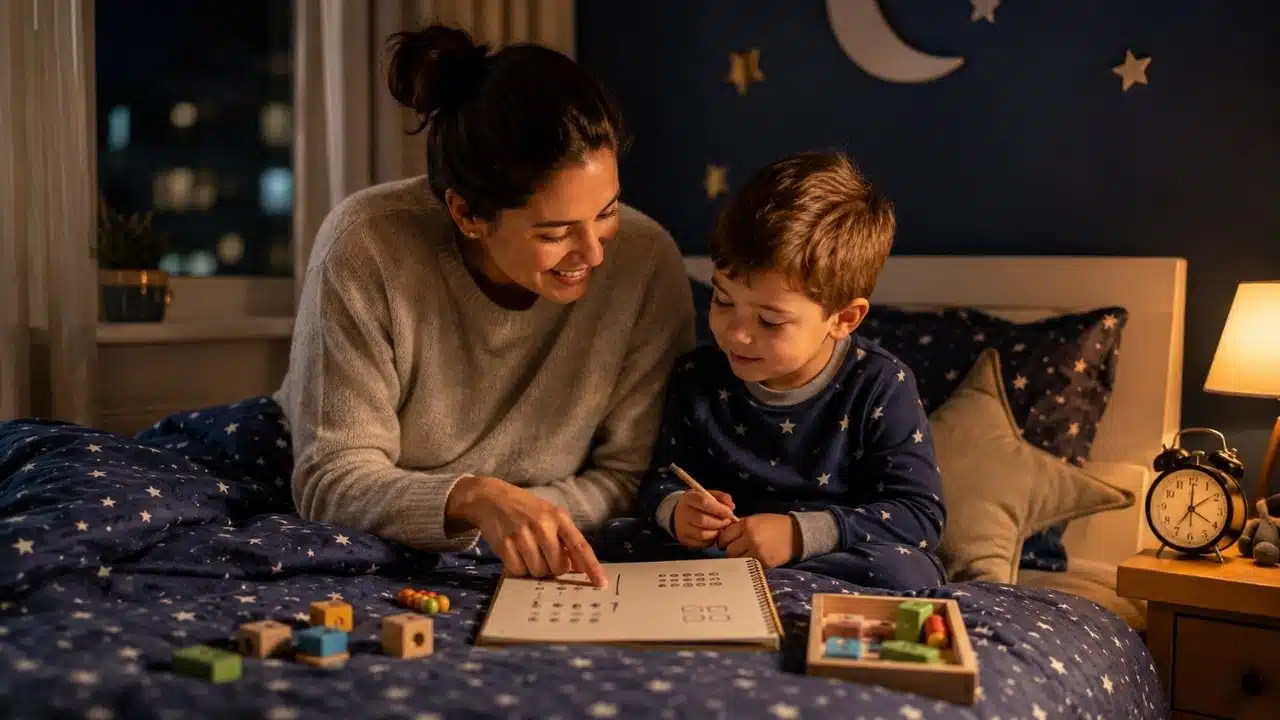
Transitioning children from the high energy of the daytime into a calm, restful sleep environment can sometimes feel like a nightly challenge. However, the wind-down period offers a golden window for cognitive growth. Integrating bedtime math into your child’s evening schedule is one of the most effective ways to build numerical confidence without the pressure of formal schoolwork.
Research shows that low-stress, playful family engagement with numbers significantly boosts a child’s mathematical mindset, reduces math anxiety, and lays the groundwork for lifelong academic achievement.
Practical Bedtime Math Strategies for Parents
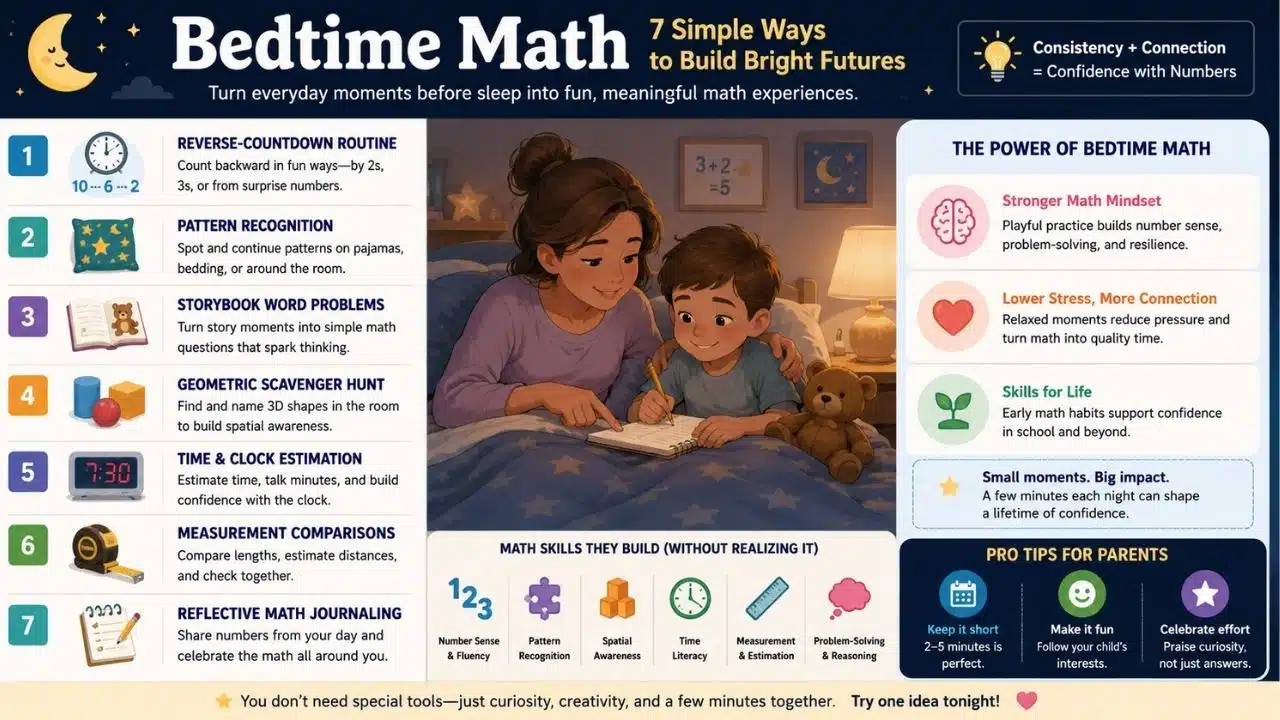
Making bedtime math a seamless, enjoyable part of your evening routine helps children view numbers as an exciting part of life rather than a chore. Here are seven creative ways to incorporate bedtime math into your nightly wind-down:
1. Reverse-Countdown Routine
Turn standard countdowns into a dynamic bedtime math exercise. Instead of just counting down conventionally from 10 to 0 before lights out, try counting backward by twos or threes, or start from non-standard numbers like 17 down to 3. This builds early subtraction skills and strengthens number-sense fluency in a playful context.
2. Pattern Recognition in Pajamas & Bedding
Incorporate bedtime math by using stripes, polka dots, and geometric prints on sleepwear or blankets to explore visual patterns. Ask your child to identify repeating sequences—such as blue star, yellow moon, blue star, yellow moon—and predict what comes next. Recognizing patterns is a foundational pillar for advanced algebraic thinking later in life.
3. Storybook Word Problems
When reading a favorite bedtime story, pause briefly to create simple, relatable math problems based on the plot. This approach makes bedtime math feel like a natural, immersive extension of storytelling.
Key Fact: Children retain narrative concepts faster when connected to everyday quantities and visual storytelling.
Example: “The bear collected 5 honey pots and ate 2. How many are left on the page?”
4. Geometric Bedroom Scavenger Hunt
Before climbing into bed, use bedtime math concepts by challenging your child to spot specific 3D shapes in their room, such as a cylindrical water bottle, a spherical toy, or rectangular books. Connecting abstract geometry to physical bedroom objects anchors spatial reasoning and bridges the gap between theory and the real world.
5. Time and Clock Estimation
Build time literacy as part of your bedtime math routine by looking at the clock together. Ask prompting questions like: “If it is 7:30 PM now and bedtime is at 8:00 PM, how many minutes do we have left?” This turns abstract time into a tangible quantity, helping children grasp elapsed time practically and engagingly.
6. Measurement and Distance Comparisons
Incorporate bedtime math into movement by comparing lengths during routine tasks. Ask if the blanket is longer than the pillow, or estimate how many footsteps it takes to walk from the bedroom door to the bed. Check the estimate by walking it together to reinforce the scientific process of estimation and verification.
7. Reflective Bedtime Math Journaling
Spend two minutes before sleep discussing the quantitative highlights of the day. This final bedtime math reflection reinforces that numbers are embedded everywhere. Ask questions like, “How many books did we read today?” or “How many hours did you spend playing outside?” to develop data-tracking and reflection habits.
The Neuroscience of Pre-Sleep Learning and Memory Consolidation
Understanding why bedtime math works so effectively comes down to how the human brain processes and stores information. During sleep, particularly through the transition into slow-wave and REM sleep cycles, the brain actively consolidates memories, sorting through the day’s experiences and transferring short-term learnings into long-term storage structures.
When you introduce bedtime math into the final moments of the day, you leverage the recency effect. Because this cognitive engagement happens right before rest, the brain prioritizes these logical pathways during overnight neural pruning and memory strengthening. Unlike daytime learning, which often competes with sensory overload from school, peers, and digital distractions, the quiet, low-stress atmosphere of the bedroom allows analytical concepts to anchor deeply and peacefully into a receptive mind.
Why Evening Numeracy Makes a Lasting Impact
The beauty of bedtime math lies in its consistency and low-stakes environment. Unlike daytime homework sessions that may carry academic pressure, the bedroom is a safe, cozy space.
Reduced Math Anxiety: Engaging with numbers in a relaxed state lowers cortisol levels and builds positive neural pathways associated with problem-solving.
Routine Reinforcement: Habit stacking, attaching a new learning habit to an existing routine like bedtime, ensures long-term consistency without adding extra tasks to a busy parent’s day.
Bedtime math transforms an ordinary end-of-day routine into a powerful bonding and learning opportunity. Pick just one technique to try tonight, observe how naturally your child engages, and watch their enthusiasm for numbers flourish!
Adapting Bedtime Math for Different Age Groups
Every child develops at their own unique pace, and tailoring your approach ensures that bedtime math remains a source of positive connection rather than frustration. Here is how to scale these strategies as your child grows:
For Toddlers (Ages 2–3)
Keep the focus sensory and experiential. Count buttons on pajamas, point out big and small pillows, or count toes as you tuck them into bed. At this stage, bedtime math is purely about rhythmic vocalization and associating numbers with physical items.
For Preschoolers (Ages 4–5)
Introduce visual and structural elements. Use the pattern recognition and shape scavenger hunt ideas, or ask simple comparative questions like, “Do we have more stuffed animals or more books on this shelf?” This builds foundational categorization skills.
For Early Elementary Kids (Ages 6–8)
Incorporate abstract thinking, elapsed time, and light word problems. Challenge them with multi-step calculations based on their favorite stories or ask them to calculate how many hours of sleep they will get if they wake up at a specific morning hour.
Handling Resistance and Keeping It Light
If your child is overly tired or resistant, never force the activity. Bedtime math should always feel like a comforting game or a special bonding ritual. If a concept feels too complex on a particular night, scale it back to a simple, comforting count-down or a soft visualization. The ultimate goal is building a positive emotional association with logic and numbers, never academic pressure.
Building a Lifelong Love for Numbers
Integrating bedtime math into your family’s nightly schedule does not require hours of extra preparation, complex worksheets, or academic pressure. By weaving playful counting, pattern recognition, spatial awareness, and storytelling into your existing evening wind-down, you transform a standard bedtime routine into a powerful cognitive habit.
-
Start Small: Choose just one strategy tonight, such as a reverse countdown, a shape scavenger hunt, or clock estimation and see how naturally your child engages.
-
Stay Consistent: Daily consistency matters far more than perfection. These bite-sized interactions compound over time, building lasting numerical fluency.
-
Keep It Fun: Let curiosity and connection drive the experience, ensuring your child associates mathematics with warmth, safety, and joy rather than stress.
Ultimately, bedtime math is about much more than test scores or academic performance. It is about empowering children to see the world through a lens of wonder, logic, and capability—setting them up for a lifetime of confident problem-solving.