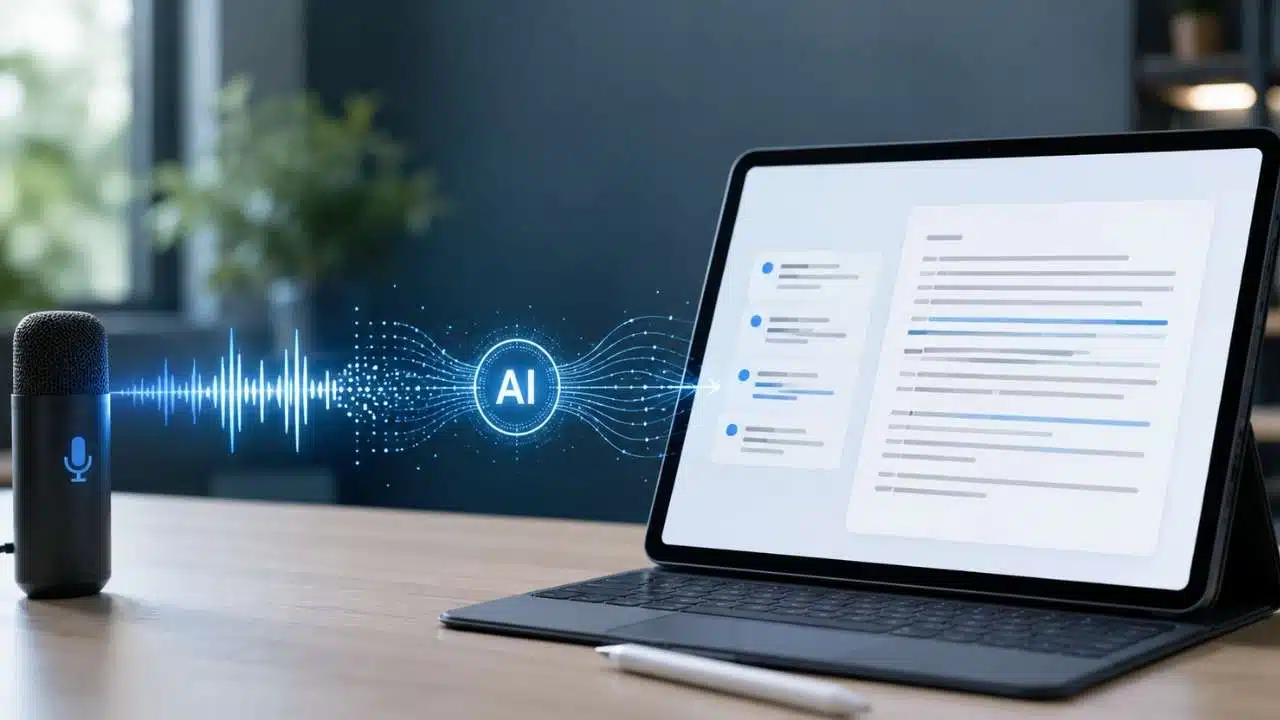
Speech recognition—also known as Automatic Speech Recognition (ASR)—is the artificial intelligence technology that converts spoken human audio into written text in real time.
Instead of relying on manual typing, speech recognition systems process continuous sound waves through digital signal filters and deep neural networks to accurately predict and transcribe the spoken word sequence.
Modern speech recognition engines power virtual assistants, automated transcription services, and voice-controlled applications. While ASR excels at audio-to-text conversion across diverse accents, background noise, and varied speech speeds, it operates alongside Natural Language Processing (NLP) systems to interpret human intent and execute complex voice commands.
Speech Recognition Explained: From Sound to Text
Speech is continuous. Text is a sequence of discrete characters, subwords, or words.
A modern recognizer usually has to:
- Capture and prepare the audio.
- Convert it into useful acoustic features or learned representations.
- Encode the changing speech patterns.
- Align the audio with output tokens.
- Decode the most likely transcript.
- Add punctuation, timestamps, capitalization, or speaker labels.
End-to-end models place more of this work inside one neural architecture. They do not remove the surrounding pipeline. A production service still needs audio ingestion, segmentation, formatting, monitoring, and a plan for uncertain results.
Poor Audio Can Defeat a Good Model
Recognition quality starts with the recording.
A headset microphone near the speaker captures a cleaner signal than a laptop microphone across a meeting room. Phone calls add compression and network loss. Air conditioning can hide quiet consonants, while room echo blurs short transitions between sounds.
Other common problems include keyboard noise, several people speaking at once, inconsistent volume, distant speakers, and automatic gain controls that raise background noise during pauses.
Systems often standardize the sample rate, number of audio channels, and volume before recognition. Voice activity detection may separate speech from silence or divide a long recording into smaller segments.
These steps are easy to underestimate. Weak endpoint detection can cut off the first or last word. Aggressive noise reduction can remove parts of speech along with the noise. Poor segmentation can break one sentence into fragments that lose useful context.
Replacing the recognizer should not be the first response to every accuracy problem. Check the microphone and audio path first.
How Audio Becomes Something a Model Can Read
A raw waveform contains thousands of measurements per second. Many systems transform it into a time-frequency representation that makes speech patterns easier to identify.
A spectrogram shows how energy at different frequencies changes over time. Mel filter-bank features reshape those frequencies using a scale influenced by human hearing. Logarithmic scaling compresses large differences in energy.
Whisper, for example, processes audio as 30-second segments and converts them into log-Mel spectrograms before passing them through an encoder-decoder Transformer. Other systems learn representations closer to the waveform instead of relying on the same fixed front end.
Neither method is automatically best. What matters is whether the representation preserves the information needed for the target language, speaker, microphone, and environment.
The Encoder Builds Context From Sound
The encoder converts the acoustic input into higher-level representations.
Recurrent neural networks were widely used because speech unfolds over time. Convolutional layers are efficient at capturing short local patterns. Transformers use attention to connect information across longer sequences, although unrestricted attention can become expensive for lengthy recordings.
The Conformer architecture combines convolution with Transformer-style attention. Convolution handles local acoustic detail, while attention captures broader context.
That combination fits speech well. A recognizer needs to distinguish short consonant transitions, but it may also need surrounding words to resolve an ambiguous sound.
The encoder does not usually produce the final sentence by itself. The system still has to align many audio frames with a much shorter output sequence.
How ASR Aligns Audio With Words
Training data may contain an eight-second recording and its transcript without showing precisely when each character or word occurs.
ASR architectures solve this alignment problem in different ways.
CTC: Efficient Alignment Without Word-Level Timestamps
Connectionist Temporal Classification, or CTC, trains on audio and transcripts without requiring frame-by-frame labels.
It introduces a blank output and allows repeated token predictions. Multiple frame-level paths can therefore collapse into the same transcript. The training process considers the valid alignments instead of requiring a person to timestamp every token.
CTC is efficient and widely useful. Its output model is less expressive than a fully autoregressive decoder, so systems may add a language model or contextual decoding when stronger word-sequence constraints are needed.
Attention: Generating Text One Token at a Time
Attention-based encoder-decoder models generate the transcript sequentially. At each step, the decoder focuses on the part of the encoded audio that appears most relevant and considers the tokens already produced.
Listen, Attend and Spell helped establish this design for speech recognition.
Classic attention models usually suit offline transcription better because they benefit from seeing the complete utterance. Later systems have also used attention or Transformer decoders as a second pass after a streaming recognizer produces initial candidates.
RNN-T: Designed for Streaming Speech
The Recurrent Neural Network Transducer, or RNN-T, can produce text while audio is still arriving.
Its encoder represents the incoming sound. A prediction network represents earlier output tokens, and a joint network combines them. The model can emit a token or wait for more audio.
This makes RNN-T suitable for live dictation, keyboards, and voice commands. It does not guarantee low latency by itself. Model size, device hardware, beam width, audio look-ahead, endpoint detection, and network dependence still affect responsiveness.
Decoding Chooses Between Plausible Transcripts
Speech often supports more than one interpretation.
Names, addresses, abbreviations, product codes, drug names, and code-switching are especially difficult. A recognizer may replace an unfamiliar surname with a common phrase that sounds similar.
Greedy decoding selects the strongest token at each step. Beam search keeps several promising sequences alive and compares them as the transcript develops. Some systems also use:
- An internal or external language model
- Pronunciation dictionaries
- Contextual phrase lists
- Domain vocabulary
- Rules for valid commands or formats
A wider beam increases computation and preserves more alternatives, but it cannot recover information missing from the recording.
Domain vocabulary is often more valuable than a small improvement in average benchmark accuracy. A warehouse may care about item codes. A clinic may care about medicine and practitioner names. A support centre may care about product models and customer surnames.
Language context can also produce convincing mistakes. A grammatically smooth transcript may still contain the wrong number, name, date, or negation.
Traditional ASR Versus End-to-End Models
Traditional large-vocabulary systems separated recognition into several components.
An acoustic model connected sound with speech units. A pronunciation lexicon mapped words to phonetic sequences. A language model scored likely word combinations. A decoder searched for the best combined path, often within a Hidden Markov Model framework.
Modern end-to-end systems learn more of the audio-to-text mapping inside one trainable architecture. CTC, attention-based models, and transducers reduce the need to engineer each component separately.
“End-to-end” does not mean that the finished product has no supporting systems. Commercial deployments may still require phrase biasing, punctuation restoration, speaker diarization, confidence estimates, audio segmentation, and custom post-processing.
Traditional components also remain useful when explicit pronunciation control or large amounts of text-only data are important.
Pretraining Reduced the Need for Transcribed Audio
Creating accurate speech transcripts is expensive, particularly for low-resource languages, regional dialects, technical fields, and noisy conversational recordings.
Self-supervised learning allows a model to learn from audio without a transcript for every recording. wav2vec 2.0, for example, learns speech representations from unlabeled audio before being fine-tuned with transcribed examples.
Whisper used large-scale weak supervision from web audio paired with text. Its multitask training supports multilingual transcription, language identification, timestamps, and speech translation.
Pretraining has improved transfer across tasks and conditions, but coverage remains uneven. A large multilingual model may still perform poorly on an underrepresented dialect, specialist vocabulary, unusual microphone, or writing system.
More training data is not the same as equally representative training data.
Streaming and Batch Recognition Have Different Priorities
A live voice command needs a fast response. A recorded interview can tolerate delay if it produces a more accurate transcript.
Streaming ASR processes audio incrementally. It prioritizes low latency, stable partial text, efficient inference, and reliable detection of when the speaker has finished.
Batch recognition can examine the full recording. It may use future context, heavier decoding, and a more expensive second pass.
Some systems combine the two. A streaming model produces immediate text, then a second model revises it after more audio becomes available.
That creates a product trade-off. Fast text is useful, but visible words that repeatedly change can make the interface feel unreliable. For a voice command, quick intent capture may matter more than perfect punctuation. For legal, medical, or broadcast transcription, delay may be acceptable, but human review remains necessary.
Word Error Rate Is Not Enough
Word Error Rate, or WER, is the standard ASR accuracy metric.
It adds substitutions, deletions, and insertions, then divides the total by the number of words in the human reference. Lower is better.
WER is useful for comparison, but it treats every error equally. Replacing “Tuesday” with “Thursday” counts as one substitution. Missing “not” also counts as one. Their real-world consequences may be far more serious than several errors involving filler words.
A production evaluation should also measure what matters to the application:
- Names, numbers, and specialist terms
- Command completion
- Speaker-label accuracy
- Timestamp quality
- Latency
- Partial-transcript stability
- Human correction time
- Performance across languages, accents, devices, and environments
An overall WER can hide poor performance for one group of speakers or one high-value vocabulary.
Recognition Is Not Understanding
A transcript is only an intermediate result.
After ASR produces text, another system may identify intent, extract names or dates, retrieve information, or trigger an action.
This distinction becomes critical when errors carry risk. A voice interface should not transfer money, delete data, change medication information, unlock a door, or send a sensitive message based only on one uncertain transcript.
Confidence scores help, but they are not guarantees. High-risk actions need confirmation, restricted command choices, human review, or another input method.
What Product Teams Should Check First
A quiet-room demo says little about production performance.
Before choosing or adapting an ASR system, define:
- Audio conditions: microphones, distance, rooms, codecs, and network quality.
- Language coverage: languages, dialects, accents, and code-switching.
- Vocabulary: names, addresses, abbreviations, and specialist terms.
- Latency: live output or slower batch processing.
- Privacy: where audio is processed, stored, and retained.
- Failure handling: what happens when the transcript is uncertain.
- Evaluation: whether test recordings resemble real use.
For many products, better microphone placement, endpoint detection, contextual vocabulary, and confirmation design will improve reliability more than replacing one strong model with another.
Final Thoughts
With speech recognition explained from waveform to transcript, the main lesson is practical: ASR performance depends on the full system, not only the neural model.
CTC, attention, RNN-T, Transformers, Conformers, and large-scale pretraining have improved transcription significantly. None of them removes poor audio, limited language coverage, unfamiliar terms, overlapping speakers, or unsafe automation.
Start by defining the recording environment, languages, vocabulary, latency, privacy requirements, and cost of a mistake. Test on audio that resembles the product’s real users rather than relying only on a public leaderboard.
A transcript can look fluent and still be wrong. It can be accurate and still be misunderstood. Reliable speech products treat recognition as one component of a larger decision system.