Why AI startups will fail by 2028? It’s not a fact but the reality. That sounds harsh, but the market needs a harsher conversation right now. Every week, another startup appears with the same pitch: it is “AI-powered,” it is “agentic,” it is “reimagining workflows,” it has a “proprietary intelligence layer,” and apparently the future of business depends on another chatbot wearing enterprise clothing.
But calling an API and slapping a dashboard on it is not exactly the brave disruption people think it is.
I do not think AI is fake. That would be lazy. AI is real, useful, and probably one of the most important technology shifts of our lifetime. The money is real too. Stanford’s 2026 AI Index reported that U.S. private AI investment reached $285.9 billion in 2025, and the U.S. had 1,953 newly funded AI companies that year. CB Insights also reported that AI companies raised $226 billion in 2025, accounting for 48 percent of total venture funding.
So no, the AI boom is not imaginary.
The problem is that many companies riding it are much weaker than the market wants to admit.
That is why I believe AI startups will fail in huge numbers by 2028. Not because AI will fail, but because the current wave has too many weak businesses pretending that model access is a moat, hype is strategy, and “we use generative AI” is a business model, rather than just a feature.
The AI Boom is Real But Most AI Startups are Not
Just because AI itself is a massive paradigm shift does not mean every startup utilizing it has a viable business model.
Every major technological shift, from the internet to smartphones to cloud computing, has spawned waves of terrible companies that eventually collapsed when investors started asking basic business questions.
When you start asking basic questions, like what their actual moat is, or what happens when Microsoft inevitably ships their feature for free, the whole pitch usually falls apart.
Most AI startups do not have satisfying answers. They have a landing page, a waitlist, a demo video, and three founders saying “workflow automation” like they discovered fire.
That might raise money in a hype cycle. It does not build a durable company.
The Wrapper Problem is Bigger Than Founders Admit
The word “wrapper” gets thrown around so often that people now treat it like an insult instead of a diagnosis. But the diagnosis is fair.
If your company is basically a nice interface around someone else’s foundation model, you do not automatically have a business. You have a dependency. Building entirely on someone else’s foundation model leaves a company highly vulnerable.
A wrapper can become valuable if it owns distribution, workflow, data, trust, compliance, vertical expertise, or a painful customer problem. That is the exception. The lazy version is just taking a generic model, adding prompts, adding a dashboard, naming it something that sounds like a Roman emperor, and calling it a revolution.
This is where many generative AI failures will come from. Not from bad technology, but from shallow packaging. The market simply cannot sustain thousands of niche chatbots that all essentially perform the same basic function.
Some of these tools will be useful. Most will be forgotten the second a platform product adds the same feature.
Big Tech is the Wall Most Startups Will Hit
The AI startup fantasy often ignores one small detail: the giants are not asleep. The major incumbents like Google, Microsoft, and Meta are not sitting idle. They already own the operating systems, the cloud platforms, and the distribution channels, and they are aggressively building out their own AI ecosystems to match.
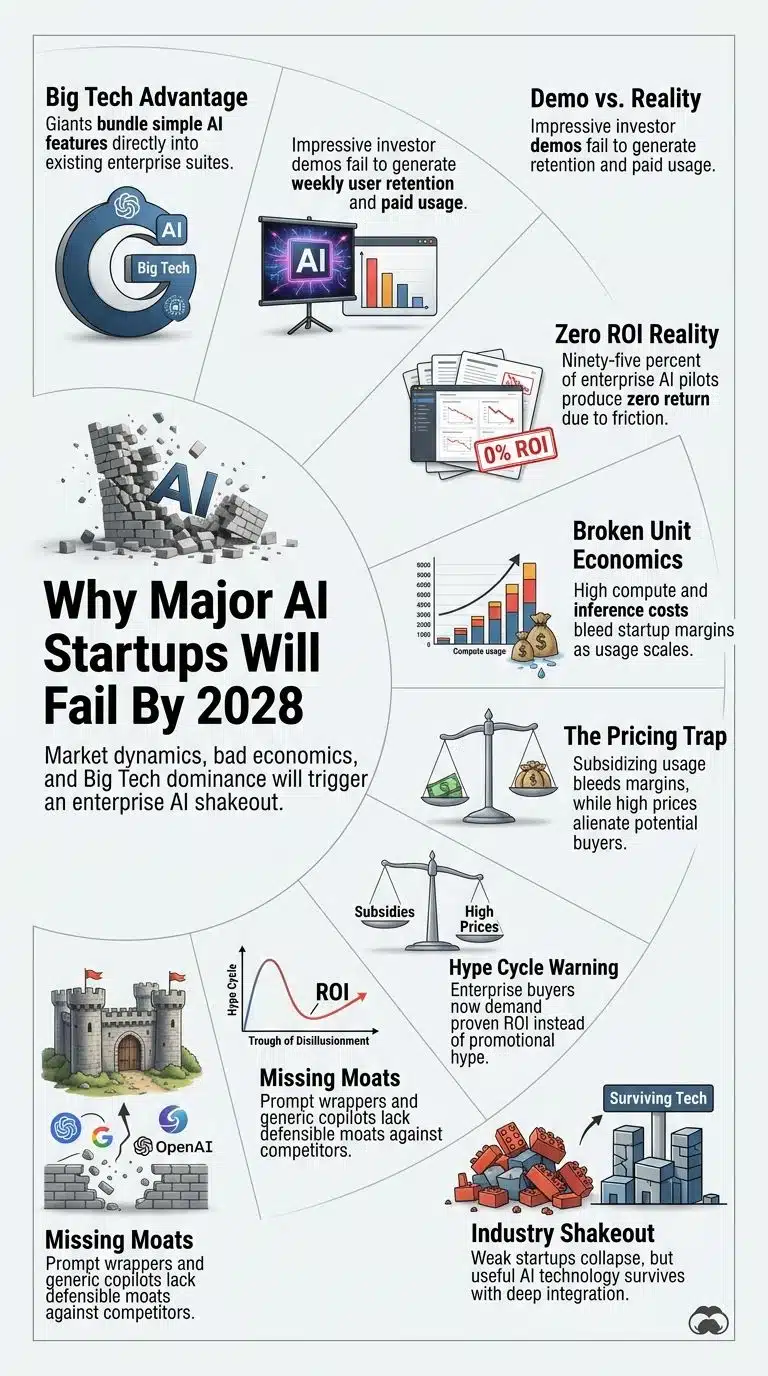
Their built-in distribution advantage matters immensely. Startups are busy building clever standalone features like summarizers or meeting assistants, but they are playing on a field where giants like Microsoft and Google can just bundle those exact tools into the enterprise suites people already use.
This does not mean startups cannot win. They can. But they need to win somewhere the giants cannot move casually.
The weak ones will die in the feature-copy zone. And honestly, many AI startups are standing right in the middle of that road while pretending the traffic is not coming.
The AI Startup Failure Rate Will be Brutal
Startups already fail at painful rates without adding GPU costs, model dependency, regulatory uncertainty, enterprise procurement, and Big Tech platform risk.
Harvard Business Review notes that more than two-thirds of startups never deliver a positive return to investors. That is the normal startup world. Now add an overheated AI market where capital floods in faster than customer trust, and the failure curve gets sharper.
The AI startup failure rate will not be brutal because founders are lazy. Many are smart. Many are technical. Many are moving fast. The failure rate will be brutal because the market is crowded with companies solving thin problems with expensive infrastructure.
A lot of AI startups look impressive during a demo because demos are theater. The real test is not whether the tool works once in front of investors. The real test is whether customers use it every week, trust it with real work, pay for it after the novelty fades, and keep using it when a cheaper or bundled alternative appears.
Over the next few years, the market will likely weed out the startups lacking foundational value.
Enterprise AI is Not as Easy as the Pitch Deck Says
Enterprise AI sounds beautiful in a pitch deck. The standard enterprise pitch promises to magically automate workflows, slash costs, and transform operations overnight.
The pitch promises massive cost savings and flawless automation, but the reality is that integration is a nightmare and enterprise data is usually too messy for a quick fix.
Enterprise data is messy. Workflows are political. Permissions are complicated. Compliance teams are not impressed by vibes. Legacy systems do not politely integrate because a founder said “agentic” Employees do not automatically trust tools that hallucinate, forget context, or fail silently in high-stakes work.
This is not just theory. MIT NANDA’s 2025 State of AI in Business report found that despite $30 to $40 billion in enterprise GenAI investment, 95 percent of organizations were getting zero return, with only 5 percent of integrated AI pilots extracting millions in value. The report said most failures were tied to brittle workflows, lack of contextual learning, and poor fit with day-to-day operations.
McKinsey’s 2025 State of AI survey told a similar story from another angle: only 39 percent of respondents reported EBIT impact at the enterprise level.
This friction with enterprise integration is exactly what will kill off the weaker tools.
Not because enterprises hate AI. They clearly do not. But enterprises hate tools that create more work, more risk, and more meetings about why the pilot did not scale.
Bad Unit Economics Will Expose the Pretenders
Old SaaS had a beautiful dream: build software once, sell it many times, enjoy high margins, and scale like a machine.
AI software is not always that clean. Every generation, every long context window, every image, every video, every agent loop, and every support-heavy workflow can carry real variable cost. Inference has become cheaper over time, and it will keep improving. But “costs will fall later” is not a business model. It is a prayer with a burn rate.
Founders are caught in a pricing trap: if you charge enough to cover compute costs, you lose customers, but if you subsidize the cost to drive growth, your margins bleed out.
This is where the cheerful “AI SaaS” label starts to crack.
Some AI companies will figure it out. They will optimize models, route tasks intelligently, use smaller models where possible, build proprietary workflows, and price around value instead of token usage. Others will discover that selling a dollar of AI for ninety cents is not exactly capitalism’s finest invention.
The Hype Cycle Is Already Warning Us
The market is still excited, but the mood is changing.
Gartner placed AI agents and AI-ready data among the fastest advancing technologies on its 2025 AI Hype Cycle, while also saying these areas were surrounded by ambitious projections and speculative promises at the Peak of Inflated Expectations. Gartner also warned that AI’s business value will not materialize spontaneously and depends on business-aligned pilots, infrastructure benchmarking, and coordination between AI and business teams.
In plain English, the magic trick still requires plumbing.
That is bad news for shallow AI startups. They are selling transformation in a market that increasingly wants proof. Not vibes. Not demos. Proof.
We are entering a phase where the “AI” label will not be enough to sell software. Buyers just want actual ROI. If the answer is just “it summarizes things,” good luck.
AI Company Collapse Will Not Mean AI Failed
When the AI company collapse arrives, people will draw the wrong conclusion. They always do. When the inevitable shakeout happens, observers will likely overreact and write off the whole generative AI movement as a fad.
That will be partly true and mostly lazy.
The better conclusion is that AI will survive while thousands of AI startups do not. The internet survived the dot-com crash. Cloud survived weak SaaS companies. Crypto infrastructure survived the NFT clown show. Useful technology does not die just because bad companies attached themselves to it.
The coming collapse will not prove that AI was fake. It will prove that too many companies were built on weak assumptions.
Companies with real distribution, trusted workflows, proprietary data, vertical expertise, regulatory credibility, embedded enterprise value, strong margins, or deep infrastructure may survive. Some will become huge. Some will get acquired. Some will quietly become boring, profitable businesses, which is honestly more impressive than becoming a loud startup with a podcast strategy.
But the copycats will not make it. Tools without a defensible moat, like generic copilots or simple prompt wrappers, will inevitably be replaced or bundled by larger competitors. And the market will be better for it.
What Surviving AI Startups Will Actually Need
The startups that survive will actually have a moat. That could be proprietary data, deep vertical expertise, or a vice-grip on a specific workflow that is simply too painful for customers to rip out.
Notice what is missing from that list.
“Uses AI.”
That is not enough anymore. It may have been enough to get attention in 2023 or 2024. It may have been enough to raise money in 2025. It will not be enough by 2028.
By then, AI will be expected. It will be infrastructure. It will be part of the product stack. Customers will not pay a premium just because a company says it has AI. They will pay when the product solves a problem better than the old way and better than the bundled alternative.
The actual test is not whether the demo wows investors. It is whether the business model survives contact with reality.
Final Thoughts
AI startups will fail by 2028 because too many of them are confusing a technology wave with a company.
A company needs more than a model. It needs customers who stay, margins that work, differentiation that lasts, distribution that compounds, and a reason to exist after the platform giants catch up. Most AI startups do not have that yet.
Right now, many of these companies are surviving on funding, slick marketing, and industry buzzwords rather than a solid product-market fit.
By 2028, the market’s patience will run out. Investors are already fatigued by endless demos, and enterprises are losing patience with disjointed tools that refuse to integrate. Users will not keep paying for slightly different versions of the exact same assistant.
AI itself will survive this shakeout, but the AI startup costume party will not. And honestly, that is healthy. The market does not need more companies selling the same thin AI layer with a different interface. It needs fewer companies solving harder problems with real products, real workflows, real economics, and real reasons to exist.
Without a real business model, the hype will not keep these companies afloat once the market tightens.