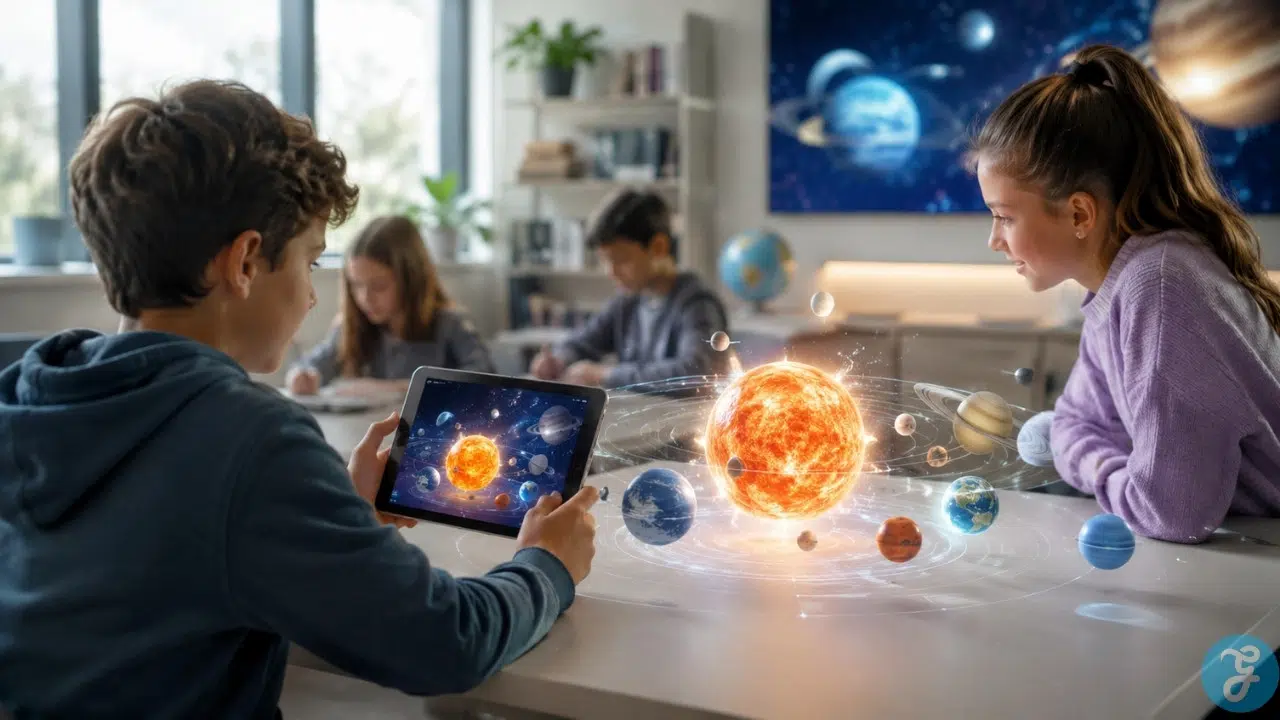
A textbook can explain a dinosaur. An AR lesson can put one on the classroom floor and make a student walk around it. That difference matters. The best AR Education Apps are not just “cool tech” sprayed over lessons; they turn learning into something students can inspect, move through, touch, play with, and remember.
Our Selection Criteria
For this list, the country decision came first. I compared the United States, China, and South Korea because they are among the strongest markets for AR gaming, immersive content, and technology-backed education. Then I narrowed the selection to companies that could be verified as U.S.-based SMEs, startups, or specialist studios with real AR, XR, immersive education, gaming-style learning, or interactive educational app experience.
The companies were selected using these filters:
- Headquartered, incorporated, or operationally rooted in the United States.
- SME, startup, private company, or specialist studio profile.
- Clear relevance to AR education, immersive learning, AR/VR/XR apps, serious games, educational games, interactive 3D learning, or classroom-ready augmented content.
- Publicly visible website, app listing, company profile, contact path, or credible third-party coverage.
- Useful for schools, museums, STEM programs, cultural learning, home learning, workforce training, or educational publishers.
- Excluded generic app developers with no education proof, pure VR-only companies with no AR/XR relevance, large Big Tech platforms, and education companies where AR was only a passing blog topic.
Why the United States and not China or South Korea?
China and South Korea are both strong immersive technology markets, but the United States had the best fit for this specific SME list. The U.S. has more visible AR education companies, gaming-style learning studios, edutainment startups, school-focused XR platforms, and independent creators with verifiable public product footprints.
Here is how the country comparison shaped the final decision:
| Country Considered | Strength in AR and Gaming-Based Learning | Fit for SME AR Education Apps | Final Assessment |
|---|---|---|---|
| United States | Strong AR game segment, deep EdTech market, active game studios, and school adoption channels | Strongest visible pool of verified SMEs, startups, and specialist studios | Selected |
| China | Large AR and gaming market with strong domestic technology adoption | Strong market, but fewer independently verifiable English-language SME vendors for this exact niche | Not selected |
| South Korea | Strong gaming culture and AR-integrated education activity | Promising market, but smaller visible company base for AR education app SMEs | Not selected |
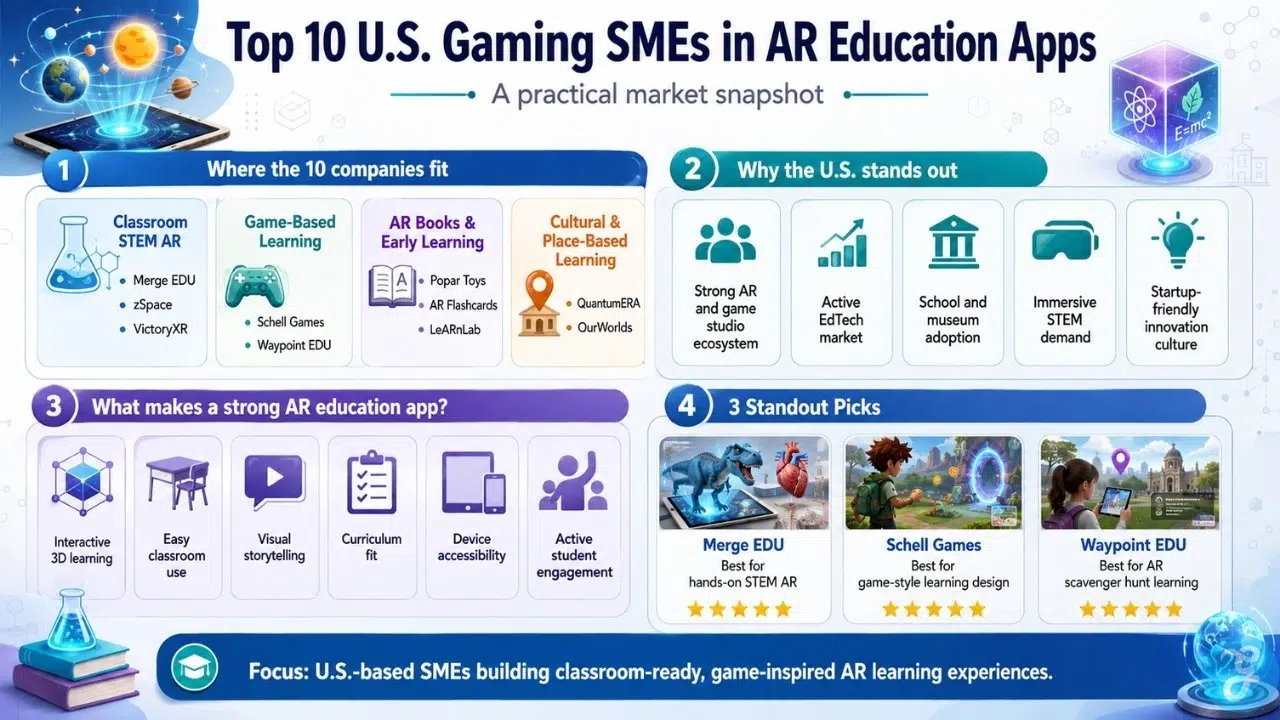
Top 10 U.S. SMEs Building AR Education Apps for Interactive Learning
The companies below do not all look the same. Some build classroom AR tools, some create serious games, some design AR books, and others create immersive cultural or STEM experiences. That variety is useful because AR education does not have one buyer; a middle-school science teacher, a museum, a parent, and a workforce training program all need different things.
1. Merge EDU
Headquarters: San Antonio, Texas, United States
Website: mergeedu.com
Email: support@MergeVR.com
Merge EDU is one of the clearest U.S. examples of hands-on augmented reality learning for schools. Its Merge Cube and platform let students hold, rotate, and inspect digital 3D objects in AR, which works especially well for STEM and science concepts that are hard to understand on a flat page. The company’s learning model feels game-like because students do not just watch content; they manipulate objects and explore them physically. For teachers who want AR without building custom apps from scratch, Merge EDU is a practical starting point.
Best Feature/For:
- Best for hands-on STEM and science AR learning in classrooms.
- Strong for schools that want AR objects students can touch, rotate, and discuss.
Why We Chose It:
- Clear U.S. SME profile with private-company roots.
- Strong focus on augmented reality for STEM and science education.
- Uses tangible interaction through the Merge Cube, which makes learning more active.
- Widely recognizable in classroom AR discussions.
Things to consider:
- Schools need devices and classroom management planning for smooth use.
- Best results come when teachers connect AR exploration to clear lesson goals.
2. Schell Games
Headquarters: Pittsburgh, Pennsylvania, United States
Website: schellgames.com
Email: info@schellgames.com
Schell Games is a U.S. game development studio known for both entertainment and education projects, which makes it a strong fit for this “gaming SME” angle. Its Happy Atoms chemistry system combines physical molecular modeling with a companion augmented reality app, giving students a more playful way to explore chemistry. Schell Games also has a wider background in educational games, VR/AR experiences, and transformational learning projects. The studio stands out because it understands both game design and instructional purpose, which is rare in education technology.
Best Feature/For:
- Best for educational game design and physical-digital AR learning.
- Strong for publishers, institutions, and partners building serious learning games.
Why We Chose It:
- U.S.-based private game studio with education and entertainment expertise.
- Happy Atoms is a strong example of AR-enhanced chemistry learning.
- The studio has real game design depth, not just education software experience.
- Useful for buyers who want learning content to feel genuinely playable.
Things to consider:
- It is more of a development studio and partner than a simple plug-and-play classroom app vendor.
- Custom game or AR development can be more expensive than off-the-shelf tools.
3. VictoryXR
Headquarters: Davenport, Iowa, United States
Website: victoryxr.com
Email: Info@VictoryXR.com
VictoryXR builds immersive education products for schools, colleges, and training programs, with a strong focus on spatial 3D learning. Its platform leans heavily into VR and simulation labs, but its broader XR education work makes it relevant to the AR education apps market, especially where schools are moving toward mixed immersive classrooms. VictoryXR’s strength is in packaged immersive learning environments rather than one-off novelty apps. It belongs here because many buyers looking for AR education are really looking for a broader spatial learning stack.
Best Feature/For:
- Best for schools and colleges building immersive science or simulation labs.
- Strong for institutions that want structured XR learning rather than isolated AR activities.
Why We Chose It:
- U.S.-based immersive education company with verified school-facing products.
- Strong focus on spatial 3D learning and classroom implementation.
- Useful for science labs, homeschool programs, and higher education pilots.
- More education-specific than many generic XR studios.
Things to consider:
- It may be too much infrastructure for teachers who only need a lightweight mobile AR app.
- Buyers should compare device requirements, implementation support, and content fit.
4. zSpace
Headquarters: San Jose, California, United States
Website: zspace.com
Email: support@zspace.com
zSpace provides AR/VR learning experiences for STEM, career readiness, and technical education. Its system uses immersive 3D interaction to let students explore objects, simulations, anatomy, engineering concepts, and career-focused lessons in ways that traditional classrooms often cannot support. It is not a small garage startup anymore, but it remains SME-sized by employee count and highly relevant to U.S. AR education. For districts and technical centers, zSpace is one of the more mature immersive learning options.
Best Feature/For:
- Best for STEM, CTE, and career-readiness programs using immersive 3D learning.
- Strong for schools that want structured hardware-plus-content solutions.
Why We Chose It:
- U.S.-based immersive education company with AR/VR learning specialization.
- Strong fit for STEM, CTE, and hands-on technical concepts.
- Used in school and workforce learning contexts.
- Provides a more mature implementation path than many early-stage AR apps.
Things to consider:
- It is less lightweight than simple mobile AR apps.
- Schools should evaluate hardware cost, training needs, and long-term content use.
5. Popar Toys
Headquarters: Phoenix, Arizona, United States
Website: popartoys.com
Email: sjochim@popartoys.com
Popar Toys is an AR education and entertainment company known for bringing books, maps, puzzles, and learning products to life through companion apps. Its products cover subjects such as dinosaurs, planets, world geography, anatomy, and interactive puzzles. The company fits this list because it sits exactly at the intersection of toys, games, learning, and AR. For younger learners, that playful format can make educational content feel less like a lesson and more like discovery.
Best Feature/For:
- Best for AR books, maps, puzzles, and child-friendly educational play.
- Strong for families, libraries, elementary classrooms, and informal learning.
Why We Chose It:
- Verified U.S. developer identity and public app listings.
- Clear AR education and edutainment product line.
- Strong fit for early learners and visual exploration.
- Combines physical learning materials with mobile AR experiences.
Things to consider:
- Some products may feel more like enrichment than full curriculum.
- Schools should check device compatibility and current app support before buying.
6. Waypoint EDU by Magnate Interactive
Headquarters: Toledo, Ohio, United States
Website: magnateinteractive.com/waypointedu
Email: info@magnateinteractive.com
Waypoint EDU is a fun educational augmented reality scavenger hunt app for classrooms and families. Teachers or parents can create AR “hunts” with questions, waypoints, and location-based exploration, which makes it especially useful for active learning. Unlike many AR education apps that stay glued to the desk, Waypoint EDU pushes students to move, search, answer, and collaborate. That simple game loop makes it one of the strongest examples of AR learning through play.
Best Feature/For:
- Best for AR scavenger hunts and movement-based classroom learning.
- Strong for teachers who want students to learn through exploration.
Why We Chose It:
- Directly positioned as an educational AR game.
- U.S.-based developer profile is publicly visible.
- Useful for classroom hunts, family learning, and outdoor activities.
- Turns lessons into active game-like challenges instead of passive screen time.
Things to consider:
- Best suited for teachers willing to design hunts and manage movement-based activities.
- It may work better for certain subjects than others.
7. QuantumERA
Headquarters: San Antonio, Texas, United States
Website: quantumera.com
Email: Sales@QuantumERA.com
QuantumERA creates immersive AR, MR, VR, and mobile experiences, including educational and historical learning applications. Its JourniGO app and historical immersive products show how AR can turn places, stories, and cultural content into interactive experiences. This makes QuantumERA a good fit for museums, tourism education, history programs, and organizations that want learning to happen through exploration rather than static content. It is less of a classroom worksheet tool and more of an immersive content partner.
Best Feature/For:
- Best for AR history, culture, tourism, and place-based education.
- Strong for museums, heritage organizations, and experiential learning projects.
Why We Chose It:
- U.S.-based immersive content company with clear public contact details.
- Strong AR and mobile app development capability.
- Relevant to educational history and place-based storytelling.
- Good example of AR learning outside the standard classroom.
Things to consider:
- Buyers may need custom project planning rather than an instant plug-and-play app.
- Best fit for organizations with strong content, locations, or stories to bring into AR.
8. AR Flashcards by Peak Reality
Headquarters: St. Louis, Missouri, United States
Website: arflashcards.com
Email: contact@mitchlehan.com
AR Flashcards is one of the earlier examples of augmented reality learning apps for young children. The product started with animal alphabet flashcards and later expanded into space, shapes, colors, addition, and Abraham Lincoln content. Its strength is simple: it makes basic learning more visual and interactive without asking a child to understand complicated software. For early childhood and elementary learning, that low-friction design still matters.
Best Feature/For:
- Best for early learning, alphabet practice, space, shapes, and simple AR flashcard activities.
- Strong for parents and teachers introducing young children to AR learning.
Why We Chose It:
- U.S.-created AR education app with a long public history.
- Strong focus on early childhood engagement.
- Combines printable or physical learning materials with AR interaction.
- A practical example of lightweight AR education, not heavy hardware.
Things to consider:
- It is better for early concepts than advanced classroom subjects.
- Buyers should confirm current app support and content availability.
9. LeARnLab
Headquarters: Houston, Texas, United States
Website: learnlabar.com
Email: Shawn.wasim@learnlabar.com
LeARnLab creates augmented reality books, cards, and educational experiences designed to make physical learning materials interactive. Its products include AR books around dinosaurs, planets, and immersive student learning. The company is small, but that is part of the appeal: it represents the newer wave of creator-led AR education startups that use apps to extend books rather than replace them. For families and classrooms that still value print, LeARnLab offers a bridge between reading and 3D discovery.
Best Feature/For:
- Best for AR books and physical learning materials enhanced with a companion app.
- Strong for younger learners, STEM topics, and home-school enrichment.
Why We Chose It:
- Verified Houston-based company profile.
- Clear focus on augmented reality for education.
- Uses AR to make books, cards, and STEM content more interactive.
- Fits the SME/startup profile closely.
Things to consider:
- It is a smaller company, so buyers should check distribution and support expectations.
- Best used as enrichment or thematic learning, not a full curriculum replacement.
10. OurWorlds
Headquarters: San Diego, California, United States
Website: ourworlds.io
Email: accounts@ourworlds.io
OurWorlds builds immersive learning experiences using geolocation, augmented reality, 360-degree media, and cultural storytelling. Its app focuses strongly on Indigenous history, place-based learning, and immersive narratives that connect physical locations with historical and cultural context. It is not a traditional classroom game, but it uses game-like exploration and location-aware interaction to make education more active. For cultural learning, museum-style education, and place-based history, OurWorlds is one of the most meaningful U.S. AR education startups.
Best Feature/For:
- Best for place-based history, Indigenous narratives, and cultural education.
- Strong for museums, schools, cultural institutions, and community learning projects.
Why We Chose It:
- U.S.-based startup with verified San Diego headquarters.
- Uses AR and geolocation to create educational experiences.
- Strong cultural and historical learning mission.
- Shows how AR education can go beyond STEM into identity, place, and memory.
Things to consider:
- It is more specialized than general classroom AR platforms.
- Best fit for history, culture, geography, and place-based learning rather than broad subject coverage.
An Overview Of United States AR Education Apps for Gaming-Style Learning
The U.S. market is strong because it is not limited to one format. Some companies build classroom AR objects. Some create AR books. Some design game-based scavenger hunts. Others create immersive simulations, history apps, or full XR labs. That gives buyers more choice, but it also means they need to know what problem they are solving before choosing a product.
Overview Comparison Table
The comparison below separates the companies by use case so readers can quickly see which type of buyer each company serves best.
| Company | Best Fit | Core Strength | Strongest Buyer Type |
| Merge EDU | STEM classroom AR | Hands-on 3D object interaction with Merge Cube | Schools and STEM teachers |
| Schell Games | Educational game development | Serious games and AR-enhanced learning systems | Publishers, institutions, partners |
| VictoryXR | Immersive labs | Spatial 3D education and simulation labs | Schools, colleges, homeschool groups |
| zSpace | STEM and CTE learning | AR/VR learning hardware, content, and simulations | Districts, technical centers, colleges |
| Popar Toys | AR educational toys | Books, maps, puzzles, and child-friendly AR | Families, libraries, elementary classrooms |
| Waypoint EDU | AR scavenger hunts | Movement-based educational AR games | Teachers, parents, activity leaders |
| QuantumERA | Historical AR experiences | Immersive history and place-based AR content | Museums, tourism, heritage education |
| AR Flashcards | Early learning AR | AR alphabet, shapes, space, and simple concepts | Parents, preschool, early elementary |
| LeARnLab | AR books | Interactive print-to-AR STEM learning | Families, classrooms, enrichment programs |
| OurWorlds | Cultural AR learning | Geolocated history and Indigenous narratives | Schools, museums, cultural institutions |
Our Top 3 Picks and Why?
The best pick depends on whether the reader wants classroom STEM, game-based learning, or cultural AR storytelling. For this list, I prioritized direct relevance to AR education, verified U.S. roots, and usefulness for real learning environments.
| Rank | Pick | Why It Stands Out |
| 1 | Merge EDU | Best overall classroom AR education pick because it combines tactile interaction, STEM relevance, and teacher-friendly use. |
| 2 | Schell Games | Best gaming-style learning studio because it understands both game design and educational outcomes. |
| 3 | Waypoint EDU | Best pure AR education game pick because it turns lessons into scavenger hunts and active learning challenges. |
Why are AR Education Apps Booming in the United States
AR Education Apps are booming in the United States because schools, parents, publishers, and museums are all trying to solve the same problem: attention. Students are surrounded by interactive media, yet too much classroom content still asks them to stare at flat diagrams and pretend to be excited. AR gives educators a way to turn abstract content into visible, movable, inspectable experiences.
What’s special about U.S. AR Education Apps?
The U.S. advantage is the collision of several industries: gaming, EdTech, museums, STEM learning, app development, toy design, and venture-backed immersive media. That creates unusual companies. One builds chemistry games. Another builds AR scavenger hunts. Another turns cultural history into geolocated AR. Another gives students 3D objects they can hold and inspect.
The secret sauce is not the headset, cube, tablet, or app store listing. It is interaction. Good AR education makes students ask, “What happens if I move closer? What happens if I rotate it? What happens if I scan this page? What is hiding in this place?” That question-driven behavior is where learning starts to feel more like discovery.
The Classroom Does Not Need More Gimmicks
My honest view is that AR education has huge potential, but it can easily become expensive decoration. A floating planet is exciting for thirty seconds. A floating planet tied to a strong lesson, a good question, and a useful activity can actually help students understand scale, orbit, rotation, and scientific observation.
The uncomfortable truth is that many schools buy immersive tools before building teaching routines around them. Then the device sits in a cabinet, the app gets opened twice, and everyone quietly agrees not to talk about the invoice. AR will not fix weak curriculum, poor classroom management, or unclear learning goals.
The future of AR Education Apps in the United States will favor companies that make AR easy to use, affordable to repeat, and meaningful beyond the first “wow.” The winners will not be the flashiest apps. They will be the ones that help teachers explain difficult ideas, help students remember what they explored, and help learning feel less like memorization and more like contact with the world.
Frequently Asked Questions (FAQs) About AR Education Apps
What are AR Education Apps?
AR Education Apps use augmented reality to place digital objects, simulations, characters, or information into the real world through a phone, tablet, headset, or specialized device. They help students explore concepts visually and interactively.
Why was the United States selected for this list?
The United States was selected because it has the strongest visible mix of AR education startups, gaming-style learning studios, immersive learning companies, and school-focused XR providers. China and South Korea are strong technology markets, but the U.S. has more verifiable SME entries for this exact niche.
Are AR Education Apps only useful for STEM?
No. STEM is one of the strongest use cases, but AR can also support history, geography, language learning, art, culture, museum education, and career training. The best subject fit depends on whether visual and spatial interaction improves understanding.
Do schools need expensive headsets for AR learning?
Not always. Many AR education tools work on smartphones or tablets. Some more advanced platforms use special hardware, cubes, viewers, or classroom systems, so buyers should check device requirements before purchasing.
What should schools check before buying an AR education app?
Schools should check curriculum alignment, device compatibility, teacher training needs, privacy policies, classroom management fit, support quality, and whether the AR activity improves the lesson rather than distracting from it.