Remember how, back in the 2010s, we only marked a “Mental Health Day” when everything finally collapsed? It felt like a fire drill we insisted we didn’t need until the alarm blared, the lights went off, notifications silenced, and the mind simply shut down. Burnout wasn’t a warning sign; it was the finish line. We treated our brains like aging factory machines, running them nonstop and patching them only when they failed, just enough to keep the assembly line moving.
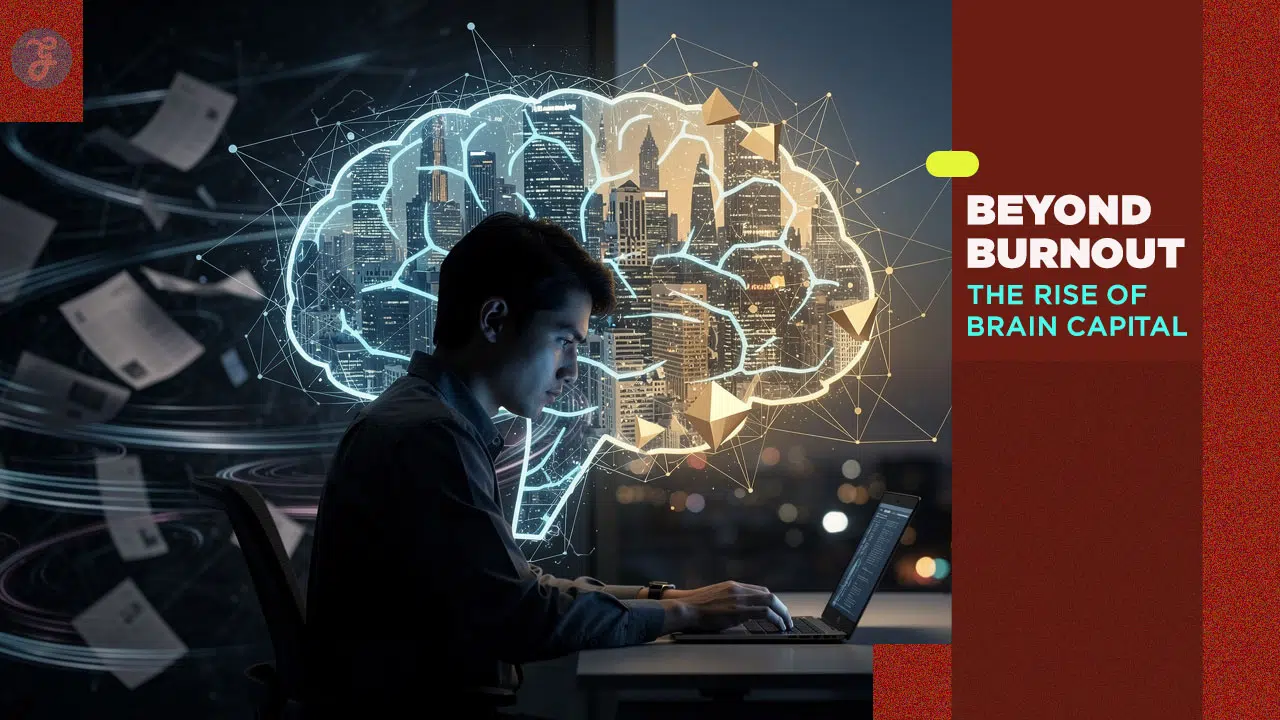
Fast forward to 2026, and the calendar tells a different story. Today’s professionals don’t wait for a crash. They schedule what’s now called a Cognitive Optimisation Audit. This is not about diagnosing illness. It’s about strengthening capacity. A data-driven review of one’s most valuable investment: Brain Capital. We have moved beyond managing breakdowns and into building Brain Wealth, treating mental energy as the defining asset in the age of AI.
The Macro-Economic Pivot: Investing in the Biological Engine
This isn’t self-help rebranded. It’s an economic recalibration.
In January 2026, the World Economic Forum released The Human Advantage: Stronger Brains in the Age of AI, arguing that as machines absorb routine logic, human Brain Capital, the fusion of neural resilience, adaptability, and emotional depth, becomes the only appreciating currency. The brain is no longer framed as a health liability. It is a strategic asset, an engine of national security and a driver of GDP.
The numbers reinforce the shift. The McKinsey Health Institute estimates that scaling brain health interventions could inject $6.2 trillion into the global economy by 2050, reclaiming 267 million disability-adjusted life years in the process. What was once categorized as cost is now reframed as dividend.
The Proactive Brain: Beyond Baseline Wellness
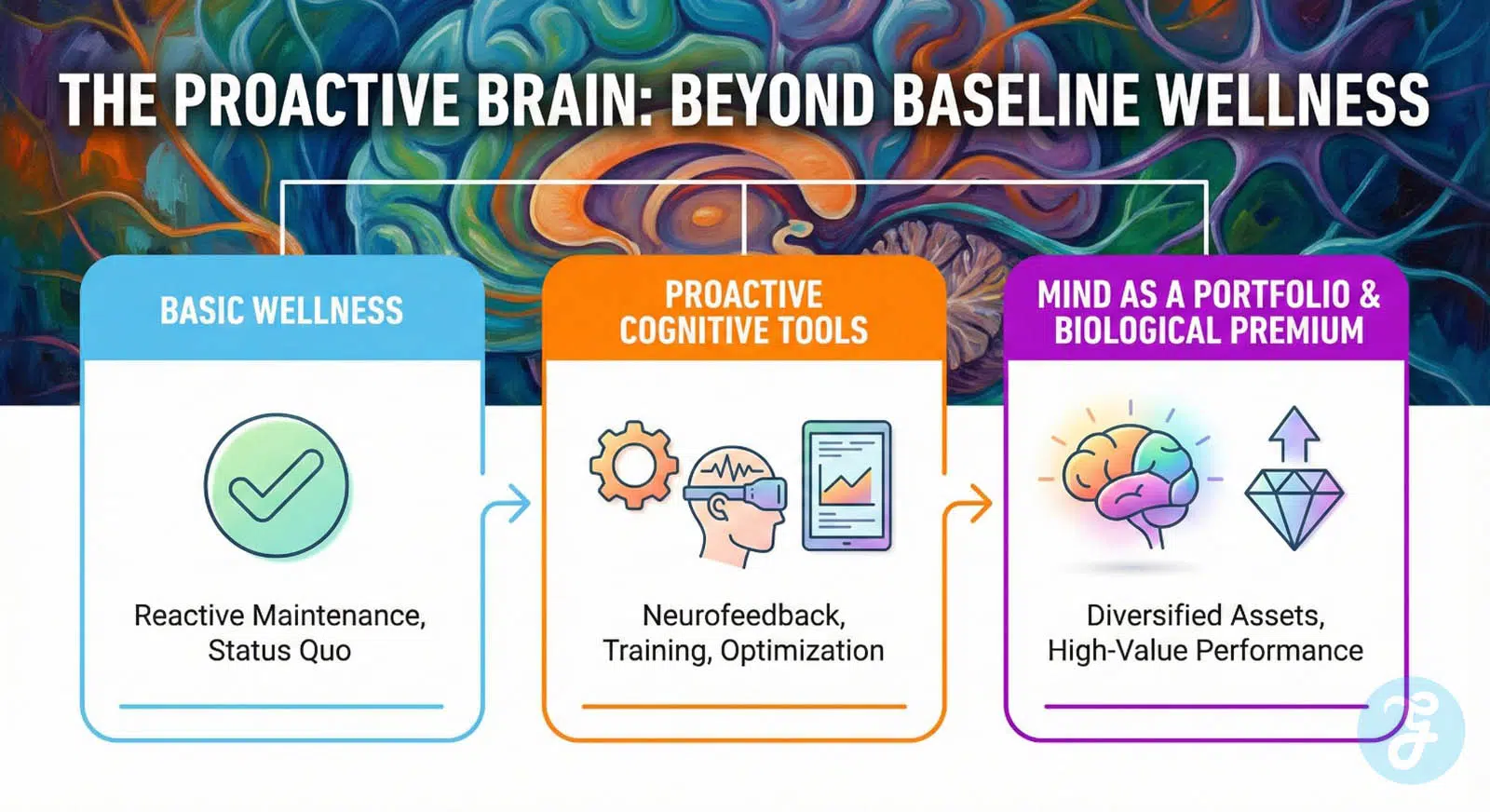
We are witnessing a Great Reclassification. The mind is no longer something to police; it is a portfolio to cultivate.
Being “healthy” is now the baseline. The competitive edge lies in building a brain that can outpace the AI transition. That demands a proactive stance. AI-assisted neurofeedback, biometric tracking, and precision supplementation are no longer fringe experiments. They are entering executive routines.
In a world where silicon is abundant and cheap, biological grey matter becomes premium. Brain Wealth is not a metaphor. It is a hedge against obsolescence.
Brain Capital: A Case for Cognitive Stillness
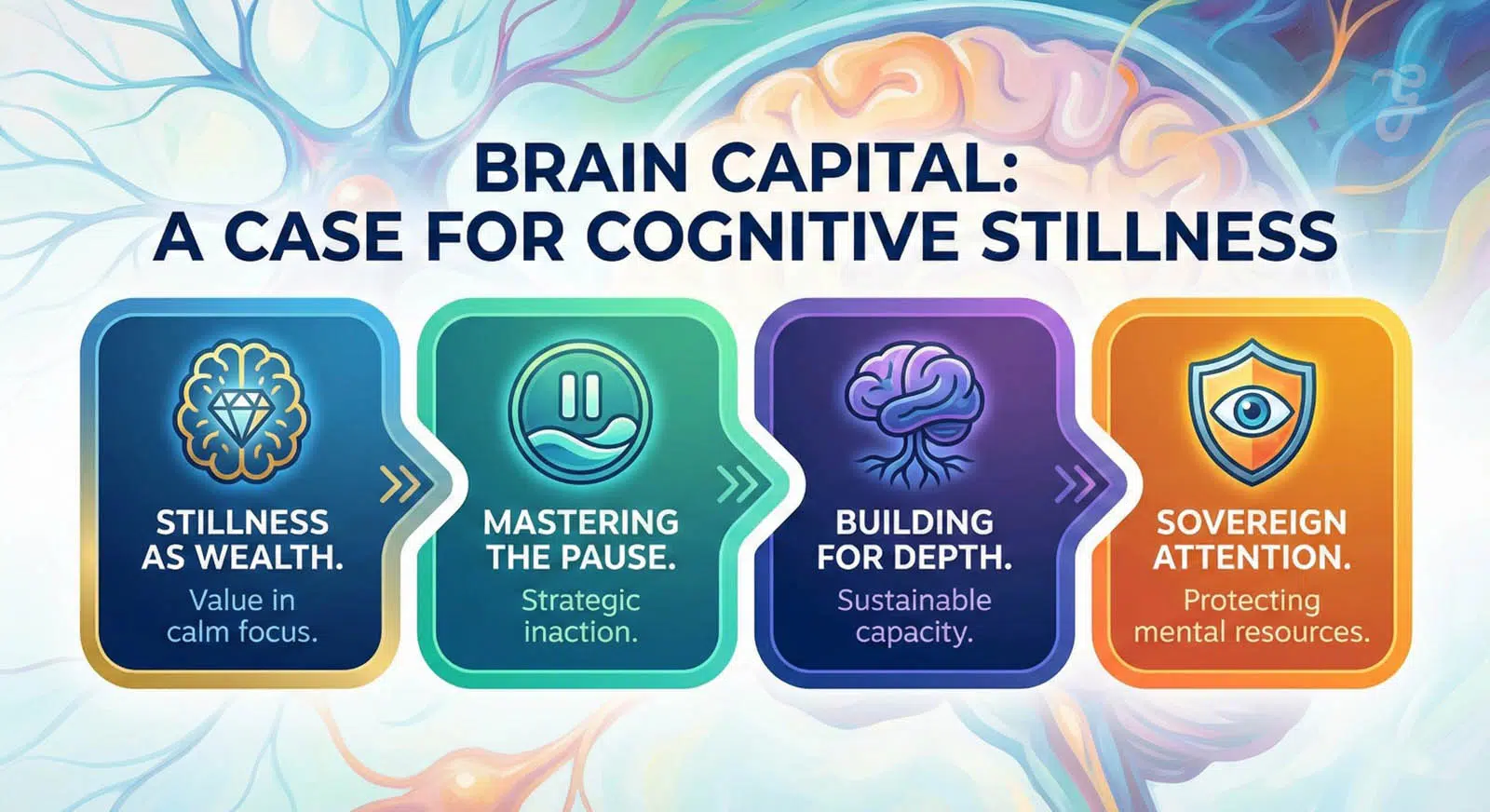
Yet here lies the paradox. At the very moment we elevate the brain to capital status, we operate inside a Dopamine Economy, optimized for speed, reaction, and constant stimulation.
True Brain Wealth demands the opposite.
It requires a Saturnian discipline: building for the century, not the quarter. Like architects designing cathedrals, we must treat our minds as structures that need silence, depth, and restoration to endure.
The AI transition is not a race to process information. Machines won that contest years ago. The real test is who can preserve distinctly human capacities in a world that never pauses.
Enter what many now call System 3 Intelligence. If System 1 is instinct and System 2 is deliberate logic, System 3 is the uniquely human capacity to pause, to synthesize context, ethics, and long-term vision. It is reflective leadership in an automated world.
If we treat our brains like processors, we become replaceable. If we treat them like sanctuaries of judgment and wisdom, we become indispensable.
Sovereign ownership of attention is the highest yield investment of this decade.
The New Portfolio: Diversifying Brain Assets
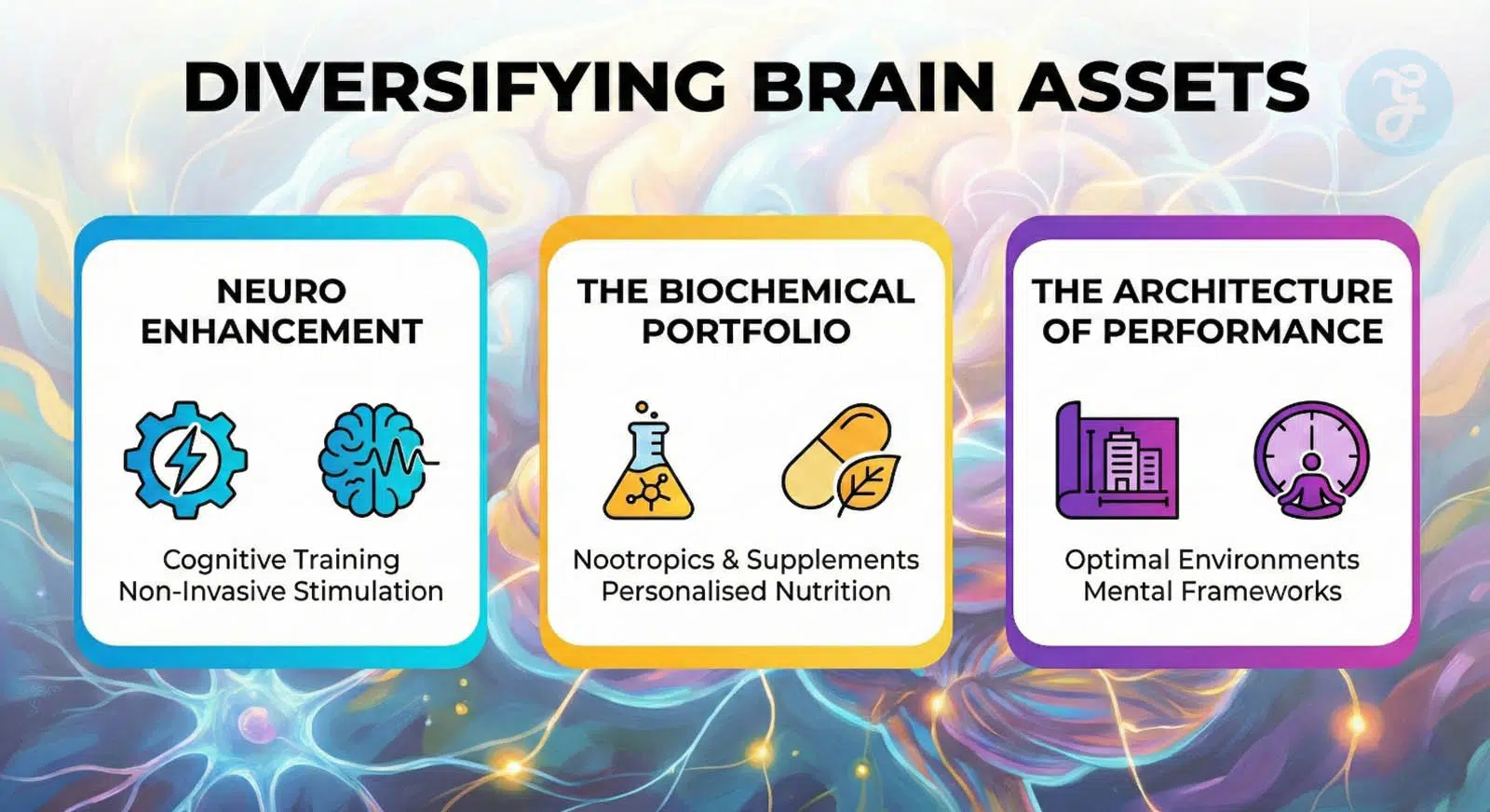
Building Brain Wealth in 2026 is not passive. It requires diversification across three primary levers.
- Neuro Enhancement
Cosmetic Neurology is moving mainstream. High performers no longer rely solely on caffeine; they subscribe to what some call “focus as a service.” Non-invasive tools like Transcranial Magnetic Stimulation (TMS) and Transcranial Direct Current Stimulation (tDCS) use magnetic pulses and microcurrents to tune neural circuits for sustained concentration. Once reserved for clinical depression, these technologies are increasingly used by the healthy to refine cognitive output.
- The Biochemical Portfolio
The generic multivitamin has given way to an $11 billion cognitive supplement industry. The frontier is AI-formulated bio-identical nootropics, precision compounds synchronized with live bloodwork and biometric data. If cortisol spikes or vitamin D dips, formulations adjust in real time. It is personalized chemistry designed to maintain optimal neural terrain.
- The Architecture of Performance
Workspaces themselves are being redesigned as cognitive infrastructure. Firms such as Perkins&Will are advancing frameworks that integrate biophilic design, natural light, restorative environments, and sensory-responsive settings. The goal is not aesthetic. It is neurological. These environments reduce cognitive load and regulate stress. In 2026, the office is not just a workplace. It is a biological support system.
The AI Transition: Why “Healthy” Is No Longer Enough
By 2030, nearly nine out of ten businesses are projected to transform core operations through AI. Routine expertise is evaporating. Stress management alone is insufficient preparation.
The emerging human edge lies in metacognition, the ability to observe and refine one’s own thinking. System 3 Intelligence reframes once dismissed “soft skills” as hard economic assets. Empathy, ethical discernment, complex judgment, these are not sentimental luxuries. They are AI-resistant competencies.
The question is no longer whether we are mentally healthy. It is whether we are cognitively adaptive.
The Neuro-Governance of Nations
As we approach the late 2020s, the concept of a “Brain-Positive” economy is moving from theoretical white papers into national policy. In early 2026, several Nordic countries began integrating the Global Brain Capital Index alongside traditional GDP in their policy frameworks, a metric that weights a nation’s wealth by the collective cognitive resilience and mental health of its citizens. This shift treats neural health as core infrastructure, akin to power grids or transport networks. Nations are now competing to attract “Cognitive Nomads” by offering environments that actively lower cortisol levels and foster deep work. For instance, India’s NIMHANS 2 initiative in the 2026 Union Budget signifies a massive state-level investment in regional neuro-centres, viewing the protection of human grey matter as a pillar of national security. This state-sponsored focus on neural stability serves as a primary hedge against the destabilising effects of rapid AI-driven automation.
The Metacognitive Dividend: System 3 in Practice
The real-world application of System 3 Intelligence is transforming the corporate hierarchy. While AI tools manage the data-heavy tasks of System 1 and System 2, humans are being re-valued for their “Metacognitive Dividend,” the ability to observe, steer, and ethically ground automated outputs. Leading global consultancies now require senior partners to undergo metacognitive training to sharpen their “System 3” traits: long-range ethical discernment and the ability to navigate high-context cultural nuances that silicon cannot grasp. This is not about working harder, but about thinking differently; specifically, the capacity to pause and integrate disparate ethical threads before an automated decision is finalised. By 2030, businesses that fail to integrate this human-centric wisdom into their core operations are projected to face a “Wisdom Gap,” where AI efficiency is high but strategic and ethical direction is absent. Investing in this tier of intelligence is the only way to ensure human leadership remains indispensable in a hyper-automated landscape.
The Ethics of the Divide
But as Brain Wealth ascends, so does inequality. Research published in Nature Mental Health in late 2025 revealed that structural inequality produces measurable neurological differences. Children raised in high-inequality environments show reduced cortical surface area in regions tied to emotional regulation and attention. We are not merely shaping opportunity; we are shaping brains.
This has ignited a global debate over Neurorights. In November 2025, UNESCO Member States adopted a normative framework on neurotechnology ethics aimed at protecting mental privacy. Brain data is emerging as the next frontier of civil liberty.
Critics warn of a cognitive class divide. If elite professionals can purchase upgrades, such as neuro-enhancement, optimised environments, and precision supplements, while others grapple with digital addiction and chronic stress, Brain Wealth risks becoming a gated community. The principle of Cognitive Liberty insists otherwise: every individual must retain sovereign ownership over their neural data. The mind cannot become a mine for corporate extraction or employer surveillance.
The Generational Asset: Investing in the Human Edge
Amid the metrics and markets, the most radical move may be restraint. We remain immersed in the Dopamine Economy, reward loops engineered for speed. Yet enduring Brain Wealth requires deliberate slowness. Just as enduring architecture demands foundation and space, the human mind requires intervals of silence to thrive.
The AI transition is not asking us to compete with machines at speed. It is asking whether we can maintain humanity under pressure. System 3 Intelligence is less about acceleration and more about integration: context, ethics, and long-view judgment.
- Cultivating Interior Depth: Moving beyond being a neural processor to becoming a sanctuary of wisdom.
- Cognitive Sovereignty: Reclaiming attention as the highest-yield investment of the decade.
- Stillness as Resistance: Recognising that in a hyper-automated world, a still mind is the ultimate luxury.
The shift from a “brain-negative” to a “brain-positive” economy reframes mental health from a cost centre to a growth strategy. Nations, firms, and individuals now treat cognitive resilience with the same rigour as financial capital allocation. Whether through neuro-enhancement, biophilic architecture, or metacognitive training, the goal is the augmentation of the human essence.
Those who invest in Brain Capital today are not simply surviving technological acceleration; they are shaping it. In the age of AI, the ultimate luxury is not a faster chip. It is a still mind.