Choosing to study in another country is exciting, but let’s be honest, the price tag can be terrifying. You are likely staring at spreadsheets of high tuition, living costs, and potential loans, wondering if it all adds up. Will your future paycheck actually cover the debt? Is this financial leap truly smart? Here is a fresh statistic to consider: according to the 2024 Open Doors Report, over 1.1 million international students are currently in the United States. That is an all-time high. You are definitely not the only one weighing these heavy options.
In this post, we are going to look at the real numbers behind that degree. We will move past the brochures and talk about the economics of International Education, including actual costs, hidden fees, and the return on investment you can expect. We will break down the data and share practical advice for keeping your debt manageable. Stick with us, and we will help you figure out if the investment makes sense for your future.
The Global Growth of International Education
More students are crossing borders today than at any point in history. It is not just about travel; it is about chasing specific career goals that require global exposure.
Rising Enrollment Numbers
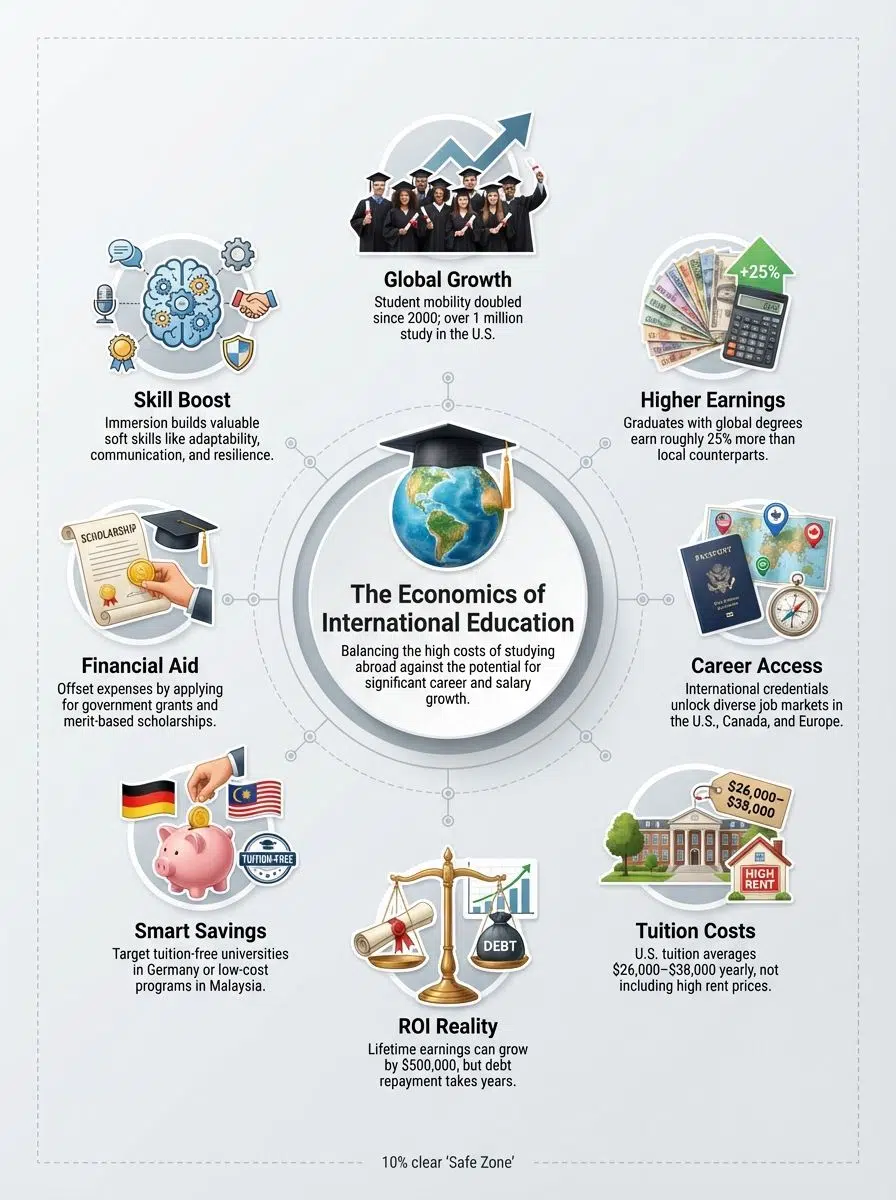
The latest data from the Institute of International Education (IIE) shows a massive surge. In the 2023-2024 academic year, the United States hosted over 1.1 million international students. This represents a 7% jump from the previous year.
A major shift is happening right now. For the first time in over a decade, India has surpassed China as the top sending country, with a 35% increase in student enrollment. Young people from across Asia and Africa are filling seats in classrooms from Boston to Berlin.
This isn’t just good for schools; it is a powerhouse for the economy. In 2023 alone, international students contributed over $50 billion to the U.S. economy. Countries compete for you because you bring talent, diversity, and vital revenue.
Key Destinations and Why They Win
While the U.S. remains the top choice due to its massive research quality and brand recognition, other nations are fighting hard for talent. The United Kingdom, Canada, and Australia are the main competitors.
Here is how they stack up in 2025:
- United States: Offers the famous OPT (Optional Practical Training) program, allowing you to work for 1-3 years after graduation.
- Canada: Popular for its Post-Graduation Work Permit (PGWP), which offers a clearer path to permanent residency than the U.S. system.
- Germany: Historically famous for free tuition, though this is changing. (More on that crucial update later).
Economic Benefits of International Education
The main reason most people take on this debt is the promise of a higher salary. Does the data back that up? Generally, yes.
Increased Earning Potential
A degree from a globally recognized university is a strong signal to employers. According to the National Association of Colleges and Employers (NACE), the average starting salary for Class of 2025 master’s graduates in the U.S. is projected to be nearly $80,000, with engineering and computer science majors often starting above $90,000.
“Education is the most powerful weapon which you can use to change the world.” – Nelson Mandela
Companies are willing to pay a premium for the adaptability that comes with studying abroad. If you can navigate a new culture and a complex visa system, you can likely handle a tough project management challenge. This “soft skill” often translates to faster promotions and higher lifetime earnings.
Access to Global Job Markets
Your degree is your passport to employment in top economies. However, your ability to stay and work depends heavily on the visa policy of the country you choose. This is where the “economics” of your decision really play out.
Visa Policy Comparison:
| Country | Post-Study Work Options | The Financial “So What?” |
|---|---|---|
| United States | 12 months (up to 36 months for STEM) | High earning potential ($70k+), but staying long-term is difficult due to the H-1B lottery. |
| United Kingdom | Graduate Route (2 years) | Good for gaining initial experience, but salaries are generally lower than in the U.S. |
| Canada | PGWP (Up to 3 years) | Slightly lower salaries than in the U.S., but a very stable path to becoming a permanent resident. |
Employers value candidates who understand multiple markets. Having experience in the U.S. or Europe can make you a prime candidate for multinational firms back in your home country, often commanding a salary 20-30% higher than local peers.
Development of Transferable Skills
It sounds like a cliché, but “intercultural communication” is a hard skill in the global economy. Working on a group project with teammates from Brazil, Japan, and Nigeria teaches you how to bridge gaps that kill deals in the business world.
Time management is another forced skill. Many international students juggle on-campus jobs (limited to 20 hours a week in the U.S.) while maintaining a full course load to keep their visa status. This pressure cooker environment builds a level of workforce productivity that recruits notice immediately.
Costs of Pursuing International Education
We need to talk about the price tag. It is not just tuition; it is the cost of existing in a new currency.

Tuition Fees and Living Expenses
According to the College Board’s “Trends in College Pricing 2024” report, the numbers are steep. For the 2024-2025 school year, the average published tuition and fees were:
- Private Non-Profit Four-Year: $43,350
- Public Four-Year (Out-of-State): $30,780
Remember, this is just for classes. Living expenses in major hubs like New York City, Boston, or San Francisco can easily add another $20,000 to $25,000 per year for rent and food. Most universities will require you to prove you have liquid funds, often exceeding $60,000, before they will even issue the I-20 form you need for your visa.
Additional Financial Challenges
There are “hidden” costs that brochures rarely mention. These can eat into your budget if you aren’t prepared.
The Hidden Cost Checklist:
- SEVIS I-901 Fee: A mandatory $350 fee just to activate your U.S. student record.
- Health Insurance: Unlike countries with public healthcare, U.S. schools mandate private insurance plans. These often cost between $1,500 and $3,000 annually.
- Technology Fees: Many STEM programs now add specific “lab fees” or “technology surcharges” that can add $500+ per semester.
- Exchange Rates: A 10% shift in currency value can suddenly make your tuition $4,000 more expensive overnight.
Benefits of International Education
Beyond the spreadsheet, there is a personal ROI. Meeting people from other cultures changes how you see the world and often opens doors that might have seemed locked tight before.
Enhanced Career Opportunities
An international degree helps you stand out in a crowded pile of resumes. Big companies like Google, Deloitte, and Procter & Gamble actively look for people who can work across time zones and cultures.
Data supports this. Reports suggest that graduates with global experience can see faster career progression. You are not just learning a subject; you are building a network. A classmate you meet in a London lecture hall might be your business partner in Dubai five years later.
Cultural and Personal Development
Living away from home forces you to grow up fast. You navigate landlords, tax forms, and grocery shopping in a second language. This builds a type of resilience that is impossible to learn from a textbook.
This confidence spills over into your professional life. When you have successfully navigated the U.S. immigration system, a difficult client meeting feels much easier to handle.
Evaluating the Debt Burden
Student loans can follow you for years. Some graduates wonder if their higher college earnings fully balance the stress of monthly payments.
Long-Term Financial Implications
A common rule of thumb from financial planners is this: Do not borrow more than your expected first-year salary.
If you expect to earn $60,000 after graduation, capping your total loans at $60,000 keeps your monthly payments manageable (roughly $600-$700/month on a standard plan). If you borrow $100,000 for a degree that pays $40,000, you are setting yourself up for a decade of financial stress.
Return on Investment (ROI)
ROI is simple math: Total Gain minus Total Cost. In the U.S., a master’s degree in Computer Science might cost $80,000 but can lead to a starting salary of $100,000+. The ROI is positive within a few years.
However, a master’s in a lower-paying field might cost the same but offer a starting salary of $45,000. In that case, the debt could linger for 15 years or more. You must research the specific employment outcomes for your intended major, not just the university’s general prestige.
Tips for Minimizing Debt While Pursuing International Education
Smart planning can save you thousands. You might find clever ways to stretch your dollar and still get a world-class education.
Researching Affordable Study Destinations
The landscape of “free education” is changing rapidly. You need to be aware of recent policy shifts of affordable study destinations.
The Germany Update (Critical Warning): For years, Germany was the go-to for free tuition. However, the state of Bavaria (home to the top-ranked Technical University of Munich) started charging tuition fees for non-EU students in the winter of 2024. You can now expect to pay €4,000 to €6,000 per semester for master’s degrees there. Other German states may follow, so always check the latest rules.
The “2+2” Model: In the U.S., you can attend a Community College for two years (average tuition ~$3,990/year) and then transfer to a major university for the final two years. Your degree still says “University of California,” but you saved $60,000.
Budgeting and Financial Planning
You cannot wing this. Use a budgeting tool like YNAB (You Need A Budget) or a simple Excel sheet to track every dollar. Set limits on eating out and travel.
Students in the United States often find on-campus jobs to cover daily expenses. While you cannot use this income to prove financial capability for your visa, it is a lifesaver for buying books and groceries once you arrive.
Applying for Grants and Scholarships
Never pay full price if you can avoid it. Many universities offer “merit-based aid” to international students, which is automatic based on your grades/test scores. You do not even have to apply separately.
Look for external giants as well:
- Fulbright Program: Covers full funding for graduate study in the U.S.
- AAUW International Fellowships: specifically for women pursuing full-time graduate or postdoctoral study in the U.S.
- Rotary Peace Fellowships: Fully funded master’s degree programs at partner universities.
The Role of Policy in International Education
Government rules can change how easy it is for you to study and work. Keeping an eye on policy is part of your due diligence
Programs to Support International Students
In the United States, the STEM OPT extension is the most critical policy for many. It allows students in Science, Technology, Engineering, and Math fields to work for a total of 36 months after graduation without needing a new visa.
In Europe, the Erasmus+ program continues to support student mobility, funding short-term exchanges that can lower your overall costs if you are already studying in a partner country.
Economic Policies Encouraging Mobility
Governments know that international students boost workforce productivity. This is why the UK reintroduced the Graduate Route visa, allowing two years of work without a sponsor. They need your skills to grow their economy.
Similarly, Canada’s immigration targets are closely tied to its international student population. They want you to study, work, and stay. Understanding these motivations helps you choose a country that wants you to succeed as much as you do.
Is International Education Worth the Debt?
Is that big student loan truly a ticket to brighter days, or just an expensive gamble? Here is the verdict.
Balancing Economic and Personal Benefits
If you choose a high-demand field (like Tech, Healthcare, or Finance) and a country with friendly work visa policies, the math usually works. The salary jump can clear the debt in 3-5 years.
However, if you choose a high-cost private university for a low-paying field in a country with strict visa rules, the “experience” might be amazing, but the financial hangover could last a decade.
Perspectives from Graduates
Surveys from the Higher Education Policy Institute (HEPI) show that the vast majority of international students believe their degree was good value for money. They cite the “brand value” of their university and the network they built as key drivers for their long-term career success. The consensus? It is worth it if you have a plan.
Wrapping Up
International students pour billions into economies, supporting jobs and boosting research quality. With over 1.1 million students in the U.S. alone, the path is well-trodden, but it is not without potholes.
College earnings vary wildly across countries and subjects. Some see fast returns on investment, while others face a long climb out of student debt. The key is to treat this like a business decision. Compare the tuition, calculate the living costs, and understand the visa rules before you board the plane.
Every dollar spent is an investment toward your future career. If you research carefully and budget wisely, it is an investment that will pay dividends for the rest of your life.