

The SaaS playbook didn’t just change in 2026; it was rewritten by autonomous agents. If you are still optimizing for “seats” or measuring growth solely by headcount, you are fighting a war with weapons from 2022. We have entered the era of Efficient AI, where “Service-as-a-Software” (selling outcomes, not tools) is the new gold standard. The founders winning today aren’t just building software; they are building the infrastructure for a world where software writes itself and sells itself.
But amidst the noise of “AI influencers” generating threads with ChatGPT, who actually knows what they are talking about?
We’ve curated the definitive watchlist for 2026. These 15 SaaS founders to follow on LinkedIn and operators are the signal in the noise. They are the architects of the new usage-based pricing models, the pioneers of sovereign AI, and the defenders of “calm” company building.
The Titans: Scaling to $100M+ ARR in the Agent Era
Focus: Strategic benchmarks, IPO-readiness, and “SaaS 2.0” macro trends.
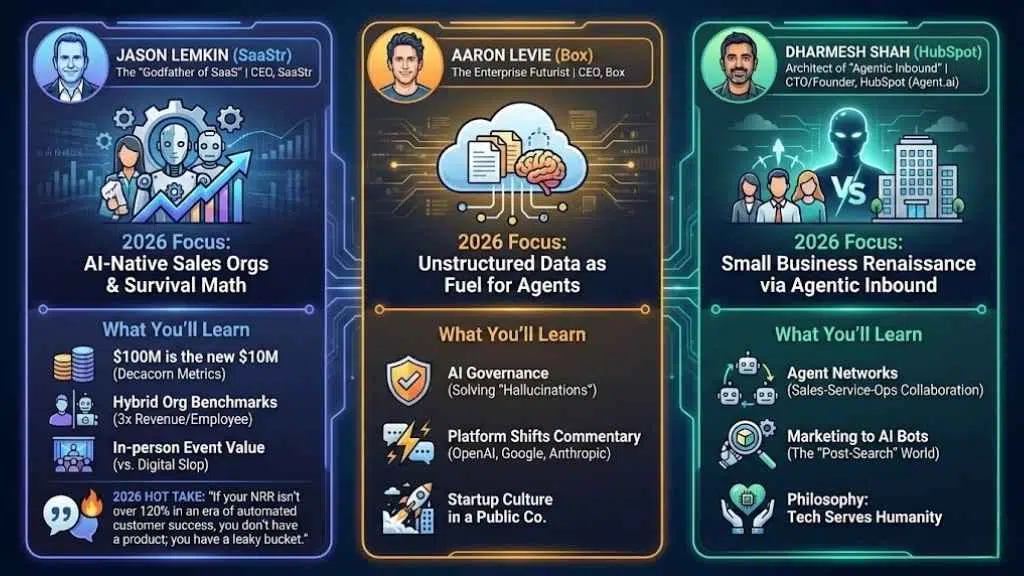
1. Jason Lemkin (SaaStr)
- The “Godfather of SaaS”
- Current Reality: CEO of SaaStr, the world’s largest community of SaaS executives.
Why Follow in 2026
Jason Lemkin has seen every cycle, from the dot-com crash to the ZIRP (Zero Interest Rate Policy) boom, and now, the AI consolidation. While others panic about AI replacing SaaS, Lemkin is providing the math to survive it. In 2026, his content has shifted from “How to hire a VP of Sales” to “How to structure a sales team when AI Agents do 80% of the prospecting.”
What You’ll Learn
- The “Decacorn” Metrics: Why $100M ARR is the new $10M ARR.
- Hybrid Human-AI Orgs: Benchmarks for revenue-per-employee in an AI-native startup (hint: it should be 3x what it was in 2023).
- Event Strategy: Why in-person events (like SaaStr Annual) are becoming more valuable as digital channels get flooded with AI slop.
2026 Hot Take: “If your NRR (Net Revenue Retention) isn’t over 120% in an era of automated customer success, you don’t have a product; you have a leaky bucket.”
2. Aaron Levie (Box)
- The Enterprise Futurist
- Current Reality: CEO of Box, leading the charge on the “Intelligent Content Cloud.”
Why Follow in 2026
Aaron Levie is the rare public CEO who posts like a relatable human. He is the best follow for understanding how the Fortune 500 is actually adopting AI, beyond the hype. Levie’s 2026 thesis revolves around unstructured data—documents, videos, contracts—being the fuel for enterprise agents. He offers a front-row seat to the war between “closed” AI models and open enterprise ecosystems.
What You’ll Learn
- AI Governance: How large enterprises are solving the “hallucination” problem in legal and compliance workflows.
- Platform Shifts: Witty, rapid-fire commentary on the latest moves from OpenAI, Google, and Anthropic.
- Culture: How to keep a 20-year-old public company feeling like a startup.
3. Dharmesh Shah (HubSpot)
- The Architect of “Agentic Inbound”
- Current Reality: CTO/Founder of HubSpot and the brain behind Agent.ai.
Why Follow in 2026:
Dharmesh saw the “Agent” wave coming years before it hit. In 2026, he is no longer just talking about “Inbound Marketing”; he is evangelizing the Small Business Renaissance. His thesis? AI Agents level the playing field, allowing a 3-person company to compete with a 300-person corporation. His posts are often high-production value deep dives, featuring “brain worms” (counter-intuitive ideas) that will stick with you for days.
What You’ll Learn
- Agent Networks: How different AI agents (Sales, Service, Ops) will talk to each other to execute tasks without human intervention.
- The “Post-Search” World: How to market your product when your customer is an AI bot, not a human searching on Google.
- Philosophy: Gentle, optimistic reminders that technology serves humanity, not the other way around.
The Growth & Product Strategists
Focus: PLG, Pricing, and Positioning in a noisy market.
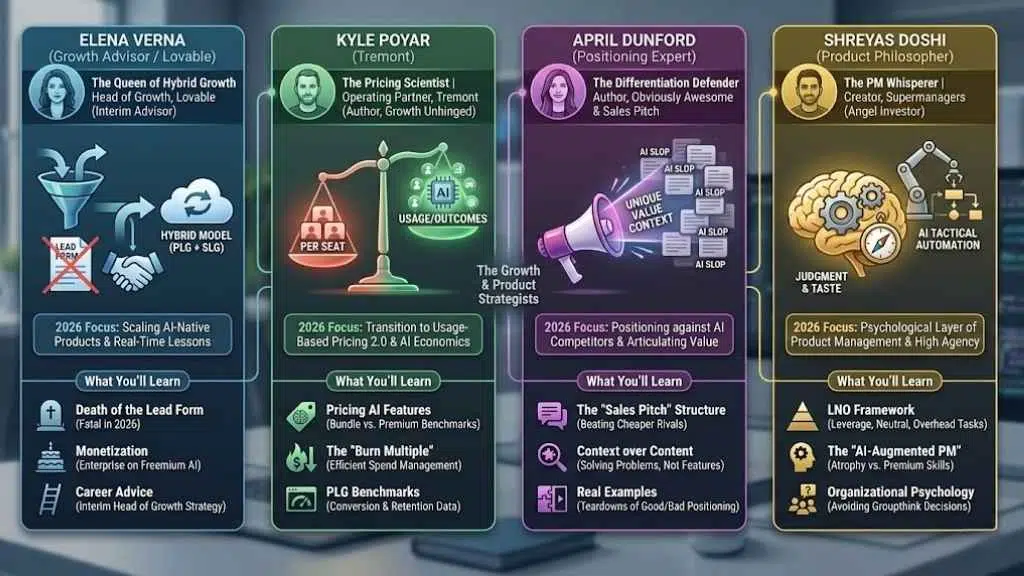
4. Elena Verna (Growth Advisor / Lovable)
- The Queen of Hybrid Growth
- Current Reality: Head of Growth at Lovable (and interim advisor to top unicorns).
Why Follow in 2026
Elena Verna practically invented the B2B growth playbook for the modern era. In 2026, she is dissecting the “Hybrid Model”—the inevitable merger of Product-Led Growth (PLG) and Sales-Led Growth (SLG). Recently joining Lovable to scale their “software engineering agent,” she is sharing real-time lessons on growing an AI-native product. She is the industry’s BS-detector for growth hacks that no longer work.
What You’ll Learn
- The “Death of the Lead Form”: Why forcing users to talk to sales is fatal in 2026.
- Monetization: How to layer enterprise sales on top of a freemium AI product.
- Career Advice: Why “Interim Head of Growth” is the smartest career move for senior operators.
5. Kyle Poyar (Tremont)
- The Pricing Scientist
- Current Reality: Operating Partner at Tremont; Author of Growth Unhinged.
Why Follow in 2026:
If you are still charging “per seat” in 2026, you are losing money. Kyle Poyar is the leading voice on the transition to Usage-Based Pricing 2.0. With AI agents doing the work of human employees, seat counts are dropping. Kyle uses hard data (often from surveys of 500+ startups) to show exactly how companies are pricing “outcomes” and “work units” instead of logins.
What You’ll Learn:
- Pricing AI Features: Should you bundle AI or charge a premium? (Kyle has the benchmarks).
- The “Burn Multiple”: How efficient companies are managing spend in a high-interest rate environment.
- PLG Benchmarks: Conversion rates, retention stats, and activation metrics for 2026.
6. April Dunford (Positioning Expert)
- The Differentiation Defender
- Current Reality: Author of Obviously Awesome and Sales Pitch.
Why Follow in 2026:
In a world where every SaaS landing page looks identical (because they were all written by the same LLM), April Dunford is your savior. Her 2026 content focuses on “Positioning against the AI Slop.” She teaches founders how to articulate unique value in a way that AI cannot replicate. If your product is “AI-powered X,” she will gently bully you until you find a better value proposition.
What You’ll Learn:
- The “Sales Pitch” Structure: How to equip your sales team to beat competitors who are cheaper/faster.
- Context over Content: Why customers don’t care about your features, only the context in which they solve a problem.
- Real Examples: Teardowns of good and bad positioning in the wild.
7. Shreyas Doshi (Product Philosopher)
- The PM Whisperer
- Current Reality: Creator of the Supermanagers program; Angel Investor.
Why Follow in 2026:
Shreyas provides the psychological layer to product management. As AI begins to take over the tactical parts of PM work (writing tickets, analyzing churn data), Shreyas focuses on Judgment and Taste. His posts are often text-heavy, nuanced explorations of cognitive biases, decision-making frameworks, and how to maintain high agency in an automated world.
What You’ll Learn:
- LNO Framework: How to categorize tasks (Leverage, Neutral, Overhead) to avoid burnout.
- The “AI-Augmented PM”: Which skills will atrophy and which will become premium (e.g., user empathy, strategic foresight).
- Organizational Psychology: Why smart people make stupid decisions in groups.
The Deep Tech & AI Innovators
Focus: Infrastructure, Sovereign AI, and the “Next Billion” Users.
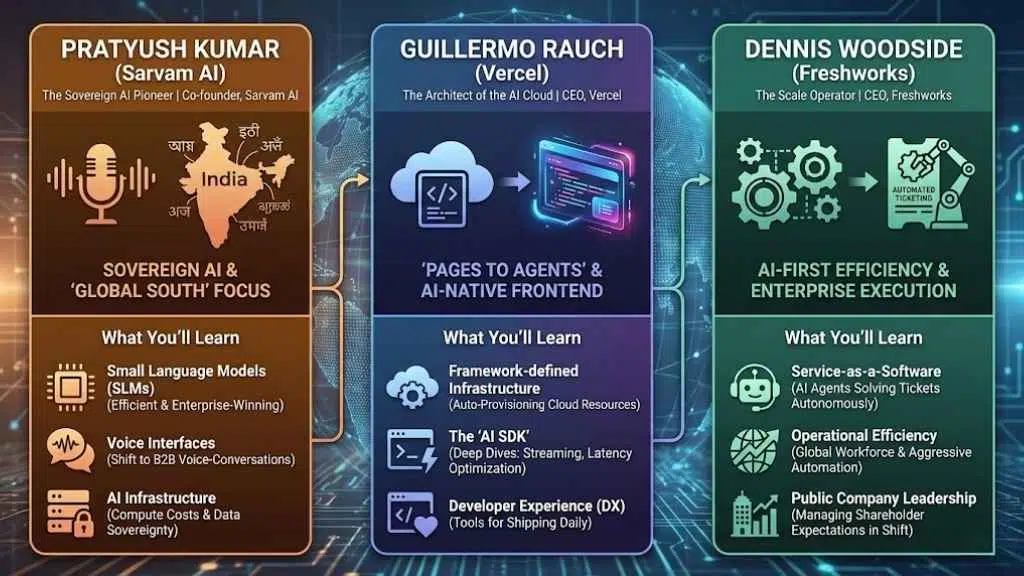
8. Pratyush Kumar (Sarvam AI)
- The Sovereign AI Pioneer
- Current Reality: Co-founder of Sarvam AI.
Why Follow in 2026:
While Silicon Valley fights over English-language LLMs, Pratyush Kumar is building for the rest of the world. Leading the charge on Sovereign AI in India, his work focuses on voice-first, multi-lingual AI models that work on low-end devices. He is the essential follow for understanding the “Global South” market and the technical challenges of training efficient models on diverse datasets.
What You’ll Learn
- Small Language Models (SLMs): Why massive models aren’t always the answer, and how SLMs are winning in enterprise.
- Voice Interfaces: The shift from text-prompting to voice-conversations in B2B apps.
- AI Infrastructure: The realities of compute costs and data sovereignty regulations.
9. Guillermo Rauch (Vercel)
- The Architect of the AI Cloud
- Current Reality: CEO of Vercel.
Why Follow in 2026:
Guillermo Rauch coined the term “Ship Fast” (or at least embodies it). In 2026, his philosophy has evolved to “Pages to Agents.” He believes the web is transitioning from static pages to dynamic, agent-generated interfaces. Following him gives you a direct line into the future of frontend development. He talks about “vibe coding“—using intuition and AI tools to build software at record speeds.
What You’ll Learn:
- Framework-defined Infrastructure: How code is automatically provisioning the cloud resources it needs.
- The “AI SDK”: Technical deep dives into how the best AI apps are built (streaming responses, latency optimization).
- Developer Experience (DX): What the top 1% of engineering teams are using to ship daily.
10. Dennis Woodside (Freshworks)
- The Scale Operator
- Current Reality: CEO of Freshworks.
Why Follow in 2026:
Dennis Woodside is the operator’s operator. Having scaled Dropbox and Impossible Foods, he is now transforming Freshworks into an AI-first efficiency machine. He is the person to follow for Mid-Market and Enterprise execution. His content bridges the gap between visionary AI tech and the boring, necessary work of IT Service Management (ITSM) and Customer Service.
What You’ll Learn
- Service-as-a-Software: How Freshworks is replacing human “seats” with AI agents that solve tickets autonomously.
- Operational Efficiency: Managing a global workforce while integrating aggressive AI automation.
- Public Company Leadership: Insights into managing shareholder expectations during a technological platform shift.
The Bootstrappers & Efficiency Experts
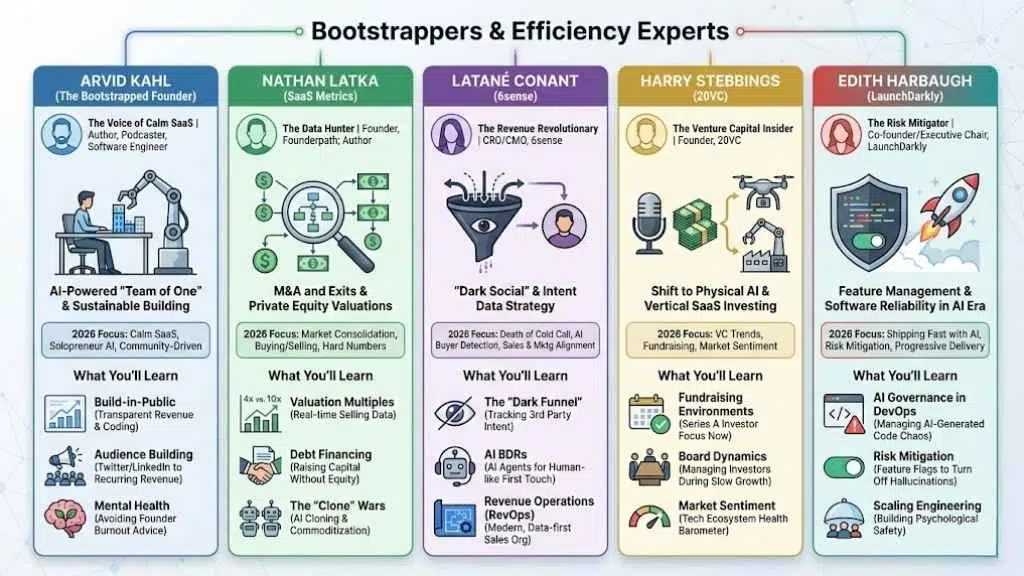
Focus: Profitability, “Indie” hacking, and sustainable building.
11. Arvid Kahl (The Bootstrapped Founder)
- The Voice of Calm SaaS
- Current Reality: Author, Podcaster, Software Engineer.
Why Follow in 2026
Not everyone wants to raise VC money and burn out. Arvid Kahl champions the “Calm SaaS” movement. In 2026, he is exploring how solopreneurs can use AI to build “teams of one.” He rejects the hustle culture, focusing instead on building sustainable, community-driven businesses that serve niche markets.
What You’ll Learn:
- Build-in-Public: Transparent revenue numbers and coding challenges.
- Audience Building: How to turn a Twitter/LinkedIn following into a recurring revenue stream.
- Mental Health: Crucial advice on avoiding founder burnout.
12. Nathan Latka (SaaS Metrics)
- The Data Hunter
- Current Reality: Founder of Founderpath; Author.
Why Follow in 2026
Nathan Latka is controversial, aggressive, and indispensable. He interviews hundreds of founders and gets them to reveal numbers they shouldn’t. In 2026, his focus is on M&A and Exits. With the market consolidating, Latka breaks down who is buying whom, for how much, and why. If you are looking to sell your micro-SaaS or understand private equity valuations, he is your source.
What You’ll Learn
- Valuation Multiples: Real-time data on what SaaS companies are actually selling for (e.g., 4x revenue vs. 10x revenue).
- Debt Financing: How to raise capital without giving up equity.
- The “Clone” Wars: Which successful SaaS tools are being cloned and commoditized by AI.
13. Latané Conant (6sense)
- The Revenue Revolutionary
- Current Reality: CRO/CMO at 6sense.
Why Follow in 2026
Latané Conant declared the “Death of the MQL” years ago. Now, she is declaring the “Death of the Cold Call.” Her 2026 strategy is all about “Dark Social” and intent data. She explains how to use AI to detect when a buyer is ready to buy before they ever fill out a form on your site. She is high-energy, data-driven, and focused on aligning Sales and Marketing.
What You’ll Learn:
- The “Dark Funnel”: How to track buyer intent on 3rd party sites and communities.
- AI BDRs: How to orchestrate AI agents to handle the first touch of sales without sounding robotic.
- Revenue Operations (RevOps): The blueprint for a modern, data-first sales org.
14. Harry Stebbings (20VC)
- The Venture Capital Insider
- Current Reality: Founder of 20VC.
Why Follow in 2026:
Harry Stebbings speaks to the money. His podcast features the world’s top investors, and his LinkedIn feed distills those conversations into punchy insights. In 2026, he is tracking the shift of capital away from “GenAI Wrappers” toward Physical AI (defense, robotics, manufacturing) and Vertical SaaS.
What You’ll Learn:
- Fundraising Environments: What Series A investors are looking for this month.
- Board Dynamics: How to manage your investors when growth slows down.
- Market Sentiment: A barometer for the overall health of the tech ecosystem.
15. Edith Harbaugh (LaunchDarkly)
- The Risk Mitigator
- Current Reality: Co-founder/Executive Chair of LaunchDarkly.
Why Follow in 2026:
As AI begins to write more code than humans, the risk of breaking things skyrockets. Edith Harbaugh is the authority on Feature Management and Software Reliability. Her 2026 insights focus on how to ship fast (using AI) without crashing production. She advocates for “progressive delivery”—testing AI features on small cohorts before a full rollout.
What You’ll Learn:
- AI Governance in DevOps: Managing the chaos of AI-generated code.
- Risk Mitigation: How to use feature flags to turn off “hallucinating” AI features instantly.
- Scaling Engineering: Building a culture of psychological safety in high-velocity teams.
How to Curate Your Own “SaaS Feed” in 2026
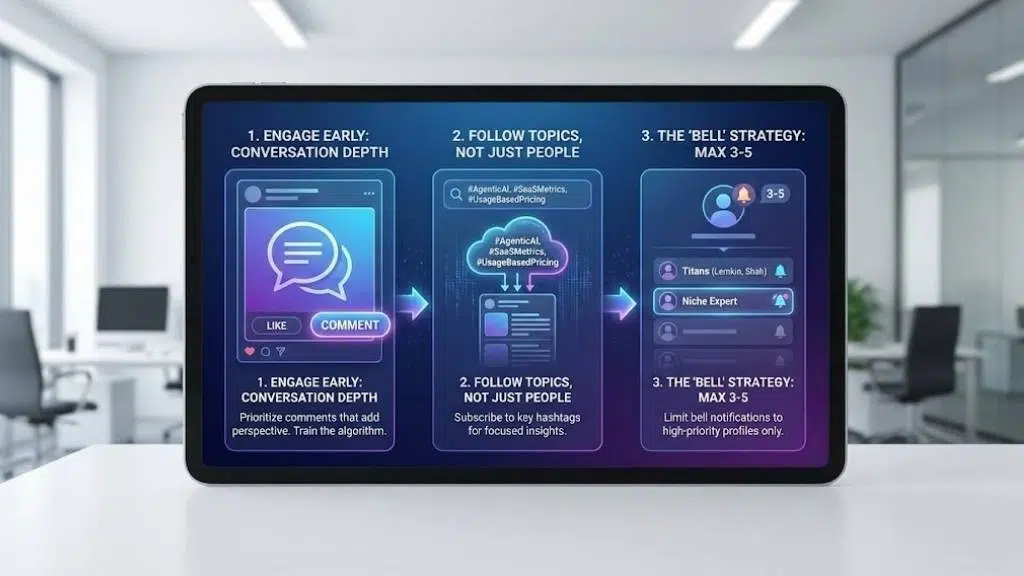
Following these 15 people is step one. To truly dominate your feed, you need to train the algorithm to show you signal, not noise.
- Engage Early: LinkedIn’s 2026 algorithm prioritizes “Conversation Depth.” Don’t just like a post; leave a comment that adds a new perspective.
- Follow Topics, Not Just People: Subscribe to hashtags like #AgenticAI, #SaaSMetrics, and #UsageBasedPricing.
- The “Bell” Strategy: Only ring the notification bell for 3-5 people max. If you ring it for everyone, you’ll ignore everything. Prioritize the Titans (Lemkin, Shah) and one niche expert relevant to your role.
Final Thoughts
The “SaaSpocalypse” isn’t an end; it’s a hard reset. The 15 founders listed above aren’t just surviving this AI shift—they are actively writing the new operating manual for it.
By following them, you aren’t just scrolling a feed; you are downloading the blueprints for the next decade of software. You’ll see exactly how they are replacing “seats” with agents, shifting to usage-based pricing, and building sovereign AI infrastructure while others are still debating RTO policies.





















