Your home is likely leaking money. From the phantom power drain of standby electronics to the HVAC system cooling an empty room, inefficiency is invisible but expensive. In 2026, the best smart home devices for energy efficiency are no longer just about convenience; they are about aggressive utility bill reduction.
The market has matured. We have moved beyond simple timers. The devices on this list use AI to learn your schedule, geofencing to shut down systems when you leave, and Matter support to ensure everything talks to each other. We are focusing on hardware that offers a tangible Return on Investment (ROI). These aren’t just gadgets; they are infrastructure upgrades that pay for themselves.
Here’s a quick overview:
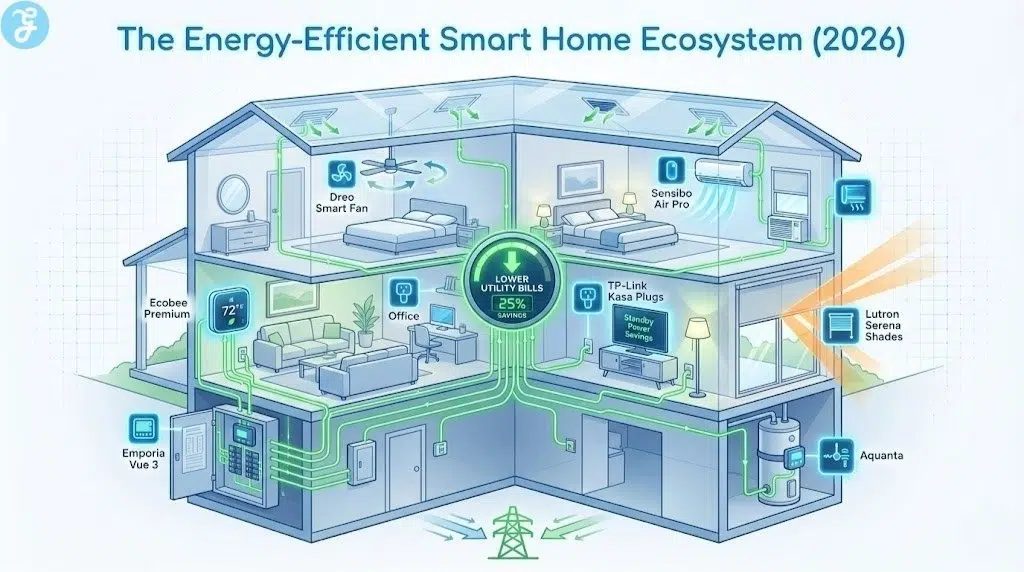
| Device | Best For | Energy Saving Feature | Connectivity |
| Ecobee Premium | Central HVAC | Occupancy Sensors | Wi-Fi / Matter |
| Emporia Vue 3 | Whole Home | Circuit-Level Tracking | Wi-Fi |
| TP-Link KP125M | Individual Appliances | Phantom Load Killing | Wi-Fi / Matter |
| Sensibo Air Pro | AC / Mini-Splits | Climate React | Wi-Fi |
| Aquanta | Water Heaters | Smart Heating Scheduling | Wi-Fi |
| Flair Smart Vents | Airflow Zoning | Room-by-Room Control | 915MHz (Bridge) |
| Lutron Serena | Passive Cooling | Sun-Tracking Automation | Caséta Hub |
| Dreo CLF712S | Air Circulation | DC Motor Efficiency | Wi-Fi |
The 8 Best Smart Home Devices for Energy Efficiency
Here are our picks for the 8 best smart home devices for energy efficiency
1. Ecobee Smart Thermostat Premium
The Ecobee Smart Thermostat Premium remains the king of the hill in 2026. While Google’s Nest is excellent, Ecobee wins on granular control. Its secret weapon is the included SmartSensor. You place this small white device in the room you actually use, like your bedroom or home office. The thermostat then cools or heats based on the temperature in that room, not just the hallway where the unit sits.
For energy efficiency, the “eco+” software suite is aggressive. It automatically pauses heating or cooling when it detects that you have left the house. It also intelligently pre-cools your home during times when electricity is cheaper (if you have time-of-use rates). The build quality is premium with a zinc body and a glass face. It also acts as a built-in air quality monitor and a smart speaker, reducing the need for extra clutter.
Best For: Homes with central HVAC that have hot or cold spots in specific rooms.
Pros:
-
Remote sensors ensure you are not heating empty rooms
-
Native support for Apple HomeKit, Alexa, and Google Home
-
“Eco+” mode automates savings based on electricity rates
-
Built-in air quality monitor adds health value
Cons:
-
More expensive than most competitors
-
Installation requires a C-wire (adapter included but adds work)
-
The interface can be overwhelming with data
2. Emporia Vue 3
Most energy monitors just tell you that your house is using power. The Emporia Vue 3 tells you where. This device installs directly into your electrical panel. It comes with clamp-on sensors that monitor your main mains and up to 16 individual circuits. You can see exactly how much your dryer, your EV charger, or your AC compressor is costing you in real-time.
The app is a revelation for energy hunters. It graphs your usage down to the second. You can set alerts to notify you if a specific circuit stays on too long (like if you left the oven on). In 2026, Emporia has improved the installation process and app interface, making it more accessible to non-electricians, though you still need to be comfortable working inside a breaker box. It creates a complete map of your home’s energy metabolism.
Best For: Homeowners who want a forensic breakdown of their electricity bill.
Pros:
-
Monitors up to 16 individual circuits for precise data
-
Incredibly affordable compared to competitors like Sense
-
Real-time data updates every second
-
Solar monitoring capabilities included
Cons:
-
Installation requires opening your electrical panel
-
The app interface is functional but not very pretty
-
Electrical panel can get crowded with all the sensor wires
3. TP-Link Kasa KP125M
If the Emporia Vue is the macro solution, the Kasa KP125M is the micro solution. This smart plug is the best smart home device for energy efficiency on a budget. It supports the new Matter standard, meaning it works instantly with Apple, Amazon, Google, and Samsung platforms without a hitch. Its “Slim” design ensures you can stack two of them in a standard wall outlet.
The killer feature is the energy monitoring dashboard in the Kasa app. It shows you the real-time draw of whatever is plugged in. This is perfect for identifying “vampire” appliances—older TVs, game consoles, or soundbars that suck power even when turned off. You can set a schedule to kill the power to these devices completely at night, stopping the phantom drain at the source.
Best For: Renters and budget-conscious users targeting specific appliances.
Pros:
-
Matter support ensures future-proof compatibility
-
Slim design does not block the second outlet
-
Detailed energy monitoring reports in the app
-
Very affordable price point for a 4-pack
Cons:
-
Energy data does not export easily to spreadsheets
-
Requires Wi-Fi at every outlet (can crowd your router)
-
Only rated for 15 Amps (don’t plug a heavy heater into it)
4. Sensibo Air Pro
Millions of homes use ductless mini-splits or window AC units. These units usually have “dumb” infrared remotes and no smart features. The Sensibo Air Pro fixes this. It sits on your wall and blasts infrared commands to your AC unit, effectively replacing the remote. It connects your “dumb” AC to your Wi-Fi network and gives it a brain.
The “Climate React” feature is the energy saver here. You can tell Sensibo to turn on the AC only when the room hits 78°F and turn it off when it hits 74°F. It also uses geofencing to turn off the unit the moment the last person leaves the house. The “Pro” model includes an air quality sensor, but the real ROI comes from ensuring you never accidentally leave the AC running while you are at work.
Best For: Homes with window AC units or ductless mini-splits.
Pros:
-
Works with almost any AC that has a remote control
-
Geofencing prevents cooling an empty house
-
Climate React mode creates a closed-loop temperature control
-
incredibly easy setup (no wiring required)
Cons:
-
The device itself is pricey for an IR blaster
-
Some advanced statistics are locked behind a subscription
-
Requires line-of-sight to the AC unit
5. Aquanta
Water heating is often the second largest expense in a home, right after HVAC. The Aquanta is a “smart controller” that retrofits onto your existing electric or gas water heater. It consists of a control unit and a temperature sensor that straps to the tank. It learns your hot water usage patterns—knowing, for example, that you shower at 7 AM and run the dishwasher at 8 PM.
It then heats the water only when you are likely to need it. During the rest of the day, it lets the tank cool down, reducing standby heat loss. For electric tanks, it can even shut off power completely during peak rate hours. It effectively turns a standard storage tank into a smart appliance that rivals tankless efficiency without the plumbing overhaul.
Best For: Homeowners with standard storage tank water heaters looking to cut costs.
Pros:
-
“Smart” heating logic reduces standby energy loss
-
Compatible with most electric and gas water heaters
-
Provides alerts for leaks or heating element failures
-
Can save significantly on time-of-use electricity plans
Cons:
-
Installation is more complex than a plug or bulb
-
Not compatible with tankless water heaters
-
The aesthetic is purely industrial (it lives in your garage/closet)
6. Flair Smart Vents
Smart thermostats have a flaw: they control the whole house based on one location. Flair Smart Vents solve the problem of uneven heating. These are motorized replacements for your standard floor, wall, or ceiling vents. They communicate with “Pucks” (wireless sensors) placed in different rooms.
If your bedroom is too hot but the living room is freezing, Flair closes the vents in the living room and forces the cool air into the bedroom. This means your HVAC system runs for less time to make you comfortable. You stop wasting energy conditioning rooms that are already at the perfect temperature. It creates a true room-by-room zoning system without expensive ductwork modification.
Best For: Multi-story homes with significant temperature differences between rooms.
Pros:
-
Corrects hot/cold spots without touching the HVAC unit
-
Battery powered (lasts years) or wired options available
-
Works with Ecobee and Honeywell smart thermostats
-
Prevents over-conditioning of unused rooms
Cons:
-
Can get expensive to outfit an entire house
-
Requires a “Gateway” puck to connect to Wi-Fi
-
You must be careful not to close too many vents (pressure buildup)
7. Lutron Serena Smart Shades
Sunlight is free heat. In the winter, you want it. In the summer, you don’t. Lutron Serena Smart Shades are the gold standard for managing this passive energy. These motorized shades are ultra-quiet and reliable. They connect to the Lutron Caséta hub, which is famous for its bulletproof connectivity.
You can program these shades to track the sun. In the summer, they can close automatically during the hottest part of the day (the “afternoon bake”) to reduce the load on your AC. In the winter, they can open to let the sun warm your floors. It is a passive efficiency upgrade that also protects your furniture from UV damage.
Best For: Homes with large windows facing east or west.
Pros:
-
Extremely quiet operation and premium fabric options
-
Best-in-class reliability and smart home integration
-
“Sun tracking” schedules reduce HVAC load significantly
-
Battery life is exceptional (years on standard D batteries)
Cons:
-
Very expensive per window
-
Requires a proprietary hub (Caséta Smart Bridge)
-
Custom ordering process takes time
8. Dreo CLF712S Smart Ceiling Fan
Moving air makes you feel cooler, allowing you to raise your thermostat by roughly 4 degrees without losing comfort. The Dreo CLF712S is a modern DC-motor ceiling fan that brings smarts to the ceiling. Unlike old AC motor fans that hum and waste power, this DC motor is silent and sips electricity.
It connects to Wi-Fi and allows for voice control via Alexa or Google. You can set schedules or have it turn on automatically when the room gets stuffy. The efficiency gain comes from the “Winter Mode” (reverse spin) which pushes rising heat back down to the floor, and the “Summer Mode” which creates a wind chill effect. Automating this ensures the fan is only on when it’s actually doing work.
Best For: Reducing AC usage in bedrooms and living areas.
Pros:
-
DC motor is significantly more efficient than traditional fans
-
Full RGB lighting options included
-
6 wind speeds with a specialized “Natural” wind mode
-
Easy installation compared to other smart fans
Cons:
-
Design is modern/plastic and may not fit traditional decor
-
The app is separate from your main thermostat app
-
Blades are shorter than some large-room fans
Wrap-Up
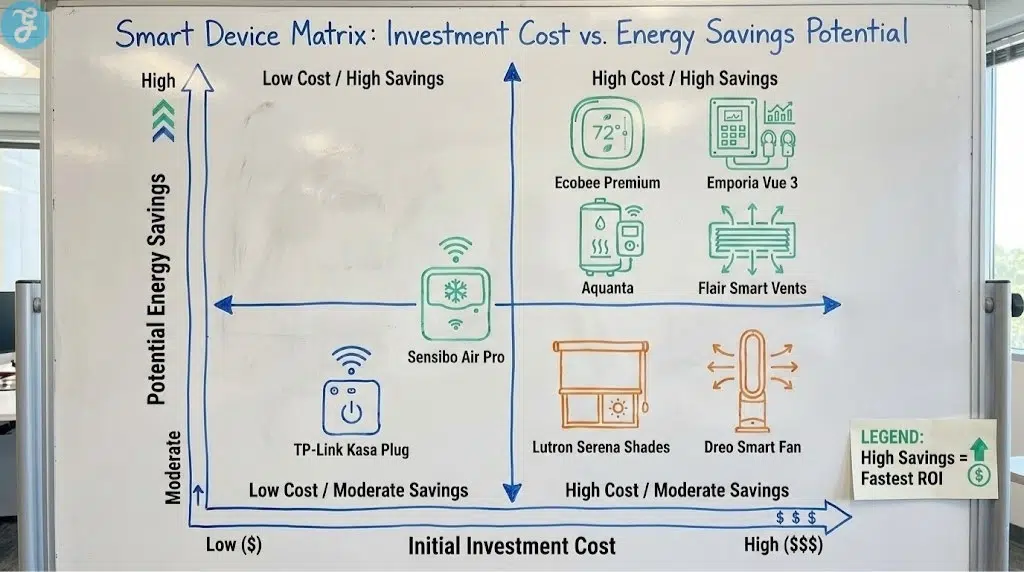
Efficiency is a game of inches. No single device will zero out your bill, but a combination of the best smart home devices for energy efficiency can slice 15-30% off your monthly costs.
Start with the Ecobee Premium to tame your HVAC. It offers the fastest return on investment. If you want to hunt down waste, the Emporia Vue 3 is the ultimate weapon. And if you just want a quick win, swap your old power strips for Kasa KP125M plugs. The technology in 2026 is ready; it is time to put your home to work.