The automotive world is currently in a “quiet revolution” phase. While the last few years were about early adopters and high-priced luxury sedans, 2026 is shaping up to be the year electric vehicles (EVs) finally hit the sweet spot of affordability, practicality, and mind-bending performance.
If you are holding onto your gas-powered car waiting for the “right time” to switch, or if your current lease ends in two years, this list is for you. From the long-awaited affordable Rivian to the mythical return of the Tesla Roadster, here are the upcoming electric vehicles 2026 has in store that are actually worth the hype.
The 2026 EV Landscape: A Year of Revolution?
Why is 2026 such a pivotal year? It marks the transition from “compliance cars” to “dedicated electric platforms.” By 2026, most major manufacturers will have abandoned adapting gas car chassis for batteries. Instead, we will see vehicles built from the ground up to be electric.
Expect to see three major shifts:
- Price Parity: More options in the $30,000–$45,000 range, challenging gas cars directly.
- Charging Unity: Almost every EV arriving in the US in 2026 will natively support the NACS (Tesla) charging port, ending the adapter headache.
- Next-Gen Tech: 800-volt architectures for faster charging will become the standard, not the exception, cutting wait times in half.
Top 7 Upcoming EVs of 2026
We have curated this list based on confirmed manufacturer timelines, concept reveals, and industry leaks. These are the game-changers.
1. Rivian R2
The Adventure EV for the Masses
While the Rivian R1T and R1S stunned the world with their capability, their $75,000+ price tags kept them out of reach for most. Enter the Rivian R2. Slated for the first half of 2026, the R2 is a slightly smaller, more approachable SUV that retains the rugged “adventure” DNA of its big siblings but brings it down to a price point that competes directly with the Tesla Model Y. It’s built on a new midsize platform using advanced 4695 cylindrical battery cells, which offer better energy density than current tech.
The design is pure Rivian—boxy, friendly, and incredibly practical. It features a rear glass that pops open electronically (a nod to classic surf SUVs) and front seats that fold completely flat, turning the entire cabin into a campsite bedroom. Uniquely, it keeps the “flashlight in the door” feature and adds two gloveboxes for extra storage. Rivian has also moved the charging port to the rear driver’s side to play nice with the NACS standard, making it easier to plug into Superchargers without taking up two spots.
| Feature | Specification |
| Est. Price | Starts at $45,000 |
| Range | 300+ miles (up to 330 mi est.) |
| 0-60 mph | < 3.0 seconds (Tri-motor variant) |
| Battery Tech | 4695 Cylindrical Cells |
| Charging | NACS Native (Tesla Supercharger Ready) |
| Release Date | H1 2026 |
2. Tesla Roadster (2nd Gen)
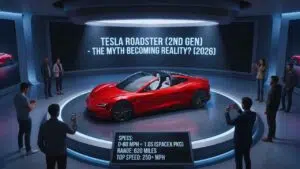
The Myth Becoming Reality?
Elon Musk has promised the next-generation Tesla Roadster for years, but recent updates point to a 2026 production reality. This isn’t just a car; it’s a statement piece designed to crush every gas-powered supercar in existence. It aims to be the “halo car” for EVs, proving that battery power can outperform combustion in every single metric, from acceleration to top speed.
The specs are nearly unbelievable: 0-60 mph in under 1 second (with the optional SpaceX rocket thruster package) and a range exceeding 600 miles. Unlike the original Roadster, this one seats four (technically 2+2), features a removable glass roof that stores in the trunk, and utilizes a tri-motor “Plaid” powertrain setup. The SpaceX package essentially replaces the rear seats with high-pressure composite overwrapped pressure vessels (COPVs) that shoot cold gas to aid in cornering, braking, and acceleration. If it arrives in 2026, it will likely be the fastest production car on Earth.
| Feature | Specification |
| Est. Price | $200,000+ |
| Range | 620 miles (claimed) |
| 0-60 mph | < 1.0 second (w/ SpaceX package) |
| Top Speed | 250+ mph |
| Layout | 4-Seater (2+2) with removable roof |
| Release Date | Production expected 2026 |
3. BMW iX3 (Neue Klasse)
Reinventing the Ultimate Driving Machine
BMW is hitting the reset button. The 2026 BMW iX3 will be the first vehicle built on the “Neue Klasse” (New Class) architecture. This isn’t just a facelift; it’s a total technological overhaul that ditches the CLAR platform used for the current iX3. It represents the biggest shift in BMW’s design philosophy since the 1960s, moving toward a “digital-first” approach.
The design moves away from the aggressive “beaver tooth” grilles of 2024/2025 to a sleek aesthetic where the kidney grille and headlights merge into a single digital panel that can display animations. Inside, the “Panoramic Vision” display projects information across the entire bottom width of the windshield, effectively killing the traditional instrument cluster. BMW promises 30% more range and 30% faster charging speeds thanks to an 800-volt architecture. The car is powered by four “super-brain” computers, with one specifically dedicated to “Heart of Joy”—BMW’s name for its powertrain and driving dynamics software.
| Feature | Specification |
| Est. Price | Starts around $60,000 |
| Range | ~370 – 450 miles (WLTP) |
| Charging | 800-volt architecture (add 186 miles in 10 mins) |
| Display Tech | Panoramic Vision (Full-width HUD) |
| Platform | Neue Klasse (NK) |
| Release Date | Spring/Summer 2026 |
4. Hyundai Ioniq 9
The Family Road Trip King
Families have been begging for a true electric replacement for the Palisade or Telluride, and the Hyundai Ioniq 9 (formerly referred to as the Ioniq 7) is the answer. Launching as a 2026 model, this three-row SUV is massive, spacious, and undeniably futuristic. It takes the “Parametric Pixel” light design of the Ioniq 5 and stretches it over a large, aerodynamic SUV body that prioritizes interior volume above all else.
Built on the extended E-GMP platform, it offers a completely flat floor, meaning the third row is actually usable for adults, not just small children. It features “swiveling seats” (in specific markets) that allow the second row to face the third row when parked, creating a lounge atmosphere. Inside, you’ll find a movable center console called the “Universal Island 2.0” and even a built-in UV-C sterilizer in the glove compartment to clean your phone or keys. With ultra-fast 350kW charging capability, you can recharge from 10% to 80% in under 24 minutes.
| Feature | Specification |
| Est. Price | Starts around $55,000 – $60,000 |
| Range | 335+ miles (Long Range RWD) |
| Charging | 10-80% in 24 mins (350kW) |
| Seating | 7-Passenger (Standard) / 6 (Captain’s Chairs) |
| Unique Tech | UV-C Sterilizer, Swiveling Seats |
| Release Date | Early 2026 |
5. Volkswagen ID.2all
The Electric Golf We’ve Been Waiting For
While the US market might have to wait to see if this lands stateside, the VW ID.2all (possibly launching as the ID. Golf or ID. Polo) is a critical global release for 2026. This is Volkswagen returning to its roots: a car for the people. After facing backlash for the touch-capacitive buttons in the ID.4, VW is using the ID.2all to apologize and course-correct.
The goal? A starting price under €25,000 ($27,000). It’s the size of a Polo on the outside but offers the interior space of a Golf. Crucially, VW has listened to feedback and brought back physical, backlit buttons for climate control and volume. It looks conventional, handsome, and affordable—exactly what the mass market needs to adopt EVs. It runs on the “MEB Entry” platform, which is Front-Wheel Drive (FWD) to maximize trunk space, offering a deep storage well under the cargo floor that can fit several grocery bags.
| Feature | Specification |
| Est. Price | ~$27,000 (€25,000) |
| Range | ~280 miles (WLTP) |
| Drivetrain | Front-Wheel Drive (FWD) |
| Controls | Physical Buttons & Rotary Dials |
| Cargo | 490 Liters (seats up) |
| Release Date | 2026 (Europe) |
6. Polestar 5
The Swedish Super-Sedan
If the Porsche Taycan is too common for your taste, the Polestar 5 is the 2026 alternative. This 4-door electric GT is designed to be a stunner. It takes a bold risk by ditching the rear window entirely—using a high-definition, roof-mounted camera and digital mirror instead. This allowed designers to extend the panoramic glass roof all the way back, giving rear passengers incredible headroom despite the car’s low, swooping silhouette.
Under the skin, it features a bonded aluminum chassis—technology usually reserved for low-volume supercars like Lotus or McLaren—to ensure extreme rigidity and lightweight performance. With a targeted 884 horsepower from its dual motors and an 800-volt architecture, it will be a silent missile on the highway. Polestar is positioning this as a direct rival to the Porsche Taycan Turbo and the Tesla Model S Plaid, but with a uniquely Scandinavian, minimalist luxury focus.
| Feature | Specification |
| Est. Price | $100,000+ |
| Range | 370+ miles |
| Power | 884 hp / 663 lb-ft torque |
| Chassis | Bonded Aluminum |
| Design Quirks | No Rear Window (Digital Mirror Only) |
| Release Date | 2026 |
7. Volvo EX60

The Safe Bet
The Volvo XC60 has been a global bestseller for years. In 2026, it gets an electric successor: the Volvo EX60. This SUV will sit on the new SPA3 platform, designed to be highly scalable and efficient. Unlike the smaller EX30, the EX60 will feature a driver’s display behind the steering wheel and a more traditional, yet modern, luxury feel.
While it will likely mirror the design language of the larger EX90, the EX60 hits the “Goldilocks” size for small families. You can expect standard LiDAR sensors mounted on the roof line (looking like a small taxi sign) for advanced safety and potential future autonomous driving capabilities. The new platform allows for energy-dense battery packs, with some reports suggesting a WLTP range of up to 810km (approx. 500 miles) for the top-tier versions, which would be a massive leap over current competitors. It also integrates Google’s latest AI assistants deeply into the infotainment system.
| Feature | Specification |
| Est. Price | Starts around $60,000 |
| Range | Up to 500 miles (WLTP Est.) |
| Platform | SPA3 (Scalable Product Architecture) |
| Safety | Standard Roof-Mounted LiDAR |
| OS | Android Automotive w/ Google AI |
| Release Date | Late Summer 2026 |
2026 EV Comparison: Price, Range, and Release
| Vehicle Model | Est. Price | Est. Range | Class | Unique Selling Point |
| Rivian R2 | $45,000 | 300+ mi | Midsize SUV | Adventure-ready, flat seats |
| Tesla Roadster | $200,000+ | 620 mi | Hypercar | <1s 0-60mph acceleration |
| BMW iX3 | $60,000 | 370 mi | Luxury SUV | Full-width windshield HUD |
| Hyundai Ioniq 9 | $55,000 | 335 mi | 3-Row SUV | Massive interior space |
| VW ID.2all | $27,000 | 280 mi | Hatchback | Affordable, physical buttons |
| Polestar 5 | $100,000 | 370+ mi | Luxury GT | No rear window, 884hp |
| Volvo EX60 | $60,000 | 500 mi | Midsize SUV | LiDAR Safety, Huge Range |
3 Major Trends Defining Electric Cars in 2026
The Rise of “Affordable” EVs
For the last decade, “long-range” and “affordable” were mutually exclusive terms. 2026 changes that. With the Rivian R2, VW ID.2all, and the continued price cuts from Tesla, we are finally seeing 300-mile EVs enter the price bracket of the average new car transaction. This is the year EVs stop being “luxury toys” and start becoming the default choice for the average household budget.
While widespread adoption might be 2027 or 2028, 2026 will likely see the first limited-run vehicles testing solid-state batteries. These batteries promise double the range and zero fire risk. However, the cars listed above largely rely on perfected lithium-ion or LFP chemistry, which have become incredibly reliable and cheap. Don’t expect solid-state in a $40k car just yet, but the tech is knocking on the door.
Native NACS Charging Ports
If you buy a car in 2026, you likely won’t need an adapter to use a Tesla Supercharger. Ford, GM, Rivian, Volvo, Polestar, and Hyundai have all committed to the North American Charging Standard. This unifies the charging network, making long-distance travel significantly easier for non-Tesla owners. The days of fumbling with apps and broken third-party chargers are ending; plug-and-charge is becoming the universal standard.
Final Thoughts: Which 2026 EV is Worth the Wait?
The “best” car depends entirely on your lifestyle. If you are an outdoor enthusiast wanting to break free from gas, the Rivian R2 looks like the bargain of the decade. For growing families, the Hyundai Ioniq 9 offers space that was previously only available in gas-guzzling minivans. And for those who simply love driving, the BMW iX3 represents a return to form for the German legend.